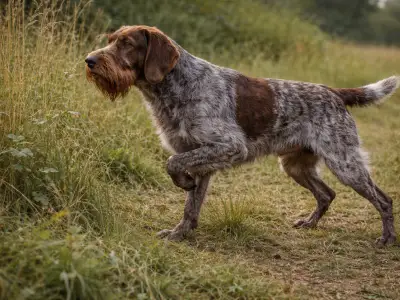
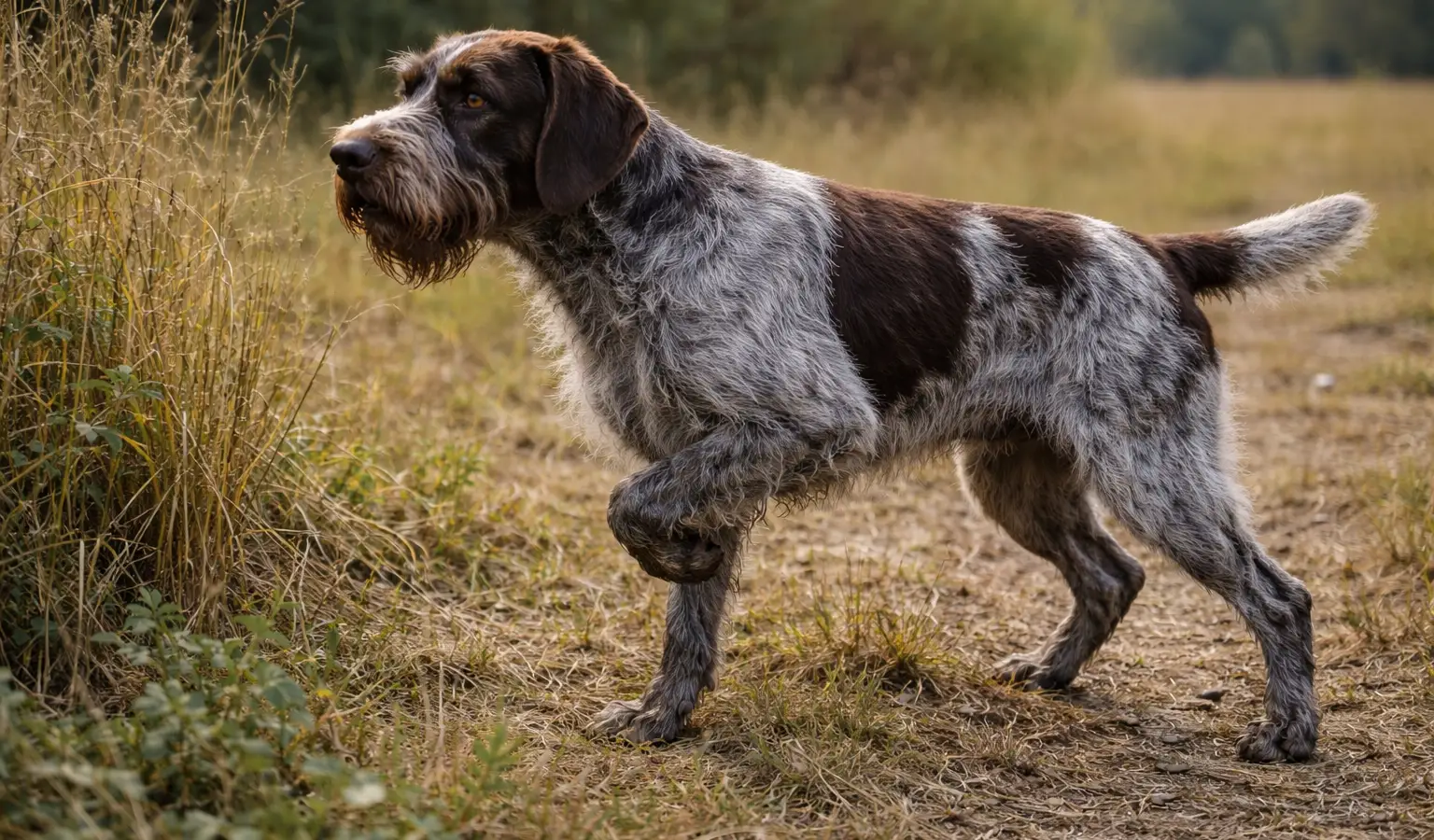
Korthals Griffon
The Korthals Griffon is a hardy and versatile pointing dog, bred to work efficiently in harsh conditions. Known for its excellent nose, stamina and adaptability, it performs well across various terrains. Loyal, people-oriented and even-tempered, it suits both hunting and active family life when given enough exercise and mental stimulation.
Life expectancy
12 – 14 years
Price
900 – 1600 €
Monthly budget
70 €
Size
Large
Profile
Korthals Griffon
Origin
France
Year of origin
1870
Developed by
Eduard Korthals
Size
Large
Coat type
Wire coat
Owner profile
Active owner
Hypoallergenic
No
Litter size
7
Life expectancy
12 – 14 years
Price
900 – 1600 €
Female
- Height : 55 – 60 cm
- Weight : 20 – 27 kg
Male
- Height : 57 – 62 cm
- Weight : 23 – 32 kg
Temperament & abilities
Affectionate
5/5
Calm
3/5
Independent
3/5
Intelligence
4/5
Obedience
4/5
Hunting instinct
5/5
Energy level
4/5
Good with children
5/5
Dog-friendly
4/5
Friendly with strangers
4/5
Hunting profile
Stamina
5/5
Hunting drive
5/5
Independence
4/5
Trainability
3/5
Beginner-friendly
3/5
Family compatibility
5/5
Feather game
5/5
Fur game
5/5
Underground work
4/5
Water work
5/5
These indicators help compare breeds and choose the right one for your hunting style.
Game & abilities
Estimated ability level by game type.
Budget
Purchase price
900 – 1600 €
The price may vary depending on the breeder, bloodline, and region.
Average monthly cost
70 €
Estimated average: food, healthcare, accessories, and grooming.
A versatile pointing dog with strong cooperation, real stamina, and clear training needs
Is the Korthals Griffon a good hunting dog?
The Korthals Griffon is widely regarded as a very capable hunting dog, especially for hunters who want a versatile pointing breed with a close, cooperative working style. In the field, many Griffons combine a useful nose, steady search pattern, natural pointing instinct, and a willingness to retrieve on both land and water. Rather than hunting with extreme speed or range, the breed is often appreciated for practical efficiency, contact with the handler, and an adaptable style that suits mixed hunting days.
Its strongest use cases are often upland work, rough cover, woodland edges, marshy ground, and situations where a hunter values methodical quartering over sheer pace. The Korthals Griffon usually works at a manageable distance, which can make handling easier for people who prefer a dog that stays connected instead of disappearing over the horizon. That same trait can be a real advantage for walked-up shooting and for hunters who want one dog able to point, track lightly wounded game in some contexts, and retrieve with determination.
Temperament matters here: the Korthals Griffon is typically biddable and people-oriented, but it is not a low-maintenance breed. Good recall, steadiness, delivery to hand, and polished field manners still require patient training and repetition. Harsh handling is rarely the best route with this type of dog; many individuals respond better to calm, consistent guidance and regular exposure to birds, gunfire, water, and varied terrain. Bloodline and individual character can influence drive, range, and boldness, so not every Griffon will work in exactly the same way.
- Strengths: versatility, cooperation, useful nose, water willingness, trainability, manageable handling
- Limitations: not always the fastest or widest-ranging choice, needs regular work and structure, can become restless without enough exercise and purpose
- Best suited to: hunters wanting a practical all-round gundog and active owners who enjoy training, outdoor time, and a dog involved in daily life
As a balance between field performance and home life, the breed often makes sense for people who want a genuine hunting companion that can also live closely with the family. The trade-off is energy level: a Korthals Griffon usually needs substantial exercise, mental work, and clear routines to stay settled. For the right owner, that combination of hunting ability and cooperative temperament is exactly the appeal; for a very casual home or a hunter seeking a specialist with maximum speed and range, another breed may be a better fit.
Excellent nose in rough cover
The Korthals Griffon is widely valued for finding game where lighter-coated or less determined dogs can struggle. In dense hedgerows, wet grass, thorny edges, and mixed cover, it often works methodically with its nose down and keeps contact with scent well. For hunters who face difficult terrain, that practical scenting ability is one of the breed’s biggest assets.
Natural all-round versatility
This is one of the classic versatile hunting dog breeds, not just a specialist for one task. Many Korthals Griffons are used for searching, pointing, flushing pressure when needed, and retrieving on land or from water. That broad usefulness appeals to hunters who want one dog for mixed days rather than a kennel full of highly specialized workers.
Steady, useful pointing style
When well bred and properly trained, the breed is known for a clear, readable point that helps the handler move in with confidence. It usually suits hunters who prefer a dog that works with purpose rather than flashy excess. That practical concentration can be especially valuable in walked-up hunting where control and teamwork matter as much as raw range.
Strong water work and retrieving
The harsh coat and rugged build are often appreciated during cold, wet outings, and many Korthals Griffons show genuine willingness on water retrieves. They are commonly seen as reliable companions for duck work, marsh edges, and wet ground where a dog must stay keen after repeated entries. Retrieving quality still depends on training and individual drive, but the working base is often there.
Cooperative with the handler
Compared with some harder-driving pointing breeds, the Korthals Griffon often appeals to hunters who want a dog that stays mentally connected and is easier to direct. That cooperation can make training smoother for owners who value a responsive hunting partner over extreme independence. In daily life, the same trait often helps the breed transition more comfortably between field work and family routine.
Endurance without frantic pace
The breed generally offers solid stamina for long hunting days, but usually in a measured, sustainable way rather than a constant all-out sprint. For many people, that is a real advantage: the dog can cover ground, handle changing conditions, and keep hunting with focus instead of burning hot early. It often suits steady foot hunters better than those seeking maximum speed at any cost.
Who the Korthals Griffon Suits Best
The Korthals Griffon tends to suit the hunter or active owner who wants a close-working, versatile pointing dog with a cooperative nature and enough stamina for regular field days. Many do best with people who enjoy training, outdoor routines, and a dog that is part hunting partner, part daily companion. In real life, this often means a household that can offer long walks, structured work, scent games, and calm but consistent handling rather than occasional bursts of activity.
It is often a strong match for rough-shooting, mixed-terrain hunting, and handlers who value contact and biddability over a very wide-ranging style. It may be less suitable for owners wanting a low-maintenance pet, a dog left alone for long stretches, or a hard-driving specialist built only for speed and range. First-time gundog owners can do well with the breed if they are committed, but a completely sedentary home, inconsistent training, or limited access to outdoor work can lead to frustration on both sides.
How a deliberately bred rough-coated pointing dog became the versatile hunter and close-working companion known today
Origin and development of the Korthals Griffon
The Korthals Griffon, often called the Wirehaired Pointing Griffon, is generally traced to the work of Eduard Karel Korthals in the late nineteenth century. Korthals set out to develop a versatile gundog that could point, track, retrieve, and work effectively on varied game in difficult terrain and wet conditions. Historical sources do not always agree on every foundation cross used, but the broad picture is consistent: this was a purpose-bred hunting dog shaped for practical field use rather than for show alone. That origin still helps explain the breed’s balanced style today: methodical, cooperative, and usually more focused on working with the handler than ranging far beyond gun distance.
Korthals worked mainly in continental Europe, and the breed took shape in a context where hunters often needed one dog to do many jobs. That helps explain several hallmark traits of the modern Korthals Griffon: a harsh protective coat for rough cover and bad weather, a strong nose, natural game-finding ability, and a temperament that tends to favor teamwork. Compared with some faster, wider-running pointing breeds, the Korthals is often appreciated for a more manageable pattern in the field. For many hunters, that means a dog that can be easier to follow on foot, especially in mixed cover, woodland edges, marsh, and practical walked-up hunting.
The breed’s development also sheds light on daily life outside the hunt. Because it was selected as a close, useful working companion, the Korthals Griffon often does best with owners who want an involved dog rather than an independent ornament. Many are affectionate at home and keen to stay connected to their people, but that does not make them low-effort. This is still an energetic pointing dog with a working background, and without regular exercise, training, and outlets for scenting and retrieving, some individuals may become restless or noisy.
For modern buyers, the history matters because it points to the kind of home and handler this breed tends to suit best. A well-bred, well-raised Korthals Griffon may be an excellent choice for the hunter wanting a versatile dog with a practical coat, a cooperative nature, and enough drive for real field work without the extreme range seen in some lines. It may also suit active families who genuinely enjoy training and outdoor life. It is usually less convincing for people seeking a very low-maintenance pet or a dog content with brief daily walks and little mental work.
Built for versatile hunting
The Korthals Griffon was developed in Europe as a practical all-around gundog, valued for pointing, tracking, and useful work on varied terrain. Rather than excelling only in one narrow task, the breed was shaped to be adaptable in field, marsh, and rough cover, which still explains much of its appeal to hunters who want one dog for several jobs.
Selection favored cooperation
Early selection appears to have emphasized a close-working, biddable hunting companion instead of an overly independent ranging dog. In practice, many Korthals Griffons tend to check in naturally, respond well to calm guidance, and suit handlers who enjoy a collaborative style. That said, initiative and drive can still vary noticeably between individual dogs and working lines.
Soft-mouthed, steady style
In the field, the breed is widely appreciated for a deliberate, methodical hunting pattern and a generally manageable range. Many dogs work game with patience, hold point with good intensity, and can be reliable retrievers when properly trained. This is often a strong match for hunters who prefer control, versatility, and readable body language over sheer speed.
Lively but usually even-tempered
At home, the Korthals Griffon is often described as affectionate, people-oriented, and easier to live with than some harder-driving pointing breeds. Still, it is not a low-energy dog. Without enough exercise, training, and daily engagement, boredom can show up as restlessness, vocalizing, or nuisance behaviors, especially in younger dogs with strong working instincts.
Best with active owners
This breed generally fits best with people who enjoy regular outdoor time, structured training, and a dog that wants to be involved. A small apartment and very sedentary routine are rarely ideal unless the owner is exceptionally committed to exercise and mental work. Hunters, hikers, and active families often find the breed easier to satisfy than casual pet homes do.
Coat needs practical upkeep
The rough, weather-resistant coat gives the Korthals Griffon its distinctive look, but it also needs routine maintenance to stay functional. Brushing, checking for debris after field outings, and occasional hand-stripping may help keep the coat in good condition. Owners drawn to the rustic appearance should expect some grooming work, especially if the dog spends time in dense cover.
Practical answers for hunters, active families, and first-time owners considering this versatile pointing breed.
Korthals Griffon hunting and daily life FAQ
Is the Korthals Griffon a good hunting dog for beginners?
The Korthals Griffon can be a very approachable hunting breed for a beginner who wants one dog for field work and home life. It is often valued for a cooperative style, close-to-medium range, and a nose that can be useful on upland birds and in mixed cover. That said, beginners usually do best with a well-bred puppy or a started dog from lines known for stable temperament and practical hunting ability. The breed still needs structured exposure to birds, consistent recall, and patient handling, so it is not a plug-and-play gun dog. For someone willing to train regularly and hunt often enough to maintain skills, it can be a rewarding first pointing dog.
How easy is a Korthals Griffon to train for hunting and obedience?
Many Korthals Griffons respond well to calm, consistent training and tend to work best with a handler who values cooperation over pressure. They are usually intelligent and willing, but some can be sensitive to harsh correction or become distracted if training is repetitive and dull. Short, frequent sessions with clear standards often work better than drilling. For hunting work, early bird exposure, recall, steadiness foundations, and comfort with gunfire should be introduced thoughtfully rather than rushed. In daily life, the same dog often benefits from household rules, place training, and regular mental work to keep its brain engaged.
Can a Korthals Griffon live happily as a family dog if it also hunts?
In many homes, the Korthals Griffon balances hunting drive with an affectionate, people-oriented temperament. Well-socialized individuals are often gentle with children and enjoy being included in family routines, but they are not typically content as a decorative pet with minimal activity. A hunting Griffon usually settles best when it gets enough exercise, training, and close contact with its people. Mud, burrs, wet coats, and a dog that wants to be involved in everything are realistic parts of daily life. Families who enjoy outdoor time and can manage an active dog often find the breed easier to live with than harder-edged working pointers.
Does a Korthals Griffon need a large yard, or can it live in a house or apartment?
A large yard is helpful, but it is not the main factor that determines whether a Korthals Griffon is happy. What matters more is whether the dog gets meaningful daily activity, training, and enough time using its nose and body. In a house with a yard, many Griffons still become restless if they are simply turned out alone instead of exercised with purpose. Apartment life can work for some individuals, but only with a serious commitment to walks, off-leash exercise where safe and legal, and regular field or nature outings. For most homes, this breed is easier to manage when its owner enjoys an active routine rather than a sedentary one.
How much exercise does a Korthals Griffon really need outside of hunting season?
Outside hunting season, a Korthals Griffon still needs substantial physical and mental work. Many do well with a mix of brisk walks, free running in safe areas, retrieving games, scent work, and short obedience sessions spread through the week. A quick leash walk around the block is rarely enough for this breed over the long term, especially in young adults. Without an outlet, some dogs may become noisy, unruly, or creatively destructive. Owners who cannot hunt year-round often keep their Griffon balanced by training regularly and building routines that mimic the problem-solving and movement the dog enjoys in the field.
Is the Korthals Griffon the right breed for every hunter?
The Korthals Griffon is not the ideal fit for every style of hunting, even though it is versatile. Hunters who want a close-working, biddable pointing dog that can handle varied terrain and often contribute on retrieves may appreciate it greatly. Those looking for extreme speed, wide range, or a highly independent all-age style may prefer another pointing breed. Coat care also matters in real hunting conditions, because the rough coat can pick up debris depending on cover and season. The breed often suits foot hunters, mixed-use hunters, and people who value partnership and trainability as much as raw range.
Who is the Korthals Griffon best suited for as a pet and working dog?
This breed usually suits people who want one dog that can share family life and still perform as a genuine hunting companion. It often fits active owners who like training, walking, hiking, or spending weekends outdoors, even if they are not hunting every week. A Korthals Griffon may be a harder match for someone who is away for long hours, dislikes coat maintenance, or wants a low-energy dog that needs very little guidance. First-time dog owners can succeed with the breed if they are organized, consistent, and realistic about exercise. In the right home, it can be a warm, useful, highly involved dog rather than a kennel-only specialist.