Hunt Rexia

Small game

Pheasant

Phasianus colchicus

A farmland and woodland-edge bird, often reared and hunted in many regions.

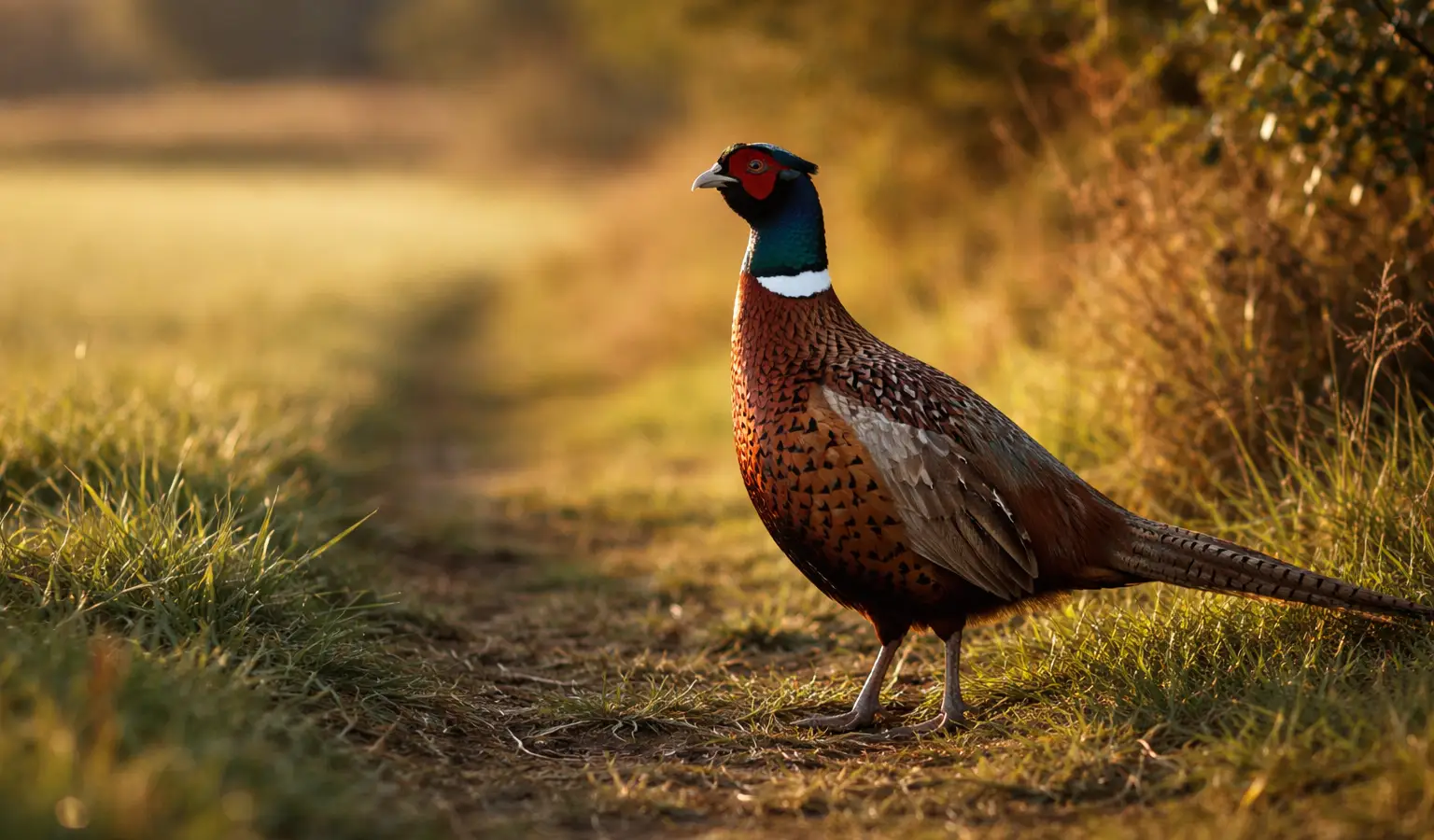
Common pheasant small game bird in field

Type

Bird

Lifespan

8 years

Hunting season

Octobre à février

Edible

Yes

Fact sheet

Pheasant

Scientific name

Phasianus colchicus

Type

Bird

Meat quality

Tasty meat

Edible

Yes

Lifespan

8 years

Gestation

23 days

Size

50-60 cm

Weight

1-1.5 kg

Diet

Omnivore: seeds, insects, berries

Status

Huntable under local regulations

Hunting season

Octobre à février

Breeding season

4 / 5

Lifestyle and behaviour

Behaviour : Small groups, dominant males, short explosive flights, often runs on the ground

Social structure : Small groups, dominant males

Migration : Sedentary

Habitat

  • Forest
  • Plains
  • Farmland

Natural predators

  • Fox
  • Birds of prey

Hunting methods

  • Drive hunt

Health risks

  • Avian parasites

Ecosystem role

  • Seed dispersal
  • Insect regulation

Signs of presence

  • Ground tracks
  • Feathers
  • Calls

Introduction

General description

The pheasant, Phasianus colchicus, is one of the best-known small game birds in agricultural landscapes, woodland edges, hedgerow country, and mixed lowland habitats. It is a large, long-tailed ground-dwelling bird that combines strong running ability with short, explosive flight. In many regions it is familiar both as a wild or naturalized bird and as a managed game species, which gives it an unusual place at the intersection of field ecology, farming, hunting culture, and rural land management.

Although often associated with open farmland, the common pheasant depends heavily on habitat variety rather than simple openness. It does best where feeding areas, cover, nesting structure, and escape routes occur close together. Cereal fields, rough grass margins, thorny cover, shelterbelts, coppice edges, ditch lines, and patches of scrub all contribute to its daily needs. This ability to use edge-rich environments explains why pheasants are so often encountered in mosaic landscapes rather than deep forest or fully treeless open ground.

Ecologically, the pheasant functions as an omnivorous forager that consumes seeds, green plant material, berries, and many invertebrates, especially during the breeding season. It can influence insect populations locally and also contributes to seed movement across the landscape. At the same time, it is an important prey item for foxes and birds of prey, particularly where cover is poor or young birds are abundant.

For observers and hunters alike, the species is notable for its wariness on the ground, loud wingbeats on takeoff, and the striking sexual dimorphism between brightly colored males and more cryptic females. Because pheasant populations may include truly wild, naturalized, managed, or regularly released birds depending on the country and estate system, abundance, behavior, and conservation value can vary significantly from one area to another.

Morphology

Morphology

The pheasant is a large-bodied game bird, typically around 50 to 60 cm in body length, though the full apparent length is increased by the long tail, especially in males. Adults commonly weigh about 1 to 1.5 kg, with hens generally lighter and more compact than cocks. The body is rounded and powerful, the neck fairly long, the legs strong for walking and running, and the wings broad enough for abrupt burst flight rather than sustained long-distance travel.

Male pheasants are highly distinctive. Most show a glossy head with iridescent tones, a red facial wattled patch around the eye, a pale neck ring in many forms, rich copper, chestnut, gold, or barred body plumage, and a long tapered tail marked with dark barring. Plumage can vary noticeably because different subspecies and managed stocks have contributed to many local populations. Some birds look intensely colorful, while others appear darker or paler depending on lineage and wear.

Female pheasants are much more discreet in appearance and better adapted to camouflage. Hens are mottled buff, brown, and black with a barred pattern that blends extremely well into dry grass, stubble, hedgerow litter, and field margins. This subdued coloration is especially important during nesting, when concealment is a primary defense. Juveniles resemble females at first, though young males gradually acquire brighter features.

In the field, identification is often helped by silhouette and movement as much as color. A pheasant on the ground appears long-tailed, horizontal, and purposeful in its stride. When flushed, it launches with rapid wingbeats and a sudden, noisy rise, often followed by a glide into cover. Even at distance, that combination of body size, tail shape, and explosive takeoff is highly characteristic.

Habitat and distribution

Habitat and distribution

Habitat

Pheasants favor habitats that combine feeding ground with secure cover. The most productive pheasant habitat is usually a patchwork of farmland, woodland edge, hedgerows, rough grassland, scrub, shelterbelts, and field margins. Rather than depending on one vegetation type, the species relies on access to several complementary microhabitats within a relatively small daily range.

In agricultural country, pheasants are often associated with cereal fields, root crops, stubble, weedy margins, drainage ditches, thorn hedges, and unmanaged corners where insects and seeds are abundant. They also use plantations, coppice edges, spinneys, and brushy woodland borders for loafing, roosting, and escape cover. Dense cover is particularly important during winter, during periods of hunting pressure, and where predator presence is high.

Nesting hens usually seek concealed sites on the ground in tall grass, rough herbaceous vegetation, hedge bottoms, or lightly managed cover crops. Broods benefit from areas that hold abundant insects while remaining open enough for movement. Intensively simplified farmland with few margins, little insect life, and limited nesting cover is generally less favorable, even if food from crops is present.

At a broader scale, pheasants are most strongly associated with lowland and gently rolling landscapes, but local occurrence depends less on altitude than on the structure of available cover, winter shelter, and breeding habitat. In many regions, the best pheasant biotope is an edge-rich rural landscape where disturbance is moderate and habitat diversity is high.

Distribution

Phasianus colchicus is native to parts of Asia, but it has been widely introduced and established across much of Europe and in other temperate regions of the world. In many countries, the pheasant is now a familiar component of rural landscapes, though its status may differ from place to place: wild-living, naturalized, managed, supplemented by releases, or heavily dependent on local game management practices.

Its distribution is therefore best understood as a mix of historical introduction and current habitat suitability. Pheasants are commonest in agricultural districts with woodland edges and good winter cover. They are often scarce or absent in heavily urbanized zones, very open treeless landscapes with little shelter, high mountains, or extensive wet habitats that do not provide suitable nesting and feeding structure.

Local density can fluctuate strongly according to land use, severity of winters, spring weather during nesting, predator pressure, disease, and the extent of releases where those occur. In some regions, apparently high numbers in autumn do not necessarily reflect strong natural reproduction. In others, stable local populations persist with limited management where habitat conditions remain favorable.

Because occurrence patterns are closely linked to local management systems, anyone assessing pheasant abundance should be cautious about generalizing from one area to another. A landscape may hold resident birds year-round, seasonal concentrations around crops or cover, or a population shaped primarily by annual release and harvest practices.

Lifestyle

Lifestyle and behaviour

Diet

The pheasant is an omnivore with a flexible diet that changes with season, age, and local food availability. Adults commonly feed on seeds, cereal grains, green shoots, buds, berries, fallen fruit, and a wide range of invertebrates. This adaptability helps the species exploit mixed farmland and edge habitats where food types shift through the year.

In autumn and winter, pheasants often rely more heavily on seeds, waste grain, acorns where available, berries, and other plant material found in stubble, margins, hedgerows, and feeding areas. During spring and early summer, fresh plant growth and invertebrates become more important. Insects, larvae, beetles, ants, and similar prey are especially valuable because they provide protein during the breeding season.

Chicks depend very strongly on invertebrate food in their early life. Areas rich in insects are therefore critical for brood survival, and this is one reason why flower-rich margins, rough grass strips, lightly disturbed field edges, and mixed low-input habitats can be so important. A countryside that offers grain but few insects may support adults while still limiting recruitment.

Pheasants usually feed on the ground, pecking, scratching lightly, and moving steadily through cover edges or open patches near shelter. Their diet can include cultivated crops, which sometimes puts them in mild conflict with farming interests, but they also consume many invertebrates that form part of the broader farmland food web.

Behaviour

Pheasants are primarily terrestrial birds with a daily routine centered on feeding, moving between cover and open ground, loafing in sheltered areas, and retreating quickly when disturbed. They are often most active in the morning and late afternoon, especially where daytime disturbance is frequent. In warm or pressured conditions they may remain quiet in cover for long periods.

The species is famously alert. A pheasant often detects danger first by posture and stillness, then by walking or running rather than immediately taking flight. This preference for running is a key part of its behavior and explains why birds can seem to vanish into hedge bottoms, crop rows, bramble edges, or woodland rides. When finally flushed, the takeoff is sudden, loud, and forceful, with rapid wingbeats that can startle even experienced field observers.

Males become especially conspicuous during the breeding season, when they call, display, and patrol favored areas. Outside that period, birds may be quieter and more secretive, especially after repeated disturbance or in landscapes with regular hunting activity. Hens with broods are typically cautious and make use of dense, broken cover that allows chicks to feed while remaining concealed.

Weather and pressure influence behavior strongly. In wind, rain, or cold snaps, pheasants often seek thicker shelter. In areas with repeated human activity, dogs, or predators, they may shift feeding times and hold tighter to cover. Even in places where they are common, individual birds can be surprisingly difficult to observe well because their behavior is shaped by a constant balance between feeding opportunity and escape security.

Social structure

Pheasants are not strongly colonial birds, but they do show a recognizable social structure that changes through the year. Outside the breeding season they are often found in small groups, loose associations, or mixed gatherings around food and cover. These groups are usually not highly cohesive in the way waterfowl flocks may be, but birds tolerate one another in productive feeding and shelter areas.

Adult males are generally more territorial during the breeding season. A dominant cock may hold and advertise an area that overlaps with the ranges of one or more hens, though the exact spacing pattern depends on habitat, density, and local population structure. Males often compete through calling, posturing, pursuit, and display rather than constant direct fighting, although aggressive encounters do occur.

Hens are more centered on nesting cover and brood-rearing needs. Once incubation begins, the female assumes the main parental role. Chicks remain with the hen after hatching, forming a family group that gradually becomes more mobile and independent as they grow. During this stage, brood cohesion and access to sheltered insect-rich ground are more important than territorial display.

In winter or after the breeding season, social organization typically loosens again into practical use of feeding areas and refuge cover. The degree of grouping can vary with food concentration, weather severity, disturbance, and whether birds are from long-established local stocks or heavily managed populations.

Migration

The pheasant is generally considered sedentary. Most birds live within a relatively limited home range and do not undertake true long-distance migration. Seasonal movement does occur, but it usually involves short shifts between feeding areas, winter shelter, breeding cover, and safer resting sites rather than directional migratory travel.

In autumn and winter, pheasants may concentrate near reliable food sources, dense hedgerows, game cover, woodland belts, or sheltered field corners. During spring, males spread into territories and hens seek nesting sites in quieter cover. Young birds may disperse from brood areas as they mature, and this juvenile dispersal can help explain local changes in abundance from one season to the next.

Movement patterns are strongly influenced by weather, habitat fragmentation, predator pressure, and human disturbance. In severe conditions, birds may stay exceptionally close to cover. In more open, low-pressure areas they may range more freely across farmland mosaics. Even so, the species remains fundamentally a resident bird rather than a migrant.

Reproduction

Reproduction

The pheasant breeding cycle usually begins in spring, when males become vocal and more visually prominent. Cocks establish and defend favored areas, calling and displaying to hens. Courtship includes posture, movement, and visual signaling, with the male’s bright plumage and facial wattles playing an important role in communication.

The hen nests on the ground, typically choosing a shallow scrape concealed in tall grass, rough vegetation, hedge margins, field edges, or light scrub. Good nest placement depends on a balance between concealment and the ability to move safely to feeding areas. Clutch size can be relatively large compared with many birds, though actual productivity depends heavily on weather, predation, disturbance, and habitat quality.

Incubation lasts about 23 days, carried out by the female. The chicks hatch covered in down and leave the nest quickly, following the hen and feeding for themselves. Early brood survival is often the most vulnerable stage of the annual cycle. Cold, wet conditions can be especially damaging because chicks need both warmth and abundant insect food during rapid early growth.

If a nest is lost early, hens may sometimes attempt to renest, but success varies widely with local conditions and season length. In practical terms, reproductive output is shaped less by egg-laying potential alone than by the quality of nesting cover, the availability of brood habitat, predator pressure, and weather during the first weeks after hatching.

Field signs

Field signs

Pheasant field signs are often easiest to detect along margins, tracks, hedgerow bases, woodland rides, feeding strips, and lightly muddy field edges. The most useful signs include ground tracks, feathers, and calls, but context matters. A single sign rarely tells the whole story; repeated signs around feeding cover and escape routes are more informative.

Tracks usually show three forward-pointing toes and a strong ground-walking pattern, often in soft soil, dust, or shallow mud. Because pheasants spend much of their time on foot, trails may appear as repeated passage lines through grass, under hedge gaps, or along field edges. Scratching is generally modest compared with some other galliform birds but may still be noticed around feeding spots.

Feathers can accumulate at roost edges, crossing points, flush sites, or predator kill locations. Tail feathers are particularly distinctive when found intact. Droppings may be encountered near habitual loafing cover, though they are less diagnostic for beginners than tracks or feathers. During the breeding season, the male’s vocalizations can reveal presence before the bird is seen, especially around dawn or in calm weather.

Other useful clues include sudden bursts from cover, dust-bathing patches in dry ground, and the regular use of edge habitat where cover meets open feeding areas. Reading pheasant sign effectively usually depends on understanding how birds move between concealment and food rather than searching randomly across the landscape.

Ecology and relationships

Ecology and relationships

Ecological role

Pheasants occupy several ecological roles within mixed rural ecosystems. As omnivorous ground foragers, they consume seeds, berries, shoots, and many invertebrates, contributing to insect regulation and some degree of seed dispersal. Their feeding activity links plant production, invertebrate abundance, and edge habitat structure in practical ways that are often visible at field scale.

They are also part of the prey base for medium and large predators, including foxes and birds of prey. Eggs, chicks, and occasionally adults may be taken, particularly where nesting cover is sparse or winter shelter is poor. Because they are relatively conspicuous and ground-oriented, pheasants can be an important food resource for local predators in some agricultural landscapes.

Their ecological significance, however, varies with how populations are maintained. In areas with long-established naturalized birds, pheasants function as integrated members of the local wildlife community. In heavily managed systems, their role may be shaped by release intensity, supplementary feeding, predator management, and habitat creation. This means their ecological footprint is highly context-dependent.

From a habitat perspective, pheasant presence often indicates the availability of cover-rich, structurally diverse farmland rather than pristine conditions. They are best viewed as a species of productive edge environments, where land use, management, and wildlife dynamics meet.

Human relationships

The pheasant has a long and complex relationship with people. It is one of the most culturally significant small game birds in many parts of Europe and elsewhere, valued in hunting traditions, rural estates, and seasonal field sports. The species is also well known to birdwatchers, photographers, and land managers because it is both visually striking and strongly tied to everyday countryside features such as hedges, rides, crop edges, and farm tracks.

For hunters, pheasants are associated with driven and walked-up shooting depending on local custom, terrain, and regulation. The bird’s fast, noisy flush and tendency to run before taking wing make it a classic quarry species. Its meat is widely regarded as edible and traditionally used in autumn and winter game cooking.

The relationship with farming is more mixed. Pheasants make use of arable land, cover crops, margins, and shelterbelts, and they can benefit from wildlife-friendly farm practices. At the same time, they may feed in crops or congregate around managed feeding areas, which can create local concerns depending on density. Where habitat measures for pheasants include hedgerow maintenance, insect-rich margins, and winter cover, other farmland wildlife may also benefit.

Public perception often depends on local context. In some areas pheasants are seen mainly as a familiar countryside bird; in others, as a managed game species whose abundance reflects human intervention. A balanced understanding requires recognizing both the bird’s natural behavior and the management systems that may influence its numbers.

Legal framework and management

Legal framework and management

Legal status

The pheasant is commonly huntable under local regulations, but legal status varies significantly by country, region, and management framework. Closed seasons, open seasons, release rules, bag limits, methods, hunting days, and land access rules can all differ. The season indicated here, roughly October to February, is consistent with many temperate hunting systems, but readers should always verify current local law before any field activity.

In some jurisdictions, distinctions may exist between wild birds, released birds, and birds on managed shooting estates. Additional rules can apply to transport, sale, use of dogs, shooting methods, habitat protection, and disease control. Nature reserves, protected areas, and certain private lands may also impose separate restrictions regardless of the general season.

Because pheasant management intersects with animal welfare, biosecurity, farmland stewardship, and game law, legal compliance should be understood as more than simply knowing opening and closing dates. Hunters and managers should consult official wildlife agencies, local hunting federations, or the current regulatory text for the specific territory concerned.

Management tips

Good pheasant management begins with habitat reading rather than simple abundance counts. The most reliable areas are those that combine nesting cover, brood habitat rich in insects, winter shelter, and nearby feeding ground. Thick cover alone is not enough, and open feeding areas alone are not enough; the value lies in how these elements connect across the same landscape unit.

  • Maintain edge diversity: hedgerows, rough margins, beetle banks, scrub corners, and woodland fringes create movement routes and refuge.
  • Protect nesting and brood cover: avoid unnecessary disturbance in spring and early summer, especially in grass margins and unmanaged field edges.
  • Support insect availability: brood survival often depends on invertebrate-rich habitat rather than seed abundance alone.
  • Provide winter shelter: dense belts, cover crops, and thorny structure help birds cope with weather and predator pressure.
  • Monitor realistically: separate observations of resident behavior, breeding success, and any released stock when assessing population health.

For observation or hunting context, it is useful to focus on transition zones: stubble near hedges, sunny woodland edges, game cover strips, ditch lines, and sheltered corners after bad weather. Under pressure, pheasants often run ahead through cover instead of flushing immediately, so reading likely escape lines is often more productive than watching a single point.

Where management is practiced, caution is important. Overgeneralized interventions can miss local limiting factors, which may be weather, brood food, predation, disease, or habitat fragmentation rather than sheer lack of birds. Effective management is usually site-specific, season-aware, and grounded in repeated field observation.

Fun facts

Fun facts

The pheasant is famous for one of the most dramatic flushes in the small game world: a bird that seems to disappear on foot can suddenly explode upward with startling speed and loud wing noise.

Despite its strong flight when alarmed, the pheasant is fundamentally a ground-oriented bird and often prefers to run first. Many close encounters happen only because the bird judged its cover safe until the last second.

Male pheasants can look surprisingly different from one area to another. That variation reflects a mix of subspecies ancestry, historical introductions, managed breeding lines, and normal plumage diversity.

Young pheasant chicks are highly dependent on insects during their earliest growth stages, which means a bright, showy game bird is also closely tied to the tiny invertebrate life of field margins and rough grass.

Although the species may live up to around 8 years in theory, far fewer birds reach old age in the wild because survival is shaped by predation, weather, disease, and human pressure.