
Red-legged partridge
Alectoris rufa
A partridge of dry open habitats, often managed and hunted in many regions.
Type
Bird
Lifespan
6 years
Hunting season
October – February
Edible
Yes
Fact sheet
Red-legged partridge
Scientific name
Alectoris rufa
Type
Bird
Meat quality
Tasty meat
Edible
Yes
Lifespan
6 years
Incubation
23 days
Size
32-38 cm
Weight
450-600 g
Diet
Omnivore: seeds, insects, berries
Status
Hunted under quotas
Hunting season
October – February
Breeding season
4 / 5
Lifestyle and behaviour
Behaviour : Family coveys, mostly ground-dwelling
Social structure : Family coveys
Migration : Resident
Habitat
- Forest
- Plains
- Farmland
Natural predators
- Fox
- Birds of prey
Hunting methods
- Shoot in front
Health risks
- Avian parasites
Ecosystem role
- Seed dispersal
- Insect regulation
Signs of presence
- Ground tracks
- Droppings
- Feathers
Introduction
General description
The Red-legged Partridge, Alectoris rufa, is a distinctive game bird of dry open country, especially farmland, scrubby slopes, field edges, and lightly wooded mosaics. Native to parts of southwestern Europe and widely recognized in hunting culture, it is a strongly terrestrial species that spends most of its life on the ground, walking, feeding, dust-bathing, and sheltering in low cover. Its combination of alert behavior, fast running, explosive flush, and family-based social life makes it one of the most characteristic small game birds of Mediterranean and Atlantic agricultural landscapes.
Ecologically, the Red-legged Partridge occupies an important middle position in open-country food webs. It feeds on seeds, green plant material, berries, and many invertebrates, especially when chicks need protein-rich food. In turn, it is prey for foxes and birds of prey, and its breeding success often reflects the quality of local habitat structure, insect availability, nesting cover, and disturbance levels. Because it is sensitive to changes in farming intensity, weather during nesting, and local management practices, it is often discussed as both a hunting species and an indicator of the condition of traditional mixed farmland.
In areas where it is hunted, the species has strong cultural and practical importance. The Red-legged Partridge is valued for challenging walked-up shooting and for the way coveys use terrain, hedges, rough edges, and broken ground. At the same time, sustainable interest in the species increasingly depends on habitat quality, careful harvest pressure, and clear distinction between healthy wild populations and areas influenced by releases. For readers searching for red-legged partridge identification, habitat, behavior, breeding, and field signs, Alectoris rufa is best understood as a bird of open land mosaics that thrives where food, cover, and low-to-moderate disturbance remain well balanced through the year.
Morphology
Morphology
The Red-legged Partridge is a medium-sized, compact ground bird measuring roughly 32 to 38 cm in length and commonly weighing about 450 to 600 g, though condition varies with season, sex, age, and local resources. It has a rounded body, relatively short tail, sturdy legs, and a small head carried on a surprisingly upright posture when alert.
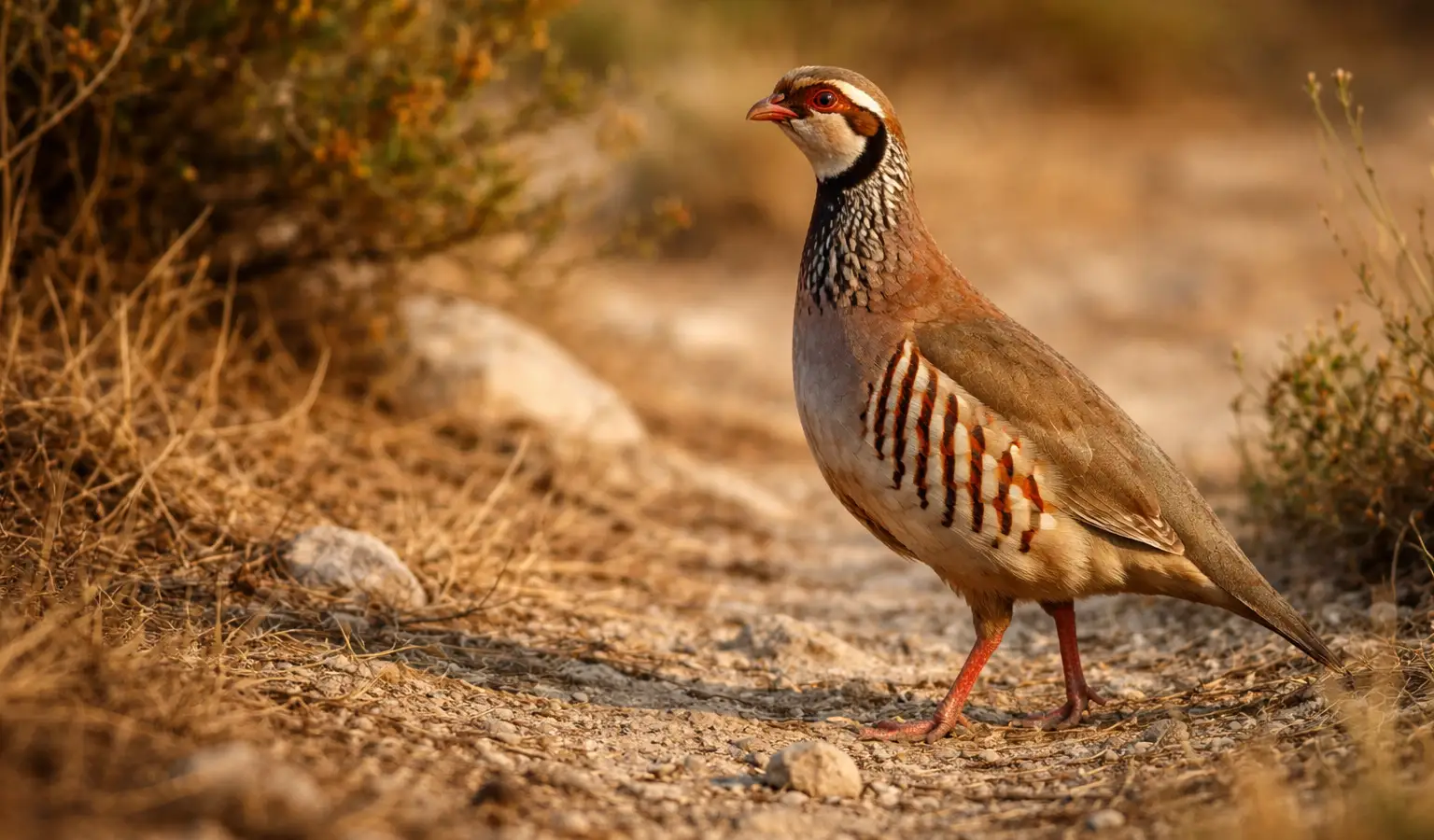
Field identification is usually straightforward at close or moderate range. The most obvious features are the red bill, red eye ring, and red legs, which give the species its common name. The throat is pale, bordered by a bold black line that extends into a necklace-like pattern. The upperparts are generally warm brown to gray-brown, helping the bird blend into dry soil, stubble, and scrub. The flanks are strongly barred with chestnut, black, and cream, a key feature when the bird is seen side-on. In flight, it appears broad-winged and fast, often flushing with a burst of wingbeats before gliding low over the ground.
Sexes look broadly similar, although males may appear slightly larger and more robust. Juveniles are duller and less crisply marked than adults. Confusion may occur with other partridge species where ranges overlap or where released birds are present, but the Red-legged Partridge typically shows a cleaner, brighter facial pattern and stronger red soft parts than many look-alikes.
Habitat and distribution
Habitat and distribution
Habitat
The Red-legged Partridge favors dry, open habitats with a varied structure rather than uniform cover. It does especially well in mixed farmland landscapes that combine cereal fields, rough grass margins, low scrub, hedgerows, vineyard edges, fallow plots, stony banks, and patches of light woodland. The ideal biotope usually offers a close arrangement of feeding ground, nesting cover, brood habitat rich in insects, and safe escape routes.
This species is often associated with plains, rolling agricultural country, and lower hills, but it can also use open forest edges and mosaic landscapes where tree cover remains broken and sunlight reaches the ground layer. Dense closed forest is generally poor habitat, while heavily simplified farmland may provide food at some times of year but too little shelter or brood cover at others. Red-legged Partridges often select places with bare ground or sparse vegetation for movement and feeding, alongside thicker nearby cover for concealment.
Habitat quality can shift markedly with season. Spring nesting requires undisturbed cover and nearby feeding areas. Summer brood-rearing depends heavily on insect-rich field margins and diverse herbaceous vegetation. In autumn and winter, access to seeds, scattered grain, berry-bearing plants, and sheltered resting cover becomes increasingly important. Where agriculture remains diverse and edge-rich, the species is more likely to persist as a stable resident bird.
Distribution
Alectoris rufa is native to southwestern Europe, with strong historical presence in the Iberian Peninsula, France, and parts of northwestern Italy. It is also known from some introduced or managed populations beyond parts of its native range, especially where it has long been associated with game management. However, abundance and population quality can vary greatly between regions.
Within its range, the Red-legged Partridge is not distributed evenly. It is most typical of lowland to foothill agricultural country with suitable dry open structure, but local occurrence depends on land use, weather patterns, predation pressure, and management history. In some districts it remains widespread; in others it has declined or become more fragmented, particularly where farmland has intensified, nesting cover has been reduced, or repeated releases have altered the status of truly wild stocks.
For practical field understanding, distribution should be read at two scales: the broad geographic range of the species and the much finer local pattern of usable habitat. A region may lie well inside the natural range of the Red-legged Partridge yet support few birds if cover, insect-rich margins, and year-round refuge are lacking.
Lifestyle
Lifestyle and behaviour
Diet
The Red-legged Partridge is an omnivore with a diet that changes through the year and according to local food availability. Adults feed heavily on seeds, green shoots, cereal grains, small fruits, and berries, while also taking a wide range of invertebrates. Beetles, ants, caterpillars, and other small insects become especially important in spring and summer.
Seasonal variation is crucial. In autumn and winter, seeds and waste grain often make up a large part of the diet, particularly in farmland. During the breeding season, hens need reliable nutrition close to nesting areas, and newly hatched chicks depend strongly on abundant invertebrates for rapid growth. This early protein supply is one of the most important factors affecting brood survival. Even in landscapes that seem suitable, poor insect availability can sharply reduce recruitment.
Feeding usually occurs on the ground, often in short vegetation, along field margins, on tracks, or in sparsely vegetated patches where food is easy to detect. The species may also use berry-bearing shrubs and weedy edges. Diet therefore links the partridge closely to habitat diversity: seed-rich winter cover, weedy margins, and insect-friendly low-intensity ground are all valuable at different times of year.
Behaviour
The Red-legged Partridge is primarily a ground-dwelling bird with a cautious, watchful temperament. It spends much of the day walking and feeding in small parties or family groups, pausing frequently to scan for danger. Its behavior combines stillness, camouflage, fast running, and sudden flight. When disturbed at moderate range, birds often prefer to run first, using folds in the ground, field edges, scrub lines, or stony banks to break contact before flushing.
When they do take wing, the flush is explosive and noisy, followed by rapid, direct flight that is often low over the terrain. This strong preference for using cover and relief makes the species highly responsive to habitat structure. In open, exposed ground, birds may become exceptionally wary; in more varied country they can hold tighter, especially in rough margins and scattered scrub.
Daily activity often peaks in the cooler parts of the day, especially during warmer weather. Midday may be used for resting, sheltering, or dust-bathing. In dry country, birds commonly seek a balance between feeding opportunities and secure resting cover. Throughout the year they remain alert to foxes, raptors, and human disturbance, and repeated pressure can make local coveys shift their routines and use denser refuge zones.
Social structure
The Red-legged Partridge is well known for its family coveys, a social structure that is especially visible from late summer through winter. After the breeding season, adults and their surviving young often remain grouped together, moving, feeding, and roosting in coordinated fashion. These coveys help birds maintain vigilance and exploit feeding areas efficiently while reducing the risk that any one individual is caught by surprise.
As the breeding season approaches, this social cohesion loosens. Pairs form or re-form in spring, and territorial behavior becomes more evident around nesting areas. During this period, adults may become less tolerant of close neighbors, especially where habitat patches are limited.
Outside the nesting cycle, local group size can vary with breeding success, habitat quality, mortality, and disturbance. A healthy autumn covey may indicate successful reproduction, but group size should always be interpreted cautiously because weather, predation, and management can all influence how birds are distributed across the landscape.
Migration
The Red-legged Partridge is generally considered a resident or sedentary species rather than a true migrant. Most birds remain within the same broad area throughout the year, shifting locally between feeding, nesting, and sheltering zones instead of making long-distance seasonal movements.
That said, local dispersal does occur. Juveniles may move away from natal areas after the breeding season, and coveys can adjust their range according to harvest pressure, weather, snow, drought, or changes in crop cover. In strongly managed or fragmented landscapes, these movements may be small and irregular rather than directional.
For field observation, this means the species is often present year-round where habitat remains suitable, but exact location within a property or landscape mosaic may change with season. Winter use may concentrate in sheltered feeding areas, while spring distribution often becomes more dispersed as pairs establish breeding territories.
Reproduction
Reproduction
Breeding typically begins in spring, though timing varies with latitude, altitude, and weather conditions. The Red-legged Partridge usually nests on the ground in concealed sites such as rough grass, field margins, low scrub, or dense herbaceous cover. The nest is a shallow scrape lined with plant material and placed where the sitting bird can remain hidden while retaining access to nearby feeding areas.
Clutch size can be relatively large for a ground bird, although exact numbers vary considerably. Incubation lasts around 23 days. As in many galliform birds, chicks hatch covered in down and leave the nest soon after hatching. They are mobile from the start but depend on adults for guidance, protection, and access to suitable feeding habitat. Early brood survival is strongly influenced by weather, especially cold rain, and by the local abundance of insects.
Successful reproduction depends on a combination of nesting cover, low disturbance, predator pressure, and brood habitat quality. In poor years, repeated nesting attempts may occur after failure, but this carries energetic costs and does not fully offset heavy losses. For management and conservation alike, the breeding season is the most sensitive period in the annual cycle of Alectoris rufa.
Field signs
Field signs
Field signs of the Red-legged Partridge are usually found on the ground and are easiest to interpret in dry soil, dusty tracks, field edges, and lightly used farm lanes. Common signs include ground tracks, droppings, and occasional feathers near resting, feeding, or escape areas.
Tracks are typically those of a medium-sized ground bird, showing three forward-pointing toes and a practical, walking pattern rather than broad hopping intervals. They are often easiest to find where birds cross bare patches between feeding and cover. Repeated use of the same routes can create subtle trails through short vegetation or along the edge of rough cover.
Droppings may accumulate near roosting or loafing areas and are often more revealing when found in combination with tracks and dust-bathing spots. Feathers can appear at flush points, roost sites, or where predation has occurred. Other useful clues include scratch marks in loose ground, dust-bath depressions, and the sudden whir of wings when birds hold tight in field-edge cover. Interpreting signs works best when linked to habitat reading: look where feeding access, shelter, and a safe line of retreat come together.
Ecology and relationships
Ecology and relationships
Ecological role
The Red-legged Partridge plays several useful roles in open-land ecosystems. As a consumer of seeds, fruits, and green plant material, it contributes to the movement of plant matter across the landscape and may assist in seed dispersal on a local scale. By feeding on insects and other small invertebrates, especially during brood-rearing, it also participates in insect regulation.
It is equally important as prey. Eggs, chicks, and adults support predators such as foxes and birds of prey, making the species part of the energy transfer between farmland habitats and higher trophic levels. Because it relies on a mixture of nesting cover, feeding ground, and brood habitat, its presence can also reflect the ecological quality of traditional low-intensity farmland mosaics.
Where populations are healthy and genuinely wild, the Red-legged Partridge can serve as a useful indicator species for habitat connectivity, edge richness, and the seasonal availability of both seed resources and invertebrates.
Human relationships
The Red-legged Partridge has long-standing ties to rural culture, agriculture, wildlife observation, and small game hunting. It is one of the best-known partridge species in western Europe and is widely appreciated for its strong running ability, difficult flush behavior, and close relationship with worked farmland and scrub-edge country. In hunting contexts, it is commonly associated with walked-up shooting or driven forms in some regions, although practices differ significantly by country and local tradition.
Its relationship with farming is complex. Traditional mixed agriculture can create excellent habitat, but intensive systems may reduce nesting cover, brood food, and winter refuge. As a result, the species often sits at the center of discussions about field margins, pesticide pressure, harvest timing, supplementary feeding, predator management, and the difference between habitat-led recovery and reliance on released birds.
For birdwatchers and land managers, the Red-legged Partridge is also a rewarding species to observe. Its calls, family cohesion, and use of terrain make it relatively easy to detect in suitable habitat, though not always easy to approach. In culinary terms it is an edible game bird, which further explains its prominence in hunting history, but long-term value depends on responsible harvest and sound habitat stewardship.
Legal framework and management
Legal framework and management
Legal status
Legal status varies by country, region, and management framework, so local regulations should always be checked directly before any hunting activity. In many areas, the Red-legged Partridge is a legally huntable small game species subject to a defined open season, bag limits, quotas, release rules, and transport or marking requirements where applicable. Based on the context provided, hunting may occur roughly from October to February, but exact dates can differ annually and geographically.
Some jurisdictions distinguish between wild birds and released birds, and this distinction can have important management and legal implications. Additional rules may cover protected areas, hunting methods, restocking, disease controls, and documentation obligations. Because population status can differ sharply between neighboring regions, harvest pressure that is acceptable in one area may be inappropriate in another.
From a practical standpoint, lawful and sustainable use depends on three checks: current local season dates, local quota or bag-limit rules, and the status of the population being hunted. If uncertainty exists, the cautious approach is to verify with the competent wildlife authority or hunting federation before the season.
Management tips
Good Red-legged Partridge management starts with habitat structure rather than short-term measures alone. The species benefits most from landscapes that hold nesting cover, insect-rich brood habitat, winter seed resources, and nearby refuge throughout the year. Practical priorities often include maintaining rough margins, uncultivated strips, low scrub, hedgerow edges, beetle banks, and varied cropping patterns that prevent the ground from becoming either too bare or too uniform.
- Protect breeding cover: limit disturbance in spring and early summer around likely nesting zones.
- Improve brood habitat: encourage diverse herbaceous margins and invertebrate-rich areas close to nesting sites.
- Maintain winter resources: retain seed-bearing cover and sheltered feeding areas during the lean season.
- Read the landscape: coveys often use transitions such as stubble to scrub, track to hedge, or slope to rough grass.
- Match harvest to population reality: where numbers are low or uncertain, caution is preferable to pressure.
- Watch health and release issues: disease, parasites, genetics, and the effect of released birds can complicate local management.
For observation or hunting relevance alike, the key is to understand how birds use cover at different times of day and across the seasons. A property that looks suitable in winter may be poor for breeding if insect-rich brood cover is missing, while a productive nesting area may fail if summer disturbance or severe weather repeatedly affects chick survival.
Fun facts
Fun facts
The Red-legged Partridge is often heard before it is clearly seen, and its vocal presence can reveal coveys in broken farmland long before birds step into the open.
Despite being a capable flier, it lives primarily on foot. Much of its reputation comes from how cleverly it runs, uses terrain, and flushes only at the last moment.
The barred flanks and bold facial pattern make Alectoris rufa one of the most visually striking partridges in Europe, especially in good side light.
Young chicks rely heavily on insect food in their first weeks, which means a bird often associated with grain fields is also closely tied to healthy invertebrate communities.
In well-structured country, observing where coveys appear at dawn and where they retreat later in the day can teach a great deal about habitat quality, pressure, and seasonal movement.