
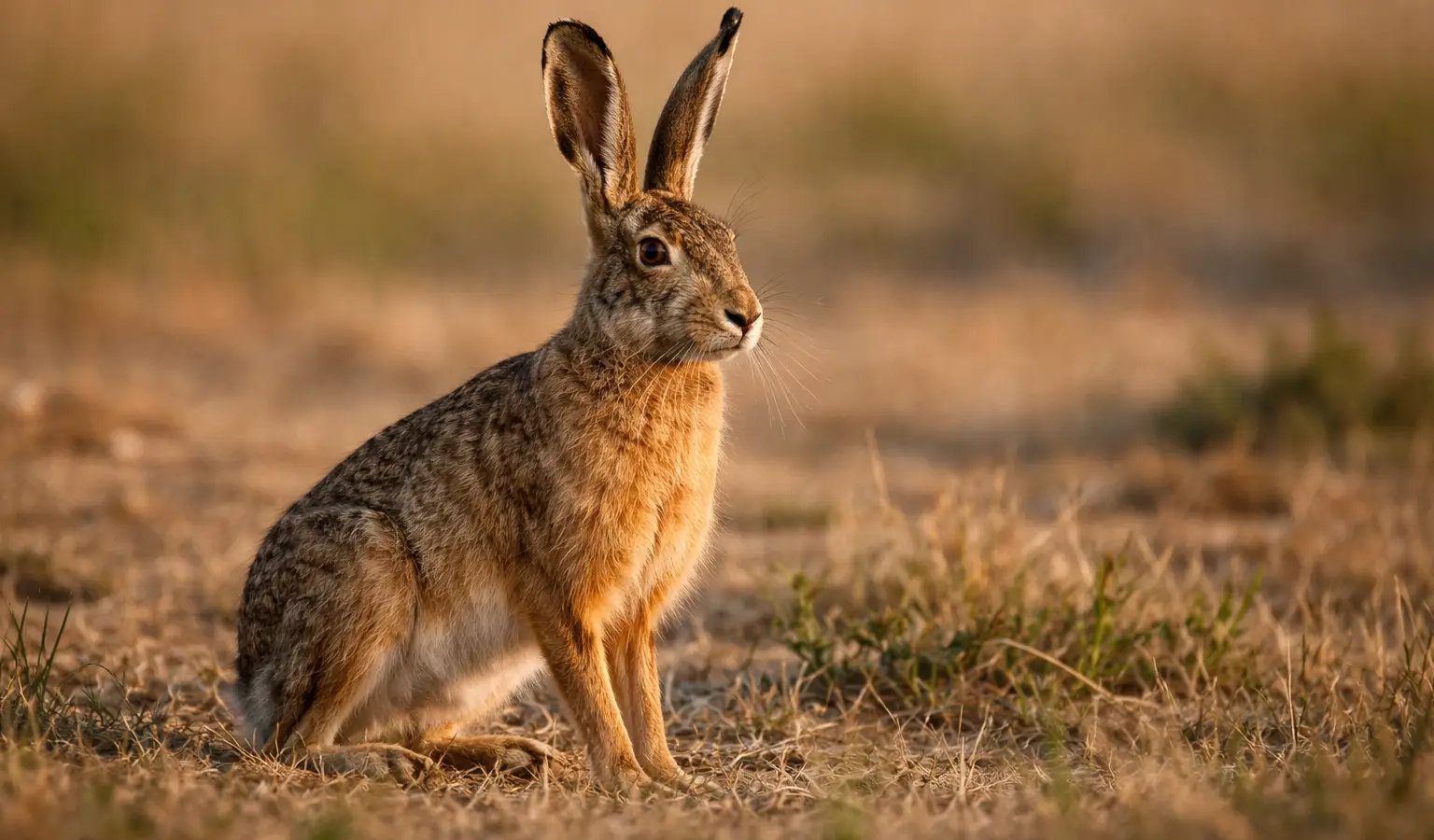
Brown hare
Lepus europaeus
A fast game species of European fields and farmland, valued for its meat.
Type
Lagomorph
Lifespan
12 years
Hunting season
Octobre à février selon quotas
Edible
Yes
Fact sheet
Brown hare
Scientific name
Lepus europaeus
Type
Lagomorph
Meat quality
Tender and fine meat
Edible
Yes
Lifespan
12 years
Gestation
42 days
Size
60-75 cm
Weight
3-5 kg
Diet
Herbivore: grasses, leaves, shoots
Status
Hunted under regional quotas
Hunting season
Octobre à février selon quotas
Breeding season
2 / 3 / 4 / 5 / 6 / 7
Lifestyle and behaviour
Behaviour : Fast, wary, mostly active at dusk and night
Social structure : Solitary or very small groups
Migration : Sedentary, limited movements for feeding
Habitat
- Forest
- Plains
- Grassland
Natural predators
- Fox
- Birds of prey
Hunting methods
- Shoot with dog in front
Health risks
- Myxomatosis
- Rabbit hemorrhagic disease
Ecosystem role
- Seed dispersal
- Soil aeration
Signs of presence
- Footprints
- Burrows
- Droppings
Introduction
General description
The brown hare, Lepus europaeus, is one of Europe’s best-known small game species and a characteristic animal of open country. Larger, longer-legged, and generally more cursorial than a rabbit, it is built for speed in farmland, grassland, and mixed rural mosaics. It is widely recognized by hunters, naturalists, and farmers alike for its wariness, powerful sprint, and preference for broad landscapes where visibility and escape routes matter.
As a game species, the brown hare has long held cultural and culinary importance. It is valued for its meat and for the challenge it presents in the field, especially where populations remain healthy and hunting is managed carefully. At the same time, the species is also an important indicator of farmland quality. Hare numbers often reflect the condition of cover, field margins, crop diversity, disturbance levels, predation pressure, and disease exposure.
Ecologically, the brown hare occupies a useful middle ground in food webs. It converts grasses, herbs, and crop vegetation into prey biomass for foxes and birds of prey, while also influencing vegetation through browsing and contributing to seed movement across open habitats. In many regions, its status is closely tied to agricultural change, which makes it a species of practical interest not only for hunting but also for wildlife management and landscape stewardship.
Morphology
Morphology
The brown hare is a medium-sized lagomorph typically measuring about 60 to 75 cm in body length and often weighing around 3 to 5 kg, though local variation occurs. It has a lean, athletic build, long hind legs adapted for rapid acceleration, and very long ears that usually show black tips. The eyes are large and set high on the head, giving a wide field of view that suits life in exposed country.
Its coat is usually tawny-brown to grey-brown above with a paler underside, often appearing finely grizzled rather than uniformly colored. Compared with a rabbit, the brown hare looks taller on the leg, less compact, and more rangy. The tail is relatively short, with a contrasting darker upper side and lighter underside. In the field, a fleeing hare is often identified by its long ears, stretched running posture, and bounding, high-speed escape over open ground.
Young hares, called leverets, differ from rabbit kits in being born furred, open-eyed, and comparatively well developed. This is a useful biological distinction when identifying breeding ecology in the field.
Habitat and distribution
Habitat and distribution
Habitat
The brown hare favors open habitats where it can feed widely and detect danger early. Productive landscapes often include a mix of arable fields, grassland, meadows, fallow ground, hedgerows, field edges, and lightly structured rural cover. It generally does best in heterogeneous farmland with both feeding areas and low, patchy shelter rather than in dense forest or highly simplified monoculture.
Although it may occur near woodland edges, the species is primarily associated with plains, open grasslands, and agricultural mosaics. Seasonal habitat use can shift with crop growth, harvest cycles, weather, and disturbance. In colder periods, hares may concentrate around winter cereals, rough grass, stubble, or other areas where food remains accessible. During daytime, they often rest in shallow surface forms in vegetation, furrows, or lightly sheltered ground rather than in true burrow systems.
Good brown hare habitat usually combines visibility, nearby escape routes, varied herbaceous food, and limited continuous disturbance. Landscapes with unmanaged margins, herb-rich strips, and moderate structural diversity tend to support more regular use than heavily uniform, intensively treated fields.
Distribution
Lepus europaeus is native to much of Europe and has been introduced to some other regions of the world. Within its core range, it is strongly associated with temperate lowland and agricultural landscapes, though local abundance varies considerably from one country or region to another.
In many areas, the brown hare remains widespread but unevenly distributed. It can still be common in favorable open country, yet much scarcer where habitat quality has declined, agricultural intensification is severe, disease events occur, or predation pressure is locally high. Altitude, climate, land use, and hunting regulation can all influence local population density.
At a practical field level, occurrence is often best predicted not simply by geography but by landscape structure: broad fields with varied edges, grass cover, mixed crops, and low fragmentation often hold more hares than heavily urbanized or ecologically simplified areas.
Lifestyle
Lifestyle and behaviour
Diet
The brown hare is a herbivore feeding mainly on grasses, leaves, shoots, herbs, and a range of cultivated or wild plants. Its diet changes with season, habitat, and what is locally available. In spring and summer, hares often take fresh green vegetation, clover, broadleaf herbs, young grasses, and tender crop growth. In autumn and winter, they may rely more on tougher grasses, winter cereals, stubble remnants, bark stripping on young woody plants, and other accessible plant material.
Feeding usually peaks during dusk, night, and early dawn, when the species moves out from resting areas to forage. In farmland, hares may exploit crop edges, pasture, volunteer growth, and uncultivated strips. Their selective feeding can be influenced by plant quality, moisture, and disturbance levels.
Like other lagomorphs, the brown hare has a digestive system adapted to extracting nutrients from fibrous plant food. This allows it to persist in open habitats where food quality changes markedly across the year, though prolonged periods of poor forage or overly simplified vegetation can reduce body condition and breeding performance.
Behaviour
The brown hare is typically fast, wary, and most active at dusk and during the night, although daytime sightings are not unusual in quiet areas. It spends much of the day resting in a shallow depression known as a form, relying on camouflage, stillness, and early detection of danger rather than on underground refuge.
When disturbed, a hare may first crouch tightly and hold its position. If pressure increases, it usually breaks away at speed, often in a powerful zigzagging run that helps evade predators. Its long hind limbs and flexible gait make it one of the most effective sprinters among small game species in open landscapes. Escape routes are often chosen through visible, navigable ground rather than dense cover.
Daily movements are shaped by feeding needs, disturbance, weather, and season. Brown hares can appear surprisingly localized for periods, then shift their use of fields as crops grow, are cut, or become less suitable. In hunting and observation contexts, this means apparent absence in one part of a landscape may simply reflect temporary redistribution rather than true disappearance.
Social structure
The brown hare is usually described as solitary or loosely associated rather than strongly social. Most individuals spend much of their time alone, especially outside the breeding context, though several hares may feed within sight of one another where food is concentrated and disturbance is low.
These loose groupings do not function like stable rabbit colonies. Brown hares do not usually maintain extensive communal burrow systems, and their spacing is more fluid, influenced by habitat structure, food resources, breeding condition, and local density. Overlap in home ranges can occur, but individuals still tend to operate independently.
During the breeding season, interactions become more visible, and temporary gatherings may be observed in open fields. Even then, the species remains better understood as a dispersed, open-country lagomorph rather than a highly cohesive social animal.
Migration
The brown hare is generally a sedentary species and does not undertake true long-distance migration. Most movements are local and linked to feeding opportunities, breeding activity, weather, crop rotation, harvest patterns, and disturbance.
Home range size can vary by habitat quality and season. In rich farmland mosaics, hares may meet many needs within a relatively limited area. In poorer or more disturbed environments, they may range more widely between resting cover and feeding sites. Juvenile dispersal also occurs, helping connect neighboring populations, but this is not the same as seasonal migration.
From a management perspective, the species is best understood as locally mobile rather than migratory: it stays within a broader familiar landscape while shifting use among fields and cover types through the year.
Reproduction
Reproduction
The brown hare has a relatively extended breeding season in many parts of its range, often beginning in late winter or early spring and continuing into summer, with timing influenced by climate and food conditions. Gestation is around 42 days. Females may produce several litters in a favorable year, which is an important feature of the species’ population dynamics.
Young are born above ground in shallow resting sites rather than in deep burrows. Unlike rabbit young, leverets are born fully furred, with eyes open, and are able to remain still and concealed shortly after birth. This precocial development is an adaptation to life in open habitats, where concealment and early mobility matter.
Litter size varies, but reproductive success depends heavily on weather, forage quality, disturbance, predation, and disease. Wet, cold conditions during the breeding season can be especially hard on leverets. Where habitat offers herb-rich cover and quiet shelter, recruitment tends to be more favorable than in heavily disturbed or simplified farmland.
Breeding behavior can include chasing and boxing, especially in spring. These displays are among the best-known signs of hare courtship activity, although they may involve both competition and female responses to persistent males.
Field signs
Field signs
Brown hare field signs can be subtle but consistent once learned. The most common indicators are tracks, droppings, feeding signs, and daytime resting forms. Tracks usually show the typical lagomorph pattern, with the larger hind feet often registering ahead of the forefeet when the animal is moving quickly. In soft ground, snow, or damp field margins, these prints can be distinctive.
Droppings are typically round to slightly flattened pellets, often found on feeding areas, edges, and regular movement routes. Unlike rabbit warrens, brown hare presence is not usually centered on extensive burrow systems. The species generally rests above ground in shallow forms, which may appear as slight depressions in grass, stubble, rough cover, or field margins.
Feeding signs may include clipped vegetation, browsing on young shoots, or repeated use of crop edges and herb-rich strips. In landscapes with regular hare activity, quiet scanning at dawn or dusk often reveals movement between resting and feeding areas more effectively than searching for sign alone.
Ecology and relationships
Ecology and relationships
Ecological role
The brown hare plays several useful roles in open-country ecosystems. As a widespread herbivore, it helps shape plant use patterns through selective feeding on grasses, herbs, and shoots. It can also contribute to seed dispersal as plant material is moved through the landscape.
It is an important prey species for predators such as foxes and large birds of prey, especially where hare populations remain robust. In that sense, the species helps transfer energy from vegetation to higher trophic levels. Young leverets may be especially vulnerable to predation, while adults rely on speed and vigilance to survive in exposed habitats.
Its presence often reflects broader farmland ecological quality. Healthy hare populations commonly coincide with structurally diverse landscapes that also benefit many other species, including ground-nesting birds, pollinators, and small mammals. For this reason, the brown hare is often considered a practical indicator species in agricultural wildlife management.
Human relationships
The brown hare has long been linked with rural life, hunting traditions, and wild food culture. As a small game species, it is valued where populations can sustain harvest, and it remains a respected quarry because of its alertness, speed, and use of open ground. Traditional pursuit often involves driven or walked-up shooting, sometimes with dogs working in front, depending on local custom and regulation.
Beyond hunting, the species is also of interest to wildlife watchers and field ecologists. Brown hares are among the most visible mammals of agricultural landscapes, especially in early morning or late evening. Their breeding chases and boxing behavior are widely appreciated by observers in spring.
Relations with farming are more mixed. In some areas, hares are welcomed as part of healthy countryside biodiversity; in others, local feeding pressure on young crops, vegetables, or tree seedlings may lead to conflict. These impacts are usually site-specific and depend on hare density, crop type, alternative forage, and seasonal scarcity. Good coexistence generally relies on balanced habitat management and realistic local monitoring.
Legal framework and management
Legal framework and management
Legal status
The brown hare is commonly hunted under regional or national regulations rather than under a single uniform rule across its range. Open seasons, quotas, bag limits, permitted methods, and local restrictions can vary substantially by country and even by subregional authority. In the context provided here, the hunting season is generally from October to February, subject to quota systems.
Because population trends can differ markedly between landscapes, legal status should always be checked locally before any harvest or control activity. Some areas may maintain regular seasons where populations are stable, while others may apply stricter limits, temporary suspensions, or targeted management responses where numbers are low.
Protected area rules, animal welfare requirements, firearms law, dog use regulations, and transport or sale provisions may also apply. The most reliable practice is to consult current official regulations each season rather than relying on past custom or generalized advice.
Management tips
Effective brown hare management begins with reading the landscape as a feeding-and-cover mosaic rather than focusing on a single field. Hares tend to benefit from mixed farming systems, winter food availability, uncultivated margins, herb-rich strips, low-intensity grassland, and patchy shelter that still allows visibility. Uniform, heavily simplified habitats generally support fewer animals.
- Maintain diverse field edges, fallows, and grassy margins to provide forage and resting cover.
- Preserve seasonal continuity of food, especially through autumn and winter.
- Reduce unnecessary disturbance in known resting and breeding areas.
- Monitor populations locally before setting hunting pressure; regional reputation is not a substitute for field-based assessment.
- Take disease risk seriously where myxomatosis or rabbit hemorrhagic disease is reported, even if impacts on hares may vary by strain and context.
- Coordinate habitat work with predator management, farming practice, and harvest decisions rather than treating each issue in isolation.
For observers and hunters alike, careful timing matters. Dawn and dusk surveys, repeated over the season, usually give a more realistic picture of abundance and habitat use than occasional daytime impressions. Conservative harvest and adaptive management are especially important where reproduction has been poor or where local numbers appear patchy.
Fun facts
Fun facts
The brown hare is famous for spring boxing, a behavior often seen in open fields and commonly associated with the breeding season. Despite popular myth, these bouts are not always simply males fighting; in some cases, females may be rebuffing persistent males.
Unlike rabbits, brown hares usually do not depend on warrens. They spend much of their lives above ground, using camouflage, vigilance, and explosive speed as their main defenses.
Leverets are born unusually well developed for such a vulnerable-looking animal: furred, open-eyed, and ready to rely on stillness almost from the start.
In folklore and literature across Europe, the hare has often symbolized alertness, swiftness, and seasonal renewal, which reflects how visible and distinctive this species has long been in rural landscapes.