
European rabbit
Oryctolagus cuniculus
A European burrowing mammal living in colonies, widely managed and hunted in many areas.
Type
Lagomorph
Lifespan
9 years
Hunting season
Septembre à février selon quotas
Edible
Yes
Fact sheet
European rabbit
Scientific name
Oryctolagus cuniculus
Type
Lagomorph
Meat quality
Tender and tasty meat
Edible
Yes
Lifespan
9 years
Gestation
31 days
Size
35-45 cm
Weight
1-2 kg
Diet
Herbivore: grasses, wild herbs, shoots, leaves, bark and crops
Status
Huntable depending on local rules
Hunting season
Septembre à février selon quotas
Breeding season
2 / 3 / 4 / 5 / 6 / 7 / 8
Lifestyle and behaviour
Behaviour : Burrowing, most active at dawn and dusk, colonial
Social structure : Underground family colonies
Migration : Sedentary, limited movements
Habitat
- Forest
- Plains
- Shrubland
Natural predators
- Fox
- Pine marten
Hunting methods
- Shoot with dog in front
Health risks
- Myxomatosis
- Rabbit hemorrhagic disease
Ecosystem role
- Seed dispersal
- Soil aeration
Signs of presence
- Footprints
- Burrows
- Droppings
Introduction
General description
The European rabbit, Oryctolagus cuniculus, is a small burrowing lagomorph native to parts of southwestern Europe and widely established elsewhere. Unlike hares, rabbits are strongly tied to warrens, social groups, and a network of underground shelters that shape much of their daily behavior. In the field, it is best understood not simply as a small game species, but as an animal whose grazing, digging, and colony life can influence vegetation structure, soil conditions, and predator activity.
It is a familiar species in farmland edges, scrub, open woodland mosaics, and sandy or easily worked soils where burrowing is practical. The European rabbit often thrives where feeding areas and protective cover lie close together. Its ecology is closely linked to edge habitat: open ground for grazing, shrubs or banks for refuge, and relatively dry soils for stable burrow systems.
In many regions, the rabbit has long held importance in hunting culture, small game management, and rural food traditions. At the same time, local populations can fluctuate sharply because of disease, predation, habitat change, and weather. That variability explains why the species may be abundant in one district and scarce in another, making local knowledge essential for both observation and management.
Morphology
Morphology
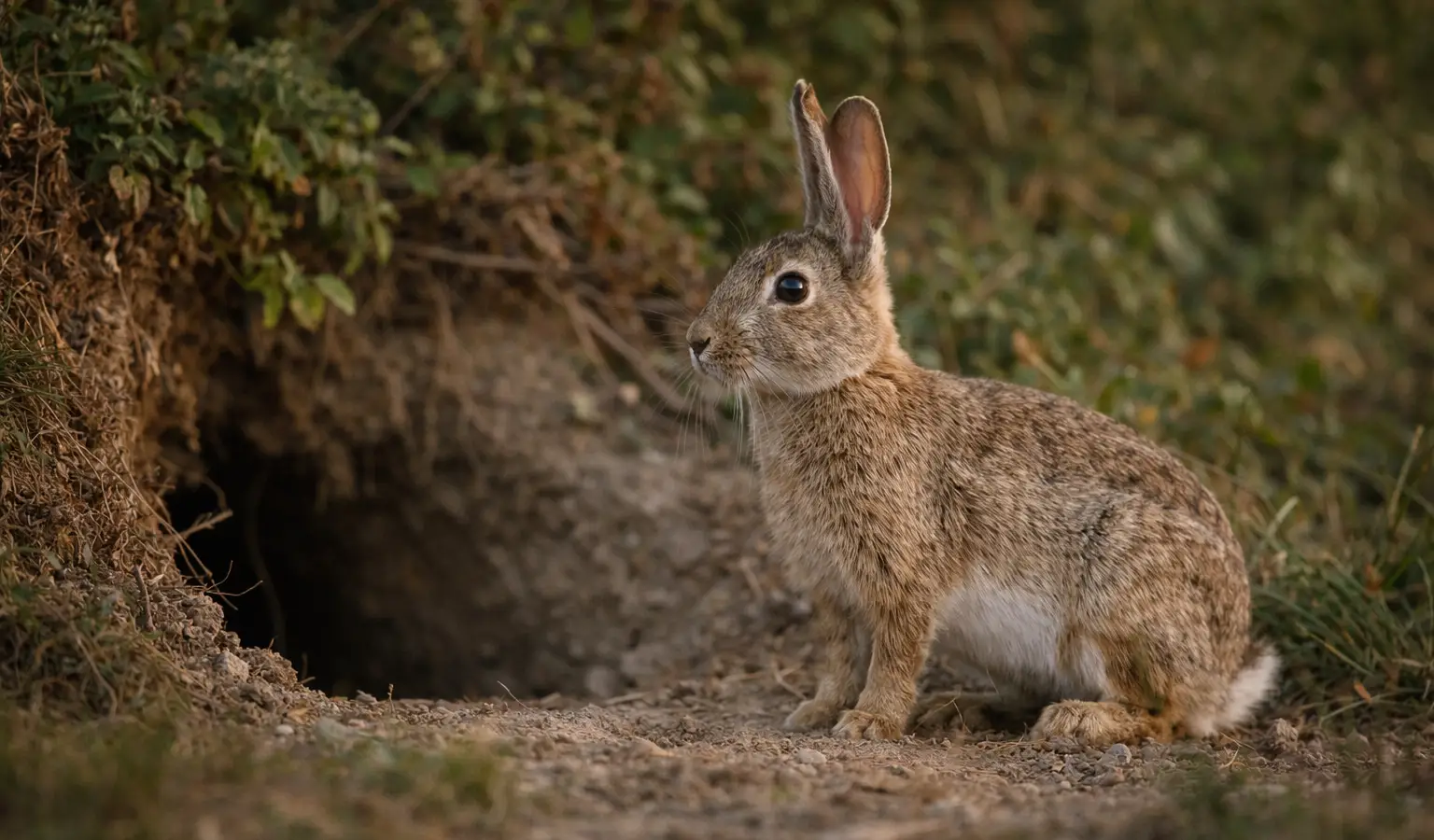
The European rabbit is a compact, short-tailed mammal typically measuring about 35 to 45 cm in body length and commonly weighing 1 to 2 kg, though local condition and habitat quality can influence size. It has a rounded body, relatively short legs compared with a hare, and ears that are moderate in length rather than especially long. The coat is usually grey-brown to sandy brown above, with paler underparts, helping it blend into dry grass, soil, and scrub.
For field identification, key features include a small white tail often flashed during escape, large dark eyes set high on the head, and a softer, less elongated silhouette than a hare. The hind feet are strong for rapid acceleration, but the species is built more for quick dashes to cover than for prolonged open-country running. Juveniles resemble adults but are smaller and often remain close to cover and warren entrances.
Habitat and distribution
Habitat and distribution
Habitat
The preferred habitat of the European rabbit combines three essentials: grazeable vegetation, nearby refuge, and soil suitable for digging. It is especially associated with plains, shrubland, woodland edges, forest openings, hedgerow systems, embankments, dunes, rough pasture, and mixed agricultural landscapes. It generally favors dry to moderately dry ground over heavy, waterlogged soils, because stable burrows are easier to maintain in lighter substrates.
Rabbits often do best in structurally varied biotopes where short feeding areas alternate with bushes, bramble patches, banks, or sparse tree cover. Overly dense forest without ground vegetation is usually less suitable than open forest mosaics and scrubby transitional zones. In intensively farmed country, persistence often depends on whether field margins, uncultivated patches, and shelter belts remain available.
Distribution
Oryctolagus cuniculus originated in the Iberian Peninsula and parts of southwestern Europe, but it has been widely introduced beyond its native range. Today the European rabbit occurs across many parts of Europe and in various regions of the world where it has become established, though abundance is highly uneven. In some areas it remains common and locally numerous; in others it has declined because of disease, habitat simplification, predation pressure, or prolonged poor recruitment.
At the local scale, rabbit distribution is often patchy. Colonies may be concentrated on favorable soils, field edges, scrub slopes, old embankments, coastal ground, or dry pasture while nearby land with less cover or unsuitable substrate may hold few animals. For practical field use, regional maps are helpful, but fine-scale presence is usually best confirmed by active warrens, droppings, grazing signs, and repeated dusk observations.
Lifestyle
Lifestyle and behaviour
Diet
The European rabbit is a herbivore feeding mainly on grasses, wild herbs, clover, shoots, leaves, and other low vegetation. It also takes agricultural crops where available, and in colder or drier periods it may browse bark, young twigs, and tougher plant material. Feeding choice is strongly influenced by season, plant growth stage, grazing pressure, and local habitat quality.
Rabbits usually prefer short, nutritious regrowth and often create closely grazed feeding lawns near cover. This selective feeding can be a useful field clue. In spring and early summer, fresh green growth is especially important; later in the year, diets may broaden as preferred forage becomes scarcer or coarser. Around cultivated land, damage may be concentrated on seedlings, vegetable plots, cereals, or young trees where rabbit density is high.
Like other lagomorphs, rabbits use an efficient digestive strategy that allows them to extract more nutrition from fibrous plants than their simple appearance might suggest. This helps explain how they can persist in habitats where forage quality changes markedly through the seasons.
Behaviour
The European rabbit is typically most active at dawn and dusk, with additional nighttime feeding common where disturbance is frequent. During the day it often remains close to cover or inside the warren, especially in warm weather or where human pressure, dogs, or predators are common. In quiet places, however, rabbits may also be seen feeding in daylight, particularly after rain, during cool periods, or where they feel secure.
Its behavior combines caution with short bursts of bold surface activity. Rabbits frequently pause upright to scan, then resume feeding while keeping escape routes in mind. When alarmed, they may freeze briefly, dash in a zigzag to the nearest burrow, or disappear directly into dense scrub. On heavily used ground, repeated movement paths can form between feeding patches and warren entrances.
Alertness is high, and colony members may react quickly to visual movement, scent, or unfamiliar sound. Surface use often shifts with weather, cover height, predation pressure, and local hunting disturbance. In practical terms, field observation is often best during calm early morning or late evening when rabbits emerge to feed near the safety of their burrows.
Social structure
The European rabbit is a notably colonial species. Rather than living as isolated individuals, it commonly forms underground family groups centered on a warren, a burrow complex with multiple entrances, chambers, and escape routes. Social organization can vary with habitat quality and density, but rabbits generally maintain repeated associations within a local colony.
Within these groups, use of space is not random. Some individuals occupy the core area around principal burrows while others feed farther out in surrounding grazing zones. Dominance, breeding status, and local pressure may influence access to prime shelter and feeding positions. Social life is expressed through scent marking, posture, chasing, and repeated use of familiar runs and latrine sites.
Even in colonial settings, rabbits do not function as a tightly coordinated herd in the way some ungulates do. Instead, they show a flexible social structure built around shared refuge, overlapping feeding areas, and rapid collective response to danger.
Migration
The European rabbit is generally sedentary. Most individuals spend their lives within a limited home range centered on feeding areas and a familiar warren system. Daily movement is usually short-range, focused on travel between burrow entrances, nearby grazing patches, cover lines, and resting spots.
There is no true migration in the seasonal sense. However, some local dispersal occurs, especially among young animals establishing themselves away from the natal colony or when crowding, habitat change, disturbance, or disease alters colony structure. These movements are usually limited rather than long-distance and often depend on the availability of connected cover and diggable ground.
From a field perspective, apparent absence in one patch and sudden presence in another is more often the result of local turnover, mortality, recolonization, or shifts in surface activity than of broad migratory movement.
Reproduction
Reproduction
The reproductive capacity of the European rabbit is one reason populations can recover quickly under favorable conditions. Breeding often begins in late winter or early spring and may continue through much of the warm season where food and weather allow. The gestation period is about 31 days, and females can produce several litters in a year when conditions are good.
Young are born in a nest chamber within the burrow system, blind and sparsely furred, and depend on maternal care during early development. Litter size varies, and annual productivity differs greatly between regions according to climate, disease pressure, nutrition, and population density. In productive habitats, recruitment can be rapid; in stressed populations, breeding may be reduced despite the species' biological potential.
This contrast between high reproductive potential and frequent population setbacks is central to rabbit ecology. Disease outbreaks, predation, flooding of burrows, or poor spring forage can sharply reduce survival even when breeding activity appears strong.
Field signs
Field signs
European rabbit presence is often easier to confirm by signs than by direct sighting. The most obvious clue is the burrow system or warren: multiple openings in banks, scrub edges, dry slopes, dunes, hedgerows, or rough pasture, often with fresh soil around active entrances. Repeated use creates visible paths leading from cover to feeding lawns.
Droppings are another classic sign. They are small, rounded pellets usually found in feeding areas, near runs, and around colony centers. Concentrations can indicate regular use and help distinguish key grazing zones. Footprints are often seen on soft soil, sand, dust, or mud, especially near entrances and along narrow travel routes.
Look also for clipped vegetation, closely grazed patches, and low openings through grass or scrub where rabbits pass repeatedly. Fresh tracks and clean-edged burrow mouths usually suggest current activity, while collapsed holes and overgrown runs may indicate reduced occupancy. Evening observation from a quiet distance is often the best way to confirm whether a suspected warren is still active.
Ecology and relationships
Ecology and relationships
Ecological role
The European rabbit can be an important ecosystem engineer in suitable landscapes. Its grazing influences plant height, species composition, and the creation of short-sward patches used by other wildlife. Its burrowing contributes to soil aeration, changes microtopography, and creates shelter opportunities that may be used by other animals in some environments.
Rabbits also help move plant material and can contribute to seed dispersal through feeding and passage across the landscape. Just as importantly, they are a prey base for a range of predators, including the fox and, in some regions, the pine marten and birds of prey. Where rabbit numbers are high, they may significantly support local predator populations.
The ecological effect of rabbits is strongly density-dependent. Moderate presence may enrich habitat structure, while overabundance can suppress regeneration of certain plants, damage crops, or increase grazing pressure on sensitive sites. Underabundance, by contrast, can reduce prey availability and alter open-ground dynamics.
Human relationships
The European rabbit has a long and complex relationship with people. It is widely recognized as a traditional small game species and remains relevant in many rural hunting systems, often pursued through methods adapted to local law, habitat, and custom. In the provided context, hunting may include shooting with dogs pushing rabbits in front, where legal and practiced, though methods vary considerably by region.
Rabbits are also important to nature observers, game managers, and farmers. They are relatively easy to watch at dawn and dusk, making them a familiar gateway species for learning tracks, feeding signs, and edge habitat use. At the same time, they may conflict with agriculture, horticulture, young forestry plantations, or erosion-sensitive ground when numbers are locally high.
The species is also closely associated with wildlife health concerns, notably myxomatosis and rabbit hemorrhagic disease, both of which can reshape local abundance and age structure. For anyone managing land, hunting ground, or conservation habitat, coexistence with rabbits requires a practical balance between habitat value, population condition, and acceptable impact.
Rabbit meat is widely considered edible and has a long place in rural cooking traditions, but any use should follow hygiene rules, local regulations, and common-sense checks on carcass condition.
Legal framework and management
Legal framework and management
Legal status
The legal status of the European rabbit varies by country, region, and sometimes by local management unit. In many places it is classified as a huntable species, but seasons, bag limits, control measures, allowed methods, and transport rules can differ substantially. The season indicated here is broadly September to February depending on quotas, but that should always be verified against current local regulations.
Because rabbit populations may decline sharply in some areas and remain abundant in others, legal treatment can range from regular game management to stricter control or special protection measures in particular contexts. Disease events, agricultural impact, conservation priorities, and restocking policies may all influence local rules.
Anyone hunting, trapping, transporting, releasing, or managing rabbits should consult the most recent official legislation and any site-specific restrictions. Legal compliance is especially important where disease control, animal welfare requirements, use of dogs, or translocation rules apply.
Management tips
Good rabbit management starts with reading the habitat rather than assuming numbers from a single sighting. Focus on the relationship between food, cover, and diggable ground. Productive rabbit country usually contains short grazing areas close to scrub, banks, bramble, hedges, or open woodland edge. Mapping active warrens, pellet concentrations, and regular feeding zones gives a far more reliable picture than casual daytime counts.
Where the objective is observation or sustainable hunting, avoid overestimating a colony's strength after a few good evenings. Local populations can be heavily affected by disease, weather, predation, and breeding success. Repeated counts at dawn or dusk, ideally across several weeks, provide a better indication of trend. In areas with health concerns, any unusual mortality, poor body condition, or abrupt disappearance should be treated cautiously and, where relevant, reported through the proper channels.
For habitat management, mixed structure generally helps: some short sward for feeding, some dense refuge, and low-disturbance zones around established warrens. In agricultural settings, managing pressure may also involve protecting vulnerable crops, seedlings, or young trees where rabbit density is high. Any intervention, including hunting pressure, predator context, burrow disturbance, or supplementary measures, should be aligned with local law, disease risk, and realistic population condition.
- Survey at first light or last light.
- Prioritize active warrens with fresh spoil, droppings, and runs.
- Distinguish temporary feeding use from stable colony occupation.
- Account for disease when interpreting sudden declines.
- Match management intensity to actual local abundance, not assumptions.
Fun facts
Fun facts
The European rabbit is not a rodent. It belongs to the order Lagomorpha, which also includes hares and pikas.
Its scientific name, Oryctolagus cuniculus, reflects its burrowing way of life; the species is strongly defined by the warren, not just by the animal seen above ground.
Many people confuse rabbits and hares in the field, but their lifestyles are very different: rabbits are generally smaller, more social, and far more dependent on underground refuge.
Although the species can reproduce quickly, rabbit populations are often unstable in practice because disease, predation, and habitat conditions can outweigh that high breeding potential.
A quiet evening near an active warren can reveal a surprising amount of behavior: feeding hierarchies, alert postures, sudden alarm dashes, and the regular use of the same runs and entrances.