
Gray partridge
Perdix perdix
A farmland bird of open landscapes, hunted under management in many European regions.
Type
Bird
Lifespan
6 years
Hunting season
September – February
Edible
Yes
Fact sheet
Gray partridge
Scientific name
Perdix perdix
Type
Bird
Meat quality
Tasty meat
Edible
Yes
Lifespan
6 years
Incubation
23 days
Size
30-35 cm
Weight
400-500 g
Diet
Omnivore: seeds, insects, small fruits
Status
Hunted under quotas
Hunting season
September – February
Breeding season
4 / 5
Lifestyle and behaviour
Behaviour : Family coveys, mostly ground-dwelling
Social structure : Family coveys
Migration : Resident
Habitat
- Plains
- Farmland
Natural predators
- Fox
- Birds of prey
Hunting methods
- Shoot in front
Health risks
- Avian parasites
Ecosystem role
- Seed dispersal
- Insect regulation
Signs of presence
- Ground tracks
- Droppings
- Feathers
Introduction
General description
The Gray partridge, Perdix perdix, is a classic small game bird of open farmland and lowland plains. It is closely associated with mixed agricultural landscapes where cereal fields, grassy margins, hedgerows, stubble, and weedy patches provide feeding and cover. Unlike larger pheasants or woodland grouse, the gray partridge is a bird of open country, spending most of its life on the ground and relying on camouflage, vigilance, and short explosive flight rather than long-distance movement.
Ecologically, this species is often treated as an indicator of farmland quality. Healthy gray partridge populations usually reflect the presence of insect-rich brood habitat, nesting cover, and a mosaic of crops and uncultivated edges. In many parts of Europe, it has also become a species of management concern because modern agricultural intensification, nest losses, predation pressure, and poor chick survival can reduce local numbers.
In hunting culture, the Gray partridge remains a respected bird because it is wary, fast on the wing, and strongly tied to habitat conditions. Where populations persist, harvest is often regulated through quotas, seasonal restrictions, or local management plans. The species therefore sits at the intersection of wildlife observation, farmland ecology, and responsible small game management.
Morphology
Morphology
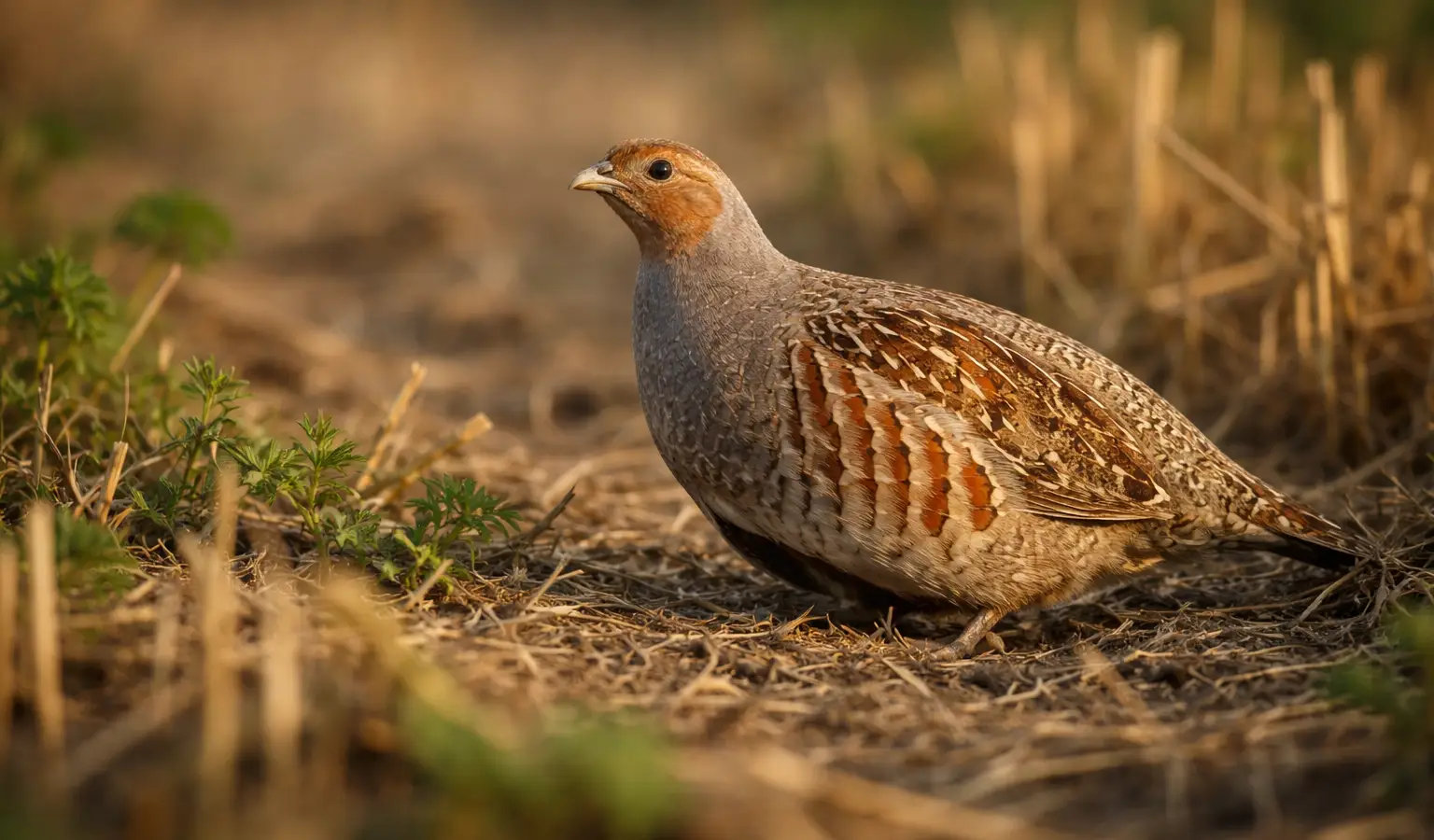
The Gray partridge is a compact, rounded game bird measuring roughly 30 to 35 cm in length and commonly weighing about 400 to 500 g. At a distance it appears gray-brown and finely patterned, a coloration that blends remarkably well with dry grass, stubble, bare soil, and field margins.
Field identification is based on a combination of shape and plumage. The bird has a small head, short tail, chestnut-toned face, pale throat, barred flanks, and a soft gray breast. Adults often show a warm brown horseshoe-shaped patch on the belly, although its visibility can vary and it may be less distinct in some birds, especially females. The upperparts are mottled brown, buff, and gray, giving excellent camouflage when the bird crouches. In flight, the wings appear rounded, the body looks stocky, and coveys often burst from cover with a sudden noisy takeoff before gliding low over the fields.
Juveniles are duller and less crisply marked than adults. Compared with the red-legged partridge, the Gray partridge looks more muted, more finely barred, and lacks the strong facial contrast and bright red bill and legs of that species.
Habitat and distribution
Habitat and distribution
Habitat
The preferred habitat of the Gray partridge is open agricultural country with a varied structure. It typically favors plains, rolling farmland, cereal-growing areas, mixed crop systems, and dry grasslands where feeding areas and escape cover lie close together. It is especially associated with landscapes that include field margins, hedgerows, grassy banks, fallows, stubble, beet fields, clover, and rough herbaceous strips.
This species generally avoids dense forest, heavily urbanized zones, and very wet habitats. It needs open sight lines for vigilance, but also enough low cover to hide nests, brood chicks, and shelter coveys in poor weather. Chick survival is often better in places with abundant insects and diverse vegetation structure. In simplified monocultures, habitat may still look open and suitable at first glance, yet prove poor if nesting cover is scarce or brood-rearing patches lack food and shelter.
Seasonally, habitat use can shift. During nesting, birds seek quiet grassy or weedy cover. After harvest, they may use stubbles and open feeding grounds more heavily, while in winter they often concentrate where seed food and sheltering cover remain available.
Distribution
Perdix perdix is native to much of Europe and parts of temperate Asia, and it has also been introduced in some regions outside its original range. In Europe, its current distribution is often patchy rather than continuous, especially where agricultural landscapes have changed substantially. It remains most closely tied to open lowland farmland, and local abundance can vary greatly from one district to another.
In some countries or regions, the Gray partridge is still locally established under active habitat management. Elsewhere it has declined or become scarce, particularly in intensively farmed areas with limited nesting cover and low insect availability for chicks. Because populations can respond strongly to weather, predation, and farming practices, presence on a map does not always mean the species is common in the field.
At a finer scale, distribution is often influenced by the quality of the farmland mosaic rather than by broad climate alone. Productive partridge ground usually combines food, cover, nesting sites, and relatively low disturbance during the breeding season.
Lifestyle
Lifestyle and behaviour
Diet
The Gray partridge is an omnivore with a diet that changes by season and age class. Adults feed heavily on seeds, green plant material, small fruits, shoots, grain, and various agricultural food resources found in stubbles, field edges, and weedy patches. Weed seeds can be particularly important outside the breeding season.
Protein-rich invertebrates become especially important in spring and summer. Chicks depend strongly on insects during their first weeks of life, feeding on small beetles, caterpillars, ants, larvae, and other invertebrates found in herb-rich margins and lightly managed cover. This is one reason why brood habitat quality is so critical: even where nesting succeeds, low insect availability can limit chick survival.
In autumn and winter, family groups often shift back toward a more seed-based diet, taking spilled grain, seeds from wild plants, and other readily available food in open farmland. Feeding usually takes place on the ground, often during calmer parts of the day when birds can combine foraging with vigilance.
Behaviour
The Gray partridge is primarily a ground-dwelling bird, cautious and alert in open terrain. It spends much of the day walking, feeding, dust-bathing, resting in cover, or moving between feeding and shelter areas. Its plumage and behavior both favor concealment: when danger approaches, birds often freeze or crouch before deciding whether to run or flush.
When flushed, the takeoff is abrupt and loud, with powerful wingbeats and a fast low flight over the fields. Birds often rise as a covey, then split or angle away toward safer cover. Compared with species that rely on long flights, Gray partridges usually make relatively short, direct escape flights and quickly seek the ground again.
Daily activity often peaks in the morning and late afternoon, though local weather, disturbance, and season can alter patterns. In hot or exposed conditions they may remain tucked into cover for longer periods. During winter and under hunting or predator pressure, they can become even more wary and difficult to approach.
Social structure
The Gray partridge is well known for its family coveys. After breeding, adults and young commonly remain together in small groups through late summer, autumn, and much of winter. These coveys help with collective vigilance in open country, allowing birds to feed while maintaining awareness of predators.
Outside the breeding season, social organization is therefore fairly cohesive, with birds often moving, feeding, and flushing together. By late winter or early spring, these groups tend to break up as pairs form or re-establish breeding territories. During this period, social behavior shifts from flock cohesion to pair bonding and territorial spacing.
Although not highly territorial in the same way as some songbirds, breeding pairs usually need access to a defined area containing nesting cover, feeding sites, and brood habitat. Local density depends heavily on habitat quality and survival from the previous year.
Migration
The Gray partridge is generally considered a resident or sedentary species rather than a true migrant. Most birds remain within the same broad agricultural landscape throughout the year, shifting locally between nesting cover, feeding grounds, winter shelter, and roosting areas.
Even so, local movement is important. After harvest, during severe weather, or under strong disturbance, coveys may redistribute within a territory or move to fields offering better food and cover. Young birds can also disperse from their natal area, contributing to population spread or recolonization where habitat is suitable.
These movements are typically short to moderate in scale compared with migratory birds. For field observers and managers, this means local habitat continuity matters greatly: populations often depend less on migration corridors than on year-round access to workable farmland structure.
Reproduction
Reproduction
The breeding cycle of the Gray partridge begins in spring, when winter coveys disperse and pairs settle into suitable nesting areas. The nest is typically a shallow scrape on the ground, hidden in grass, field margins, cereal edges, roadside vegetation, or other low cover. Concealment is essential because eggs and incubating females are vulnerable to agricultural operations and predators.
Clutch size can be notably large for a ground bird, although actual brood success varies widely with weather and habitat quality. Incubation lasts about 23 days. Newly hatched chicks are precocial: they leave the nest quickly, follow the adults, and begin feeding for themselves, taking mostly insects in their earliest life stages.
Breeding success depends on a delicate chain of factors, including nest survival, warm and dry conditions during early chick development, and access to insect-rich brood habitat. Cold wet weather can be especially damaging to chicks. In favorable landscapes, reproduction can support stable or recovering populations; in poor years, recruitment may be weak despite normal nesting effort.
Field signs
Field signs
Gray partridges can be hard to see directly, but several field signs may reveal their presence. The most useful clues are often ground tracks, droppings, feathers, and flush patterns. Tracks are small three-toed prints left in soft soil, dust, light mud, or along field edges and farm tracks. Because the birds spend so much time walking, repeated passages can create subtle runways through low vegetation.
Droppings are usually found where coveys feed, rest, or roost, especially near hedgerow bottoms, grassy margins, stubble edges, and sheltered patches. Feathers may be found at dusting spots, roosting areas, or where a predator has taken a bird. In winter, snow or damp ground can make covey movements easier to read, sometimes showing multiple birds traveling together between feeding and shelter cover.
Observation is often best at first or last light in calm weather. A sudden explosive flush from underfoot in open farmland, followed by a compact group flying low and fast, is one of the clearest practical signs of Gray partridge presence.
Ecology and relationships
Ecology and relationships
Ecological role
The Gray partridge plays several roles in open farmland ecosystems. As a consumer of seeds, shoots, and small fruits, it contributes modestly to seed dispersal and participates in the transfer of plant resources through the food web. By feeding heavily on insects during the breeding season, especially when chicks are growing, it also contributes to insect regulation at a local scale.
The species itself is an important prey item for predators such as foxes and birds of prey, particularly where cover is limited. Nest predation can be significant, and chick survival may be shaped by both predator communities and weather. Because the Gray partridge responds strongly to vegetation structure, insect availability, and farming intensity, it is often seen as a useful indicator species for the ecological condition of agricultural landscapes.
Where partridges thrive, farmland usually retains a degree of biological diversity and structural complexity that benefits many other birds, pollinators, and small mammals as well.
Human relationships
The relationship between people and the Gray partridge is closely tied to farming, wildlife management, and small game hunting. Historically, it was one of the emblematic birds of traditional European farmland, valued both as quarry and as a familiar resident of open country. Today, that relationship is more complex because the species often depends on deliberate habitat stewardship to maintain healthy numbers.
For farmers and land managers, the Gray partridge can reflect the biological quality of the agricultural matrix. Unsprayed margins, winter cover, nesting strips, and diverse rotations tend to favor the species. For birdwatchers, it remains a sought-after observation, though often difficult to detect unless birds flush or call. For hunters, the species carries a reputation for fast, testing shooting when flushed in front, but responsible harvest depends on realistic appraisal of local abundance and annual productivity.
The bird is also edible, which has long contributed to its cultural importance as a traditional game species. However, modern relevance increasingly rests on balancing sporting interest with habitat restoration, prudent quotas, and close monitoring of wild populations.
Legal framework and management
Legal framework and management
Legal status
The Gray partridge is commonly subject to regional hunting regulation rather than a single universal rule. In some areas it may be legally hunted under quotas, seasonal limits, management plans, or permit systems; in others, hunting may be restricted or suspended if local populations are weak. The broad indication given here is that the species may be hunted under quotas, but exact rules vary significantly by country, region, and annual population status.
A typical hunting period in some European contexts runs from September to February, though open seasons and methods differ locally. Releases, wild-stock management, bag limits, protected zones, and reporting obligations may also apply. Because the conservation status of Gray partridge populations can differ sharply from one landscape to another, legal harvest often depends on local monitoring.
Anyone observing, managing, or hunting this species should therefore consult current national and local regulations before the season. This is especially important where wild and released birds may coexist or where conservation measures have been introduced to support recovery.
Management tips
Good Gray partridge management starts with reading the habitat as a year-round system rather than focusing only on one season. Productive ground usually combines nesting cover, brood habitat rich in insects, autumn feeding areas, and winter shelter within a relatively small radius. Large uniform blocks of crop with few margins may look expansive but often function poorly for partridges.
- Protect nesting cover: Maintain grassy margins, beetle banks, rough strips, and undisturbed edge habitat through the breeding period where possible.
- Improve brood habitat: Diverse herb-rich vegetation and reduced insecticide pressure can help sustain the invertebrate food chicks need.
- Retain winter resources: Leave stubbles, seed-bearing cover, and sheltered patches to support coveys in colder months.
- Monitor realistically: Covey counts, spring pair counts, and brood observations are more useful than assumptions based on occasional sightings.
- Be cautious with harvest: Where numbers are low or reproduction has been poor, restraint or no harvest may be the soundest decision.
For hunters and field naturalists alike, the best partridge landscapes are often those with structure, diversity, and moderate disturbance. Careful observation of edge habitat, tracks, covey behavior, and predator pressure can reveal a great deal about whether a population is merely present or genuinely secure.
Fun facts
Fun facts
The Gray partridge is sometimes called the English partridge, although its range extends far beyond Britain. Its scientific name, Perdix perdix, reflects its long recognition as a distinct Old World partridge.
One of its most remarkable traits is how well it disappears in plain sight. A covey can crouch in sparse cover that seems far too thin to hide anything, yet remain invisible until the last second. This reliance on camouflage is one reason the species can be difficult to census accurately.
Gray partridge chicks are unusually dependent on insects in early life, so a bird often associated with grain fields is, in practice, also deeply tied to healthy invertebrate communities. In that sense, a successful partridge brood says as much about the small life of a field margin as it does about the birds themselves.