
Mallard
Anas platyrhynchos
A very common wetland duck across Europe, widely hunted and observed.
Type
Bird
Lifespan
10 years
Hunting season
September – February
Edible
Yes
Fact sheet
Mallard
Scientific name
Anas platyrhynchos
Type
Bird
Meat quality
Tasty and firm meat
Edible
Yes
Lifespan
10 years
Incubation
28 days
Size
50-65 cm
Weight
0.8-1.5 kg
Diet
Omnivore: seeds, aquatic plants, insects
Status
Huntable under local regulations
Hunting season
September – February
Breeding season
3 / 4 / 5
Lifestyle and behaviour
Behaviour : Flies in groups, rarely dives, highly alert
Social structure : Loose flocks, pairs during breeding season
Migration : Partially migratory
Habitat
- River
- Lake
Natural predators
- Fox
- Birds of prey
Hunting methods
- Hunting hide
- Driven pass
Health risks
- Avian parasites
- Avian influenza
Ecosystem role
- Aquatic invertebrate regulation
Signs of presence
- Footprints
- Feathers
Introduction
General description
The Mallard, Anas platyrhynchos, is the familiar wild duck of ponds, rivers, marshes, lakes, gravel pits, flooded meadows, and many urban wetlands across Europe and far beyond. It is one of the best-known waterfowl species because it is both highly visible and highly adaptable. For many people, the Mallard is the duck by which all other ducks are judged: a medium-sized dabbling duck that feeds mainly at the surface or by tipping up rather than diving.
Ecologically, the Mallard is an important wetland bird that links aquatic and terrestrial food webs. It consumes seeds, plant material, aquatic invertebrates, and small animal prey, helping shape wetland vegetation use and invertebrate dynamics. Because it thrives in both natural and human-influenced landscapes, it is also a useful indicator of how well water bodies provide cover, feeding opportunities, and secure breeding habitat.
In wildlife observation and hunting culture, the Mallard holds a central place. It is widely watched, photographed, and studied, and in many regions it is also one of the most important huntable waterfowl species under regulated seasons and local rules. Its abundance should not lead to oversimplification, however: local populations can be influenced by habitat quality, breeding success, winter severity, disturbance pressure, releases of domestic-type birds in some areas, and broader wetland management.
Morphology
Morphology
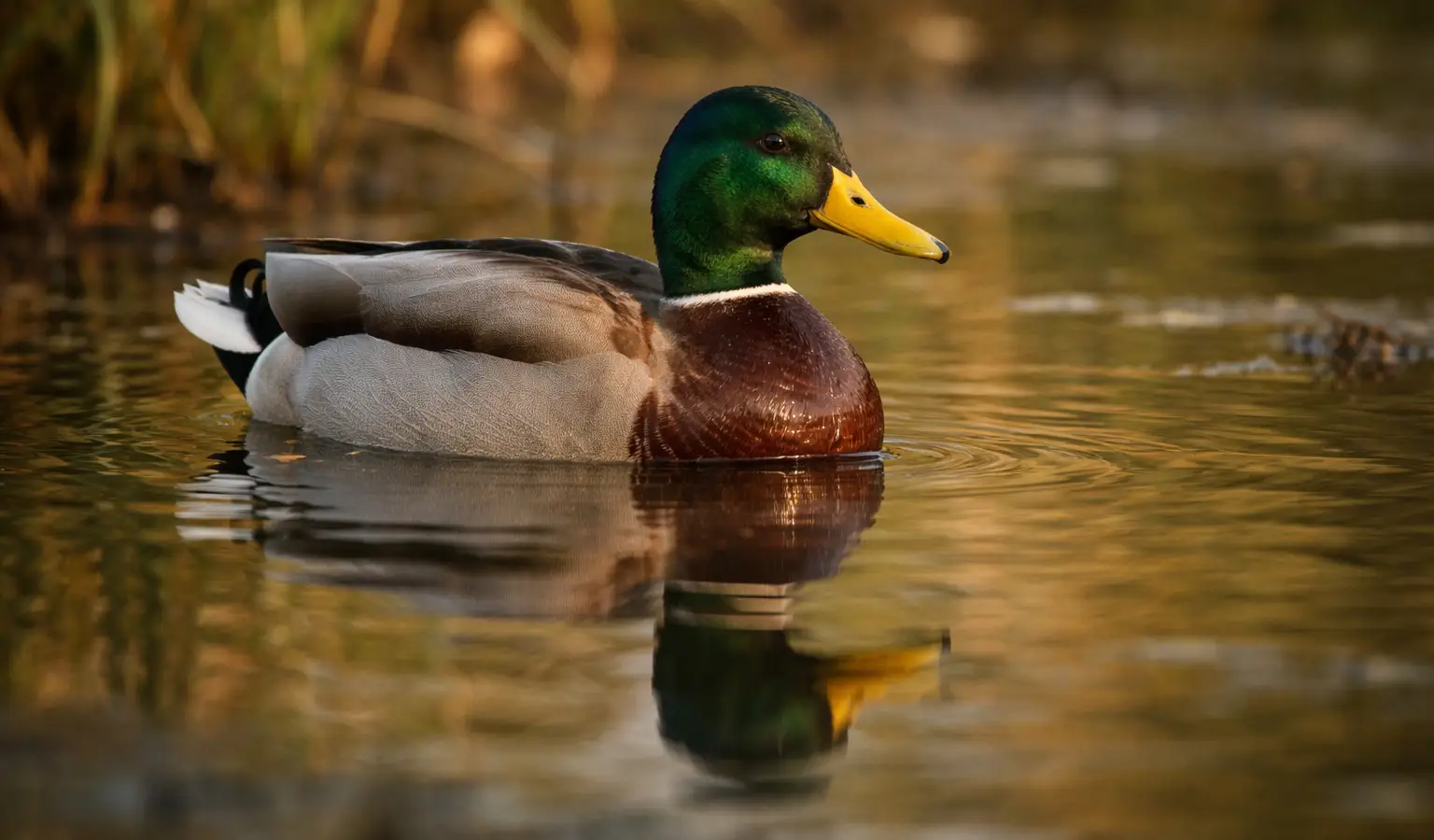
The Mallard is a medium to fairly large dabbling duck, usually around 50 to 65 cm in length and often weighing roughly 0.8 to 1.5 kg, though body mass varies by sex, season, and condition. The species shows clear sexual dimorphism in classic plumage. The adult drake is easily recognized by its glossy green head, narrow white neck ring, chestnut breast, pale gray body, darker rear, and curled black tail feathers. The bill is typically yellow to yellow-green, and the legs are orange.
The hen is much more cryptic, with a mottled brown body that provides strong camouflage in reeds, grass, and nesting cover. She usually shows an orange-brown bill with darker markings. In both sexes, one of the best field marks in flight or at rest is the blue-violet speculum on the wing bordered by white. Juveniles resemble the female but often appear less sharply patterned.
For field identification, structure matters as much as color. Mallards have a fairly broad body, a rounded head, and a classic shallow-water duck silhouette. They sit relatively high on the water compared with diving ducks. Their takeoff is explosive and mostly direct from the water surface without the long running start seen in some larger waterfowl.
Habitat and distribution
Habitat and distribution
Habitat
The Mallard uses a very broad range of wetland habitats, which is one reason for its success. Typical habitat includes rivers, lakes, ponds, reservoirs, marsh edges, oxbows, drainage channels, flooded fields, wet meadows, and sheltered estuaries or brackish areas where local conditions allow. It generally favors shallow water with access to banks, mud margins, emergent vegetation, and nearby resting cover.
Its preferred biotope often combines three key elements: food-rich shallow water, secure loafing zones, and concealed nesting cover nearby. Reedy margins, willow-lined channels, flooded grassland, and quiet backwaters are especially attractive. During the breeding season, females may nest some distance from open water if suitable grass, scrub, hedge bases, or rough cover are available.
The species is also notably tolerant of human presence. It frequently occupies urban parks, village ponds, managed lakes, and agricultural landscapes, although heavily disturbed sites may still reduce breeding success or alter daily movement patterns. In hunting and field ecology terms, the best habitat is usually not just open water, but water with edge structure, feeding shallows, and limited repeated disturbance.
Distribution
Anas platyrhynchos has an exceptionally wide natural distribution across much of the Northern Hemisphere. In Europe, the Mallard is widespread and often common from lowland farmland wetlands to river valleys, lakes, and coastal marshes. It also occurs across large parts of Asia and North America, with many regional populations showing different degrees of residency, migration, and winter concentration.
Within Europe, occurrence can shift with season. Breeding birds are broadly distributed wherever suitable wetlands and nesting cover exist, while winter numbers may increase in milder western and southern areas as birds move away from frozen waters farther north or east. In some regions, local abundance is also influenced by released birds, urban feeding, or mixed populations containing domestic ancestry.
At a local scale, Mallard presence is often patchy rather than evenly spread. A river system with sheltered bends, a lake with vegetated margins, or a wet agricultural basin may hold high numbers, while apparently similar but heavily disturbed water may hold fewer birds. This makes habitat reading important for both observation and management.
Lifestyle
Lifestyle and behaviour
Diet
The Mallard is an omnivore with a flexible diet centered on what is seasonally available in shallow water and along wetland edges. Common foods include seeds, grains, aquatic plants, pondweed fragments, shoots, roots, sedges, and a wide variety of invertebrates such as insects, larvae, snails, worms, and small crustaceans. It usually feeds by dabbling, sieving, grazing, or tipping up rather than by true diving.
Seasonal variation matters. In autumn and winter, Mallards often make heavier use of seeds, waste grain, acorns where available, and energy-rich plant material. In spring and early summer, animal prey may become more important, especially for breeding females that need protein and minerals for egg production. Ducklings depend heavily on insects and other small invertebrates during early growth.
Feeding behavior changes with water level, disturbance, and surrounding land use. Birds may forage in shallow margins at dawn and dusk, move into flooded fields, or use quiet backwaters during the day if pressure is high. In managed landscapes, food availability can be boosted by seasonal flooding, aquatic plant growth, and the maintenance of muddy edges and productive shallows.
Behaviour
The Mallard is generally active from early morning through evening, with feeding peaks often strongest at dawn, dusk, and sometimes at night where disturbance is frequent. It is a highly alert species that quickly learns patterns of danger. On pressured wetlands, birds may spend daylight hours loafing in safer water and shift feeding movements to quieter periods.
In escape behavior, the species usually flushes strongly and directly from the water or shoreline. It is a fast, powerful flyer, often leaving in small groups or larger flocks with rapid wingbeats and characteristic calls. Unlike diving ducks, Mallards rarely evade danger by prolonged diving. Their main response is vigilance, swimming away from threat, using vegetated edges, or taking immediate flight.
Daily behavior often includes a rhythm of feeding, preening, loafing, social interaction, and short local movements between roosting and feeding areas. They can become surprisingly cautious on heavily visited or hunted waters, circling before landing and favoring sheltered approach routes, while birds in parks may appear far tamer. This contrast shows how adaptable Mallard behavior is to local pressure.
Social structure
The Mallard typically forms loose flocks outside the breeding season, though flock size varies widely with habitat, weather, food concentration, and disturbance. On productive winter waters, birds may gather in significant numbers, while on smaller rivers or ponds they are often seen in scattered groups using several nearby resting and feeding areas.
During the breeding season, social structure shifts toward pair-based behavior. Pairs form well before nesting in many cases, and males may remain associated with females during the pre-laying period. Once incubation begins, the female becomes more solitary and secretive, while drakes often gather in male groups and later move toward molting areas.
This flexible social organization is one reason the species occupies such a wide range of wetlands. It can function as dispersed territorial breeders in spring, then as mobile flocking birds during molt, autumn dispersal, and winter concentration. For observers, social structure often reveals the season: pairs in spring, broods in summer, and mixed flocks in colder months.
Migration
The Mallard is partially migratory, meaning some populations are largely resident while others move seasonally over short or long distances. In milder regions with open water year-round, many birds remain close to breeding or wintering sites. In colder climates, freezing conditions can trigger marked movements toward ice-free rivers, lakes, estuaries, and lowland wetlands.
Migration and dispersal are therefore closely tied to weather, food access, and local habitat conditions rather than a single uniform pattern. Autumn movement may build gradually as northern and continental birds arrive, while severe winter cold can cause sudden redistribution. Spring movement is often less obvious because returning birds spread quickly across breeding habitat.
At a local scale, many so-called resident Mallards still make regular daily or seasonal movements between roosts, feeding grounds, and safer refuge water. For field observers and managers, these routine movements can matter as much as true long-distance migration.
Reproduction
Reproduction
The breeding cycle of the Mallard usually begins in spring, though exact timing varies with latitude, climate, water levels, and local habitat conditions. Nest sites are often hidden in tall grass, reeds, rough field margins, under bushes, in hedgerows, or other sheltered cover close to water, but sometimes surprisingly far from it. The female builds a shallow nest lined with plant material and down.
Clutch size is commonly moderate to large for a duck, though it varies. Incubation is carried out by the female alone and lasts about 28 days in many cases. The drake does not take part in incubation and often leaves the nesting area once the female is fully committed to the nest. Eggs and ducklings are vulnerable to many predators, including foxes, corvids, mustelids, and birds of prey under some circumstances.
Ducklings are precocial: they leave the nest soon after hatching and begin feeding themselves under the hen's guidance. Brood survival depends heavily on weather, food availability, cover from predators, and the quality of shallow nursery habitat rich in invertebrates. In favorable conditions, reproduction can be good, but cold wet periods, repeated disturbance, poor brood cover, or predation pressure may reduce recruitment substantially.
Field signs
Field signs
Mallard field signs are often easy to find around quiet wetland edges, muddy banks, sandbars, and shallow inlets. The most common signs include footprints, feathers, droppings, feeding disturbance in soft mud, and flattened loafing spots in shoreline vegetation. Tracks typically show three forward-pointing webbed toes; on soft ground, the rear toe may leave little or no mark.
Feathers found near resting sites, predation points, or molting areas can be especially useful. The iridescent blue-violet wing speculum bordered with white is one of the best identification clues. During the molt period, waters used by groups of birds may accumulate noticeable feather sign along sheltered margins.
Other signs are behavioral rather than physical. Repeated splash marks at dawn, tipping birds in shallow weed beds, muddy dabbling zones, and regular flight lines between roost water and feeding areas can all indicate Mallard use. On pressured sites, signs may be concentrated in secluded corners rather than obvious open banks.
Ecology and relationships
Ecology and relationships
Ecological role
The Mallard plays a broad ecological role in wetlands as a consumer of both plant and animal material. By feeding on seeds, aquatic vegetation, and invertebrates, it participates in nutrient transfer between shallow water, mud margins, grassland edges, and nearby terrestrial resting sites. Its feeding can influence plant use patterns and contributes to the regulation of some aquatic invertebrate populations.
It also serves as prey, directly or indirectly, for predators such as foxes and birds of prey, while eggs and ducklings support a wider predator community. Because Mallards use many habitat types and respond quickly to water conditions, they are part of the dynamic fabric of wetland seasonal change.
In practical ecology, the species can be both resilient and informative. Strong Mallard presence may indicate productive edge habitat and reliable food resources, but unusually high densities in artificial settings can also reflect heavy supplementation, urban feeding, or altered ecological balance. Context is important when interpreting numbers.
Human relationships
The Mallard has a long and complex relationship with people. It is one of the most familiar ducks to birdwatchers, anglers, rural communities, and hunters. Many people first learn wetland wildlife through observing Mallards on ponds and rivers, while in traditional hunting culture it is often regarded as a key quarry species where populations and regulations allow.
Its relationship with agriculture is mixed and usually modest. Mallards may use flooded stubble, cereal margins, and wet grasslands as feeding habitat, which can benefit winter survival, but they can also congregate around highly modified landscapes where natural behavior becomes less predictable. Urban feeding by the public may habituate some birds and alter movement or diet quality.
From a management perspective, Mallards also raise practical questions about wetland restoration, disturbance control, disease surveillance, and the effects of captive-reared or domestic-origin birds on wild populations. Where hunting occurs, ethical practice depends on species identification, legal compliance, retrieval capacity, and maintaining habitat conditions that support genuinely wild waterfowl behavior.
The species is also edible and valued as game in many regions, but meat quality can vary with habitat, diet, age, and handling. As with all wild birds intended for consumption, hygiene, local health guidance, and awareness of disease risks remain important.
Legal framework and management
Legal framework and management
Legal status
In many European contexts, the Mallard is a huntable waterfowl species under local regulations, but legal status always depends on national law, regional rules, migratory bird frameworks, protected area restrictions, and the current open season. The season provided here, September to February, fits many hunting calendars, but exact dates and methods vary and should always be checked locally before any field activity.
Legal conditions may also govern permitted hunting methods, shooting hours, decoy use, transport, reporting obligations, and restrictions in nature reserves or refuge zones. Some jurisdictions may impose temporary changes in response to severe weather, disease concerns, conservation measures, or site-specific management objectives.
Because the Mallard can hybridize with domestic ducks and because released birds may occur in some areas, management and legal interpretation can become more complex than the species' commonness suggests. The safest general rule is that current local legislation and competent wildlife authorities take precedence over any general overview.
Management tips
Good Mallard management starts with habitat quality rather than with numbers alone. The species responds well to wetlands that combine shallow feeding water, vegetated margins, secure loafing areas, and nearby nesting cover. On rivers and lakes, productive sections are often the quieter edges, backwaters, reed-fringed bays, and seasonally flooded margins rather than the deepest open water.
For observation, census, or practical field reading, pay attention to wind shelter, first-light movement, evening return flights, and the contrast between feeding water and refuge water. Birds under repeated disturbance often shift quickly to less accessible zones or become more nocturnal in feeding activity. One useful principle is to read pressure as carefully as habitat.
Where local management is possible, priorities often include maintaining shallow wetland structure, avoiding excessive disturbance during breeding and severe winter periods, protecting brood habitat rich in invertebrates, and preserving rough edge cover for nesting. Disease awareness also matters: because Mallards can be exposed to avian parasites and avian influenza, unusual mortality or abnormal behavior should be treated cautiously and reported according to local wildlife health guidance.
- Maintain shallow, food-rich margins and muddy edges.
- Preserve nesting cover near water but not only directly on the bank.
- Limit repeated disturbance in key resting and brood-rearing areas.
- Monitor seasonal movement rather than assuming birds are permanently resident.
- Verify all hunting rules locally before the season.
Fun facts
Fun facts
- The Mallard is the wild ancestor of most domestic ducks, which explains why domestic-looking ducks can still resemble Anas platyrhynchos in shape or behavior.
- The familiar loud quack is most strongly associated with the female; males often give softer, raspier calls.
- Mallards are dabbling ducks, not diving ducks, so they usually feed by tipping forward with the tail angled up rather than submerging completely.
- The blue wing patch, called the speculum, is one of the quickest ways to confirm identification in flight.
- Although common, Mallards are not simple birds: local behavior can change dramatically depending on hunting pressure, urban habituation, weather, and wetland condition.