
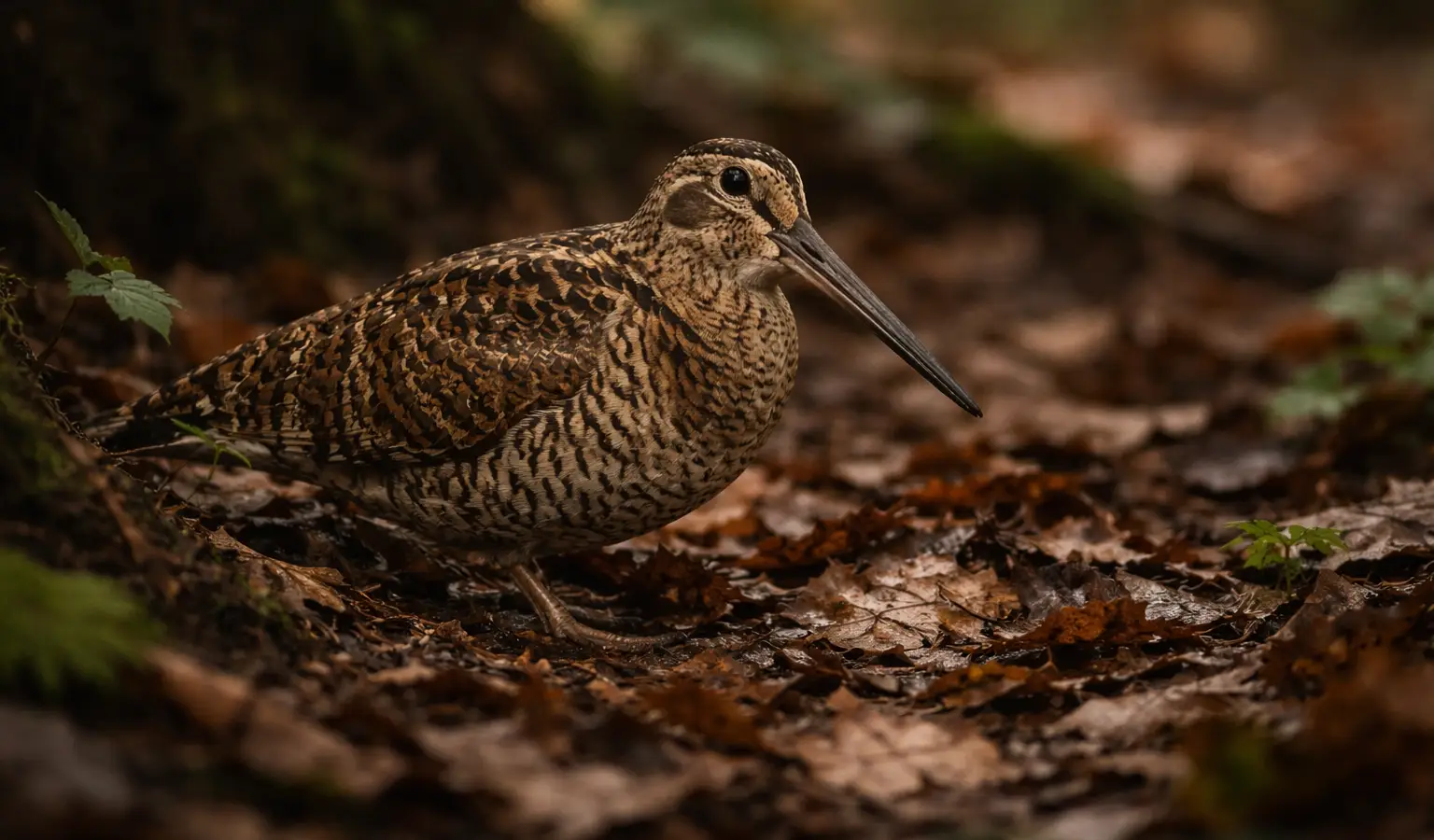
Eurasian woodcock
Scolopax rusticola
A secretive woodland bird, highly prized by hunters.
Type
Bird
Lifespan
7 years
Hunting season
October – February
Edible
Yes
Fact sheet
Eurasian woodcock
Scientific name
Scolopax rusticola
Type
Bird
Meat quality
Exceptional meat
Edible
Yes
Lifespan
7 years
Incubation
21 days
Size
33-38 cm
Weight
250-350 g
Diet
Invertebrates: worms, insects, larvae
Status
Huntable under national regulations
Hunting season
October – February
Breeding season
3 / 4 / 5
Lifestyle and behaviour
Behaviour : Secretive, crepuscular, zigzag flight
Social structure : Solitary
Migration : Partial migrant
Habitat
- Forest
- Wetland
Natural predators
- Fox
- Birds of prey
Hunting methods
- Pointing dog
Health risks
- Avian parasites
Ecosystem role
- Earthworm regulation
Introduction
General description
The Eurasian woodcock, Scolopax rusticola, is a compact, long-billed wading bird that has adapted remarkably well to life in woodland cover. Although it belongs to a group often associated with open marshes and shorelines, this species is primarily a bird of damp forests, shaded thickets, rides, and edges where soft soils allow it to feed. Its cryptic plumage, dusk-and-dawn activity, and tendency to freeze rather than flush make it one of the most elusive migratory birds in Europe and western Asia.
For wildlife observers, the woodcock is a species of atmosphere as much as appearance: most encounters happen in dim light, in quiet woodland, or during seasonal movements. For hunters, it has long held a special place because of its secrecy, erratic flight, and strong association with well-managed forest habitat. In ecological terms, the Eurasian woodcock is also an indicator of moist, structurally diverse woodland mosaics that support rich invertebrate life, especially earthworms.
Depending on region, the species may be resident, partially migratory, or mainly present in autumn and winter as northern birds move south and west. This seasonal turnover is important for understanding local abundance. A woodcock seen in one forest in summer may belong to a breeding population, while winter birds in the same general area may come from far beyond the local landscape.
Morphology
Morphology
The Eurasian woodcock is a medium-sized woodland wader, typically around 33 to 38 cm in length and often weighing roughly 250 to 350 g, though body mass can vary with season and migration condition. It has a rounded body, short legs, broad wings, and a very long, straight bill designed for probing soft ground. The overall impression is stocky rather than elegant, especially when seen on the forest floor.
Its plumage is one of its most effective field identification features. The upperparts are richly mottled in chestnut, rufous, brown, buff, and black, creating exceptional camouflage among dead leaves, moss, and shaded woodland litter. The underparts are paler but still barred and patterned. The head shows distinct dark transverse bars, and the large eyes are set high and far back on the skull, giving the bird an unusually wide field of vision.
In flight, the woodcock appears broad-winged and compact, with a relatively short tail and dangling bill profile. When flushed at close range, it often bursts away low through the trees in a fast, twisting, zigzag line. This sudden, erratic departure is one of the classic field marks of the species.
Habitat and distribution
Habitat and distribution
Habitat
Woodcock habitat is defined less by a single vegetation type than by a combination of cover, moisture, and access to feeding ground. The species is strongly associated with forest and wet woodland environments, especially deciduous or mixed woods with soft, damp soils rich in earthworms and other invertebrates. It often favors mosaics that include coppice, young regrowth, shrub layers, rides, glades, stream margins, alder carr, damp hollows, and sheltered woodland edges.
During the day, Eurasian woodcock typically seek dense cover where they can remain concealed. Bramble patches, holly, hazel, conifer shelter belts, and thick understorey can all serve as daytime refuge. At night, birds may move out to feed in more open but still moist places such as grassy rides, wet meadows near woodland, pasture margins, marshy clearings, and soft agricultural fields where probing is easier.
Habitat quality is often highest where there is structural diversity: mature trees for shelter, broken canopy, humid microclimates, little disturbance in key resting areas, and nearby feeding zones. Prolonged drought, intensive drainage, over-simplified forestry, or repeated disturbance can reduce habitat suitability even where tree cover remains extensive.
Distribution
Scolopax rusticola has a broad Palearctic distribution. It breeds across much of Europe and extends eastward through temperate and boreal Asia. The species is especially tied to wooded landscapes within this range, but local density varies widely according to forest structure, soil moisture, climate, and seasonal conditions.
In western and southern Europe, the Eurasian woodcock may occur as a breeding bird, winter visitor, or both. In northern and eastern parts of its range, many populations are more strongly migratory, moving south or west as cold weather hardens the ground and limits access to soil invertebrates. As a result, winter concentrations can develop in milder Atlantic and Mediterranean-influenced regions, although annual patterns depend heavily on frost, snow cover, and broader weather systems.
At local scale, occurrence is often patchy rather than evenly distributed. Some forests hold woodcock regularly year after year, while nearby blocks of woodland with drier soils or poorer feeding conditions may support few birds. For field observation or management, understanding the distribution of damp feeding areas is often just as important as mapping woodland extent.
Lifestyle
Lifestyle and behaviour
Diet
The Eurasian woodcock feeds mainly on invertebrates, with earthworms often considered a key food source where soils are suitable. It also takes insects, beetles, larvae, spiders, and other small soil- or litter-dwelling organisms. Its long sensitive bill is highly specialized for probing into soft ground, allowing it to locate prey beneath the surface rather than only picking from the top layer.
Diet can shift with season, temperature, and ground conditions. In moist autumn and winter periods, birds may feed heavily in worm-rich soils in rides, meadows, and wet field edges. During drier spells or when the upper soil hardens, they may rely more on litter invertebrates, larvae, or sheltered damp pockets within woodland. In breeding season, adults also forage in secluded forest habitats where prey availability remains reliable.
Because feeding success depends so much on penetrable soil, weather has a direct effect on body condition, local movement, and habitat use. Frost, prolonged snow cover, or severe drought can reduce access to prey and may force birds to shift feeding areas or move more widely in search of workable ground.
Behaviour
The Eurasian woodcock is best described as secretive, crepuscular, and highly alert. It spends much of the day motionless in dense cover, relying on camouflage and stillness to avoid detection. When approached too closely, it may hold until the last moment before erupting from cover with a startling burst of wings. The flight is typically low, fast, and irregular, weaving through trees in a characteristic zigzag that makes visual tracking difficult.
Most feeding activity occurs from dusk into the night and again around dawn. Birds often leave sheltered roosting spots to probe in softer or more open ground under low light. During the breeding season, males perform a conspicuous display flight known in many regions as roding, patrolling along woodland edges, rides, and clearings at dusk and dawn while giving distinctive calls.
Outside breeding display periods, woodcock behavior is usually discreet. Individuals may shift between day cover and night feeding grounds with considerable regularity, but they remain hard to observe unless weather, migration pressure, or disturbance concentrates them. Their combination of camouflage, nocturnal movement, and abrupt escape behavior explains why the species can be locally present yet rarely seen.
Social structure
The Eurasian woodcock is generally a solitary bird for much of the year. Individuals typically feed, rest, and move alone, especially outside periods of migration or breeding display. This solitary structure is one reason why densities can be underestimated in suitable habitat.
During migration or in productive wintering areas, several birds may occur within the same woodland complex or feeding landscape, but they do not form cohesive flocks in the way many open-country birds do. Local concentrations usually reflect shared use of good habitat rather than true social grouping.
In the breeding season, the social system becomes more structured around male display and female nesting. Males may patrol overlapping routes during roding flights, while females select concealed nesting sites on the ground. Even then, direct social contact remains limited compared with more colonial or openly territorial bird species.
Migration
The Eurasian woodcock is a partial migrant, and migration strategy varies greatly across its range. Some populations are largely sedentary in mild regions, while others undertake substantial seasonal movements from northern and eastern breeding areas toward western and southern wintering grounds.
Autumn passage often becomes more noticeable as temperatures drop and soils begin to harden farther north. Birds may arrive in waves influenced by frost, wind direction, and broader weather fronts. In milder winters, some individuals remain relatively stable in favored areas, while harsh cold can trigger further displacement into more oceanic or southern zones.
Spring migration returns birds toward breeding grounds, but its visibility depends on local geography and habitat. Because woodcock often move at night and settle discreetly by day, migration can be easy to miss without favorable conditions or regular field observation. For practical purposes, local numbers in autumn and winter should not be assumed to represent only local breeding birds.
Reproduction
Reproduction
Breeding usually takes place in spring, although timing varies with latitude and local climate. The female Eurasian woodcock nests on the ground in well-concealed woodland cover, often among leaf litter, low vegetation, or young growth where camouflage is effective. The nest itself is a shallow depression rather than an elaborate structure.
A typical clutch is often around four eggs, though variation can occur. Incubation lasts about 21 days and is carried out mainly by the female. Chicks hatch covered in down and are precocial, leaving the nest soon after hatching while remaining dependent on the female for guidance and protection. As with many ground-nesting birds, breeding success can be strongly influenced by predation, disturbance, and weather during nesting and brood-rearing.
Males are best known during the breeding season for their roding display flights at dusk and dawn, which function in mate location and territorial advertisement. Productive breeding habitat generally combines concealed nesting cover, a calm disturbance regime, and nearby damp feeding areas suitable for both adults and growing chicks.
Field signs
Field signs
Field signs of Eurasian woodcock are often subtle. In woodland, the best clues are usually indirect: repeated use of quiet, shaded resting cover; probing holes in soft ground; and flush locations in dense thicket edges, rides, or damp hollows. Feeding marks may appear as small bill probes in muddy or moist soil, though these are not always easy to distinguish from the activity of other ground-feeding animals.
At dawn or dusk in spring, the most reliable sign can be auditory rather than visual. Males on roding flights give characteristic calls while moving along woodland corridors, edges, and clearings. Learning this display behavior is often more effective for detection than searching the forest floor for signs.
Tracks may occasionally be found in soft mud or wet margins near feeding areas, showing relatively small bird prints with forward toes, but they are seldom as diagnostic or commonly used as signs from larger game species. Feathers at a flush point, droppings in favored roosting spots, or repeated evening movement between cover and nearby wet feeding ground can also help reveal presence, though none should be interpreted in isolation.
Ecology and relationships
Ecology and relationships
Ecological role
Within forest and wet woodland ecosystems, the Eurasian woodcock plays a meaningful role as a consumer of soil and litter invertebrates. By feeding heavily on earthworms, insects, and larvae, it contributes to the regulation of invertebrate communities and reflects the biological productivity of moist woodland soils.
The species is also part of the prey base for predators such as foxes and birds of prey, especially when nests, chicks, or weakened birds are exposed. Because it depends on soft ground, cover, and low-disturbance mosaics, the woodcock can function as a useful indicator of habitat quality in managed forests and mixed rural landscapes.
Its ecological importance goes beyond direct feeding relationships. The presence of woodcock often signals a landscape where hydrology, woodland structure, and invertebrate abundance remain sufficiently intact to support specialized wildlife that does not thrive in simplified or heavily dried-out habitat.
Human relationships
The Eurasian woodcock has long-standing cultural importance in many parts of Europe, especially in relation to woodland hunting traditions, seasonal migration, and the use of pointing dogs. It is widely regarded as a challenging quarry because of its camouflage, elusive habits, and explosive, twisting flush through cover. At the same time, it is also appreciated by birdwatchers, foresters, and naturalists for its roding displays and its association with healthy, varied woodland.
The species is edible and has historically been valued as game, but modern understanding increasingly emphasizes the need for restraint, good habitat knowledge, and attention to local population status. In some regions, hunting pressure, habitat change, and climatic stress may all interact, making simple assumptions about abundance unreliable.
Outside hunting contexts, woodcock generally have limited direct conflict with farming or forestry. However, drainage, loss of damp woodland structure, heavy mechanized disturbance, and fragmented habitat can reduce local suitability. As a result, the bird often benefits from land-use practices that maintain moist soils, dense understorey patches, and a balanced mosaic between cover and feeding areas.
Legal framework and management
Legal framework and management
Legal status
The Eurasian woodcock is huntable under national regulations in some countries, but legal status, season dates, bag limits, and permitted methods vary significantly by jurisdiction. The hunt season provided here, October to February, fits a common autumn-winter framework in parts of its range, yet readers should always verify current local law before any field activity.
Because the species is migratory and population trends can differ between breeding and wintering areas, management often requires a cautious approach. Some countries or regions apply additional restrictions related to severe weather, protected areas, migration timing, or conservation concerns. International agreements on migratory birds may also influence national policy.
From a practical and ethical standpoint, legal compliance should be paired with attention to habitat condition, local abundance, and disturbance levels. Where uncertainty exists, the most responsible approach is to consult official wildlife authorities or current hunting regulations rather than relying on generalized summaries.
Management tips
Good woodcock management starts with reading the habitat rather than focusing only on seasonal presence. The most useful landscapes usually combine damp woodland soils, sheltered daytime cover, quiet thickets, and accessible night feeding areas such as rides, glades, wet meadows, or soft pasture near forest edges. If any one of these elements is missing, holding capacity may decline.
- Maintain or restore moist woodland structure where possible; drainage and prolonged drying generally reduce feeding value.
- Preserve a mosaic of dense cover and open feeding corridors rather than uniform, closed, heavily shaded forest.
- Limit disturbance in key resting zones, especially during cold spells or breeding periods.
- Use caution when interpreting annual abundance, because migration, frost, and regional weather can cause sharp short-term changes.
- Where hunting occurs, conservative pressure and close attention to local regulations are important, particularly during severe weather or low-availability years.
For observers, scouting at dusk around woodland edges and rides is often more productive than walking deep cover in daylight. For land managers, small-scale habitat diversity, humid soils, and low-disturbance refuge areas are usually more valuable than large but simplified blocks of forest.
Fun facts
Fun facts
- The Eurasian woodcock is a woodland bird from a group better known for wetlands and shorelines, making it an unusual ecological specialist.
- Its eyes sit unusually far back and high on the head, helping it monitor surroundings while its bill is pointed down into the soil.
- The bill is not just long; it is also highly sensitive, allowing the bird to detect prey underground by touch.
- Its spring display flight, often called roding, is one of the classic dusk spectacles of European woodland wildlife.
- Although many people think of it as rare because they seldom see one, woodcock can be locally regular yet remain almost invisible in daytime cover.
- Its camouflage is so effective that a resting bird among dead leaves can be overlooked at only a few steps' distance.