
Common quail
Coturnix coturnix
A small farmland gamebird known for long-distance migration.
Type
Bird
Lifespan
2 years
Hunting season
August – September
Edible
Yes
Fact sheet
Common quail
Scientific name
Coturnix coturnix
Type
Bird
Meat quality
Fine and tender meat
Edible
Yes
Lifespan
2 years
Incubation
16 days
Size
16-18 cm
Weight
90-120 g
Diet
Seeds and insects
Status
Huntable under regulations
Hunting season
August – September
Breeding season
5 / 6 / 7
Lifestyle and behaviour
Behaviour : Migratory, secretive, small groups
Social structure : Solitary or small groups
Migration : Long-distance migratory
Habitat
- Forest
- Grassland
- Farmland
Natural predators
- Fox
- Birds of prey
- Mustelids
Hunting methods
- Pointing dog
Health risks
- Avian parasites
- Stress-related disease
Ecosystem role
- Insect regulation
Introduction
General description
The Common quail, Coturnix coturnix, is one of the smallest gamebirds regularly encountered in open country across parts of Europe, North Africa, and western Asia. Despite its modest size, it is remarkable for being a true long-distance migrant, moving between breeding areas in temperate farmland and grassland and wintering zones farther south. It is a discreet bird, far more often heard than seen, and many people know it first by its repetitive territorial call rising from cereal fields, meadows, or rough herbaceous cover.
In ecological terms, the Common quail is closely tied to low, dense vegetation that offers concealment, nesting cover, and access to seeds and invertebrates. Its presence often reflects the quality of open agricultural mosaics, especially landscapes that retain field margins, fallows, hay meadows, and mixed cropping. Because it feeds heavily on insects as well as plant material, it links farmland plant communities with invertebrate dynamics and serves as prey for a range of predators.
For hunters and wildlife observers, the species has a special place because it combines strong migratory behavior with highly secretive habits on the ground. It can be legally hunted in some countries under strict seasonal frameworks, often during late summer migration, but populations may fluctuate from year to year depending on breeding success, weather, harvest timing, and broader agricultural pressure. As a result, the Common quail is best understood not simply as a small gamebird, but as a sensitive indicator of open-country habitat quality and seasonal movement.
Morphology
Morphology
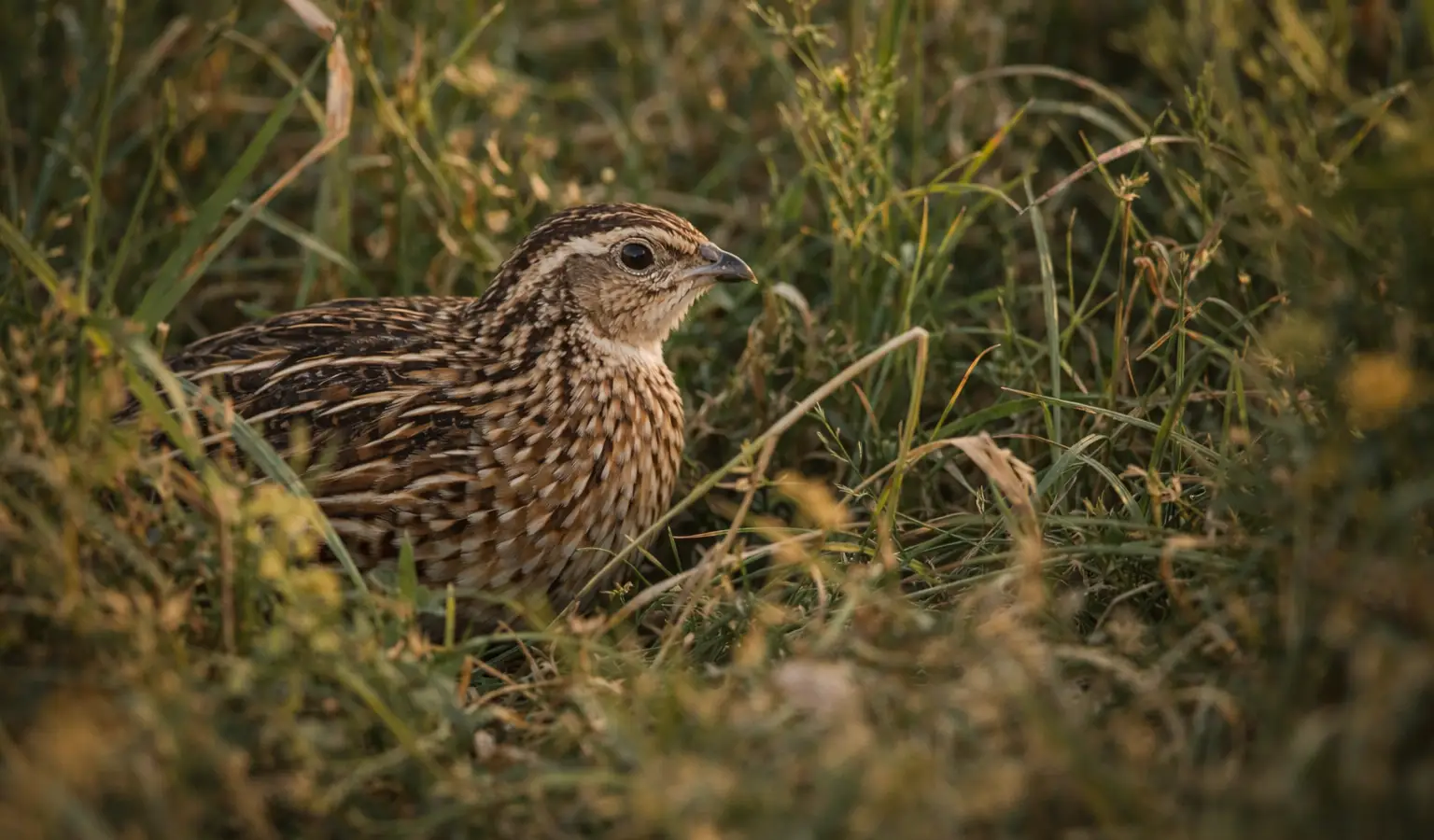
The Common quail is a compact, short-tailed, round-bodied bird measuring roughly 16 to 18 cm in length and often weighing about 90 to 120 g, though body mass can vary with sex, season, and migratory condition. It has a cryptic overall appearance, dominated by warm brown, buff, cream, and black streaking that blends effectively into dry grasses, cereal stems, and field-edge vegetation.
Field identification usually depends on shape, plumage pattern, and behavior rather than prolonged open views. The bird appears low-slung with relatively short wings at rest, a small head, and a finely patterned back. Underparts are buff to pale with variable mottling. The crown and upperparts show strong longitudinal striping, while the face often carries pale and dark contrasts that can be subtle in the field. Males may show a more defined throat pattern, often with darker markings, whereas females tend to look slightly plainer and more softly marked.
When flushed, the Common quail erupts suddenly from underfoot or from close cover, flying low and fast with rapid wingbeats before dropping back into vegetation. That explosive, short-range flush is often one of the best practical identification clues in farmland habitat.
Habitat and distribution
Habitat and distribution
Habitat
Coturnix coturnix favors open habitats with dense but not overly woody ground cover. The classic breeding biotope includes cereal fields, hay meadows, rough grassland, herb-rich margins, lucerne or clover stands, and mixed farmland where birds can move concealed at ground level. Although it is associated mainly with farmland and grassland, it may also use open patches near woodland edges where low cover is abundant and disturbance remains limited.
Good quail habitat usually combines several structural features: nesting cover, nearby feeding areas rich in seeds and invertebrates, and enough continuity of vegetation to allow movement without repeated exposure. The species tends to avoid heavily urbanized landscapes, very intensively managed areas with little ground cover, and places where mowing or harvest leaves no refuge during the breeding season.
Seasonally, habitat use can shift. During migration, Common quail may pause in a wider range of open country, including stubble, late-summer fields, rough fallows, and coastal lowlands. Moisture, vegetation height, harvest date, and insect abundance often influence local presence more than any single crop type.
Distribution
The Common quail has a broad Palearctic range, breeding across much of Europe, parts of North Africa, and western to central Asia. Distribution is not always uniform from year to year, because this species responds quickly to weather, habitat conditions, and agricultural timing. In some regions it can be locally common in suitable years, while in others it appears scattered and irregular.
Across its breeding range, occurrence is strongly tied to open cultivated plains, grassland mosaics, and lowland agricultural systems, though it may also use upland valleys or plateaus where vegetation structure is favorable. Its presence can be especially variable near the margins of its range or in areas where farmland intensification has reduced nesting and feeding cover.
During migration, the species passes through southern Europe and the Mediterranean basin, with some birds crossing large barriers including sea stretches. Wintering areas lie mainly farther south, especially in warmer parts of Africa, although exact winter distribution can vary and is not always easy to assess because of the bird's secretive habits.
Lifestyle
Lifestyle and behaviour
Diet
The diet of the Common quail is mixed and opportunistic, centered on seeds and insects. Adult birds commonly take small seeds from grasses, cereals, and various annual plants, along with shoots or other soft plant material when available. Invertebrates are also important, particularly beetles, ants, caterpillars, grasshoppers, and other small arthropods found in field margins, weedy strips, and herbaceous cover.
Season matters. During the breeding period, protein-rich animal food becomes especially important, above all for chicks, which depend heavily on abundant invertebrates during early growth. Landscapes that look suitable structurally but are poor in insect life may therefore offer lower breeding value than more botanically diverse areas with richer ground fauna.
In late summer and during migration, quail often make greater use of seeds in harvested or ripening fields, stubbles, and rough cover. This flexibility helps the species exploit changing farmland conditions, but it also means that pesticide pressure, simplified crop systems, and the loss of weedy feeding zones can reduce food availability.
Behaviour
The Common quail is a largely ground-dwelling, secretive bird with a strong tendency to remain hidden in cover. It is often most active at dawn, dusk, and at night, although it may feed intermittently through the day where disturbance is low. Vocal males are easiest to detect during the breeding season, when their repeated calling carries across meadows and cereal fields even if the bird itself remains invisible.
Its escape behavior is characteristic: rather than flying immediately, a quail often runs through vegetation, crouches, or freezes, relying on camouflage until pressure becomes too close. When finally flushed, it rises abruptly and flies low, fast, and direct, usually for a relatively short distance before dropping back into cover. This makes observation brief and challenging.
During migration, behavior can become more concentrated around temporary stopover habitats that offer food and shelter. Weather influences movement strongly, and birds may appear suddenly in good numbers after favorable migratory conditions. In heavily disturbed areas, quail become even more difficult to detect, spending long periods motionless in dense vegetation.
Social structure
Common quail are generally solitary or found in small groups, especially outside peak breeding display. During the nesting season, males advertise from calling stations within suitable cover, and birds are often spaced loosely across the habitat rather than forming visible flocks. Because they remain concealed, local density can be underestimated.
Pair bonds are not conspicuous in the way they are in some larger gamebirds, and social organization is relatively simple and discreet. Females handle most of the nesting and brood care, while males are more often detected through calling and territorial spacing. After breeding, and particularly during migration or in productive feeding areas, birds may occur in small loose aggregations where cover and food are concentrated.
Even in these situations, the species does not usually present a strongly cohesive flocking structure on the ground. Spacing is influenced by vegetation, disturbance, and season, with birds often acting independently within the same patchwork of habitat.
Migration
The Common quail is a long-distance migratory species, unusual among small gamebirds in the scale of its seasonal movement. Many breeding birds move north in spring to occupy temperate farmland and grassland, then depart southward in late summer and autumn toward wintering areas in warmer regions, particularly in Africa. This migratory strategy helps the species exploit seasonal food peaks and breeding cover across a wide geographic range.
Migration timing can vary with latitude, weather, and annual breeding conditions. In parts of western and southern Europe, movements are often especially noticeable from August to September, when birds may use harvested farmland, stubble, rough grass, and other temporary stopover habitats. Some individuals travel over sea crossings, which highlights the species' surprising endurance despite its small size and apparently short-winged profile on the ground.
Not all local patterns are identical. Some regions may experience irregular passage, and in milder climates a small number of birds may linger longer depending on conditions. Overall, however, migration is a defining feature of the species' biology and a key reason why annual abundance can seem highly changeable.
Reproduction
Reproduction
The breeding cycle of Coturnix coturnix is linked to spring and summer conditions in open farmland and grassland. Nesting usually takes place on the ground, concealed in dense herbaceous cover, often under grasses, cereals, or rough vegetation that hides the bird from view and provides some protection from weather and predators. The nest itself is a shallow scrape lined with fine plant material.
Clutch size can be relatively large for such a small bird, often around several eggs and sometimes more under favorable conditions, though exact numbers vary. Incubation lasts about 16 days, carried out mainly by the female. After hatching, chicks are precocial: they leave the nest quickly, follow the female, and begin feeding themselves on very small invertebrates and other suitable food items. Early brood survival depends heavily on weather, insect abundance, and the availability of undisturbed cover.
Breeding success can fluctuate sharply between years. Mechanical mowing, early harvest, repeated disturbance, predation, and prolonged wet or cold periods may all reduce nesting output. In favorable landscapes with staggered cutting, diverse vegetation structure, and good food supply, the species may attempt replacement nesting or extended breeding activity, especially where seasonal conditions remain suitable.
Field signs
Field signs
Field signs of the Common quail are subtle, and direct visual evidence on the ground is often limited compared with larger gamebirds. The most useful sign is usually sound: in the breeding season, calling males reveal their presence from within dense cover long before a bird is seen. Repeated listening at dawn, dusk, or on calm evenings is often the best detection method.
On the ground, observers may sometimes find narrow runways through grass or cereal stems where birds have moved repeatedly under cover. Small resting depressions or lightly flattened spots can occur in dense vegetation, though these are difficult to attribute with certainty unless a bird is flushed nearby. Droppings are small and inconspicuous, and tracks are usually too slight and ephemeral to be reliable except on very soft soil.
In practical fieldwork, the strongest clues are often behavioral rather than physical: a sudden close flush from low cover, repeated calling from the same patch, or concentration of birds in rough stubble and field margins during migration. Because signs are easily overlooked, patient listening and careful habitat reading are more useful than searching for obvious tracks.
Ecology and relationships
Ecology and relationships
Ecological role
The Common quail plays several useful roles in open-country ecosystems. As a consumer of both seeds and invertebrates, it participates in the transfer of energy between plant communities, arthropod populations, and higher predators. Its feeding on insects contributes, at least locally, to insect regulation, while seed consumption links it to the structure and productivity of farmland vegetation.
It is also an important prey item for a range of predators, including foxes, mustelids, and birds of prey. Because it nests on the ground and depends on dense herbaceous cover, it sits within a broader guild of farmland wildlife sensitive to mowing schedules, harvest pressure, pesticide use, and habitat simplification. In that sense, quail can act as a useful indicator species for the ecological quality of low-intensity or structurally diverse agricultural landscapes.
Where quail remain present, they often signal that the habitat still offers a combination of cover, food, and seasonal continuity. Where they decline, the causes often overlap with wider biodiversity pressures affecting pollinators, insects, and other farmland birds.
Human relationships
The relationship between people and the Common quail is shaped mainly by agriculture, hunting, and wildlife observation. Farmers influence quail habitat more than almost any other group, because crop choice, mowing date, field margins, pesticide regimes, and the retention of rough cover directly affect nesting success and feeding conditions. Traditional mixed farming systems often provide more suitable structure than highly simplified, intensively treated landscapes.
For birdwatchers and field naturalists, the species is especially valued as a bird of sound rather than spectacle. Many encounters begin with the male's distinctive call carrying over summer fields at dawn or dusk. Seeing one well is harder than hearing one, and that elusiveness adds to the species' reputation among observers.
In hunting culture, the Common quail has long been recognized as a small migratory gamebird, often associated with late-summer passage and work with a pointing dog. Ethical hunting relevance depends on moderation, legal compliance, local population status, and careful reading of annual conditions. Because the species can be vulnerable to habitat pressure and variable recruitment, responsible management and restraint are central to maintaining a sustainable relationship with this bird. The species is also edible, which explains part of its historical game interest, though modern use is generally framed by regulation and conservation awareness.
Legal framework and management
Legal framework and management
Legal status
The Common quail is generally considered huntable under regulations in some parts of its range, but legal status varies significantly by country, region, and annual management decisions. Open seasons, bag limits, methods, and protected periods may differ, and in some areas additional restrictions may apply because of migration timing, conservation concerns, or local population trends.
Where hunting is allowed, the season often coincides with late summer or early autumn passage; in the context provided here, a typical period is August to September. However, anyone seeking current legal guidance should always verify the latest national and local regulations before hunting, transporting, or possessing birds.
Beyond hunting law, the species may also be affected by broader wildlife legislation relating to migratory birds, habitat protection, and animal welfare. Because annual abundance can fluctuate and because identification issues may arise in some contexts, a cautious, up-to-date legal check is essential.
Management tips
Good Common quail management begins with maintaining a structurally diverse open landscape. The species benefits from mosaics of cereals, meadows, fallows, uncultivated strips, and insect-rich field margins that provide nesting cover, movement corridors, and feeding habitat through the breeding season and migration period. Uniform fields harvested all at once tend to reduce refuge availability dramatically.
- Retain or create grassy and herb-rich margins along fields.
- Favor staggered mowing or harvest where possible to leave escape and nesting cover.
- Encourage plant diversity and reduce unnecessary pesticide pressure to support chick food in the form of insects.
- Monitor calling males in spring and early summer as a practical index of local use.
- During migration, pay attention to rough stubble, late-cut plots, and low-disturbance stopover habitat.
- If hunting is permitted, adapt pressure to local abundance and avoid concentrating effort where numbers are clearly weak.
For observers, managers, and hunters alike, the key is caution. Annual numbers can change quickly, and habitat that looked productive one year may become poor after early cutting, drought, or heavy disturbance. Small adjustments in field management can make a disproportionate difference for such a secretive ground-nesting migrant.
Fun facts
Fun facts
- Despite being a tiny gamebird, the Common quail is capable of impressive long-distance migration, including crossings that seem surprising for such a compact bird.
- Many people hear Common quail far more often than they ever see them; the species is a classic example of a bird identified first by voice and only second by sight.
- Its camouflage is so effective that a bird may stay motionless until the last moment, then burst from underfoot with startling speed.
- Unlike some larger gamebirds that are strongly associated with resident populations, Coturnix coturnix is defined by movement, seasonal turnover, and year-to-year variability.
- Typical lifespan in the wild is often short, and many individuals face high risks from migration, predation, weather, and agricultural disturbance.