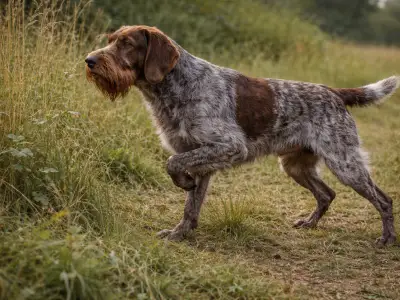
Irish Setter
The Irish Setter is an elegant and athletic pointing dog, famous for its deep red coat and fast, wide-ranging search style. Specialised in bird hunting, it stands out for its excellent nose, endurance and enthusiasm in the field. Affectionate, playful and highly sociable, it also makes a wonderful family companion when given plenty of exercise, space and consistent training.

Life expectancy
11 – 15 years
Price
1000 – 1800 €
Monthly budget
75 €
Size
Large
Profile
Irish Setter
Origin
Ireland
Year of origin
1700
Developed by
Irish hunters and breeders
Size
Large
Coat type
Long coat
Owner profile
Active owner
Hypoallergenic
No
Litter size
7
Life expectancy
11 – 15 years
Price
1000 – 1800 €
Female
- Height : 55 – 62 cm
- Weight : 24 – 29 kg
Male
- Height : 58 – 67 cm
- Weight : 27 – 32 kg
Temperament & abilities
Affectionate
5/5
Calm
2/5
Independent
3/5
Intelligence
4/5
Obedience
3/5
Hunting instinct
5/5
Energy level
5/5
Good with children
5/5
Dog-friendly
5/5
Friendly with strangers
5/5
Hunting profile
Stamina
5/5
Hunting drive
5/5
Independence
4/5
Trainability
3/5
Beginner-friendly
3/5
Family compatibility
5/5
Feather game
5/5
Fur game
1/5
Underground work
1/5
Water work
3/5
These indicators help compare breeds and choose the right one for your hunting style.
Game & abilities
Estimated ability level by game type.
Budget
Purchase price
1000 – 1800 €
The price may vary depending on the breeder, bloodline, and region.
Average monthly cost
75 €
Estimated average: food, healthcare, accessories, and grooming.
A stylish pointing dog with range, stamina, and real demands in training and daily life
Is the Irish Setter a good hunting dog?
The Irish Setter can be a very capable hunting dog, especially for upland bird work, but it is not the easiest pointing breed for every handler. At its best, Irish Setter hunting combines speed, ground-covering range, an expressive search pattern, and a good nose with the kind of stamina needed for long days in the field. The trade-off is clear: this is usually a high-energy dog that needs thoughtful training, regular work, and a handler who can shape enthusiasm into practical field control.
In hunting terms, the breed is generally most coherent as a pointing dog for hunters who value style, pace, and broad searching over close, naturally conservative handling. Many Irish Setters work with animation and momentum, covering terrain freely and showing strong desire to hunt. In open country, moorland, stubble, light cover, and other spaces where a wider search pattern is useful, that can be a real strength. Depending on the line and training, some individuals also retrieve willingly, but the breed is better known for finding and pointing game than for being a specialist retriever.
Handling matters. An Irish Setter often responds best to calm, consistent education rather than heavy pressure, and recall is a point that usually deserves serious early work. Trainability is often good when the dog is engaged and the program is clear, but maturity may come a little unevenly in some individuals, especially if excitement regularly outruns concentration. Hunters comparing breeds should know that this is not usually the most naturally compact or low-maintenance field partner. It tends to suit people who enjoy developing a dog, not simply managing one.
- Strengths: nose, stamina, fast search, stylish pointing, enthusiasm in open terrain
- Demands: high energy level, regular exercise, steady recall work, patient handling
- Best fit: active hunters who want a versatile pointing dog with flair and can provide daily outlet beyond the season
- Less ideal for: owners wanting a calm, low-drive pet or a naturally close-working hunting companion
In everyday life, the same qualities that make the Irish Setter attractive in the field shape family life too. This is often an affectionate, sociable dog with a lively temperament, but it rarely thrives on a short walk and a quiet corner. A well-bred, well-trained Irish Setter can balance hunting ability with pleasant home life, yet that balance usually depends on enough exercise, structure, and mental work. For the right owner, it is a charismatic hunting dog and companion; for the wrong household, its energy and sensitivity may feel like too much dog.
Fast ground coverage
The Irish Setter is widely valued for the way it covers country with speed and reach. In open ground, moorland, and big fields, this can be a real advantage for locating birds that sit far apart. That same range can feel like a lot of dog for beginners, so the breed often suits hunters who enjoy handling an energetic, forward-moving pointing dog.
Bird-finding nose
A good Irish Setter often shows a capable nose on upland game, especially when allowed to hunt with rhythm rather than being over-controlled. Scenting ability still depends on breeding, conditions, and training, but the breed has a long reputation as a serious bird dog. It tends to shine most when it can search actively and use wind well.
Stylish pointing instinct
One of the breed’s most appreciated field traits is its expressive style on point. Many Irish Setters combine intensity with elegance, which is part of why they remain admired as gundogs as well as companions. For the practical hunter, that style matters less than reliability, but a dog that points cleanly and holds with composure is easier to read and work around.
Endurance for long days
The Irish Setter is not usually chosen for short, casual outings alone. It is a high-energy pointing breed that can keep going for long periods when fit and properly conditioned. This stamina is useful during full hunting days and repeated outings, but it also means daily life typically requires substantial exercise, not just a quick walk around the block.
Responsive, but sensitive
Irish Setters are often trainable in capable hands, though they are not always the easiest fit for heavy-handed handling. Many respond better to clear, consistent guidance and regular field exposure than to pressure. For hunters who enjoy building cooperation and maintaining enthusiasm, this sensitivity can become a strength. For inconsistent handlers, it can make progress less predictable.
Best for upland bird work
This breed is most closely associated with pointing and finding game birds rather than highly specialized retrieving tasks. Some individuals will retrieve willingly, but the Irish Setter is typically chosen for quartering, locating scent, and establishing point on upland birds. It tends to suit hunters who want an athletic bird dog with range, animation, and a strong desire to hunt ahead.
Who the Irish Setter suits best
The Irish Setter tends to suit a hunter or active owner who genuinely enjoys living with a fast, athletic, people-oriented dog rather than simply owning one. In the field, it is often a strong match for walked-up shooting, mixed upland days, and handlers who appreciate range, style, and enthusiasm but are also willing to shape steadiness and recall through regular training. At home, it usually fits best with households that like long outings, mental stimulation, and a sociable dog that wants to be involved in daily life.
It is usually less suitable for very sedentary homes, owners wanting a naturally low-maintenance hunting companion, or people who are away for long hours every day. Some Irish Setters can be sensitive, exuberant, and slow to mature mentally, so they often do better with patient, consistent handling than with harsh correction. If you want a calm apartment dog, a highly independent kennel-only gundog, or a breed that is easy to exercise in brief sessions, this may be a poor match. If you want an elegant pointing dog with energy, warmth, and real hunting potential, it can be a rewarding fit in the right hands.
From Irish bird dog to fast, stylish modern gundog
Origins of the Irish Setter and how they shaped the breed
The Irish Setter was developed in Ireland as a bird dog built to cover ground, locate game birds, and indicate their position for the hunter. Most historians agree that the breed emerged from a mix of older setting dogs, spaniel-type hunting dogs, and pointers, though the exact recipe is not fully documented. What is clear is the purpose behind the breeding: hunters wanted a dog with speed, reach, scenting ability, and a visible coat color that could be spotted at distance across fields, moorland, and rough country.
Early Irish setters were not always the deep mahogany red many people picture today. Red-and-white dogs existed, and coat color appears to have been refined over time as breeders selected for a more uniform look. Alongside appearance, they also selected for an energetic, free-running style of work. That history still helps explain the modern Irish Setter: an athletic, enthusiastic pointing dog that often works with animation and range, and that usually needs more exercise and handling than a casual owner expects from a glamorous show dog.
As the breed developed through the nineteenth century, two broad emphases became more visible in some lines: dogs bred mainly for field performance and dogs bred more strongly for the show ring. The divide is not always absolute, and individual dogs vary, but it matters for anyone considering the breed today. A field-bred Irish Setter may be especially driven, lighter in build, and better suited to active hunting or demanding dog sports, while a show-bred dog may still be energetic but somewhat different in pace, range, and day-to-day intensity.
This background is useful because it connects the breed’s past directly to present-day life. The Irish Setter was shaped to hunt in partnership, not simply to stroll at heel or settle all day with little stimulation. In the right home, that often translates into a cheerful, affectionate companion with a playful nature and a strong desire to be involved. In the wrong home, the same history can show up as restlessness, distracted behavior, or hard-to-manage exuberance. For hunters and active families, the breed’s origin explains both its appeal and its demands: beauty, speed, sociability, and style, paired with real exercise needs and thoughtful training.
Irish sporting roots
The Irish Setter developed in Ireland as a fast, wide-ranging bird dog used on open ground. Early breeders selected for scenting ability, style, and stamina, shaping a dog that could cover country efficiently while remaining biddable enough to work with the gun. Modern lines can vary, but the breed’s image is still closely tied to elegant movement and upland hunting.
A pointing dog with range
In the field, the Irish Setter is generally valued for speed, enthusiasm, and a flowing search pattern. Many work with an animated, forward style that suits hunters who enjoy active ground coverage. Depending on breeding and training, some dogs hunt quite big, so recall, patterning, and steadiness often matter as much as raw drive.
Warm nature, lively mind
This breed is often affectionate, social, and engaging at home, but it is rarely a low-maintenance personality. Irish Setters tend to stay playful for a long time and can be sensitive rather than hard-headed, which usually makes calm, consistent training more effective than pressure. They often thrive with people who enjoy interaction, routine, and plenty of outdoor activity.
Best fit for daily life
An Irish Setter usually does best with space to move, regular outings, and owners who genuinely want an active dog in their routine. A short walk around the block is seldom enough for long. This breed may suit sporting families, runners, and hunters better than very sedentary homes, especially if the dog comes from energetic working stock.
Coat and upkeep
The breed’s striking red coat is part of its appeal, but it brings regular grooming duties. Feathering on the ears, legs, chest, and tail can pick up burrs, mud, and tangles after exercise or a day in cover. Routine brushing, sensible coat maintenance, and checks after field work help keep the dog comfortable and presentable.
Who handles one well
The Irish Setter tends to suit patient handlers who appreciate enthusiasm and can channel it without dulling the dog’s spirit. It is often a better match for people willing to invest in training, outlets, and partnership than for those wanting an instantly easy dog. For the right owner, it can be both a stylish hunting companion and a cheerful family presence.
Practical answers on hunting ability, trainability, family life, exercise needs, and owner fit.
Irish Setter hunting and daily life FAQ
Is an Irish Setter a good hunting dog for beginners?
An Irish Setter can suit a beginner, but usually not one looking for an easy, low-maintenance first gundog. The breed often brings speed, range, enthusiasm, and a stylish pointing instinct, yet that same energy can make early training more demanding. A novice handler who enjoys consistent work, learns how to channel drive, and hunts regularly may do very well with one. For occasional hunters who want a naturally close-working, highly steady dog with minimal input, other pointing breeds may feel simpler. Bloodline and early education matter a great deal.
How much exercise does an Irish Setter really need outside the hunting season?
This is a high-energy sporting breed, and most Irish Setters need far more than a short walk around the block. In daily life, they usually do best with a mix of physical exercise, free running in safe areas, scent-based activities, and short training sessions that give the mind something to do. A dog that only receives basic leash walks may become restless, noisy, or hard to manage indoors. During the off-season, many owners maintain balance through field-style drills, retrieving games, canicross, hiking, or structured play. A settled house dog generally depends on an active routine.
Are Irish Setters easy to train for recall, steadiness, and field manners?
Irish Setters are usually intelligent and willing, but they are not always straightforward because excitement can overtake concentration. Recall and responsiveness often need careful, repetitive work from a young age, especially if the dog has plenty of speed and prey drive. Harsh handling is rarely helpful with a sensitive, lively setter; most respond better to calm consistency, clear structure, and well-timed rewards. Steadiness around birds can take time, and some individuals mature a little slowly in their self-control. With patient training, many become enjoyable field companions, but they are not typically a shortcut breed.
Can an Irish Setter live happily as a family dog if it also hunts?
Yes, many Irish Setters can combine family life and hunting life very well when their exercise and training needs are met. They are often affectionate, sociable dogs that enjoy being included in everyday routines rather than left alone for long stretches. In a home with children, their friendly nature can be a real asset, but their size and exuberance may be too much for very young kids unless manners are taught early. A hunting Irish Setter usually thrives in households that like outdoor activity and can maintain structure between field days. They tend to do best when they are both companion and working dog.
Is an Irish Setter suitable for apartment living or a small house?
An Irish Setter can live in a smaller home, but only if the owner is genuinely committed to daily outdoor activity and training. The key issue is not square footage alone but whether the dog has enough chances to run, use its nose, and decompress in a controlled way. In apartments, management becomes especially important because an underworked setter may struggle with boredom and impulsive behavior. Access to safe exercise areas, reliable routines, and good leash skills make a big difference. For very sedentary households, this breed is usually a difficult fit.
What kind of owner or hunter is the Irish Setter best suited to?
The Irish Setter generally suits an owner who enjoys an active dog, has time for regular training, and appreciates a lively, expressive temperament rather than a purely mechanical worker. As a hunting companion, it often fits people who like pointing dogs with pace, style, and enthusiasm on open ground, while accepting that polish may require patience. It is less suited to someone wanting a calm pet with modest exercise needs or a highly finished field dog with little development. Owners who value partnership, outdoor life, and daily involvement often get the most from the breed. Good breeder selection can strongly influence that experience.
Do Irish Setters get along with other dogs and pets?
Many Irish Setters are sociable with other dogs, and that outgoing nature can make them pleasant companions in active multi-dog homes. Still, excitement, youthfulness, and strong bird interest mean introductions and household rules should not be left to chance. With smaller pets, outcomes vary by individual, upbringing, and supervision, so careful management is sensible rather than assuming friendliness equals reliability. Early socialization helps, but it does not replace ongoing training and impulse control. In practical terms, this breed often does best with owners who are attentive and proactive rather than casual about boundaries.