
Quail
Colinus virginianus
A small game bird found in open habitats, locally hunted depending on country and region.
Type
Bird
Lifespan
6 years
Hunting season
September – December
Edible
Yes
Fact sheet
Quail
Scientific name
Colinus virginianus
Type
Bird
Meat quality
Tasty meat
Edible
Yes
Lifespan
6 years
Incubation
23 days
Size
25-30 cm
Weight
200-350 g
Diet
Omnivore: seeds, insects, small fruits
Status
Huntable depending on local rules
Hunting season
September – December
Breeding season
4 / 5 / 6
Lifestyle and behaviour
Behaviour : Flies in small groups, secretive, hides in fields
Social structure : Small groups
Migration : Partly migratory depending on climate
Habitat
- Forest
- Plains
- Farmland
Natural predators
- Fox
- Birds of prey
Hunting methods
- Shoot with dog in front
Health risks
- Avian parasites
Ecosystem role
- Seed dispersal
- Insect regulation
Signs of presence
- Ground tracks
- Feathers
- Calls
Introduction
General description
The quail described here, Colinus virginianus, is better known in North America as the northern bobwhite, a small ground-dwelling game bird of open country. It is closely associated with grasslands, weedy field edges, brushy cover, and mixed farmland landscapes where feeding areas, nesting cover, and escape shelter occur within short walking distance. Although often simply called quail in everyday use, this species has its own distinct ecology, voice, and management needs.
Bobwhite quail are valued both as wildlife and as small game. They are widely appreciated by birdwatchers for their characteristic calls and by hunters for classic pointing-dog upland hunting. At the same time, they are considered an important indicator of habitat quality in early-successional landscapes. Where plant diversity, insect abundance, and protective cover decline, local quail numbers often decline as well.
Because populations can respond strongly to weather, habitat structure, predation pressure, and agricultural practices, the status of quail is highly variable from one region to another. In some places they remain huntable and locally common; in others they are scarce and depend on active habitat restoration. Understanding Colinus virginianus therefore means looking not only at the bird itself, but also at the condition of the wider farmland and open-country ecosystem it inhabits.
Morphology
Morphology
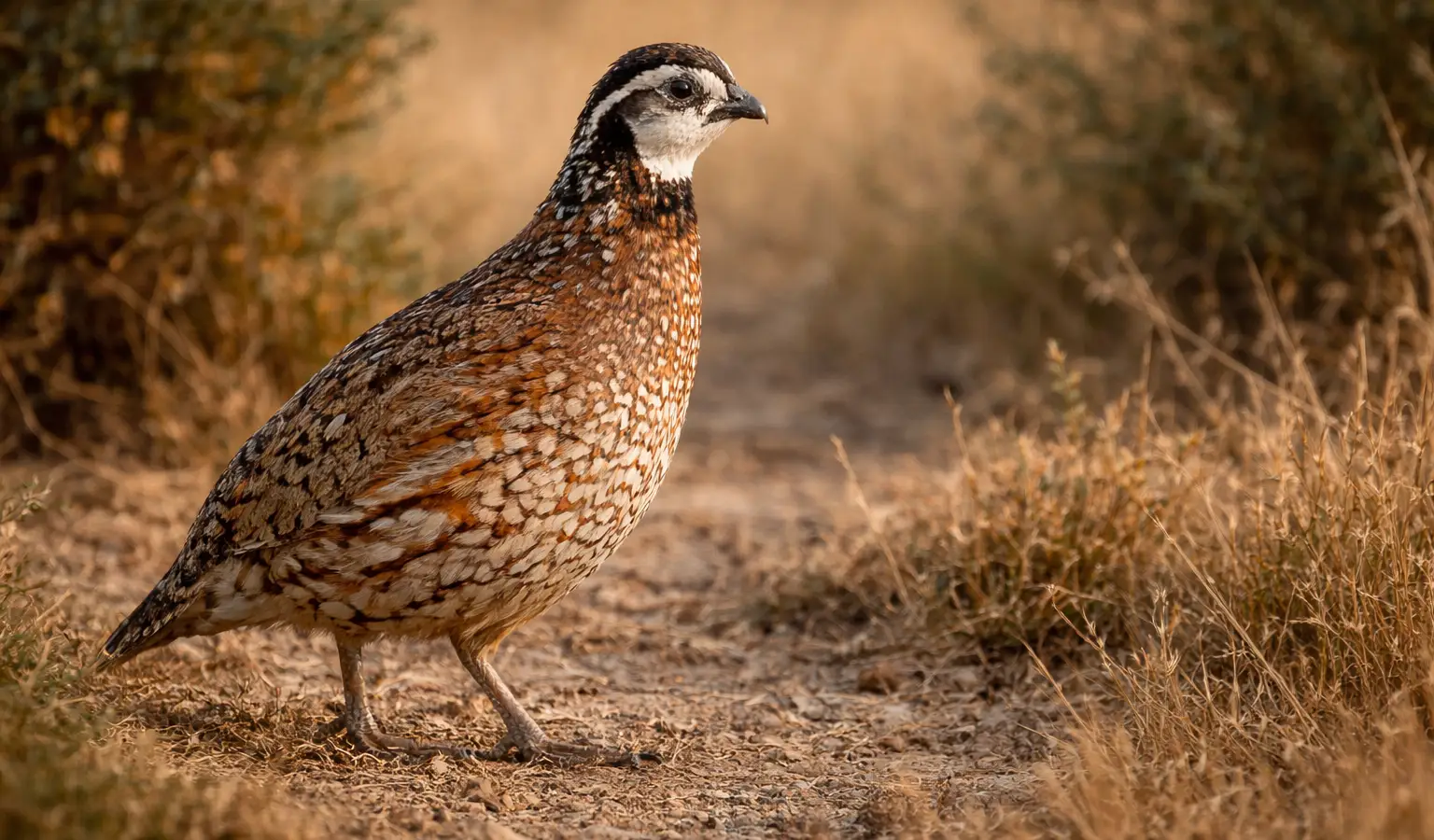
Colinus virginianus is a compact, short-tailed bird measuring roughly 25 to 30 cm in length and commonly weighing about 200 to 350 g, though local variation occurs. It has a rounded body, small head, short bill, and strong legs adapted for moving through ground vegetation. The overall appearance is mottled brown, buff, chestnut, gray, and black, giving excellent camouflage against soil, dead grass, and low brush.
Field identification often relies on the head pattern. Adult males typically show a bold white throat and white eyebrow stripe bordered with darker markings, while females usually show warmer buff or tan tones in those same areas. The back and flanks are intricately patterned, helping the bird disappear in stubble, weeds, and leaf litter. In flight, the quail bursts upward with rapid wingbeats and a short, explosive takeoff, then often drops quickly back into cover.
At close range, the species looks sturdy rather than delicate. The legs are suited to running, and quail often prefer to move on foot before flushing. This combination of cryptic plumage, low profile, and sudden flight is one of the most useful identification clues in the field.
Habitat and distribution
Habitat and distribution
Habitat
Quail prefer open habitats with a patchwork structure: grassy ground for feeding and brood movement, shrubby or brushy cover for concealment, and bare or lightly littered soil where chicks can move easily and find insects. Typical habitat includes plains, rough pasture, field borders, hedgerows, fallow strips, young forest edges, and diversified farmland. They are less at home in dense mature forest, heavily urbanized landscapes, or large uniform monocultures with little edge cover.
The best quail biotope usually combines several elements within a small area: nesting cover made of bunch grasses or similar vegetation, feeding zones rich in seeds and insects, loafing cover for daytime shelter, and escape cover from foxes, raptors, and human disturbance. In agricultural settings, quail often benefit from unmanaged margins, weedy ditches, brushy corners, and lightly disturbed strips that many other game species also use.
Habitat quality is especially sensitive to vegetation height and density. If cover becomes too sparse, quail are exposed to predators and weather; if it becomes too thick and matted, movement and foraging become difficult. Productive ground tends to be structurally diverse rather than uniformly clean or overgrown.
Distribution
Colinus virginianus is native primarily to North America and is historically associated with the eastern, central, and southeastern United States, extending into parts of Mexico and, locally, southern Canada in suitable conditions. Its present distribution is uneven, and abundance can differ sharply between neighboring regions depending on climate, land use, and management.
In some strongholds the species still occurs across farmland, pine-savanna mosaics, rangeland edges, and brushy open country. In other areas it has declined or become fragmented, especially where agricultural intensification, loss of early-successional cover, and repeated poor nesting seasons have reduced recruitment. Local introductions or managed releases have occurred in some places, but wild self-sustaining populations are not equivalent to stocked birds and should be considered separately.
For readers searching by region, it is important to check current local wildlife data rather than rely only on historical range maps. Quail presence can be very local, tied closely to habitat blocks, winter survival, and annual breeding success.
Lifestyle
Lifestyle and behaviour
Diet
Quail are omnivorous. Their diet includes seeds, small fruits, green plant material, and a wide range of invertebrates, especially during the warm season. Seeds from native grasses, legumes, forbs, and agricultural weeds often form a substantial part of the adult diet, particularly in autumn and winter when insects are less available.
Insects are especially important for growing chicks. Newly hatched young need protein-rich prey such as beetles, grasshoppers, ants, caterpillars, and other small invertebrates to support rapid development. For this reason, brood habitat is not just about cover; it also needs to provide abundant insect life and open ground structure so chicks can move and feed efficiently.
Seasonal feeding patterns often reflect what the habitat offers. In late summer and autumn, quail may concentrate on seed-rich weedy patches and waste grain where available. During dry or cold periods, access to diverse food sources becomes even more important. Areas that appear tidy from a human perspective can be poor quail feeding habitat if they lack seed-bearing plants and insect abundance.
Behaviour
Quail are generally secretive, alert birds that spend much of their time on the ground. They usually rely on camouflage and stillness first, slipping through vegetation or crouching tightly rather than flushing at long range. When pressure becomes too close, they erupt into fast, noisy flight, often as a small group, then dive back into cover after a relatively short distance.
Daily activity often peaks in the cooler parts of the day, especially morning and late afternoon, when birds move to feed, dust, call, and travel between cover types. In hot weather, they may remain inactive in shade or loafing cover during midday. Their movement pattern is usually practical and energy-efficient: short ground movements between feeding sites, shelter, and roost areas rather than long open crossings.
The species is well known for its vocal behavior, especially the clear whistled calls associated with the bobwhite. Calls can help maintain contact, advertise territory in the breeding season, and reveal presence in otherwise hidden birds. Under hunting or repeated disturbance pressure, quail can become even more reluctant to flush, holding tightly in thick cover or moving ahead on foot.
Social structure
Outside the breeding season, quail commonly form small groups called coveys. This social structure is one of the defining features of the species. Coveys help birds maintain contact, locate food, and reduce risk through collective vigilance. Group size varies with habitat quality, season, and survival, but the basic pattern of small social units is typical.
During colder months, covey behavior becomes especially important. Birds often feed together and may roost in a tight circle on the ground, with individuals facing outward. This arrangement is thought to improve heat conservation and predator detection. The covey also has characteristic contact calls that help regroup birds after disturbance or flushing.
As the breeding season approaches, winter groups begin to break up. Pairs form, territorial behavior increases, and birds shift from covey living toward nesting and brood-rearing behavior. Social organization is therefore strongly seasonal rather than fixed year-round.
Migration
Quail are generally considered non-migratory to partly migratory, depending on region and climate. In much of their range, they are essentially resident birds that remain within the same broader landscape year-round. However, seasonal movements can occur, especially in response to severe winter weather, snow cover, habitat changes, or local food availability.
Most movement is better described as short-range dispersal or seasonal shifting between cover types rather than true long-distance migration. Birds may move from exposed feeding areas into denser winter cover, or young birds may disperse after the breeding season to locate suitable territory and resources.
For field observers and managers, these modest movements still matter. A property may hold quail only part of the year if nesting cover, winter shelter, or food resources are missing from the habitat mosaic.
Reproduction
Reproduction
Quail begin breeding in spring and early summer, though timing varies with latitude, temperature, rainfall, and body condition. The nest is usually a shallow ground depression lined with grasses and concealed in herbaceous cover, often beneath clumps of vegetation. Good nesting habitat typically combines overhead concealment with enough nearby openness for adults and chicks to move out and forage.
Clutch size can be relatively large for a bird of this size, and incubation lasts about 23 days. As with many ground-nesting birds, nesting success depends heavily on weather, predation, and disturbance. Heavy rain, prolonged cold during hatch, mowing, or repeated predator access can significantly affect productivity in a given year.
Young quail leave the nest quickly after hatching and begin feeding actively, but they still depend on suitable brood habitat and parental guidance. In favorable conditions, some populations may attempt renesting after failure, and reproductive output can vary greatly between years. This variability is one reason quail numbers can rise or fall noticeably over a short period.
Field signs
Field signs
Quail can be difficult to see directly, so field signs are often important. Useful clues include small ground tracks in soft soil, light scratching or feeding disturbance near seed-rich edges, scattered feathers at roost or predation sites, and the species' distinctive calls during the breeding season or when coveys try to regroup.
Covey use may also be suggested by repeated movement lanes through low vegetation, dusting spots in dry loose soil, and sheltered ground roost sites under brush or grass clumps. After flushing, birds often land and run, so the initial flush point may reveal more sign than the landing area.
Observers should pay particular attention to transition zones: weedy margins beside crops, brushy fence lines, corners of fields, open pine understory, and lightly disturbed grass patches. These edges often hold the combination of tracks, feathers, droppings, and vocal evidence most useful for confirming presence.
Ecology and relationships
Ecology and relationships
Ecological role
Quail play several useful ecological roles in open-country systems. As seed eaters, they help interact with plant communities and can contribute modestly to seed dispersal and seed predation dynamics. As insect consumers, especially during chick development, they are part of local insect regulation processes and reflect the productivity of healthy, diverse ground-layer vegetation.
They are also an important prey species for a range of predators, including foxes, snakes, small carnivores, and birds of prey. Because they occupy a middle position in the food web, changes in quail abundance can influence and reveal broader ecosystem conditions. A declining quail population often signals not only direct losses but also simplification of habitat structure.
From an ecological monitoring perspective, quail are often treated as a practical indicator species for early-successional habitat quality. Where bobwhites persist in good numbers, many pollinators, songbirds, and other wildlife associated with mixed open cover may benefit as well.
Human relationships
Quail have a long and important relationship with people. They are a classic small game bird, associated with traditional walk-up hunting, especially with pointing dogs. Their fast flush, group behavior, and use of broken cover have made them one of the most characteristic upland hunting species in many rural landscapes. The meat is edible and widely regarded as good table fare where harvest is legal and sustainable.
Beyond hunting, quail are also valued by landowners, naturalists, and wildlife managers as a symbol of healthy field margins, native grasses, and diversified farmland. Their presence can reflect land stewardship practices such as maintaining hedgerows, rotational disturbance, brushy escape cover, and insect-rich brood habitat.
Relations with agriculture are mixed but often complementary when habitat diversity is maintained. Intensive clean farming tends to reduce quail resources, while mixed farming with uncultivated edges can support them. In many regions, quail conservation has become as much a habitat-restoration issue as a hunting issue.
Legal framework and management
Legal framework and management
Legal status
The legal status of quail varies substantially by country, state, province, and local management unit. In some regions Colinus virginianus remains a huntable game bird with a defined open season, bag limits, licensing requirements, and rules on hunting methods. Based on the information provided, a commonly cited season may fall between September and December, but exact dates and conditions must always be verified locally.
Elsewhere, hunting may be restricted, shortened, suspended, or prohibited where populations are low or habitat conditions are poor. Management authorities may also distinguish between wild birds and released birds, and additional rules may apply regarding dogs, transport, sale, and possession.
Anyone seeking to hunt, observe, manage, or transport quail should consult the current official regulations in the relevant jurisdiction. Legal status can change over time in response to population monitoring, conservation priorities, and regional harvest policy.
Management tips
Good quail management starts with reading habitat as a mosaic rather than a single cover type. The key question is whether nesting cover, brood habitat, feeding areas, loafing cover, and winter shelter all exist within easy daily movement distance. If one element is missing, the property may look suitable yet still support few birds.
- Maintain mixed structure: clumped grasses, weedy strips, brushy escape cover, and some open ground at chick level.
- Avoid overly uniform habitat, whether too clean and short or too dense and matted.
- Protect or restore field edges, hedgerows, shrubby drains, and rough corners that provide travel and shelter.
- Time mowing, heavy grazing, or mechanical disturbance carefully to reduce nesting losses.
- Encourage native plants and insect-rich cover where brood survival is a priority.
- Use harvest conservatively where populations are uncertain, and base decisions on local monitoring rather than assumption.
For hunters and wildlife watchers alike, pressure management matters. Repeated disturbance on small areas can make coveys difficult to hold and may reduce site use. Where avian parasites or other health concerns are present, basic hygiene, lawful handling, and awareness of local game health guidance are sensible precautions.
Fun facts
Fun facts
- The everyday name bobwhite comes from the male's clear, whistled call, one of the most recognizable sounds of open-country birdlife in parts of North America.
- Quail often roost in a circle on the ground, facing outward, a striking social behavior linked to warmth and early predator detection.
- Despite being strong enough for a rapid flush, they spend much more time running and slipping through cover than flying long distances.
- Young quail depend heavily on insects early in life, so a landscape can look green and still be poor brood habitat if insect abundance is low.
- Because they respond quickly to habitat improvement or decline, bobwhite quail are often used as a practical measure of early-successional land management success.