
Common snipe
Gallinago gallinago
A discreet wetland wader, famous for its fast zigzag flight when flushed.
Type
Bird
Lifespan
6 years
Hunting season
September – January
Edible
Yes
Fact sheet
Common snipe
Scientific name
Gallinago gallinago
Type
Bird
Meat quality
Very fine meat
Edible
Yes
Lifespan
6 years
Incubation
21 days
Size
25-27 cm
Weight
80-120 g
Diet
Invertebrates: worms, insects, mollusks
Status
Huntable under regulations
Hunting season
September – January
Breeding season
3 / 4
Lifestyle and behaviour
Behaviour : Very secretive, zigzag escape flight, probes mud to feed
Social structure : Solitary
Migration : Migratory
Habitat
- Wetland
Natural predators
- Fox
- Birds of prey
Hunting methods
- Driven pass
Health risks
- Avian parasites
Ecosystem role
- Invertebrate consumption
Introduction
General description
The common snipe, Gallinago gallinago, is a small wetland wader known for its discreet habits, cryptic plumage, and explosive flush. Often invisible until the last second, it lies tight in marsh vegetation and then bursts away in a rapid zigzag flight that has made it one of the most distinctive birds of bogs, wet meadows, fens, flooded edges, and muddy wetlands. Although compact in size, it is highly specialized, especially in the way it feeds by probing soft ground with its long sensitive bill.
Ecologically, the common snipe is closely tied to healthy wetland mosaics. Its presence often reflects a landscape that still offers shallow water, saturated soils, cover, and abundant invertebrate life. Because it depends on soft substrates for feeding and structurally diverse vegetation for concealment, it can be affected by drainage, intensification, prolonged drought, or excessive disturbance.
In wildlife observation and hunting culture, the species holds a particular place because it combines secrecy, speed, and seasonal movement. In many regions it is a migratory game bird hunted under regulation, typically during autumn and winter passage or wintering periods. Sound management, careful species identification, and respect for local regulations are especially important for a bird whose abundance can vary widely between sites and years.
Morphology
Morphology
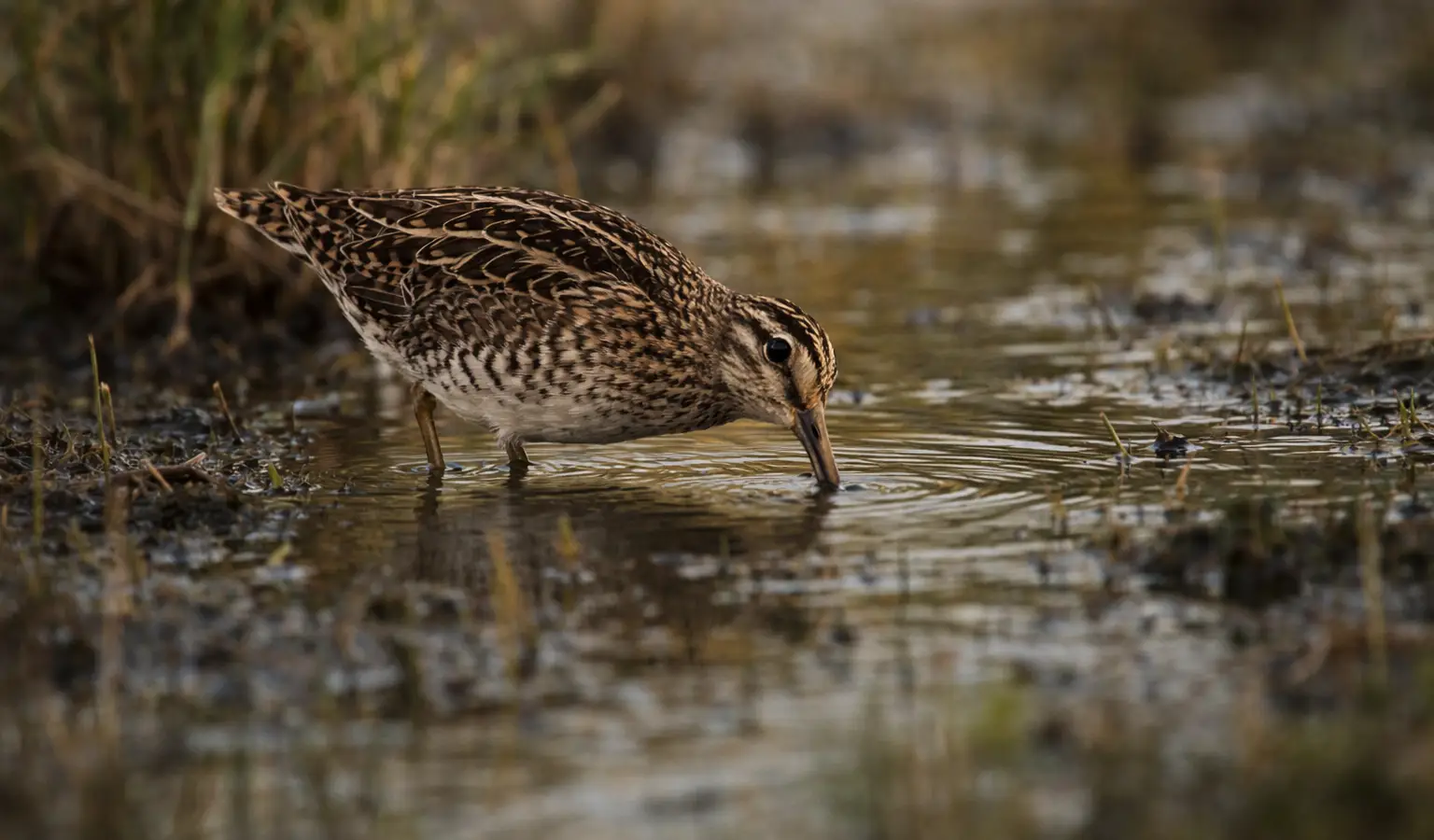
The common snipe is a slim, medium-small wader measuring roughly 25 to 27 cm in length and typically weighing about 80 to 120 g, though body mass can fluctuate with season and migration condition. Its silhouette is defined by a relatively long straight bill, short legs, a compact body, and pointed wings. The bill is a key field mark: long, narrow, and adapted for probing mud and saturated soil.
Its plumage is intricately patterned in browns, buffs, blackish tones, and pale longitudinal stripes, producing excellent camouflage among sedges, rushes, dead grass, and peat-dark mud. The back shows bold striping, while the underparts are paler, usually with variable barring or mottling on the flanks. The crown is dark with pale stripes, and the eye sits high on the head, helping the bird remain alert while feeding.
When flushed, identification often relies on shape and flight style as much as color. The common snipe launches suddenly and flies with fast wingbeats and sharp erratic jinks before often straightening out at distance. In poor light or mixed wetland bird assemblages, it can be confused with other snipe species, so bill proportion, overall structure, and behavior should all be considered together.
Habitat and distribution
Habitat and distribution
Habitat
The preferred habitat of the common snipe is wet, soft, and structurally varied ground where feeding and concealment are both possible. It is especially associated with marshes, wet meadows, peatlands, floodplain edges, sedge beds, boggy pastures, reed-fringed depressions, and shallow muddy margins around pools, ditches, and slow-water systems. The key habitat features are saturated soil, shallow standing water or seepage, and low to medium vegetation that allows cover without completely blocking movement.
Feeding habitat is usually any area where the substrate remains soft enough for deep probing. This may include muddy edges, trampled wet pasture, grazed marsh, and waterlogged hollows rich in worms, larvae, and other invertebrates. Resting and roosting areas tend to be slightly more concealed, often within rough wet vegetation or sheltered depressions.
Habitat use can shift with season, water level, frost, and disturbance pressure. During migration and winter, birds may concentrate in unfrozen wetlands, coastal marshes, inland flood zones, or heavily irrigated grassland if natural wetlands are scarce. Where wetlands are fragmented, the species often depends on a network of small suitable patches rather than one large site alone.
Distribution
Gallinago gallinago has a broad Palearctic distribution and occurs across much of Europe and Asia, with breeding concentrated in northern, temperate, and boreal wetland regions. It is widely known as a migratory or partially migratory species, and its local presence may change strongly between breeding season, autumn passage, wintering period, and spring return.
In western and southern parts of Europe, including many Atlantic and temperate lowland regions, the common snipe is often most noticeable in autumn and winter, when migrants from farther north join or replace local birds. In colder continental areas, frozen ground can force birds to move rapidly toward milder zones where probing remains possible.
Occurrence is often patchy at landscape scale because distribution follows wetland availability rather than simple administrative boundaries. A region may hold many birds after rainfall, flooding, or mild winter conditions and far fewer during drought or prolonged frost. As a result, local abundance should be interpreted cautiously and in relation to seasonal water dynamics.
Lifestyle
Lifestyle and behaviour
Diet
The common snipe feeds mainly on small invertebrates obtained by probing soft mud, peat, or waterlogged soil. Earthworms, insect larvae, adult insects, small mollusks, and other wetland invertebrates form the core of the diet. Its bill is highly sensitive at the tip, allowing it to detect prey below the surface without needing clear visual contact.
Diet composition varies with habitat and season. In wet meadows and pastures, worms and larvae can be especially important; in marshy edges and muddy pools, aquatic or semi-aquatic invertebrates may become more prominent. During migration and winter, birds often focus on places where prey remains accessible despite cold weather, which can make unfrozen seepages, muddy ditch margins, and recently flooded ground particularly valuable.
Feeding is usually deliberate and methodical, with repeated probing movements interspersed with short steps. The species may also pick food from the surface when conditions favor it, but deep substrate feeding is its defining method. Because prey availability depends strongly on soil moisture and organic productivity, diet quality is closely linked to good wetland condition.
Behaviour
The common snipe is notably secretive and often remains motionless until danger is very close. This reliance on camouflage is one reason it can seem absent even in suitable habitat. Once flushed, it typically erupts from cover with a rasping call and a fast, evasive zigzag flight designed to break visual pursuit. After the initial burst, it may level out and continue in a straighter line toward another patch of cover.
Activity is often highest during calm periods such as dawn, dusk, and overcast daylight hours, though local patterns vary with disturbance, weather, and season. In heavily disturbed sites, birds may become more crepuscular or shift toward quieter sectors of the wetland mosaic. During cold periods they may spend more time conserving energy in sheltered spots and feed intensely when conditions allow.
While foraging, the species moves with a cautious, stop-and-go rhythm, probing repeatedly and remaining alert. It is generally a bird of cover rather than open exposure. In breeding areas, behavior can become more conspicuous, especially during display, whereas wintering birds tend to emphasize concealment, vigilance, and short-distance relocation within feeding territories.
Social structure
For much of the year, the common snipe is best described as loosely solitary. Individuals often feed alone or at some distance from one another, even when several birds use the same marsh or wet meadow. This spacing likely reflects both the patchy distribution of food and the species' preference for concealment.
Outside the breeding season, small local concentrations can occur where conditions are especially favorable, such as in shallow flooded grasslands or sheltered muddy marsh edges. Even then, it does not usually form the kind of dense, cohesive flocks seen in many ducks or geese. Birds sharing a site often remain behaviorally independent, flushing separately or in ones and twos.
During breeding, social organization shifts toward territorial use of wetland habitat, with display activity and nesting linked to suitable patches. The overall impression, however, remains that of a discreet and scattered bird rather than a strongly gregarious species.
Migration
The common snipe is a migratory bird across much of its range, with movements shaped by latitude, frost, water level, and food accessibility. Northern and eastern breeding populations generally move south or west in autumn, while milder regions may hold wintering birds for extended periods. Some populations are partially migratory, meaning not all individuals move the same distance.
Migration is often diffuse rather than spectacularly concentrated, because birds can travel through many inland and coastal wetlands. Weather has a major influence on movement. Frost can trigger sudden departures from inland feeding grounds, while rainfall and flooding may create temporary stopover habitat and attract fresh arrivals.
Autumn passage and winter presence are especially relevant in hunting and observation contexts, often from September into January depending on the country and local regulations. Spring return tends to be less visible to the general public, but breeding areas can receive birds back as wetland conditions recover and display season begins.
Reproduction
Reproduction
The breeding cycle of the common snipe is tied to wetland availability in spring and early summer. Nesting usually takes place on the ground in concealed vegetation, often in damp grass, sedge cover, or marshy hummocks that provide both camouflage and proximity to feeding areas. The nest itself is generally a shallow scrape lined with plant material.
Clutch size is commonly around four eggs, although variation can occur. Incubation lasts about 18 to 21 days, with the given figure of 21 days fitting the upper end of the typical range. As in many ground-nesting wetland birds, breeding success depends heavily on water conditions, vegetation structure, predation pressure, and disturbance during the nesting period.
Chicks leave the nest soon after hatching and are relatively precocial, feeding under parental guidance in wet ground and shallow margins. Young birds develop quickly, but early survival can be affected by cold snaps, flooding, drought, trampling, mowing, or predator activity. In favorable habitat, adults may live several years, though many wild individuals do not reach the species' potential lifespan of around six years.
Field signs
Field signs
Field signs of common snipe are often subtle compared with those of larger wetland birds. The most reliable evidence is frequently the bird itself flushing from close cover, accompanied by its abrupt rasping call and characteristic zigzag launch. Repeated flushes from the same marshy field, ditch edge, or boggy hollow can reveal favored holding areas.
Feeding sign may include clusters of fine probe holes in soft mud, shallow wet pasture, or muddy margins where the bill has been inserted repeatedly. These marks are usually small and easy to overlook, and they can be confused with probing by other waders in mixed habitats. Look for them in sheltered wet patches rather than in dry, compacted ground.
Tracks are delicate and typically short-lived in wet substrates. They may show slender forward toes suited to soft ground, but they are rarely distinctive enough for confident identification without supporting context. Droppings and resting impressions are likewise not especially diagnostic. In practice, habitat reading, fresh flushes, and feeding-probe patterns are more useful than classic mammal-style sign.
Ecology and relationships
Ecology and relationships
Ecological role
The common snipe plays an important role as a consumer of wetland invertebrates, helping transfer energy from mud-dwelling and soil-dwelling prey into higher levels of the food web. By feeding on worms, larvae, small mollusks, and other invertebrates, it participates in the ecological functioning of marshes, bogs, wet meadows, and flooded grasslands.
It also serves as prey for predators such as foxes and birds of prey, especially when nesting on the ground, roosting in exposed spots, or moving through open habitat. Eggs and chicks can be vulnerable in breeding areas, while weakened or weather-stressed birds may face greater risk during migration and winter.
Because the species responds quickly to hydrology, disturbance, and habitat quality, it can also be a useful indicator of functional wetland mosaics. A site that regularly supports feeding or wintering snipe often retains soft soils, invertebrate productivity, and structural cover that benefit many other marshland organisms as well.
Human relationships
The relationship between people and the common snipe is shaped by wetland use, rural land management, birdwatching, and regulated hunting. For naturalists, it is a classic but often frustrating bird to observe well because its camouflage keeps it hidden until it flushes. For hunters in regions where the species is legally huntable, it is traditionally valued as a challenging migratory game bird because of its erratic flight, small target profile, and preference for difficult wet ground.
Agricultural practices can either support or reduce local suitability. Extensive wet grazing, shallow seasonal flooding, and the retention of ditch networks may create useful feeding habitat, while drainage, heavy mowing, peat degradation, and simplification of wet grasslands generally reduce carrying capacity. Disturbance from repeated access, dogs, machinery, or poorly timed interventions can also displace birds from otherwise suitable areas.
As table fare, the species has historically been considered edible, but any use must follow legal harvest rules, hygiene standards, and local health guidance. Avian parasites and general game handling risks reinforce the need for careful inspection, proper processing, and awareness of current veterinary or public health advice.
Legal framework and management
Legal framework and management
Legal status
The legal status of the common snipe varies by country and management framework. In some regions it is a huntable species under seasonal regulation, often during autumn and winter, while in others additional restrictions, bag limits, site protections, or temporary conservation measures may apply. The provided context indicates a hunt season from September to January, but exact dates and methods should always be checked against current local law.
Because this is a migratory wetland bird, legal considerations may involve national wildlife codes, regional decrees, protected-area rules, migratory bird agreements, and species identification requirements. Closed seasons, non-hunting refuges, ammunition restrictions in wetlands, and transport or reporting obligations may also be relevant depending on jurisdiction.
Anyone observing, managing, or hunting common snipe should rely on the latest official sources rather than assumptions based on previous seasons. Regulatory status can change with conservation assessments, disease controls, flyway considerations, or local population trends.
Management tips
Effective management for common snipe begins with water. Maintain or restore wetland hydrology so that at least part of the site retains soft, probeable ground through migration and winter, and avoid excessive drainage that hardens the soil. A varied structure is usually best: shallow water, muddy margins, short feeding zones, and nearby taller cover for security.
Wet grassland management should aim for a mosaic rather than uniformity. Light grazing can help keep parts of a marsh open and accessible, but overgrazing may reduce cover and invertebrate richness. Conversely, complete abandonment can lead to dense rank vegetation that limits feeding access. Timing matters greatly; mowing, heavy machinery use, or disruptive works during breeding or key migration periods can lower habitat value.
From a field perspective, careful observation of water level, frost conditions, disturbance pressure, and recent weather often predicts snipe presence better than broad assumptions about region alone. In hunting contexts, restraint is important on small wetlands that concentrate birds during cold spells, and strong species identification is essential where similar waders may occur. Conserving quiet refuge areas alongside huntable sectors generally benefits both the species and long-term site quality.
Fun facts
Fun facts
- The common snipe is famous for holding so tightly in cover that people often walk very close before it flushes.
- Its long bill is not just long; the tip is highly sensitive, helping the bird detect prey hidden in mud.
- During breeding season, males can produce a distinctive drumming or bleating sound in display flight, created by air passing over the tail feathers.
- The species' erratic escape flight is so characteristic that it has long been part of field lore among birdwatchers and hunters alike.
- Because numbers can shift quickly with rainfall, frost, and water levels, the same wetland may seem empty one week and hold several birds the next.