
Hunt Rexia

Big game

Wild boar

Sus scrofa

The wild boar is the most hunted big game in France, valued for its meat and role in population management.

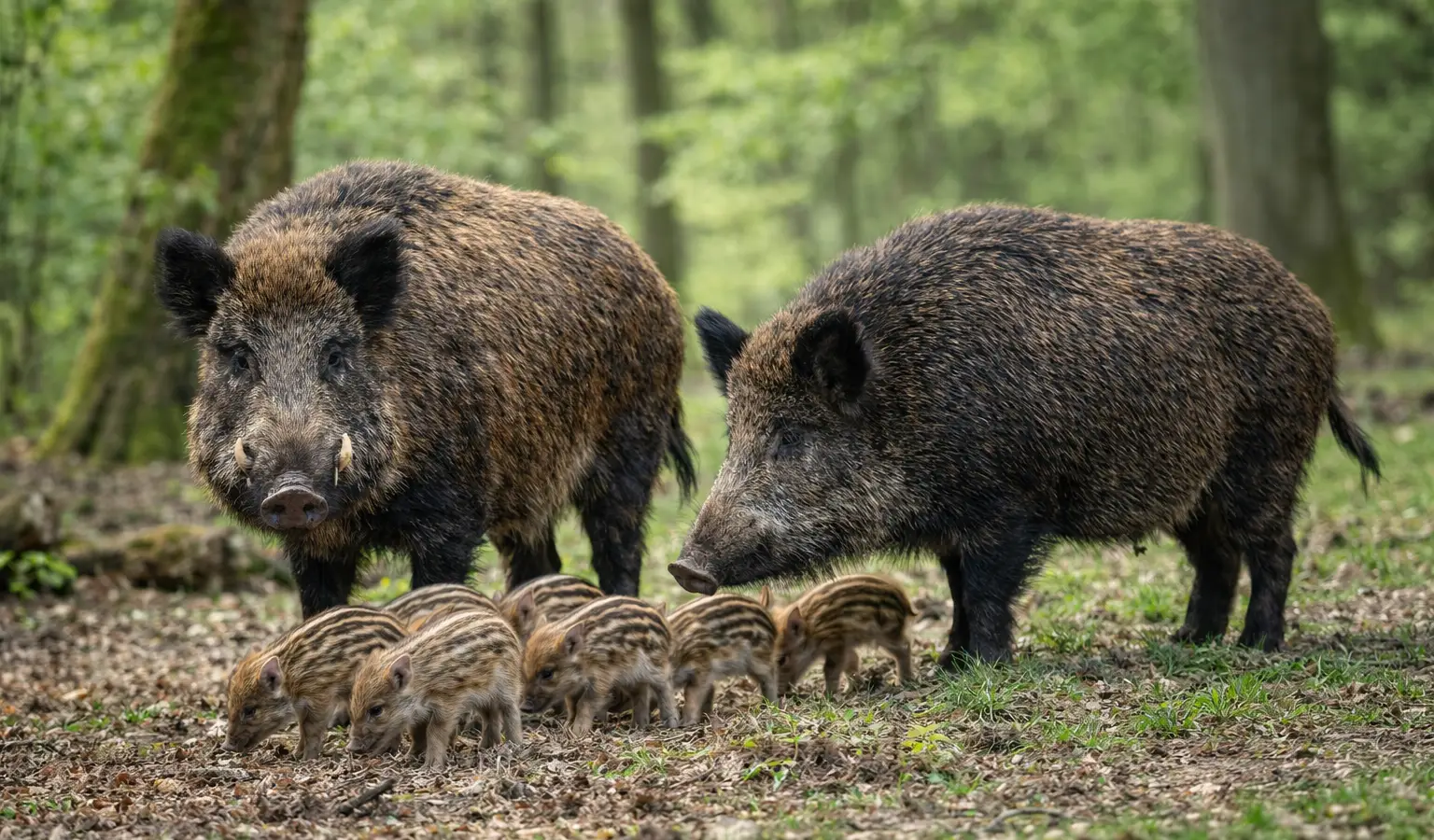
Wild boar (Sus scrofa) in its natural habitat

Type

Large mammal

Lifespan

15 years

Hunting season

Septembre à février selon réglementation régionale

Edible

Yes

Fact sheet

Wild boar

Scientific name

Sus scrofa

Type

Large mammal

Meat quality

Firm and tasty meat

Edible

Yes

Lifespan

15 years

Gestation

115 days

Size

90-150 cm (longueur corps)

Weight

50-150 kg

Diet

Omnivore: roots, fruits, small animals, insects

Status

Huntable, regulated by quotas

Hunting season

Septembre à février selon réglementation régionale

Breeding season

11 / 12

Lifestyle and behaviour

Behaviour : Nocturnal, social in family groups, digs

Social structure : Females and piglets in family groups, adult males often solitary

Migration : Limited seasonal movements

Habitat

  • Forest
  • Plains
  • Shrubland

Natural predators

  • Wolf
  • Lynx
  • Bear

Hunting methods

  • Drive hunt
  • Blinds
  • Stalking

Health risks

  • African swine fever
  • Tuberculosis
  • Intestinal parasites

Ecosystem role

  • Seed dispersal
  • Influence on vegetation and forest soils

Signs of presence

  • Footprints
  • Soil digging marks
  • Droppings

Introduction

General description

The wild boar, Sus scrofa, is one of the most adaptable and recognizable large mammals in Europe and a major big game species across France. It is the wild ancestor of the domestic pig, but in the field it is a distinct animal: powerful, wary, highly mobile over short ranges, and strongly shaped by cover, food availability, and human pressure. In many regions it is the most hunted large game species, both for its meat and for the practical need to regulate populations where numbers become high.

Ecologically, the wild boar is far more than a quarry species. By rooting, trampling, feeding, and moving seeds, it changes soil structure, influences regeneration, and affects both woodland and agricultural habitats. Those effects can be locally positive or problematic depending on density, season, and land use. This dual role explains why the species is often discussed in both wildlife conservation and game management contexts.

For readers interested in identification, habitat, behavior, tracks, and hunting relevance, wild boar are especially important because they leave obvious field signs and respond quickly to changes in disturbance, crops, mast production, and weather. Their success comes from a combination of intelligence, omnivorous feeding, strong reproductive capacity, and the ability to use forests, farmland mosaics, scrub, and edge habitats with equal efficiency.

Morphology

Morphology

Wild boar are compact, muscular animals with a heavy forequarters, relatively short legs, a wedge-shaped head, and a long mobile snout used for rooting. Adult body length commonly falls around 90 to 150 cm, with weight often ranging from 50 to 150 kg, though local conditions, age, sex, and food supply can produce notable variation. Boars from rich agricultural landscapes may become especially heavy.

The coat is usually coarse and dark, varying from grey-brown to nearly black, often with longer bristles along the back that can stand up when the animal is alarmed. Piglets are very distinctive, showing pale longitudinal stripes on a rusty or brown background during early life; these stripes fade as they grow. Adult males tend to appear bulkier in the neck and shoulders, while females usually look lighter and more refined in profile.

Field identification is helped by the head shape, rounded body, short tail, and direct, forceful movement. In older males, the canine teeth develop into visible tusks, though they are not always obvious at distance. Compared with deer, a wild boar carries its body lower, moves with a grounded and deliberate gait when feeding, and often leaves visible disturbance in the soil where it has been rooting.

Habitat and distribution

Habitat and distribution

Habitat

The wild boar favors habitats that combine cover, water, and abundant food. In practice, this means forests, woodland edges, shrubland, reedbeds, rough cover, and agricultural mosaics where crops, mast, and shelter occur close together. Dense daytime refuge is especially important, particularly in landscapes with regular disturbance from people, vehicles, dogs, or hunting activity.

In France and much of Europe, wild boar are commonly associated with broadleaf and mixed forests rich in acorns, beechnuts, chestnuts, roots, and invertebrates, but they also use conifer stands, plains with hedgerows, river corridors, marshy cover, and scrubby hillsides. Farmland near woodland often becomes highly attractive when maize, cereals, tubers, or other energy-rich foods are available.

Habitat use changes through the year. In warm periods, animals often stay close to shaded cover, damp soils, and wallows. In autumn, mast-producing woods can concentrate activity. In heavily hunted or disturbed areas, boar may become strongly nocturnal and spend daylight in thick, hard-to-access bedding areas. Their biotope preference is therefore not fixed: it reflects a balance between feeding opportunity, security, and seasonal conditions.

Distribution

Sus scrofa has a broad native distribution across much of Eurasia and has also been introduced to other parts of the world. In Europe it is widespread, and in France the wild boar is present across most regions, from extensive forest blocks to mixed agricultural landscapes, provided there is enough cover and food.

Local abundance is not uniform. Population density tends to be higher where woodland, crop fields, mild winters, and productive food sources combine. Mountain areas, wetlands, plains, and Mediterranean scrub can all hold boar, but numbers vary with habitat quality, disturbance, disease, and management pressure. Expansion into peri-urban and fragmented rural zones has also been noted in some regions where shelter and food remain available.

Because distribution patterns can shift over time, readers should treat local occurrence as dynamic rather than static. Harsh weather, food failures, outbreaks of disease, and changes in hunting pressure or land use can all influence where wild boar are regularly seen, how visible they are, and how intensively they use a given territory.

Lifestyle

Lifestyle and behaviour

Diet

The wild boar is an omnivore with an extremely flexible diet. Common foods include roots, bulbs, tubers, acorns, beechnuts, chestnuts, fruits, seeds, green plant material, fungi, worms, insect larvae, and other invertebrates. It also takes small vertebrates opportunistically and may scavenge carrion when available. This dietary breadth is one of the main reasons the species adapts so well to varied habitats.

Seasonal variation is important. In autumn and early winter, hard mast such as acorns and beechnuts can become a major energy source. In spring, fresh vegetation, underground plant parts, and soil invertebrates are heavily used. In summer, crops and soft fruits may attract boar into farmland or orchard edges. During food shortages, rooting activity may increase as animals search for buried resources.

For land managers and observers, feeding ecology explains much of the species' movement and impact. Rooting can be concentrated where soils are soft and rich in invertebrates, while field damage often rises where crops offer concentrated calories. Diet therefore links directly to habitat use, body condition, reproductive success, and conflict with agriculture.

Behaviour

Wild boar are typically described as nocturnal or crepuscular, especially in areas with regular human activity. In low-disturbance settings they may also be active by day, but strong hunting pressure often pushes feeding and movement toward dusk, night, and dawn. Their behavior is shaped by caution: they rely heavily on smell and hearing, use cover efficiently, and often pause to test wind and sound before entering open ground.

When feeding, boar move slowly and methodically, frequently stopping to root, browse, or listen. When alarmed, they can leave cover with surprising speed and power, often taking the shortest secure route into dense vegetation, woodland, reedbeds, or rough thickets. Escape behavior is usually direct and decisive rather than graceful, and animals may use habitual paths between bedding and feeding areas.

Daily patterns often include resting in sheltered daytime beds, visiting water or wallows in warm weather, and making evening feeding movements toward crops, mast woods, meadows, or disturbed soil rich in invertebrates. Wild boar are intelligent and quickly learn from repeated disturbance. In practical field terms, this means that timing, wind direction, access routes, and the level of local pressure all strongly influence whether they are seen or remain hidden.

Social structure

The basic social unit of the wild boar is the family group, often called a sounder. These groups are usually composed of adult females and their piglets or juveniles, sometimes joined by related subadult females. Such groups provide collective vigilance and allow young animals to learn movement routes, feeding areas, and refuge sites within the home range.

Adult males are more often solitary outside the breeding period, especially as they age. Younger males may still associate loosely with others for a time, but mature boars typically spend much of the year apart from female groups, joining them more regularly during the rut. As a result, observers often notice a clear contrast between cohesive maternal groups and the more independent behavior of large males.

Group size varies with season, food abundance, hunting pressure, and local population structure. In productive habitats, family groups may be relatively visible through shared rooting areas and trails, while in disturbed landscapes they can fragment into more discreet units. Social organization is therefore stable in principle but flexible in expression.

Migration

The wild boar is generally considered sedentary rather than migratory. Most individuals operate within a home range shaped by cover, water, food, disturbance, and social structure. Even so, movement is far from random. Boar often follow regular travel routes between bedding cover, wallows, water points, mast areas, and feeding grounds.

Seasonal movement does occur on a local scale. Animals may shift toward crop fields in summer, oak and beech woods in autumn, sheltered thickets in hunting season, or wetter ground during dry periods. In mountainous or highly seasonal landscapes, altitudinal or habitat-based adjustments can happen, but these are better described as limited seasonal relocations than true migration.

Dispersal is most relevant in younger animals, particularly subadult males, which may leave their natal area and establish themselves elsewhere. Such dispersal helps the species colonize suitable habitat and can influence genetic exchange, crop damage patterns, and the appearance of boar in newly occupied sectors.

Reproduction

Reproduction

Wild boar have a relatively high reproductive potential, which helps explain how populations can increase quickly under favorable conditions. Breeding season varies somewhat with climate, food supply, and population structure, but mating often intensifies in late autumn and winter. Adult males range more widely at this time in search of receptive females.

Gestation lasts about 115 days. Before farrowing, the female typically selects dense cover and may build a sheltered nest of vegetation. Litters commonly contain several piglets, though exact numbers vary with age, body condition, and local habitat quality. In rich environments, well-fed females may breed earlier or more successfully than those in poorer conditions.

Piglets are born striped, which provides useful camouflage in vegetation and dappled light. The mother remains highly attentive and can be defensive around young. Reproductive timing influences field observation because late winter and spring may reveal fresh family activity, small tracks, and concentrated use of secure nursery habitat. Longevity can reach around 15 years, although many wild individuals experience much shorter lives due to hunting, disease, accidents, and environmental pressures.

Field signs

Field signs

Wild boar leave some of the most obvious field signs of any large mammal. The first is often rooting: patches of turned soil, lifted turf, disturbed leaf litter, or shallow excavation where the snout has searched for roots, bulbs, worms, and larvae. In wet meadows, woodland rides, crop edges, and soft forest soil, these feeding marks can be extensive.

Footprints are also highly characteristic. The track shows a cloven hoof, broad and rounded compared with many deer tracks, and in soft ground the dewclaws may register clearly behind the main print. Trails can appear as repeated passages through brush, along forest edges, into crops, or toward water and wallows. Muddy rubbing trees, wallow depressions, and hair caught on bark may reveal regular use of a site.

Droppings vary with diet but are often dark, clumped, and less pellet-like than deer sign. Bedding sites may be found in thick cover as flattened nests or sheltered resting spots lined with vegetation. Where family groups are active, the combination of multiple track sizes, fresh soil disturbance, and frequent movement corridors is often a strong indicator of recent presence.

Ecology and relationships

Ecology and relationships

Ecological role

Wild boar play a strong and sometimes controversial ecological role. Through rooting and trampling, they disturb the upper soil layer, expose seeds, mix organic matter, and alter microhabitats for plants and invertebrates. In some contexts this can create patches of ecological renewal or increase structural diversity at small scales.

They also contribute to seed dispersal by consuming and moving fruits and other plant material. Their feeding pressure can influence forest regeneration, ground vegetation, and the availability of resources for other species. In wetlands, woods, and edge habitats, their effects may be especially visible where densities are high or soils are soft.

At the same time, ecological influence can become excessive when populations exceed what the habitat and surrounding land use can absorb. Heavy rooting, predation on ground-level nests or small animals, and concentrated pressure on crops or young forest stands may create management problems. Their ecological role is therefore best understood as significant, dynamic, and density-dependent rather than simply beneficial or harmful.

Human relationships

The relationship between people and wild boar is complex and longstanding. The species is valued as game, widely appreciated for its meat, and deeply embedded in rural hunting culture. In France in particular, it holds a central place in big game management because it is both abundant in many areas and capable of causing substantial agricultural and ecological impacts.

For farmers and landowners, wild boar can be a difficult neighbor. Rooting in meadows, damage in maize or cereal fields, and disturbance of pasture or vineyard margins can create real economic costs. Near roads and peri-urban zones, collisions and safety concerns also matter. At the same time, wildlife watchers value boar as a fascinating species to observe, especially where tracks, wallows, and evening movement reveal a hidden but active mammal community.

Human relations are also shaped by health concerns. Wild boar can be involved in the circulation of diseases and parasites relevant to domestic pigs, wildlife, dogs, or in some cases people handling carcasses. Caution, hygiene, and proper game processing are therefore important. In practical coexistence terms, the wild boar is a species that demands both respect and active management.

Legal framework and management

Legal framework and management

Legal status

In France, the wild boar is generally a huntable species, but its legal status and the exact rules governing harvest depend on national law as well as regional and local regulation. Seasons, quotas, authorized hunting methods, safety requirements, and damage-control measures may differ by department, management unit, and current administrative decisions.

The commonly cited hunting period runs roughly from September to February depending on the region and applicable regulation, though additional control measures or specific interventions may be permitted in some contexts where crop damage or population pressure is high. Because rules can change, hunters and land managers should always verify the latest local framework before any activity.

Legal oversight is also linked to sanitary monitoring, transport of carcasses, disease prevention, and in some areas coordinated population management plans. The species is not generally treated as protected game in this context; rather, it is regulated as a managed wild resource whose abundance often requires active supervision.

Management tips

Good wild boar management starts with reading the landscape rather than relying only on sightings. Productive mast woods, crop interfaces, dense daytime cover, wallows, water points, and sheltered transit corridors often explain presence better than any single observation. Repeated rooting, fresh tracks in damp ground, and regular entry points into fields help identify pressure zones and movement patterns.

For observation or hunting, wind direction and disturbance are decisive. Wild boar trust their nose, and access routes that cut through bedding cover can quickly educate a local population. Areas hunted intensively often show rapid behavioral change, with more nocturnal movement and tighter use of inaccessible refuge. Quiet, disciplined approach and good habitat reading usually matter more than covering long distances.

From a broader wildlife management perspective, the key issue is balance. Monitoring abundance, crop damage, reproduction, and disease risk is important, especially in landscapes where food is abundant and population growth can be fast. Coordinated local action is generally more effective than isolated efforts. Given the potential presence of African swine fever, tuberculosis, and intestinal parasites, carcass handling, reporting, and sanitary precautions should always be taken seriously.

Fun facts

Fun facts

  • The wild boar is the wild ancestor of the domestic pig, which is why the two share many anatomical and behavioral traits.
  • Piglets are born with pale stripes, a useful camouflage pattern that helps them disappear in broken light and ground vegetation.
  • A boar's snout is an extremely efficient tool: it functions like a biological spade for detecting and digging up buried food.
  • Wild boar can transform a patch of ground overnight, leaving rooting signs so obvious that even casual walkers notice them.
  • Although often seen as strictly nocturnal, they can be active in daylight where disturbance is low and security is high.
  • The species is highly intelligent and quickly adjusts its routine to hunting pressure, food pulses, and repeated human activity.