
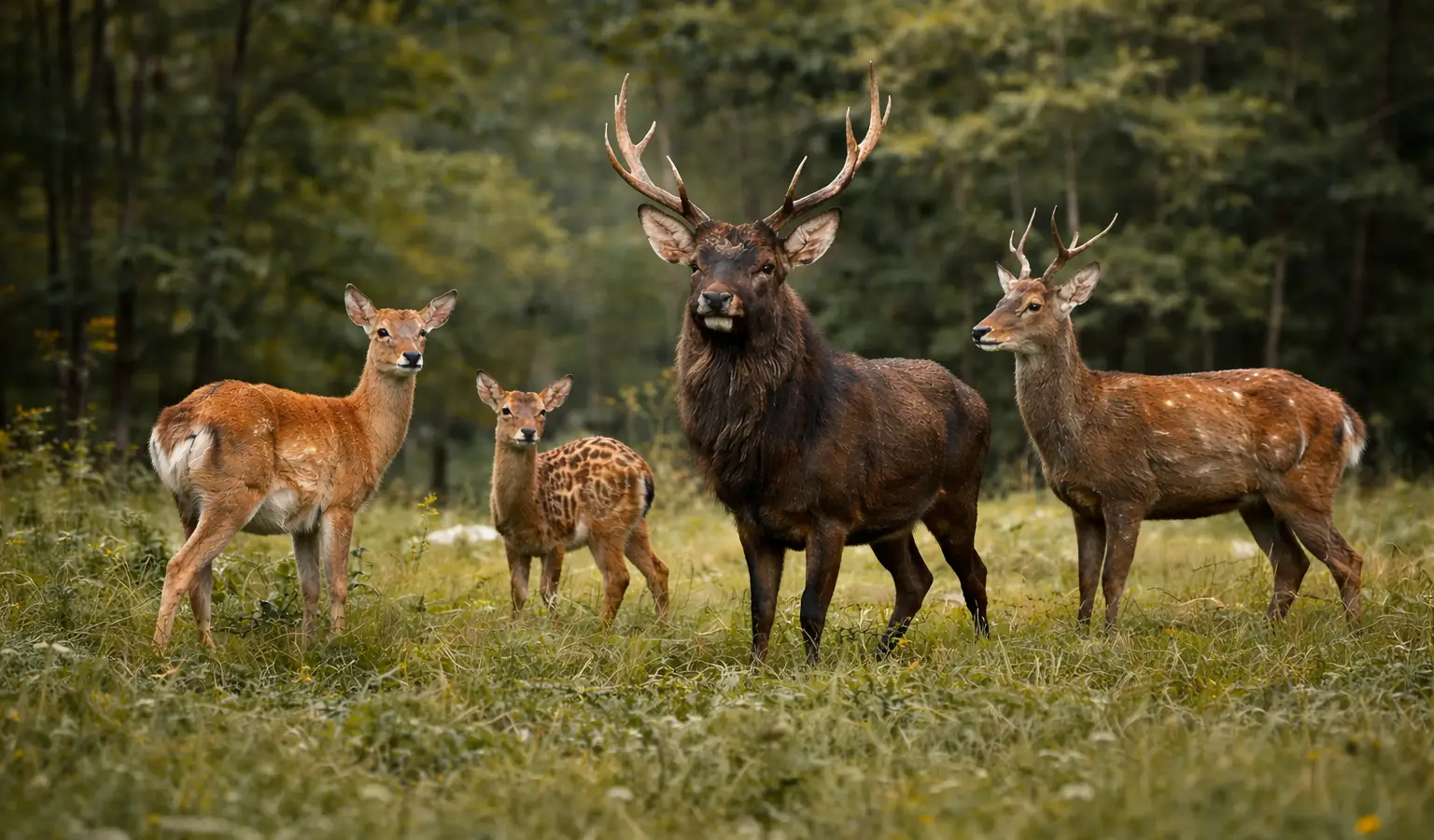

Big game
Sika deer
Cervus nippon
A deer native to Asia, introduced and managed through hunting in parts of Europe.
Type
Large mammal
Lifespan
13 years
Hunting season
Septembre à novembre selon quotas
Edible
Yes
Fact sheet
Sika deer
Scientific name
Cervus nippon
Type
Large mammal
Meat quality
Tender meat
Edible
Yes
Lifespan
13 years
Gestation
230 days
Size
100-140 cm
Weight
40-80 kg
Diet
Herbivore: grasses, leaves, shoots
Status
Huntable depending on local laws
Hunting season
Septembre à novembre selon quotas
Breeding season
9 / 10
Lifestyle and behaviour
Behaviour : Diurnal and crepuscular, lives in herds
Social structure : Herds by age and sex
Migration : Limited seasonal movements
Habitat
- Forest
- Mountain
Hunting methods
- Drive hunt
- Blinds
Health risks
- Intestinal parasites
Ecosystem role
- Seed dispersal
Signs of presence
- Footprints
- Droppings
Introduction
General description
Sika deer (Cervus nippon) is a medium-sized deer native to East Asia and now established in several parts of Europe, where it is managed as a big game species. It is valued by wildlife observers for its striking appearance and by game managers and hunters for its adaptability, wariness, and ability to thrive in dense cover. In many landscapes, the species occupies a space between traditional woodland deer and more edge-oriented ungulates, using forest structure, broken relief, and quiet feeding areas to its advantage.
Compared with larger red deer, sika deer are generally more compact, often more secretive, and highly capable of living in wooded, humid, or mountainous terrain. They can remain difficult to observe even where populations are established because they rely on cover, move carefully, and often become more cautious under human pressure. Their vocal activity during the rut, however, can make them unusually conspicuous at certain times of year.
Ecologically, the sika deer is a browsing and grazing herbivore that influences woodland regeneration, understorey composition, and seed movement. In regions where it is introduced, its presence may raise management questions linked to forest damage, competition with other deer, and population expansion. For that reason, the species sits at the intersection of wildlife ecology, habitat management, and hunting regulation.
Morphology
Morphology
Sika deer is a relatively small to medium deer with a body length commonly around 100 to 140 cm and an adult weight often ranging from about 40 to 80 kg, although local conditions can influence size. The body is athletic and lightly built, with fairly long legs, a narrow head, large ears, and a distinct, alert posture. The coat varies seasonally and geographically but is often one of the easiest identification features.
In many individuals, the summer coat is rich chestnut to reddish brown with pale spots, giving the animal a dappled appearance that can remain more visible in adults than in many other deer species. The winter coat is darker, greyer, and usually less clearly spotted. A pale rump patch is typical and can stand out strongly when the animal is alarmed. The tail is relatively short, and the contrast between the rump and darker surrounding coat is often useful in field identification.
Males carry antlers, usually with fewer tines than a mature red deer stag, and a proportionally lighter overall frame. During the rut, the neck appears thicker and the posture more powerful. Females are smaller, antlerless, and usually finer in build. In mixed deer country, sika deer can be distinguished by their compact silhouette, brisk movement, and often darker, cleaner-lined woodland appearance.
Habitat and distribution
Habitat
Sika deer favor habitats that combine cover, food, and relative security. Forest edges, mixed woodland, conifer blocks, mountain forests, dense young plantations, heath-woodland mosaics, wet woodland margins, and secluded glades can all be suitable. They often do particularly well where thickets, regeneration patches, and broken terrain allow them to feed while remaining close to shelter.
Although strongly associated with forest, the species is not limited to closed canopy woodland. It may use meadows, agricultural fringes, clearings, forest rides, and shrubby transition zones, especially at dawn, dusk, or during quiet weather. In mountain settings, local altitude, snow cover, and forage availability can influence how high or low animals spend their time during different seasons.
From a biotope perspective, sika deer tend to prefer landscapes with year-round structure rather than very open country. Dense daytime bedding cover, access to water in some regions, and a patchwork of browsing and grazing opportunities are important. Under sustained disturbance, they often retreat deeper into cover and become more nocturnal in their visible movements.
Distribution
The natural range of Cervus nippon lies in Asia, including parts of Japan, eastern China, Korea, Taiwan, and the Russian Far East, though distribution and status differ among subspecies and regions. Beyond its native range, sika deer has been introduced to several countries, especially in Europe, where some populations are free-ranging and others have historical links to park escapes, releases, or managed estates.
In Europe, occurrence is uneven and highly regional. Some populations are localized and intensively managed, while others have expanded into wider woodland and upland systems. Their distribution can be strongly shaped by habitat continuity, hunting pressure, legal status, and interactions with other cervids. In some areas they remain relatively discreet and patchy; in others they are established enough to be considered a regular game species.
Because introduction history varies, local knowledge is especially important. Presence, density, and management objectives can differ significantly from one country or district to another, so field interpretation should always be grounded in current regional data.
Lifestyle
Lifestyle and behaviour
Diet
Sika deer is an herbivore that feeds on a mix of grasses, leaves, shoots, herbs, buds, and various woody plant parts. Its diet shifts with season, habitat, and local availability. In productive edge habitats, it may graze on grasses and forbs, while in woodland it often browses shrubs, saplings, bramble, heather, and fresh tree growth.
Spring and early summer usually bring more tender, nutritious forage, including young leaves and shoots. In late summer and autumn, feeding may broaden according to mast, agricultural edges, and available green vegetation. During winter, especially in colder or upland areas, animals may rely more heavily on browse, evergreen material, rougher herbage, and whatever digestible plant matter remains accessible.
Like many deer, sika can be selective when forage quality is high and more opportunistic when resources tighten. This feeding flexibility helps explain its success in varied habitats, but it also means it can exert notable browsing pressure on woodland regeneration where densities rise.
Behaviour
Sika deer are commonly described as diurnal and crepuscular, with strongest visible activity around dawn and dusk. In areas with frequent disturbance, however, they may shift more movement into low-light or nighttime hours. They are alert, quick to detect scent and sound, and often use cover intelligently rather than exposing themselves for long periods.
Their behavior is often shaped by pressure. In quiet ground, they may feed calmly along rides, clearings, or woodland margins. In hunted or heavily visited areas, they become more secretive, hold tighter to dense cover, and use familiar travel routes. Once alarmed, they can leave at a sharp, springing pace, sometimes pausing in cover to reassess before moving farther away.
One of the most distinctive behavioral features of the species is rutting vocalization. Males can produce striking whistles, moans, or screams during the breeding season, and these calls are often an important clue to presence. Outside the rut, sika deer may be surprisingly unobtrusive despite living in apparently suitable habitat.
Social structure
Sika deer usually organize themselves in herds or loose groups structured by age, sex, and season. Females commonly occur with fawns and young animals, while adult males may spend much of the year alone or in small bachelor groups. Group size varies widely depending on habitat openness, disturbance, local density, and time of year.
In dense forest, social units may appear fragmented because visibility is poor and animals spread through cover rather than standing in large exposed groups. In more open feeding areas, temporary aggregations can form, especially where food is concentrated. During the rut, males become more territorial or more focused on access to females, and social tension increases.
This age-and-sex separation is useful for field reading. Tracks, droppings, and browsing sign can accumulate in shared use areas, but actual sightings may still be brief because groups do not always remain cohesive in thick woodland.
Migration
Sika deer are generally considered only weakly migratory or largely sedentary, with limited seasonal movements rather than long-distance migration. Most animals live within a familiar home range shaped by cover, food, water, and disturbance. Daily and seasonal shifts are often more important than true migration.
In mountain or colder regions, some vertical movement can occur as animals respond to snow depth, winter exposure, or forage access. In heavily forested landscapes, they may also shift between dense daytime refuge areas and more open feeding zones on a regular rhythm. During the rut, males can range more widely than usual while searching for females or defending favored areas.
Young animals may disperse from natal areas, helping local populations expand into adjacent habitat. In introduced populations, this gradual dispersal can be an important driver of range growth over time.
Reproduction
Reproduction
The breeding season of sika deer usually falls in autumn, often from roughly September to November depending on climate, latitude, and local population patterns. At this time, males become more vocal and more active, advertising presence and competing for access to females. Rutting behavior may include calling, scent marking, parallel walking, posturing, and direct contests between males.
Gestation lasts about 230 days. Most births therefore occur in late spring to early summer, when vegetation offers both nutrition and cover for females with young. A hind typically gives birth to a single fawn, though twins are possible in some cervids generally and may occur only occasionally if at all in sika depending on local conditions.
Newborn fawns are well camouflaged, with a spotted coat that helps them remain concealed in vegetation. For the first part of life, the mother keeps the fawn hidden and returns regularly to nurse it. Juvenile survival depends on weather, disturbance, forage quality, and local predation pressure where predators are present.
Field signs
Field signs
Field signs of sika deer often resemble those of other deer, so context matters. The most useful signs include footprints, droppings, narrow game trails, browsing on low woody growth, and bedding spots in cover. Tracks usually show the classic cloven hoof shape, relatively neat and pointed, with size depending on age, sex, substrate, and ground conditions.
Droppings are typically pellet-like, dark when fresh, and often deposited in feeding areas, along trails, or near resting cover. In soft ground, repeated use may reveal well-worn slots through bracken, grass, or young plantation. During the rut, additional signs can include churned ground, scent-marked spots, and concentrated activity around favored calling or display areas.
Observation strategy matters as much as sign recognition. Woodland edges at first light, quiet rides, muddy crossings, and transitions between cover and feeding ground are often productive places to look for evidence. Because sign can overlap with other cervids, confidence improves when multiple clues are read together rather than in isolation.
Ecology and relationships
Ecological role
Sika deer contributes to ecosystem function as a medium to large herbivore that transfers plant biomass into the wider food web and helps move seeds through fur contact and digestion. Its feeding activity influences vegetation height, browse lines, shrub density, and the composition of the woodland understorey. In some habitats this can create structural diversity; in others, especially at high density, it may suppress regeneration of sensitive plant species.
The species also creates trails, resting areas, and localized nutrient inputs through droppings. These effects can shape microhabitats used by invertebrates and other wildlife. Where populations are introduced or expanding, ecological impact depends heavily on numbers, habitat resilience, and whether management keeps herbivory within acceptable limits.
In practical field ecology, sika deer is therefore both a normal component of ungulate communities and a potential driver of vegetation change. Its role cannot be judged in the abstract; it has to be assessed within the local landscape, forest objectives, and deer density.
Human relationships
Sika deer has a complex relationship with people. It is appreciated as a distinctive game animal and as a species of strong interest for wildlife observation, especially during the rut when vocal activity can make encounters memorable. Its meat is edible and, where legally harvested, is part of the wider venison resource associated with managed deer populations.
At the same time, coexistence issues can arise. Browsing on forestry plantations, natural regeneration, ornamental plantings, or some agricultural edges may create conflict where densities are high. In introduced ranges, managers may also be concerned about expansion into new habitat, interaction with native deer species, and the long-term effects of hybridization where compatible cervids occur.
For landowners, foresters, naturalists, and hunters, sika deer often becomes a management species rather than simply a species to admire. Good coexistence depends on monitoring, realistic population assessment, habitat reading, and regulation adapted to local conditions.
Legal framework and management
Legal status
The legal status of sika deer varies by country and sometimes by region, estate type, or management unit. In many areas it is a huntable species under specific seasons, permits, quotas, or population control frameworks. The broad hunting period often centers on autumn, but exact dates and categories can differ, so local law always takes priority over general guidance.
Where the species is introduced, regulation may be influenced not only by game management but also by conservation, forestry, and invasive or non-native species policy. Some jurisdictions may encourage control in expansion zones, while others manage the species through ordinary big game rules. Sex, age class, weapon type, hunting method, reporting obligations, and carcass handling may all be regulated.
Anyone observing, photographing, or hunting sika deer should consult current official regulations in the relevant area. Legal requirements can change, and protected areas or private lands may have stricter rules than the surrounding countryside.
Management tips
Effective sika deer management starts with accurate local observation. Count sign as well as sightings, because this species can remain largely hidden in dense forest. Regularly check tracks on soft ground, pellet concentrations, browsing pressure on regeneration, and repeated crossing points between bedding cover and feeding areas. Seasonal comparison is especially useful for understanding movement and pressure.
Habitat reading is critical. Areas that combine secure daytime cover with nearby feeding opportunities often hold deer consistently. Forest rides, wet flushes, sheltered edges, young conifer or mixed regeneration, and calm dawn or dusk access routes can reveal patterns that random observation misses. During the rut, vocal activity may help locate core use areas, but outside that period sign-based monitoring becomes even more important.
- Adjust management goals to local context: observation, forest protection, population control, or balanced harvest do not always require the same approach.
- Watch for browsing impact on young trees and sensitive understorey plants, especially where densities appear to rise.
- In regions with other deer species, improve identification skills to avoid confusion in both field recording and harvest decisions.
- Remain attentive to animal health, including parasite burden, carcass condition, and any unusual behavior.
- Always align field practice with current legal frameworks, access rules, and animal welfare standards.
Fun facts
Fun facts
Sika deer is one of the few deer species widely noted for its distinctive rutting calls, which can sound surprisingly sharp, eerie, or whistling in still woodland air. For many observers, hearing a sika stag before seeing one is part of the species' appeal.
Unlike many deer that lose visible spotting in adulthood, sika often retains clear body spots, especially in the summer coat. This gives the animal a striking appearance and makes it one of the more visually recognizable woodland deer.
The name Cervus nippon reflects the species' strong association with Japan, where some forms of sika deer are deeply embedded in local culture and landscape history. Across its wider range, however, the species can occupy very different roles: native wildlife in one place, introduced big game in another, and a management concern where populations expand beyond desired levels.