
Badger
Meles meles
A burrowing mammal living in family groups.
Type
Mammal
Lifespan
14 years
Hunting season
Selon réglementation
Edible
No
Fact sheet
Badger
Scientific name
Meles meles
Type
Mammal
Meat quality
-
Edible
No
Lifespan
14 years
Gestation
56 days
Size
35-45 cm
Weight
700-1200 g
Diet
Worms, insects, small mammals, fruits
Status
Huntable or controlled depending on country
Hunting season
Selon réglementation
Breeding season
3 / 4
Lifestyle and behaviour
Behaviour : Nocturnal, burrowing, territorial
Social structure : Family groups in setts
Migration : Sedentary
Habitat
- Forest
- Grassland
Natural predators
- Wolf
Hunting methods
- Blinds
- Digging out
Health risks
- Tuberculosis
- Avian parasites
Ecosystem role
- Seed dispersal
- Soil aeration
Introduction
General description
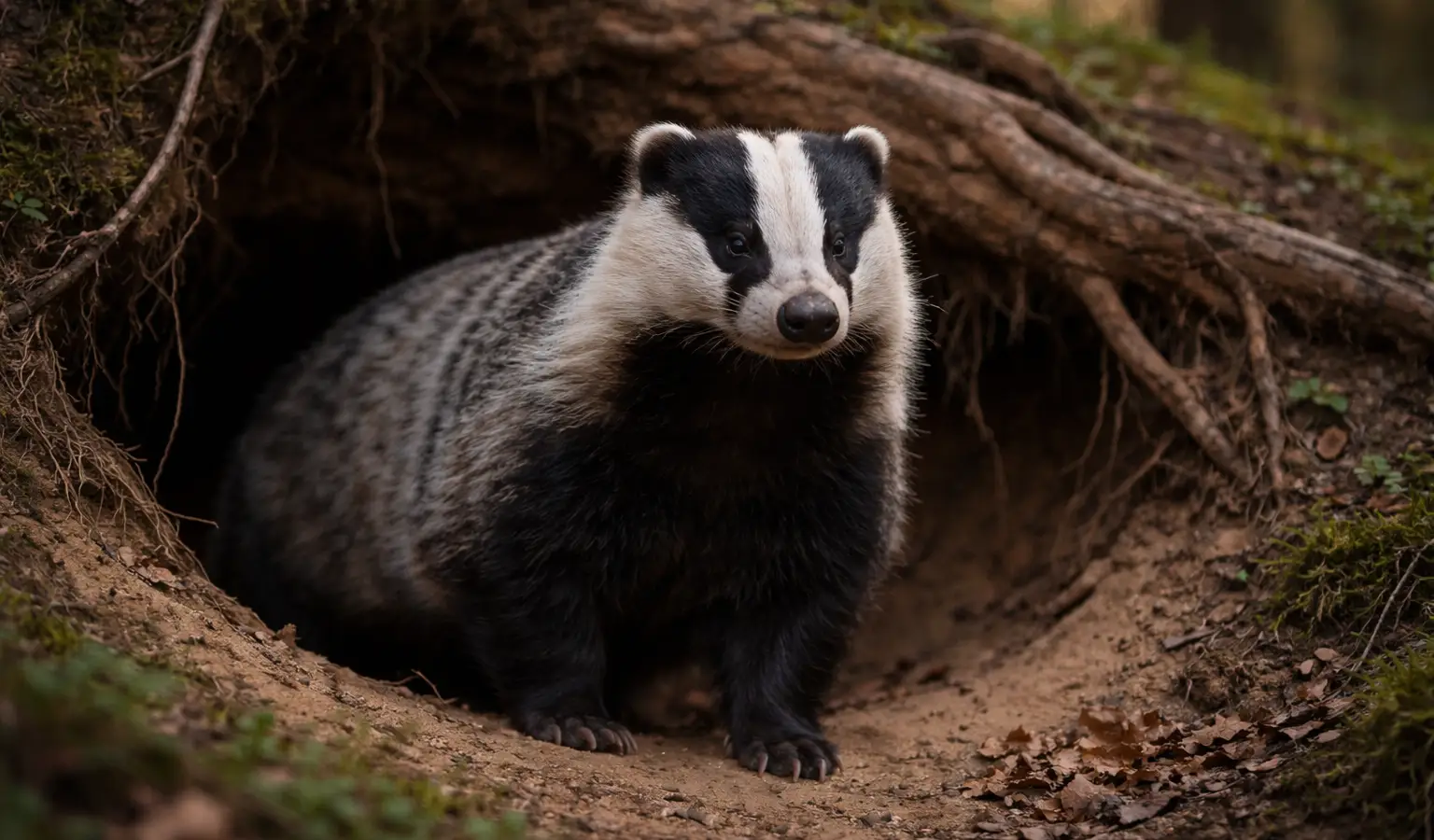
The European badger, Meles meles, is a robust, burrowing carnivoran of the mustelid family and one of the most recognizable nocturnal mammals in temperate Eurasia. It is best known for its black-and-white striped face, powerful digging ability, and complex underground homes called setts. Although often grouped with predators or pest species in management language, the badger is in reality a highly adaptable omnivore whose ecology links woodland, pasture, hedgerows, and field margins.
In the field, badgers are more often detected by their signs than by direct sight. Fresh digging, well-used paths, latrines, and spoil heaps around sett entrances often reveal their presence long before an animal is seen. Their mostly nocturnal habits, cautious temperament, and strong attachment to territory make them an important species for wildlife observation and for understanding how mammals use mixed agricultural and forest landscapes.
From an ecological perspective, the badger plays several roles at once. It consumes earthworms, insects, fruit, carrion, and small vertebrates, helping recycle nutrients and move energy across habitats. Its digging disturbs and aerates soil, while fruit consumption may contribute to local seed dispersal. In hunting and land management contexts, the species can be relevant because of sett damage, local conflict with farming, disease concerns in some regions, and variable legal treatment depending on national or regional regulation.
Morphology
Morphology
Meles meles is a low-slung, heavily built mammal with a broad body, short neck, short powerful legs, and strong foreclaws adapted for excavation. The head is elongated with a pointed muzzle, small eyes, and relatively small rounded ears. The coat is generally grey to grizzled silver on the back and flanks, with darker underparts and legs. The face is the key identification feature: a white head marked by two bold black stripes running from the snout past the eyes to the ears.
Seen in profile, the badger moves with a deliberate, rolling gait. Its tail is short and not bushy, which helps separate it from foxes at night. Adult size varies by region and season, and body mass changes strongly through the year as fat reserves rise and fall. The measurements sometimes reported in simplified hunting tables can underestimate true adult weight in many populations, so field identification is usually more reliable when based on body shape, head pattern, gait, and digging signs rather than raw dimensions alone.
Habitat and distribution
Habitat and distribution
Habitat
The badger favors a mosaic habitat rather than a single vegetation type. It commonly uses deciduous woodland, mixed forest, scrub edges, hedgerow networks, rough grassland, pasture, and arable country where cover and food are both available. A good badger biotope usually combines safe denning ground with nearby foraging areas rich in earthworms and other invertebrates.
Sett placement is often linked to practical soil and topographic conditions. Well-drained soils, banks, slopes, wooded embankments, and places with stable substrate are preferred because they allow long-lasting burrow systems. In open farmland, badgers often rely on copses, thickets, railway embankments, streamside cover, or neglected corners of the landscape. In drier or poorer soils they may still occur, but sett density and digging patterns can differ.
Human-modified landscapes can support badgers surprisingly well if disturbance is moderate and connectivity remains intact. Forest edges, livestock pasture, and old hedge lines are especially important because they combine daytime security with night feeding routes.
Distribution
The European badger is widely distributed across much of Europe and extends into parts of western and central Asia, though its exact range and local abundance vary with habitat quality, persecution history, road density, disease issues, and legal management. In many countries it is a familiar mammal of lowland farmland and woodland mosaics, but it can also occur in uplands, larger forest blocks, and suburban fringes where cover persists.
Occurrence is rarely uniform. Some regions hold dense populations with numerous occupied setts, while others support scattered family groups separated by less favorable terrain. Soil suitability, food availability, climate, and human pressure all influence local presence. In intensive agricultural zones with little cover, badgers may be restricted to remnant shelter belts or wooded patches, whereas in well-connected landscapes they can be widespread and locally common.
Lifestyle
Lifestyle and behaviour
Diet
The badger is an opportunistic omnivore with a diet that shifts according to season, soil moisture, local prey supply, and habitat type. Earthworms are often a major food source where conditions are suitable, especially in damp grassland and pasture. It also feeds on beetles and other insects, larvae, slugs, small mammals, carrion, eggs when available, and a variety of plant foods including berries, orchard fruit, cereals, bulbs, and roots.
Seasonal feeding patterns are important. In wet periods, badgers may concentrate heavily on worm-rich ground. During drier spells, when worms are less accessible near the surface, they often broaden their diet and use more insects, fruit, grain, or scavenged food. In late summer and autumn, energy intake may rise as individuals build body reserves before winter. This flexibility is one reason the species persists in many different landscapes.
For hunters, land managers, and wildlife observers, understanding diet helps explain movement. Freshly grazed pasture after rain, orchard margins in fruiting season, maize edges, and invertebrate-rich field borders can all attract nocturnal foraging badgers.
Behaviour
Badgers are mainly nocturnal and spend much of the day below ground in setts. Emergence time varies with season, weather, disturbance, and local security. On quiet summer evenings they may appear before full darkness, while in exposed or disturbed areas they often delay movement until later at night. Their behavior is usually cautious rather than fast, and they tend to rely on scent, memory of routes, and immediate access to cover.
When foraging, a badger often moves with purpose along habitual paths, pausing to sniff, root, and dig. It can cover ground steadily but usually remains within a familiar home range. If alarmed, it may retreat directly to cover, dense vegetation, or a sett entrance. Badgers are not agile like foxes in open-country escape, but they are determined, strong, and difficult to dislodge once in burrows.
Territorial behavior is expressed through scent marking, latrines, and repeated use of route networks. Activity levels may decline in severe winter weather, especially in colder parts of the range, but the species is not a true long-distance migrant and does not normally undergo deep hibernation.
Social structure
Unlike many mustelids, the European badger often lives in social groups, commonly called clans, centered on one or more main setts. Group size varies greatly by habitat productivity and regional population density. In rich lowland landscapes, several adults and young may share a territory and a complex underground system, while in poorer or more marginal environments social units may be smaller.
These family groups are not random gatherings. They are organized around stable territories, repeated den use, scent communication, and shared route systems. Individuals may rest together, use different entrances or subsidiary setts, and forage alone or loosely apart at night before returning to the same social center. Social tolerance is often higher within the clan than toward neighboring badgers.
Migration
The badger is essentially sedentary. It does not migrate seasonally over long distances, and most adults remain closely tied to a defined territory centered on a principal sett and supported by subsidiary burrows. Nightly movements are usually local, focused on feeding grounds, patrol routes, and access corridors through cover.
Dispersal mainly concerns younger animals leaving or shifting away from their natal group. This movement can create new sett occupancy or recolonization in suitable habitat, but even dispersing badgers generally move within the broader landscape matrix rather than undertaking true migration. Roads, fragmented habitat, and human disturbance can strongly shape these movements and are important causes of mortality in some areas.
Reproduction
Reproduction
Badger reproduction is biologically unusual and can be difficult to summarize simply because timing may vary and delayed implantation is important in many populations. Mating can occur across a broad part of the year, but successful development of the embryos is often delayed before active gestation proceeds. This means the visible breeding calendar does not always match the first mating event.
Cubs are typically born underground in the main sett, often in late winter or early spring depending on region and conditions. Litters are usually small to moderate in size. The young remain below ground for their first weeks and emerge later in spring as they become more mobile. Female reproductive success can be influenced by food supply, body condition, social rank, and local density.
Because simplified data tables may list a short gestation figure, it is worth noting that the full reproductive cycle in badgers is more complex than a single number suggests. For practical field understanding, the main points are delayed implantation, underground birth, and spring emergence of cubs.
Field signs
Field signs
Badgers often leave very clear field signs once you know what to look for. The most obvious is the sett: a burrow system with one or many oval entrances, often wider than high, accompanied by fresh spoil heaps of excavated earth. Entrances may show bedding material such as dry grass or leaves dragged out or pulled in. Repeated use creates bare, polished ground around the holes.
Well-worn paths are another classic sign. These tracks often link sett entrances to pasture, hedgerows, or woodland feeding areas and may pass under fences through regularly used gaps. Latrines are also important: badgers commonly deposit droppings in small pits, often near territorial boundaries or feeding zones. The dung varies with diet, from dark and soft when worm-rich to more fibrous or fruit-filled later in the season.
Tracks show five toes with claw marks, but prints are not always easy to read in hard ground. Feeding signs include shallow snuffle holes, rooted turf, and small excavations where worms, larvae, or other prey have been sought. Around sett banks, hair caught on rough surfaces and fresh earth on paths can further confirm current activity.
Ecology and relationships
Ecology and relationships
Ecological role
The badger occupies a useful middle position in the ecosystem as both predator and scavenger, while also functioning as a soil engineer. By feeding on worms, insects, larvae, small vertebrates, and carrion, it helps regulate some prey populations and recycle organic matter. Through fruit consumption it may contribute to short-distance seed dispersal, especially in hedgerow and woodland-edge habitats.
Its digging activity has wider effects than many people realize. Setts and feeding excavations disturb, turn, and aerate the soil, which can alter microhabitats for plants and invertebrates. Abandoned or partially used setts may also provide shelter opportunities for other wildlife. In this sense, badgers influence not only food webs but also the physical structure of the ground layer.
Human relationships
Human relationships with badgers are mixed and often shaped by local land use. Many people value the species as one of the most characteristic nocturnal mammals of European countryside, and badger watching is a well-established form of wildlife observation. Setts on quiet woodland edges can become important educational and ecological monitoring sites.
At the same time, conflicts do occur. Digging can damage embankments, tracks, field margins, gardens, and occasionally farm infrastructure. In some regions badgers are discussed in relation to livestock disease, particularly bovine tuberculosis, which makes management socially and politically sensitive. Badgers may also prey opportunistically on ground-nesting eggs or small animals, although the extent of this impact is highly context dependent.
In hunting culture, badgers have historically been pursued in some places, but methods, legality, and social acceptance vary widely. Where control is considered, it is usually tied to specific management objectives rather than general game harvesting, and it should be approached with strong attention to law, welfare, and ecological context.
Legal framework and management
Legal framework and management
Legal status
Legal status varies markedly by country and sometimes by region. In some jurisdictions the badger is fully protected or strongly regulated because of conservation, animal welfare, or disease-management policy. Elsewhere it may be huntable, subject to seasonal take, or controlled under permit in specific circumstances such as damage prevention or official health programs.
Because regulation can change and methods may be tightly restricted, anyone dealing with badgers should verify current law before any intervention. Key points usually include protection of occupied setts, close seasons, authorized control methods, disease-control protocols, and transport or carcass-handling rules. A simple label such as 'huntable' or 'controlled' is rarely enough on its own to reflect the true legal framework.
Management tips
For observation or practical management, start by reading the landscape rather than looking only for the animal itself. Focus on wooded banks, hedge junctions, pasture near cover, and places with diggable soil. After rain, feeding activity can increase on grassland where worms are accessible. Quiet evening watches downwind of active sett areas can be productive, but disturbance should be kept low, especially in the breeding period.
If management concerns arise, the first step should be accurate assessment of occupancy and activity. Not every old hole is an active sett, and not every digging site justifies intervention. Look for fresh spoil, bedding, footprints, path wear, and recent latrine use before drawing conclusions. Mapping main setts, outlier setts, feeding routes, and conflict points helps avoid unnecessary action.
- Confirm current legal status before any control, exclusion, or sett work.
- Use a seasonal approach: breeding, cub dependency, and soil conditions matter.
- Where damage is localized, consider fencing, route diversion, or habitat-based mitigation before lethal measures.
- In disease-sensitive areas, follow official veterinary and wildlife guidance rather than informal practice.
- For hunters and land managers, caution around occupied setts is essential because methods and access rights may be heavily regulated.
Fun facts
Fun facts
The European badger is one of the few mustelids that commonly lives in stable social groups and maintains extensive, multi-generation sett systems. Some main setts can be used for very long periods, with tunnels and chambers expanded over time.
Its striped face is not just distinctive to people; it also makes the species one of the easiest nocturnal mammals to identify in a headlamp or camera-trap image. Despite its sturdy appearance, the badger is a surprisingly versatile feeder, able to switch from worms to fruit, insects, grain, or carrion depending on season and ground conditions.
Another memorable detail is how tidy badgers can be around the sett. They often manage bedding and use specific latrine sites, leaving behind a level of structure and routine that reflects their strong territorial and social organization.