
Wood pigeon
Columba palumbus
A large migratory pigeon widely hunted across Europe.
Type
Bird
Lifespan
6 years
Hunting season
September – February
Edible
Yes
Fact sheet
Wood pigeon
Scientific name
Columba palumbus
Type
Bird
Meat quality
Tasty and firm meat
Edible
Yes
Lifespan
6 years
Incubation
17 days
Size
40-42 cm
Weight
400-600 g
Diet
Seeds, berries, shoots
Status
Huntable
Hunting season
September – February
Breeding season
4 / 5 / 6
Lifestyle and behaviour
Behaviour : Partial migrant, large flocks
Social structure : Large flocks
Migration : Partial migrant
Habitat
- Forest
- Plains
Natural predators
- Birds of prey
Hunting methods
- Blinds
- Standing post
Health risks
- Trichomoniasis
Ecosystem role
- Seed dispersal
Signs of presence
- Feathers
Introduction
General description
The wood pigeon, Columba palumbus, is the largest common pigeon across much of Europe and one of the most familiar migratory game birds in agricultural and wooded landscapes. Often called the common wood pigeon, it is a broad-winged, powerful flier recognized by its white neck patches, white wing markings, and heavy-bodied silhouette. In many regions it is both highly visible and highly adaptable, using forests, hedgerows, farmland, parks, and even suburban edges.
Ecologically, the species matters because it links woodland and open country. Wood pigeons feed on seeds, green plant material, buds, berries, and cultivated crops, then move between roosting woods and feeding areas, helping redistribute plant material and seeds across the landscape. Their numbers can be locally high where food is abundant, especially in mixed farming regions with nearby cover.
In hunting culture, the wood pigeon is a major small game species in many European countries. It is valued for challenging flight, wary behavior, and strong seasonal movement, especially during autumn and winter when flocks may build around feeding grounds or migration routes. At the same time, it is also a widely watched bird, and its presence often reflects how modern farmland, woodland edges, and migratory corridors function together.
Morphology
Morphology
The wood pigeon measures about 40 to 42 cm in length and typically weighs roughly 400 to 600 g, making it noticeably larger and bulkier than most urban pigeons and doves. The body is deep-chested, the head relatively small, and the tail fairly broad. In flight it looks strong, direct, and purposeful, with rapid wingbeats broken by short glides.
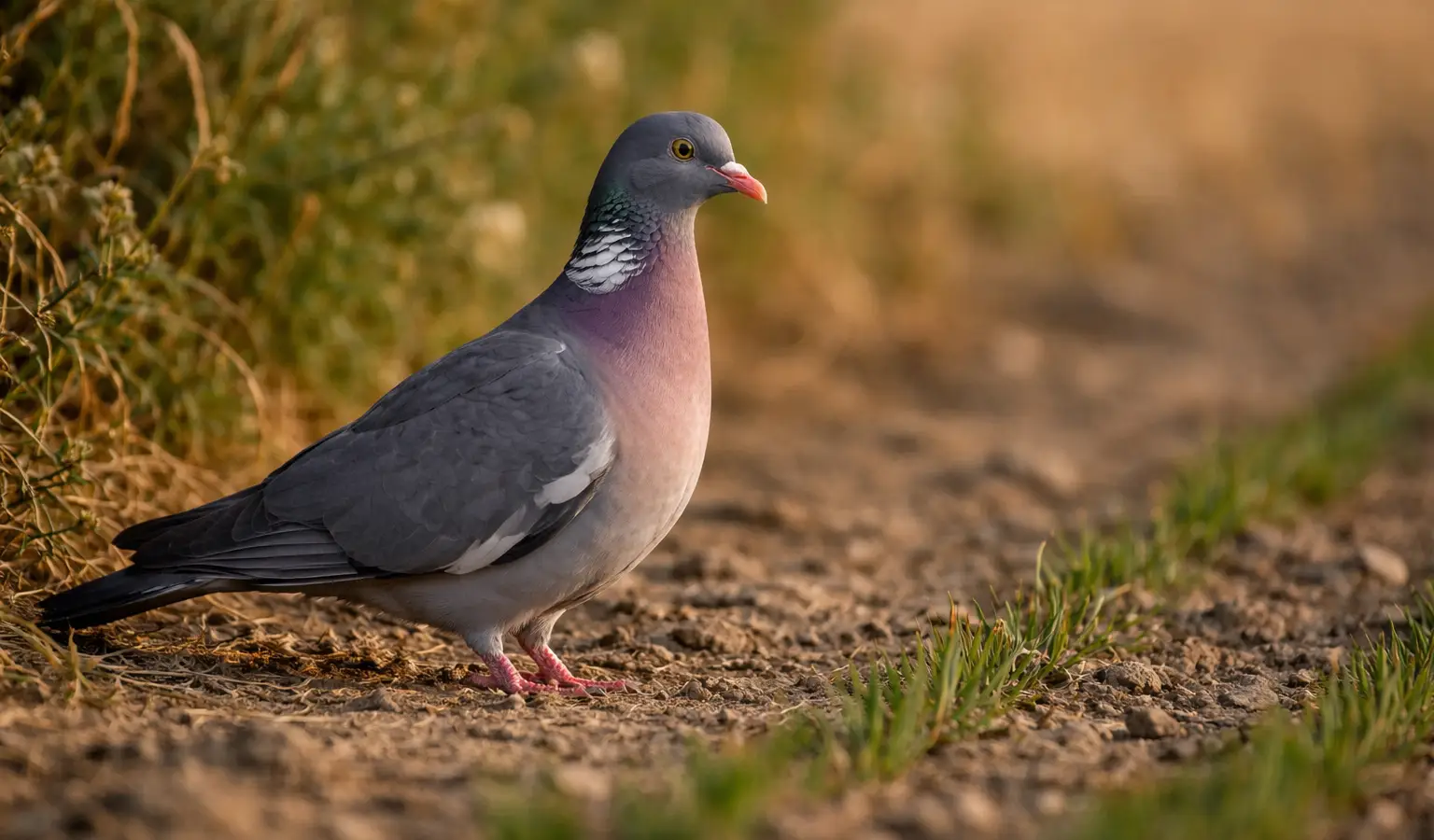
Field identification is usually straightforward at moderate range. Adults are mostly bluish grey, with a pinkish or wine-toned breast, a pale bill with a yellowish tip, and a striking white patch on each side of the neck. The broad white wing bars are especially obvious in flight and are among the best marks for quick identification. Juveniles are duller and generally lack the full white neck patch, which can make them look plainer in late summer and early autumn.
When perched, the species often appears upright and thick-necked. Compared with the stock dove, it is larger and more contrasting; compared with feral pigeons, it usually looks cleaner, greyer, and more uniform, without the variable city-pigeon patterns. The wing clatter of a flushed wood pigeon can also be a useful clue in dense cover.
Habitat and distribution
Habitat and distribution
Habitat
Wood pigeons use a wide range of habitats, but they are especially associated with a mosaic of forest, woodland edge, hedgerows, plains, and cultivated land. They often need two things close together: secure roosting or nesting cover, and reliable feeding areas. This is why mixed landscapes with copses, shelterbelts, hedged fields, pasture, cereal ground, and small woods are often particularly favorable.
They are comfortable in mature woodland, conifer plantations, broadleaf woods, riverine tree lines, and farmed plains with scattered cover. Outside the breeding season they frequently use harvested fields, stubble, rape, legumes, grassland, and acorn-rich woodland margins. In many regions they have also adapted well to parks, golf courses, orchards, and peri-urban green spaces.
At a finer ecological scale, good wood pigeon habitat usually offers daytime feeding areas with visibility, nearby trees for loafing or roosting, and sheltered nesting sites during the breeding season. Heavy disturbance may shift birds elsewhere, but the species is generally adaptable and can tolerate moderate human presence if food and cover remain dependable.
Distribution
Columba palumbus is widely distributed across Europe and extends into parts of western Asia and North Africa. It is common in much of western and central Europe and occurs from Atlantic regions through temperate continental landscapes. In some areas it is resident year-round, while in others it is mainly a breeding bird augmented by passage and wintering flocks.
Occurrence varies with latitude, climate, and food availability. Northern and eastern populations tend to show stronger seasonal movement, while milder western regions often hold large resident or partially migratory populations. During autumn and winter, numbers can increase sharply in favorable lowland farmland and coastal migration zones as birds arrive from colder areas.
Local abundance is often highest where woodland and agriculture meet. In heavily urbanized regions the species may still be present if parks, tree cover, and feeding opportunities remain available. Distribution at the local level can also shift with crop rotation, mast years, winter severity, and hunting pressure.
Lifestyle
Lifestyle and behaviour
Diet
The wood pigeon is primarily a plant feeder, with a diet centered on seeds, berries, shoots, buds, leaves, and agricultural grain. It forages both on the ground and in trees, depending on season and food type. In farmland it may feed on spilled cereals, emerging crops, brassicas, clover, peas, beans, and other cultivated plants; in more wooded country it also takes acorns, beech mast, berries, and tender shoots.
Diet changes through the year. In spring and early summer, green plant material, shoots, and buds can become important. In late summer and autumn, seeds, grain, and mast often dominate. During winter, birds may concentrate where stubble, winter crops, ivy berries, or other dependable food sources remain accessible. This seasonal flexibility helps explain the species' success across different biotopes.
Wood pigeons have a well-developed crop and can feed quickly before moving to safer loafing cover. In agricultural settings, this habit may bring them into conflict with growers when local flocks are dense, especially around freshly sown fields or vulnerable leafy crops.
Behaviour
Wood pigeons are mainly diurnal and spend much of the day moving between roost sites, loafing trees, and feeding grounds. They are often most active early in the morning and again later in the afternoon, especially in open country where midday disturbance or bright conditions may reduce visible movement. Their daily pattern often follows a practical rhythm: leave cover, feed in fields, rest in trees, then return to feed before evening.
In the field, the species is alert and often wary, particularly where it is regularly hunted. Birds on open ground commonly post sentinels or react quickly to unusual movement, vehicle stops, or changes in skyline. Once alarmed, they rise fast with loud wing noise and often gain height before swinging toward safer woodland or a distant line of trees.
Flight is strong and direct, but wood pigeons can also approach feeding areas with caution, circling several times before committing. In settled weather they may follow habitual routes between roost and feeding sites. During migration or cold-weather movements, larger streams of birds may pass high overhead, especially along ridges, coastlines, river valleys, and other guiding landscape features.
Social structure
The wood pigeon is often seen in pairs during breeding and in large flocks outside the nesting season. This flexible social structure is one of the species' defining traits. During spring, territorial behavior becomes more obvious around nesting areas, with pairs holding space in trees or woodland edges. Even then, suitable habitat may support many pairs in relative proximity.
After breeding, family groups begin to merge into larger feeding assemblies. By autumn and winter, wood pigeons may form sizeable local or migratory flocks, especially where crops, mast, or safe roosts concentrate birds. Flock size can vary from a few individuals to many dozens or more, depending on region and season.
These groupings are not random. Birds often gather where food is temporarily rich and where access to nearby cover reduces risk. Roosting can also be communal, particularly in sheltered woods, dense conifers, or mature tree belts used repeatedly over time.
Migration
The wood pigeon is best described as a partial migrant. Some populations are largely resident, while others undertake regular seasonal movements, sometimes over considerable distances. Migration intensity depends strongly on geography, weather, and food availability. Birds breeding in colder northern or eastern areas are generally more likely to move south or west for winter.
Autumn passage is often the most visible movement period. Flocks may travel along broad fronts but are frequently funneled by coastlines, mountain passes, river valleys, and open corridors. In milder winters, some birds remain close to breeding areas, while others continue moving until they reach favorable feeding grounds and frost-free conditions.
Winter movements can also be dynamic rather than fixed. Severe cold, snow cover, or depleted food may trigger secondary displacement, and spring return migration may be more diffuse. This mixture of resident birds, local dispersers, and true migrants is important when interpreting seasonal abundance in the field.
Reproduction
Reproduction
The breeding season usually begins in spring, though timing varies with latitude and weather and may start earlier in mild regions. Courtship includes display flights, bowing, and soft vocalizations, with the male often advertising from prominent perches or during short aerial displays. The nest is a rather flimsy platform of twigs placed in a tree, hedge, dense shrub, or wooded edge.
A typical clutch contains two eggs. Incubation lasts about 17 days, with both adults taking part. As in other pigeons, the young are initially fed nutrient-rich crop secretion produced by the parents, then gradually receive more solid food. Nestlings grow quickly but remain dependent on suitable cover and regular adult attendance.
Wood pigeons can raise more than one brood in a favorable season, especially where food is abundant and disturbance is limited. This potential for repeated nesting contributes to the species' resilience. However, breeding success can still be affected by predation, poor weather, nest exposure, and local habitat quality.
Field signs
Field signs
Wood pigeon presence is often easier to detect through repeated signs than by direct sighting alone. The most obvious clue is often feathers beneath plucking posts, roost trees, or raptor feeding points. Roost sites may also show accumulations of droppings under conifers, mature broadleaf trees, or sheltered woodland edges used repeatedly by flocks.
Feeding signs can include trampled patches in crops, pecking on seedlings or leafy plants, and concentrations of birds on stubble, rape, clover, or recently drilled fields. Beneath favored trees, observers may find clipped buds, berry remains, or scattered droppings. In mast years, birds may gather around acorn or beech-rich edges where repeated take-off and landing polish the pattern of use into the site.
Auditory clues matter too. The species' five-note cooing is familiar in the breeding season, while flushed birds produce a loud wing clap that often reveals hidden presence before the bird is seen. At dawn and dusk, commuting lines between woods and fields can be one of the most reliable field signs of regular use.
Ecology and relationships
Ecology and relationships
Ecological role
Wood pigeons play several roles in temperate ecosystems. They are significant consumers of seeds, buds, berries, and green vegetation, linking woodland, scrub, and farmland through daily movement and seasonal dispersal. By feeding widely and then moving between habitats, they contribute to seed dispersal, particularly for some berry-bearing plants and species taken from wooded edges.
They also serve as prey for birds of prey, including large hawks and other avian predators able to exploit their regular commuting flights. In productive landscapes, wood pigeons can form an important part of the prey base for raptors. Their nesting and roosting behavior may also influence local nutrient deposition beneath favored trees and roost sites.
Because they respond quickly to changes in cropping, mast production, and disturbance, wood pigeons can also function as a useful indicator of how food resources and cover are distributed across a working landscape.
Human relationships
The relationship between people and the wood pigeon is complex and often practical rather than symbolic. It is a widely recognized game bird in Europe and is pursued in traditional and modern forms of hunting, including blinds and standing post approaches where legal and customary. Hunters value the species for its sharp eyesight, variable flight lines, and the need for good fieldcraft, especially around feeding routes, decoying situations, and migration watch points.
At the same time, farmers may regard dense local flocks as a source of crop pressure, particularly on young brassicas, legumes, or newly sown ground. Elsewhere, birdwatchers and general observers appreciate the species as one of the most conspicuous large pigeons of countryside and parkland. It is also edible and commonly used as table game in regions with strong culinary traditions.
Good coexistence usually depends on local context: crop type, season, available natural food, roost proximity, and legal management options. Public attitudes can differ sharply between urban observers, rural land managers, and hunting communities, so discussions around the species are often shaped by place and season.
Legal framework and management
Legal framework and management
Legal status
The wood pigeon is commonly considered huntable in many European countries, but the exact legal framework varies by nation and sometimes by region. Open seasons, permitted methods, bag limits, migration-period restrictions, and rules for crop protection can differ substantially. A stated hunting period such as September to February may apply in some contexts, but it should never be assumed universal.
As a migratory bird, the species is typically managed under both national wildlife law and broader conservation frameworks that regulate hunting periods and acceptable methods. Closed seasons generally aim to protect breeding activity and, in some jurisdictions, parts of migration. Local derogations or damage-control measures may exist where crop impacts are documented, but these are highly regulated in many places.
Anyone observing, managing, or hunting wood pigeons should verify current local law each season. Legal status can change with conservation assessments, disease concerns, agricultural policy, and updates to bird protection regulations.
Management tips
Effective wood pigeon management starts with reading the landscape rather than focusing only on individual birds. The key is to identify the relationship between feeding areas, roost cover, loafing trees, and regular flight lines. In many places, pressure on a field makes sense only if the site is close enough to secure cover for birds to use it consistently.
- Watch fields at first light and late afternoon to identify true feeding peaks rather than occasional visits.
- Check crop stage, recent drilling, harvest residue, and nearby mast sources before interpreting local abundance.
- Map roost woods, hedge lines, and sheltered approach routes; wood pigeons often reuse predictable movement corridors.
- Distinguish resident use from passage movement. A migration day can create heavy overhead traffic without much local feeding pressure.
- Where health concerns arise, monitor for signs of disease such as poor condition or abnormal mouth lesions consistent with trichomoniasis, and follow local wildlife health guidance.
- Use caution around repeated disturbance during the breeding period, especially in nesting woods and hedgerows.
For habitat management, a balanced mosaic tends to hold birds most consistently. For crop protection or hunting relevance, timing matters more than constant effort: food availability, weather shifts, and recent disturbance often determine where flocks settle from one day to the next.
Fun facts
Fun facts
- The wood pigeon is the largest widespread pigeon in much of Europe, which is why it often looks surprisingly robust beside town pigeons.
- Its white neck patches and bold white wing bars make it one of the easiest pigeons to identify in flight.
- Unlike many people expect from a heavy-bodied bird, it is a fast, powerful migrant capable of long seasonal movements.
- Parents feed newly hatched chicks with a special crop secretion often called pigeon milk.
- In favorable years, wood pigeons can attempt multiple broods, helping populations recover quickly where food and nesting cover are good.
- Although strongly associated with woods, many of the largest flocks are seen over open farmland, showing how dependent the species is on landscape mosaics rather than forest alone.