
Western capercaillie
Tetrao urogallus
Europe’s largest wild grouse, a sensitive forest species hunted only very locally under strict rules.
Type
Bird
Lifespan
12 years
Hunting season
Très réglementée, octobre à décembre
Edible
Yes
Fact sheet
Western capercaillie
Scientific name
Tetrao urogallus
Type
Bird
Meat quality
Lean meat
Edible
Yes
Lifespan
12 years
Incubation
27 days
Size
70-90 cm
Weight
3.5-5 kg
Diet
Herbivore: buds, shoots, conifer needles, seeds
Status
Hunted only very locally, strict regulation
Hunting season
Très réglementée, octobre à décembre
Breeding season
4 / 5
Lifestyle and behaviour
Behaviour : Solitary, territorial males, spring displays
Social structure : Solitary, territorial males
Migration : Local within forest areas
Habitat
- Forest
- Mountain
Natural predators
- Fox
- Birds of prey
Hunting methods
- Blinds
Health risks
- Avian parasites
Ecosystem role
- Seed dispersal
Signs of presence
- Ground tracks
- Feathers
Introduction
General description
The Western capercaillie, Tetrao urogallus, is the largest native grouse in Europe and one of the most emblematic birds of mature mountain and boreal forest. Often simply called capercaillie or wood grouse, it is a bird of old conifer-dominated landscapes, forest mosaics, and quiet upland habitat where cover, food, and breeding space still coincide. Its presence is widely treated as a sign of relatively intact forest structure, because the species is sensitive to disturbance, fragmentation, and changes in ground vegetation.
For field naturalists, the capercaillie is best known for the spectacular spring display of the male at traditional lekking grounds. For wildlife managers, it is a demanding small game species whose conservation status and hunting relevance vary strongly by region. In many areas it has declined or become highly localized, which is why any hunting remains exceptional and tightly controlled.
Ecologically, the Western capercaillie links forest understory, shrub layers, seed production, and predator-prey dynamics. Culturally, it occupies a special place in European hunting history and mountain forest lore, but modern discussion around the species is increasingly shaped by habitat management, recreation pressure, and the need for cautious long-term population monitoring.
Morphology
Morphology
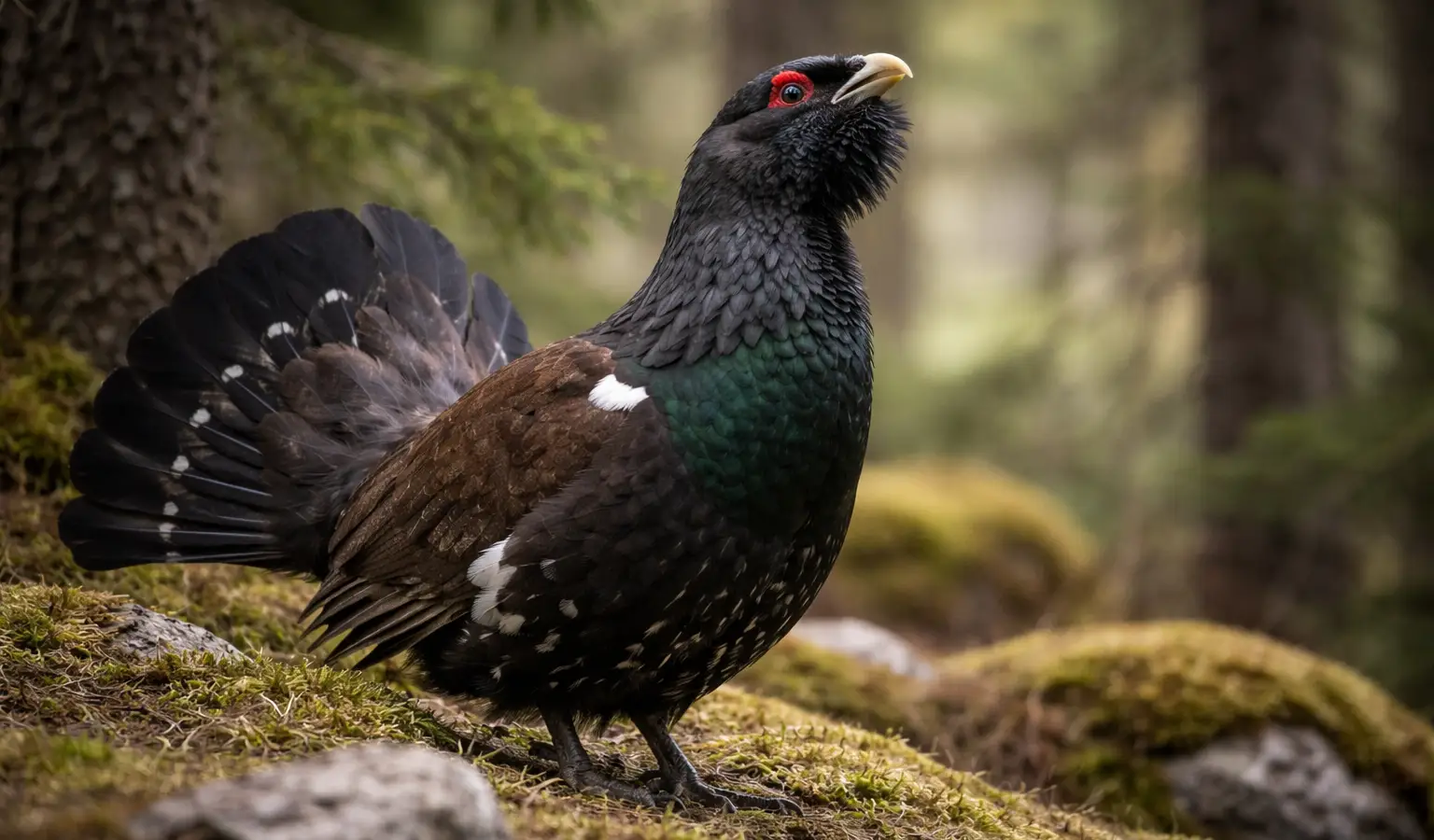
The Western capercaillie is a large, heavy-bodied grouse with strong sexual dimorphism, making males and females look strikingly different in the field. Adult males are much larger, typically around 70 to 90 cm in length and often weighing roughly 3.5 to 5 kg, with a bulky chest, broad rounded tail, and powerful neck. Their plumage appears dark overall at distance, but closer views may show a slate-black to charcoal body, glossy green sheen on the breast, reddish eyebrow combs, and a fan-shaped tail displayed prominently in spring.
Females are much smaller and more cryptically colored, with mottled brown, buff, black, and rusty patterning that provides camouflage on the forest floor. This hen-like appearance can cause confusion with other grouse, but the Western capercaillie female is still relatively large, long-bodied, and robust. Both sexes have feathered legs adapted to cold conditions, and the bill is short, pale, and sturdy. In flight, the species looks broad-winged and heavy, often producing a sudden, forceful flush from the forest floor or low branches.
Habitat and distribution
Habitat and distribution
Habitat
The Western capercaillie is primarily a bird of extensive forest habitat, especially mature coniferous and mixed mountain forest with structural diversity. It favors landscapes that combine older trees for cover and roosting, openings or lighter stands for ground vegetation, and a rich understory with bilberry, heather, dwarf shrubs, mosses, and other feeding resources. In many regions, Scots pine, spruce, fir, and mixed montane forests provide the most suitable biotope.
Good capercaillie habitat is rarely just dense woodland. The species generally benefits from a mosaic of shelter and visibility: enough cover to feel secure, but also enough spacing, edge structure, and sunlight for ground-layer growth. Hens with chicks especially depend on areas rich in insects and low vegetation during early summer. Heavy fragmentation, intensive forestry, repeated disturbance, or simplification of the understory can reduce habitat quality quickly.
In mountainous areas, the species often uses forest belts, ridges, slopes, and quiet upper-valley woodland. In northern Europe it may occupy boreal forest over broad lowland landscapes. Local use of habitat changes with season, snow conditions, and the need for breeding, feeding, and shelter.
Distribution
Tetrao urogallus has a broad but fragmented Palearctic distribution extending from parts of western and central Europe across northern forests into areas of northern Asia. Within Europe, the Western capercaillie persists mainly in Scandinavia, parts of the Alps, the Carpathians, sections of the Balkans, and some remaining strongholds in central and eastern forest systems. In western and southern parts of its range, occurrence is often patchy and populations may be isolated.
Its current distribution is shaped less by simple geography than by forest continuity, habitat quality, climate, and human pressure. In some countries it remains locally common in suitable boreal habitat; in others it survives only in restricted mountain blocks or protected forest landscapes. Search interest often focuses on where to see capercaillie, but the answer is highly regional: presence can vary sharply even between neighboring valleys or forest districts.
Lifestyle
Lifestyle and behaviour
Diet
The Western capercaillie is largely herbivorous, with a diet that changes by season and age class. Adults feed heavily on buds, shoots, leaves, berries, seeds, and conifer needles, especially in winter when other food sources become limited. Pine and other conifer needles can be especially important in cold months, allowing the bird to remain in forest habitat year-round.
During spring and summer, the diet broadens to include fresh plant growth, flowers, berries, and a variety of seeds. Hens and growing chicks use productive feeding areas where soft vegetation and small invertebrates are available. Although adults are commonly described as herbivores, chicks depend strongly on protein-rich insects in their earliest life stages, which makes weather and ground-layer productivity important to brood survival.
Feeding signs may include clipped shoots, use of berry-rich patches, and droppings beneath favored roost or feeding trees in winter.
Behaviour
The Western capercaillie is generally wary, quiet, and difficult to observe outside the breeding season. It spends much of its time on the ground while also using low or mid-level branches for resting, feeding, or shelter. Daily activity often peaks around dawn and dusk, although local weather, snow cover, disturbance, and season can alter movement patterns.
When surprised, a capercaillie may first rely on stillness and camouflage, especially a female. If pressed, it can leave explosively with loud wingbeats, often threading through trees with impressive power despite its size. Males are typically more conspicuous in spring, when they become highly territorial and perform ritualized displays at traditional lek sites. These displays include posturing, tail fanning, vocalizations, and reduced attention to surroundings, which historically made displaying birds vulnerable to disturbance and overharvest.
Outside the breeding season, the species often keeps a low profile. In severe weather it may reduce unnecessary movement and remain within sheltered forest zones that provide both food and thermal cover.
Social structure
The Western capercaillie is largely solitary for much of the year. Adult males maintain separate territories or display areas during the breeding season, and their spacing reflects both habitat structure and local population density. Males gather loosely at lekking grounds, but this is not a cooperative social group in the way seen in flocking birds; rather, it is a breeding aggregation shaped by competition and display.
Females are usually more discreet and range through suitable cover, especially during nesting and brood-rearing. After hatching, a hen remains with her chicks and guides them to sheltered feeding habitat. Temporary loose associations can occur outside the breeding season, particularly among younger birds or where food and cover concentrate individuals, but the species is not strongly gregarious overall.
Migration
The Western capercaillie is generally considered a resident or only locally mobile forest bird rather than a true migrant. Most movements are short-range and tied to seasonal feeding areas, snow conditions, breeding grounds, or the need for shelter within a forested landscape. In that sense, its migration pattern is best described as local movement within forest areas.
Young birds may disperse from natal areas, sometimes over meaningful distances for a forest grouse, but the species still depends on habitat continuity or functional connectivity between woodland blocks. In mountainous terrain, small elevational shifts may occur between seasons, especially where winter food and shelter differ from summer brood habitat.
Reproduction
Reproduction
Breeding is centered on spring display, when adult males advertise at traditional lek sites through posture, sound, and territorial behavior. Females visit these display areas to select mates, after which they nest alone on the ground, usually in a shallow scrape concealed by vegetation, fallen branches, or low cover. Nest placement is crucial because eggs and chicks are vulnerable to predators and disturbance.
Clutch size varies, but the female typically lays several eggs and incubates them for about 27 days. After hatching, the chicks are precocial, leaving the nest quickly and feeding under the hen's guidance. Early brood survival depends heavily on weather, insect availability, and cover quality. Cold, wet conditions during the first days and weeks can sharply reduce chick survival in some populations.
Sexual maturity, breeding success, and recruitment all vary by habitat quality and regional population conditions. Because the species reproduces slowly relative to the speed at which disturbance and habitat change can affect it, population recovery may be uneven.
Field signs
Field signs
Field signs of Western capercaillie are often subtle but distinctive when interpreted in the right habitat. Ground tracks can be found on mud, soft forest roads, snow, or sandy patches, showing a large grouse print with three forward-pointing toes and a strong, widely spaced stance. In winter, feathered toes may leave softer-edged impressions that differ from those of smaller grouse.
Droppings are a useful sign, especially beneath winter feeding trees or regular roosts. They are often cylindrical and may vary with diet, becoming more fibrous when birds feed heavily on conifer needles. Feathers can be found near roost sites, dusting areas, display grounds, or places where a bird was taken by a predator. Display areas may also show repeated use through trampled ground, droppings, feathers, and regular male presence in spring.
Observation often depends on reading habitat first: mature forest edges, bilberry-rich understory, quiet ridges, and lightly disturbed openings are more informative than random searching.
Ecology and relationships
Ecology and relationships
Ecological role
The Western capercaillie plays several ecological roles within temperate and boreal forest ecosystems. As a consumer of buds, shoots, berries, seeds, and conifer needles, it is part of the seasonal flow of plant matter through the forest food web. By feeding on fruits and seeds, it may contribute modestly to seed dispersal in suitable habitats, especially in shrub-rich forest mosaics.
It is also an important prey species for natural predators such as foxes and birds of prey, while eggs and chicks are especially vulnerable to a wider range of predators. Because the species responds strongly to forest structure, understory condition, and disturbance, it is often treated as an indicator of broader woodland quality. Where capercaillie populations remain viable, they can signal the persistence of large-scale, connected, low-disturbance forest habitat with functional breeding and feeding conditions.
Human relationships
The relationship between people and the Western capercaillie is a mix of admiration, caution, and local controversy. It is one of Europe's most famous forest game birds, yet also one of the clearest examples of a species whose hunting relevance has diminished in many places because conservation needs now outweigh harvest opportunities. Where it still exists in huntable numbers, hunting is generally very limited, highly regulated, and often restricted to specific local contexts.
Beyond hunting, the capercaillie is valued by birdwatchers, photographers, foresters, and mountain communities as a flagship species of quiet forest landscapes. At the same time, human recreation can create real pressure, particularly near lek sites or brood habitat. Ski touring, forest roads, repeated off-trail disturbance, dogs, and intensive tourism infrastructure may all affect habitat use and breeding success if poorly managed.
The species is also edible, as with other grouse, but this has little practical importance in many modern contexts compared with the larger questions of habitat conservation and population resilience.
Legal framework and management
Legal framework and management
Legal status
The legal status of the Western capercaillie varies markedly by country and sometimes by region. In many parts of Europe, populations are protected or effectively not hunted because numbers are too low, too fragmented, or too sensitive to sustain harvest. Where hunting remains legal, it is usually subject to strict regulation, limited seasons, licensing controls, local quotas, and close monitoring.
Available local information indicates that any hunt season is very tightly regulated, often falling in autumn, such as roughly October to December where permitted. However, this should never be generalized without checking current national and regional legislation. For a species like Tetrao urogallus, legal access can change with population trends, management plans, conservation assessments, and protected-area rules.
Anyone seeking to observe, photograph, or hunt capercaillie should consult official local regulations and avoid assumptions based on past practice or conditions in another country.
Management tips
Effective capercaillie management begins with habitat, not harvest. The species generally benefits from large, connected forest blocks with a varied age structure, secure cover, and productive ground vegetation. Managers often focus on maintaining understory quality, limiting excessive fragmentation, preserving lekking areas, and reducing disturbance during sensitive periods such as spring display and brood-rearing.
- Protect known lek sites from repeated disturbance, especially in spring.
- Maintain a mosaic of mature trees, open structure, and shrub-rich ground layers.
- Avoid overly dense, uniform stands that suppress field-layer vegetation.
- Retain habitat connectivity between breeding, feeding, and shelter areas.
- Monitor predator pressure, recreation pressure, and local population trends carefully before considering any harvest.
- Use great caution with forest operations during nesting and chick-rearing periods.
For observers and hunters alike, restraint is part of good management. Repeatedly pushing birds from winter habitat, approaching lek sites, or concentrating activity in small remnant populations can have effects disproportionate to the number of birds seen.
Fun facts
Fun facts
- The Western capercaillie is the largest grouse in Europe, giving it an outsized place in forest folklore and wildlife culture.
- Spring lek displays are among the most famous breeding spectacles of European woodland birds.
- The male's fan-shaped tail, swollen posture, and red eye combs make a displaying bird look dramatically larger than it does at rest.
- Despite its heavy build, a capercaillie can burst into flight with surprising speed and power through dense timber.
- Its dependence on quiet, structurally rich forest makes it a classic indicator species for the health of upland and boreal woodland habitat.
- Winter survival is closely tied to the bird's ability to live on tough conifer-based food when many other resources are scarce.