
Weasel
Mustela nivalis
A very agile small mustelid, managed differently depending on country.
Type
Mammal
Lifespan
3 years
Hunting season
Selon réglementation
Edible
No
Fact sheet
Weasel
Scientific name
Mustela nivalis
Type
Mammal
Meat quality
-
Edible
No
Lifespan
3 years
Gestation
34 days
Size
16-26 cm
Weight
50-100 g
Diet
Small rodents, birds, insects
Status
Huntable or controlled depending on country
Hunting season
Selon réglementation
Breeding season
4 / 5 / 6
Lifestyle and behaviour
Behaviour : Nocturnal, very active, extremely agile
Social structure : Solitary
Migration : Sedentary
Habitat
- Forest
- Farmland
Natural predators
- Fox
- Birds of prey
Hunting methods
- Trapping
Health risks
- Avian parasites
Ecosystem role
- Micromammal population regulation
Introduction
General description
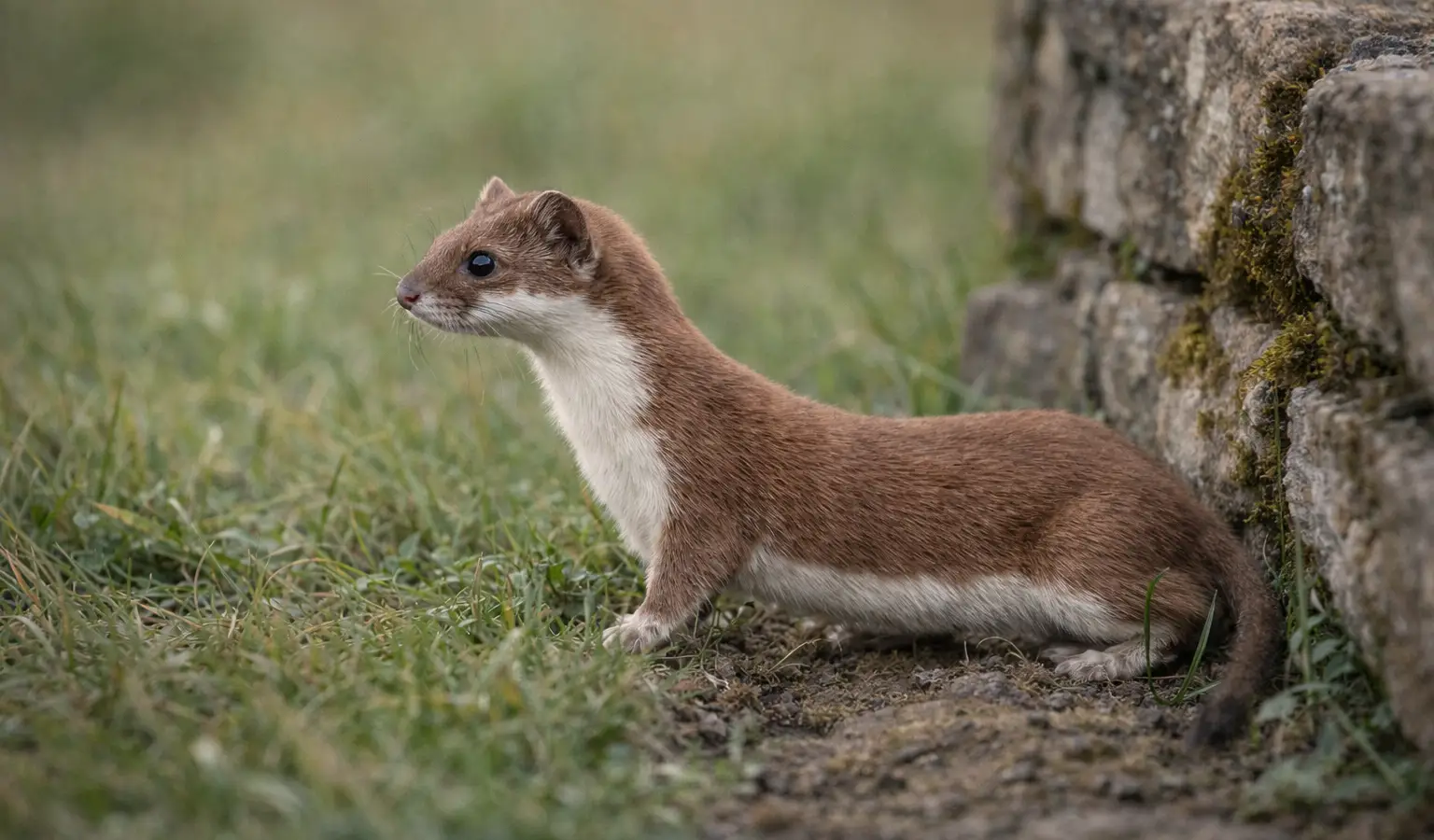
The weasel, Mustela nivalis, is the smallest member of the weasel family and one of the most efficient small predators found in farmland, woodland edges, rough grassland, stone walls, hedgerows, and around old buildings. Despite its tiny size, it is a highly specialized hunter built to pursue prey into narrow burrows and dense cover. In many landscapes it is noticed only briefly, often as a fast chestnut-brown flash crossing a path or slipping through vegetation.
Ecologically, the weasel plays an important role in regulating populations of voles, mice, and other small mammals. This can make it beneficial in agricultural settings where rodent pressure affects crops, feed stores, or young plantings. At the same time, its predatory habits may bring it into conflict with people where small poultry, gamebird chicks, or captive birds are vulnerable, which helps explain why management and legal treatment vary from one country to another.
For wildlife observers, trappers, land managers, and hunters interested in predator ecology, the weasel is a species worth understanding in detail. Its biology reflects a classic mustelid strategy: intense activity, rapid movement, solitary behavior, strong territorial use of cover, and a high-energy lifestyle linked to frequent hunting. Because it is small, elusive, and often active in thick cover or low light, it can be under-recorded even where it is locally present.
Morphology
Morphology
Mustela nivalis is a very small, slender mammal with a long body, short legs, a narrow head, small rounded ears, and a relatively short tail compared with stoats. Typical body length is around 16 to 26 cm, with weight often in the range of 50 to 100 g, although size can vary by sex, region, and subspecies. Females are usually noticeably smaller than males.
The upperparts are generally warm brown to reddish-brown, while the underparts are white or pale cream, creating a clear contrast. Unlike the stoat, the tail lacks a distinct black tip, which is one of the most useful field identification features where both species occur. The body is extremely flexible, allowing the animal to enter vole runs, cracks in walls, woodpiles, and burrow systems that larger predators cannot use.
In winter, coat color may remain brown and white in many areas, though some northern populations can become much paler or even white depending on climate and local adaptation. In the field, the weasel often appears as a compact but elongated predator with a quick, darting gait, rapid head movements, and a restless, highly alert posture.
Habitat and distribution
Habitat and distribution
Habitat
The weasel favors habitats that combine prey abundance with close cover. It is especially associated with farmland mosaics, pasture edges, hay meadows, hedgerows, ditches, rough grass, woodland margins, scrub, orchards, dry stone walls, and areas around barns or sheds where rodents are common. In forest landscapes it is more often linked to rides, clearings, edges, and structurally diverse ground layers than to uniform dense stands.
The best weasel habitat usually contains abundant vole or mouse populations and a network of safe travel routes such as hedge bases, tussocky grass, root tangles, rock piles, brush heaps, and field margins. It tends to avoid prolonged exposure in open ground unless prey density is very high or cover is available in short intervals.
This species is adaptable and may also use suburban gardens, allotments, and older farm buildings when access to prey is good. Moisture, soil type, snow cover, and local land use influence occupancy, but the common factor is usually the presence of small mammals and enough structural complexity to support concealed movement and hunting.
Distribution
The weasel has a broad distribution across much of Europe, Asia, and parts of North Africa, and it has also been introduced in some regions outside its original range. Within Europe it is widely known, although local abundance can vary greatly depending on agricultural intensity, prey cycles, winter severity, and landscape structure.
At country scale, the species may appear common yet remain unevenly detected because of its secretive nature and small size. It can occur from lowland farmland to upland areas where prey and shelter remain available, but local populations often rise and fall with vole numbers. In some regions it may be genuinely scarce, while in others it is simply overlooked.
Distribution patterns should therefore be interpreted cautiously. A lack of sightings does not always mean absence, especially in dense hedgerow country, rough grassland, or fragmented woodland where weasels can persist at low visibility.
Lifestyle
Lifestyle and behaviour
Diet
The weasel is a carnivorous specialist of small prey, feeding primarily on small rodents such as voles and mice. This prey base is the foundation of its ecology and strongly influences breeding success, territory size, activity patterns, and local abundance. Because of its high metabolic demands, a weasel must hunt frequently and efficiently.
Although micromammals are usually the core of the diet, Mustela nivalis may also take small birds, nestlings, eggs, shrews, reptiles, amphibians, and large insects when available. Seasonal opportunities matter: ground-nesting birds may be more vulnerable in spring and early summer, while insects or alternative small vertebrates may be taken when rodent numbers drop.
Its hunting method relies on speed, surprise, and the ability to follow prey into tunnels, cavities, and dense cover. In agricultural landscapes this makes the weasel one of the more effective natural regulators of vole populations, though its impact varies with prey density, habitat structure, weather, and competition from other predators.
Behaviour
The weasel is extremely active, nervous, and agile, rarely staying still for long. It often hunts by moving in short bursts along linear cover, investigating holes, scent points, and vole runs with constant alertness. Although it is frequently described as nocturnal, its activity can occur by day, at dusk, or at night depending on disturbance, prey activity, season, and local conditions.
Its movement is low, rapid, and fluid, with repeated pauses to scan and scent-check the surroundings. When alarmed, it may freeze briefly, slip into cover, dive into a wall or burrow, or zigzag through vegetation. The species is bold in relation to its size but depends heavily on concealment and speed rather than prolonged confrontation.
In cold or prey-rich periods, hunting effort may be concentrated in small productive patches. In more difficult conditions, individuals may range more widely between cover features. Because the species has high energetic needs, periods of rest are usually short and interspersed with repeated foraging bouts.
Social structure
The weasel is primarily solitary. Adult males and females usually maintain separate home ranges, with male ranges often larger and potentially overlapping those of several females. Direct association is generally brief and mainly linked to mating.
Territorial use is shaped by prey distribution, habitat connectivity, and population density. Scent is important in communication, and individuals may mark key routes, den sites, or feeding areas. Encounters between adults outside the breeding context are often avoided through spacing behavior rather than constant direct conflict.
Young remain with the female only during the dependent stage. Once independent, they disperse to establish their own ranges if habitat and prey allow. In productive farmland or edge habitat, several individuals may live relatively close together without forming true social groups.
Migration
The weasel is a sedentary species rather than a true migrant. Most individuals live within relatively small home ranges centered on food-rich cover, den sites, and regular hunting routes. Movements are therefore best understood as local ranging behavior rather than seasonal migration.
However, dispersal does occur, especially among young animals leaving the maternal area. These movements may be short or more extensive depending on habitat continuity, prey abundance, winter conditions, and competition. In fragmented farmland, hedgerows, ditch lines, stone walls, and rough margins can function as movement corridors.
At times of prey shortage, individuals may expand their search area or shift use toward farm buildings, stacks, or sheltered edges where rodents remain available. Even then, the species remains fundamentally resident in character.
Reproduction
Reproduction
Breeding in the weasel can vary with latitude, climate, and especially food supply. Where prey is abundant, reproduction may begin in spring and continue through favorable months, while poor rodent years can reduce breeding output. The gestation period is often around 34 days, and females may raise more than one litter in a good season.
Litter size is variable but can be relatively large for such a small mammal. Young are born blind, helpless, and dependent in a sheltered nest site such as a burrow, cavity in a wall, pile of stones, wood stack, root system, or similar protected location lined with dry vegetation or fur. Growth is rapid, reflecting the species' short life expectancy and high turnover.
Sexual maturity may be reached quickly in favorable conditions, though this can differ between populations. With a lifespan often only a few years in the wild, annual breeding success is critical to local persistence, and population trends may closely track the rise and fall of small rodent populations.
Field signs
Field signs
Field signs of weasels are often subtle. Tracks are tiny and can be difficult to interpret unless substrate conditions are excellent. In mud, fine dust, or snow, prints may show five toes, but not every toe registers clearly. The trail pattern often appears in short bounds, especially when the animal is moving quickly between cover points.
Droppings are slender, dark, and twisted, sometimes left on stones, logs, path edges, or other slight prominences used as scent points. They may contain fur, tiny bones, feathers, or insect fragments. A musky odor can occasionally be noticeable at denning or marking spots.
Useful indirect signs include sudden rodent remains near walls or hedge bases, repeated use of vole runs, entrances to cavities in stone piles, and small prey caches in sheltered places. Brief visual sightings remain one of the most common ways the species is detected. Distinguishing weasel from stoat is especially important: the absence of a black tail tip is a key clue.
Ecology and relationships
Ecology and relationships
Ecological role
The weasel is an important mesopredator in many terrestrial ecosystems, particularly in farmland and mixed edge habitats. Its main ecological role is the regulation of micromammal populations, especially voles and mice. In years of high rodent abundance, it can respond quickly and exert meaningful predation pressure at very local scale.
Because it targets small prey in burrows, grass tussocks, and confined spaces, it occupies a niche that larger predators cannot exploit as efficiently. This makes Mustela nivalis a valuable component of predator diversity. It can influence prey behavior as well as prey numbers, changing how rodents use cover and forage.
The weasel also serves as prey for larger carnivores and raptors, including foxes and birds of prey. In that sense it links lower trophic levels to higher ones, transferring energy through the food web. Its presence often indicates a functioning small-mammal community and structurally complex ground habitat.
Human relationships
Human views of the weasel are mixed and often depend on local context. In farming landscapes it may be appreciated as a natural controller of mice and voles, especially where rodent damage affects feed, stored grain, or crops. For wildlife watchers, it is a striking and charismatic species despite being small and hard to observe well.
Conflicts arise where weasels gain access to vulnerable captive birds, eggs, or very small poultry. In game management settings, concerns may also focus on predation of nests or chicks, although the actual level of impact varies by habitat, prey conditions, and the broader predator community. Because it is not eaten and is rarely seen in the open for long, its relevance is usually practical rather than sporting.
Where control is permitted, it is generally linked to trapping and must be approached with legal, ethical, and welfare considerations. Misidentification with other small mustelids can create management errors, so careful species recognition is important before any intervention.
Legal framework and management
Legal framework and management
Legal status
The legal status of the weasel varies significantly by country and sometimes by region. In some places it is protected, in others it may be classed as huntable, trappable, or controllable under specific conditions, and elsewhere its status may change over time in response to conservation reviews or predator management policy.
Because of this variation, no single rule can be assumed. Anyone considering observation, trapping, predator control, or land management measures involving Mustela nivalis should consult current national and local regulations, including closed seasons, permitted methods, animal welfare rules, and any site-specific restrictions.
Where hunting seasons are described broadly as dependent on regulation, that should be understood literally: the lawful period and method are determined by the competent authority. Regulatory updates can occur, so current official sources matter more than general summaries.
Management tips
Good weasel management starts with accurate habitat reading. Look first for strong small-mammal habitat: rough margins, grassy banks, hedge bottoms, ditches, stone walls, rank corners, and field edges with vole activity. Where these features are abundant, weasels may be present even if sightings are rare.
If the goal is observation or ecological monitoring, focus effort at dawn, dusk, or calm daylight periods along linear cover and prey-rich edge habitat. Snow, soft mud, and lightly dusted tracks around farm buildings can improve detection. Camera placement should target narrow funnels such as wall gaps, hedge bases, woodpile edges, and vole run intersections.
If management concerns exist around poultry, aviaries, or gamebird rearing, prevention is usually better than reacting late. Secure mesh, exclusion of access points, rodent-proof feed storage, and removal of easy shelter immediately around vulnerable enclosures can reduce attraction and entry opportunities. Any control action should follow local law strictly and should only be considered after correct identification and a clear assessment of actual damage.
Fun facts
Fun facts
- The weasel is the smallest carnivorous mammal in many parts of its range. Its tiny body is built to chase prey into spaces that larger predators cannot enter.
- It is often mistaken for a stoat. The easiest field clue is the tail: a weasel lacks the stoat's black tail tip.
- Its shape is an adaptation, not an accident. The long body and short legs are ideal for hunting through burrows, wall crevices, and thick ground cover.
- It lives fast. With a short lifespan and high energy demands, a weasel spends much of its life hunting.
- A tiny predator can have a big effect. In vole-rich farmland, local weasels may contribute significantly to micromammal population control.