
Tufted duck
Aythya fuligula
A common diving duck of lakes and reservoirs.
Type
Bird
Lifespan
10 years
Hunting season
September – January
Edible
Yes
Fact sheet
Tufted duck
Scientific name
Aythya fuligula
Type
Bird
Meat quality
Strong-flavoured meat
Edible
Yes
Lifespan
10 years
Incubation
28 days
Size
40-50 cm
Weight
500-800 g
Diet
Omnivore: mollusks, insects, aquatic plants
Status
Huntable under regulations
Hunting season
September – January
Breeding season
4 / 5
Lifestyle and behaviour
Behaviour : Diving duck, lives in flocks
Social structure : Groups
Migration : Migratory
Habitat
- Wetland
- Lake
Natural predators
- Birds of prey
Hunting methods
- Hunting hide
Health risks
- Avian parasites
Ecosystem role
- Aquatic invertebrate regulation
Introduction
General description
The tufted duck, Aythya fuligula, is a compact diving duck widely recognized across lakes, reservoirs, gravel pits, urban park waters, and sheltered wetlands. It is one of the most familiar diving ducks in much of Europe and parts of Asia, often seen sitting low on the water before disappearing in a quick, clean dive. Unlike dabbling ducks that tip up in shallow margins, the tufted duck feeds mainly by submerging completely, which shapes both its habitat use and its daily behavior.
This species has real ecological importance in freshwater systems because it exploits aquatic invertebrates, mollusks, and plant material in open water and along submerged feeding grounds. In many regions it is also a useful indicator of productive still-water habitats with suitable depth, food resources, and resting security. Large winter flocks can gather on reservoirs and lakes where feeding areas and undisturbed roosting water coincide.
In wildlife observation, the tufted duck is valued as an accessible and distinctive waterfowl species. In hunting contexts, where legally huntable, it is usually considered part of the broader waterfowl assemblage rather than a species tied to highly specialized pursuit. Its presence often reflects seasonal movement, weather pressure, water conditions, and human disturbance. Understanding Aythya fuligula means reading both the bird and the wetland: depth, shelter, feeding beds, and the rhythm of migration all matter.
Morphology
Morphology
The tufted duck is a medium-sized diving duck, typically about 40 to 50 cm long and commonly weighing around 500 to 800 g, though body mass can vary with sex, season, and condition. It has a compact body, relatively short neck, rounded head profile, and a posture that sits low in the water, all classic features of a true diving duck.
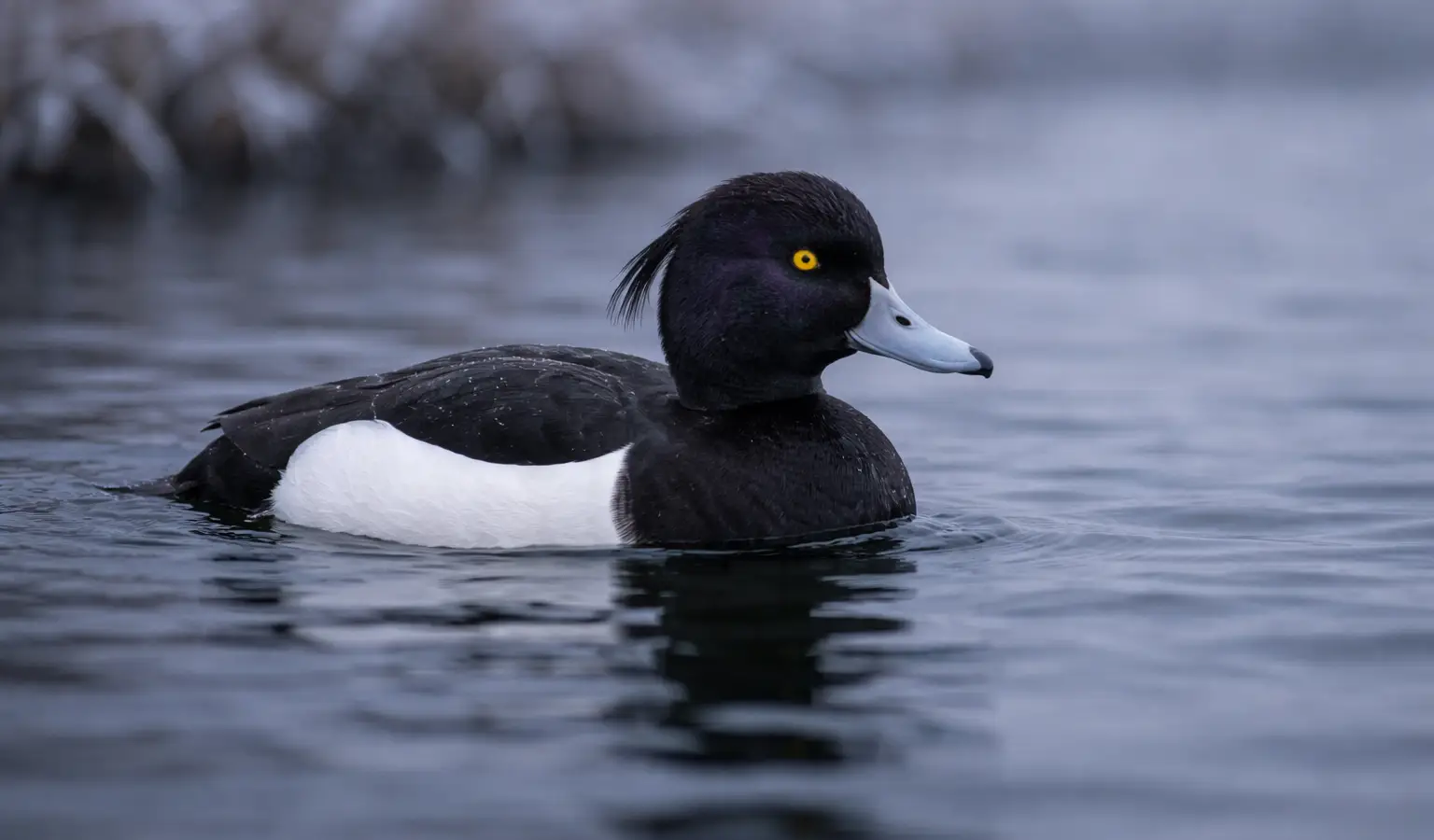
The adult male is especially distinctive in breeding plumage: glossy black on the head, chest, and back, contrasting with bright white flanks, a yellow eye, and the characteristic drooping head tuft that gives the species its common name. The female is generally dark brown with paler flanks, also often showing a tuft, though it is usually shorter and less striking. Females can vary considerably in tone, and some show pale areas around the base of the bill. Juveniles and eclipse males can be less obvious, so observers should rely on the overall shape, diving behavior, dark upperparts, and the yellow eye when visible.
In flight, the tufted duck appears fast and direct, with relatively narrow wings and a dark overall impression relieved by a pale wing stripe. On the water, it can be separated from many dabbling ducks by its deeper body, rounded head, tendency to raft in open water, and repeated diving rather than surface feeding.
Habitat and distribution
Habitat and distribution
Habitat
The tufted duck prefers freshwater habitats with enough depth for diving and enough food in the water column or on the bottom. Typical habitat includes lakes, reservoirs, flooded gravel workings, large ponds, sheltered wetlands, and slow sections of broader waterways. It often favors open water with nearby cover such as reedbeds, islands, vegetated margins, or undisturbed banks that provide loafing and nesting opportunities.
During winter and migration, it commonly uses larger water bodies where conditions remain ice-free and food is available. Artificial waters can be highly important, especially reservoirs and former extraction pits that develop rich submerged feeding areas. In some regions it also occurs in estuaries or brackish coastal lagoons, although it is generally more associated with inland waters than many sea ducks.
From a habitat-reading perspective, the species often responds to a combination of depth, prey availability, shelter from disturbance, and secure daytime resting zones. Where hunting pressure, boating, or repeated disturbance is high, birds may shift toward deeper central water or use sites primarily at night and twilight.
Distribution
Aythya fuligula has a broad Palearctic distribution, breeding across much of northern and temperate Eurasia and wintering farther south and west where waters remain usable. It is especially familiar across Europe, where it occurs as both a breeding bird and a winter visitor depending on latitude and local conditions.
In many western and central European areas, tufted ducks are present year-round but numbers often increase strongly in autumn and winter with arrivals from northern and eastern populations. Farther north and east, breeding birds may be strongly migratory because freezing conditions reduce access to open water. In milder regions, some populations are more sedentary or only partially migratory.
Occurrence at local scale can vary from year to year according to winter severity, water management, eutrophication, disturbance, and shifts in food resources such as zebra mussels or other aquatic invertebrates. As a result, reservoirs and wetlands that hold modest numbers one season may support substantial flocks in another.
Lifestyle
Lifestyle and behaviour
Diet
The tufted duck is an omnivore with a strong preference for animal food in many situations, especially aquatic invertebrates. Mollusks, small snails, mussels, insect larvae, crustaceans, and other submerged prey can form an important part of the diet. Aquatic plants, seeds, and vegetative material are also taken, sometimes in greater proportion depending on season, habitat, and local food supply.
Because it is a diving duck, feeding usually involves repeated short dives to gather food from the bottom or from submerged vegetation. On productive lakes and reservoirs, mollusks can be especially important. On shallower wetlands or nutrient-rich waters, insect larvae and mixed plant material may become more prominent. Young birds rely heavily on protein-rich invertebrates during growth.
Seasonal variation matters. In colder months, tufted ducks often concentrate where reliable submerged food remains accessible in open water. During breeding, females need areas that combine secure cover with high-quality foraging. Their feeding ecology links them closely to wetland productivity and water quality.
Behaviour
The tufted duck is a primarily diurnal and crepuscular waterfowl species, though local feeding patterns can shift with disturbance, weather, and hunting pressure. Its most characteristic behavior is repeated diving: birds disappear quickly with little splash, remain underwater briefly, then resurface and often pause before diving again. Compared with many surface-feeding ducks, it spends more time on open water and less time tipping up along shorelines.
Outside the breeding period it is often strongly gregarious, resting in flocks and moving as a group when alerted. On exposed waters, birds commonly remain well offshore during the day, especially where human activity is frequent. They are alert but not always visibly nervous until pressure increases; once disturbed, they may paddle away, dive repeatedly, or take off in a compact group to relocate to quieter water.
Daily rhythm often includes alternating bouts of feeding, preening, sleeping, and rafted resting. In cold weather or on heavily used waters, some feeding may occur more at dusk, dawn, or night. During breeding, behavior becomes more localized, with pairs using sheltered zones near nest cover while still relying on nearby open water for feeding.
Social structure
For much of the year, the tufted duck lives in groups. Small parties, loose rafts, and larger winter flocks are all typical, especially on reservoirs and major lakes. This social structure improves collective vigilance and helps birds exploit productive feeding sites while retaining access to safe resting water.
During the breeding season, social organization becomes more dispersed. Pairs form and occupy nesting areas in suitable cover near water, though the species is not strongly territorial in the same way as some more solitary waterfowl. Several pairs may nest around the same wetland where habitat quality is high.
After breeding, sociality increases again as birds gather during moult, migration, and wintering. Flock size can vary greatly with habitat extent, weather, and regional movement, from a few birds on small ponds to substantial concentrations on major open waters.
Migration
The tufted duck is a migratory species overall, but migration is highly flexible across its range. Northern and continental populations are often strongly migratory, moving south or west as waters freeze. Birds from milder regions may be only partially migratory or may remain close to breeding areas if open water persists through winter.
Autumn movements usually build from late summer into winter, and local numbers often peak after cold snaps push birds onto larger ice-free lakes, reservoirs, and coastal refuges. Spring migration tends to be more diffuse, with birds gradually returning toward breeding grounds as conditions improve.
At local scale, movement is not just long-distance migration. Tufted ducks also shift between feeding and roosting waters, redistribute in response to disturbance, and change sites according to water levels, food resources, and hunting pressure. This makes them a dynamic species whose presence on a given wetland can change rapidly over the season.
Reproduction
Reproduction
The breeding season generally begins in spring, with timing influenced by latitude, water conditions, and local climate. The female builds a nest close to water, usually in concealed vegetation such as dense grasses, reed margins, low scrub, or on sheltered islands. Nest placement tends to favor cover and reduced disturbance while remaining within practical reach of feeding water.
A clutch commonly contains several eggs, and incubation is carried out mainly by the female for about 23 to 28 days. After hatching, ducklings leave the nest quickly and follow the female to water. As with many ducks, the young are precocial: they feed themselves soon after hatching but still depend on the hen for guidance, brooding, and protection during early development.
Breeding success can vary widely with water-level fluctuation, predation, spring weather, disturbance, and food availability for ducklings. Productive wetlands with stable margins, rich invertebrate life, and sheltered brood habitat generally support better recruitment than exposed waters with heavy recreational pressure.
Field signs
Field signs
Field signs of tufted duck are usually detected through observation of the birds themselves rather than obvious ground traces. The most reliable sign is a flock of compact diving ducks resting on open water, often forming a raft and repeatedly diving over the same feeding zone. On productive lakes, birds may surface with small prey items or forage persistently over submerged beds.
Physical signs on shore are often limited because the species spends much of its time afloat. Feathers may occasionally be found near roosting margins, sheltered islands, or sites used for preening and moulting. Droppings can occur on favored loafing structures, banks, pontoons, or islands, but they are usually not distinctive enough on their own for confident identification without supporting observation.
For practical field reading, useful clues include:
- Repeated diving in open water rather than dabbling in the shallows
- Grouped resting behavior on lakes and reservoirs
- Use of sheltered water during windy or disturbed conditions
- Feeding concentrations over deeper zones rich in mollusks or aquatic invertebrates
- During breeding, discreet use of vegetated margins near open water
Tracks are rarely a primary identification tool for this species except close to nests or loafing edges, where webbed prints may appear briefly in mud.
Ecology and relationships
Ecology and relationships
Ecological role
The tufted duck plays an important ecological role in freshwater food webs by consuming aquatic invertebrates, especially mollusks and insect larvae, and by linking submerged prey resources to higher trophic levels. Through this feeding activity, it contributes to the regulation of aquatic invertebrate communities and participates in energy transfer within lakes and wetlands.
As both predator and prey, it occupies a middle position in wetland ecology. Eggs, ducklings, and occasionally adults may be vulnerable to birds of prey and other predators, while the ducks themselves influence benthic and submerged communities through concentrated feeding. Their habitat use can also reflect broader wetland condition, including water quality, productivity, and the availability of undisturbed open water.
In some waters, large seasonal concentrations of diving ducks can become ecologically significant in their own right, shaping nutrient cycling locally through feeding and roosting patterns. The species therefore matters not only as an individual bird of interest but also as part of the broader functioning of wetland ecosystems.
Human relationships
The tufted duck has a close relationship with people because it readily uses human-made waters such as reservoirs, park lakes, settlement ponds, and gravel pits. This makes it one of the diving ducks many people encounter most often, whether through birdwatching, angling landscapes, urban nature observation, or wetland management.
In hunting culture, where regulations allow, it is regarded as a huntable waterfowl species, often encountered incidentally in broader duck hunting from a hide or on managed wetland systems. Its use of open water, tendency to raft, and sensitivity to disturbance mean that excessive pressure can quickly alter local behavior and distribution. Ethical and legal identification is especially important because mixed flocks may include similar diving ducks and protected species depending on region.
For managers and land users, coexistence issues are usually moderate compared with some agricultural species, but water quality, shoreline disturbance, boating, and repeated flushing can all affect local use. The tufted duck is also of interest in public education because it helps illustrate the difference between diving ducks and dabbling ducks in an easily observable way.
Legal framework and management
Legal framework and management
Legal status
Legal status varies by country and sometimes by region, flyway rules, and annual wildlife management measures. In the context provided here, the tufted duck is considered huntable under regulations. Open seasons, permitted methods, bag limits, protected areas, and species identification requirements must always be checked in current local law before any hunting activity.
In many jurisdictions, waterfowl regulations are shaped by migratory bird frameworks and may change with conservation assessments, disease controls, or local population concerns. The indicated hunting season of roughly September to January fits a common autumn-winter pattern in some areas, but exact dates should never be assumed without consulting official sources.
Outside hunting law, the species may also be covered by general bird protection measures related to nesting sites, protected wetlands, reserve boundaries, and restrictions on disturbance. Because status can differ across its range, the most responsible approach is to rely on up-to-date national and regional regulations.
Management tips
Good tufted duck management starts with water. Wetlands, lakes, and reservoirs that combine open water, moderate depth, secure resting areas, and productive submerged feeding habitat are the most consistently valuable. Maintaining a mosaic of open water and vegetated margins generally supports both feeding adults and breeding females.
Where the species is present regularly, practical management points include:
- Limit repeated disturbance on key resting waters, especially in winter and during moult
- Retain or restore sheltered shoreline vegetation and island cover for nesting
- Monitor water quality and aquatic productivity, since food availability drives use
- Avoid abrupt water-level changes during the breeding period where possible
- Read pressure carefully: boating, shoreline traffic, and hunting intensity can displace birds from otherwise suitable habitat
- In hunting areas, prioritize clear identification and awareness of mixed diving-duck flocks
For observation or census work, dawn and dusk can be especially informative, particularly on pressured sites. In management terms, a water body that appears empty by day may still function as an important nocturnal feeding site or as a refuge after disturbance elsewhere.
Health surveillance also matters. Like other waterfowl, tufted ducks can carry avian parasites and may be affected by broader wetland disease issues, so unusual mortality events should be taken seriously and referred through appropriate wildlife health channels.
Fun facts
Fun facts
The tufted duck is one of the easiest diving ducks to learn once you understand its silhouette: compact body, low floating posture, yellow eye, and in many birds a noticeable head tuft.
Despite its elegant appearance, it is a hard-working underwater forager. A calm flock on the surface can hide constant feeding effort below, with birds diving again and again over the same productive patch.
It often thrives on artificial waters. Reservoirs, gravel pits, and park lakes have helped make Aythya fuligula a familiar species far beyond remote natural wetlands.
For hunters and birdwatchers alike, the tufted duck is a useful lesson in waterfowl ecology: where dabbling ducks search the surface and margins, this species belongs to the deeper, diving side of the wetland world.