
Thrush
Turdus
A migratory songbird valued in hunting and cuisine.
Type
Bird
Lifespan
5 years
Hunting season
October – February
Edible
Yes
Fact sheet
Thrush
Scientific name
Turdus
Type
Bird
Meat quality
Tasty meat
Edible
Yes
Lifespan
5 years
Incubation
13 days
Size
23-27 cm
Weight
80-120 g
Diet
Omnivore: fruits, seeds, insects
Status
Huntable locally
Hunting season
October – February
Breeding season
4 / 5
Lifestyle and behaviour
Behaviour : Migratory, small flocks or solitary
Social structure : Small groups
Migration : Migratory
Habitat
- Forest
- Plains
Natural predators
- Birds of prey
Hunting methods
- Driven pass
- Standing post
Health risks
- Avian parasites
Ecosystem role
- Seed dispersal
Signs of presence
- Feathers
- Calls
Introduction
General description
The name thrush covers several medium-sized songbirds in the genus Turdus, a group that includes some of the most familiar migratory birds of woodland edges, hedgerows, orchards, and open country with scattered cover. In practical field use, the term often refers to huntable thrushes that move seasonally through Europe and nearby regions. These birds are valued both by birdwatchers for their calls and migration and, in some areas, by hunting traditions and regional cuisine.
A thrush is typically recognized by its compact but elegant shape, direct flight, alert posture, and a feeding style that alternates between hopping on the ground and pausing upright to scan. Although species within Turdus differ in plumage and migration strategy, they broadly share an omnivorous diet, a strong link to fruiting vegetation, and an important role in seed dispersal. Their seasonal presence can change quickly with weather, food supply, and migration pressure, which makes them especially relevant to people who read landscapes closely.
From an ecological perspective, thrushes connect forest, scrub, farmland, and plain habitats by moving seeds and feeding heavily on invertebrates during part of the year. In hunting contexts, they are usually associated with passage periods and cold-season movements, when birds may appear singly, in loose groups, or in localized concentrations around feeding and shelter areas. Understanding a thrush means understanding movement, habitat mosaics, weather effects, and the fine-scale rhythm of migration.
Morphology
Morphology
Thrushes of the genus Turdus are medium-sized birds, here generally around 23 to 27 cm in length and roughly 80 to 120 g in weight depending on species, condition, and season. They have a fairly streamlined body, medium-length tail, rounded wings, and a straight to slightly slender bill suited to taking both soft fruits and invertebrates. The legs are relatively strong, reflecting their frequent ground-feeding behavior.
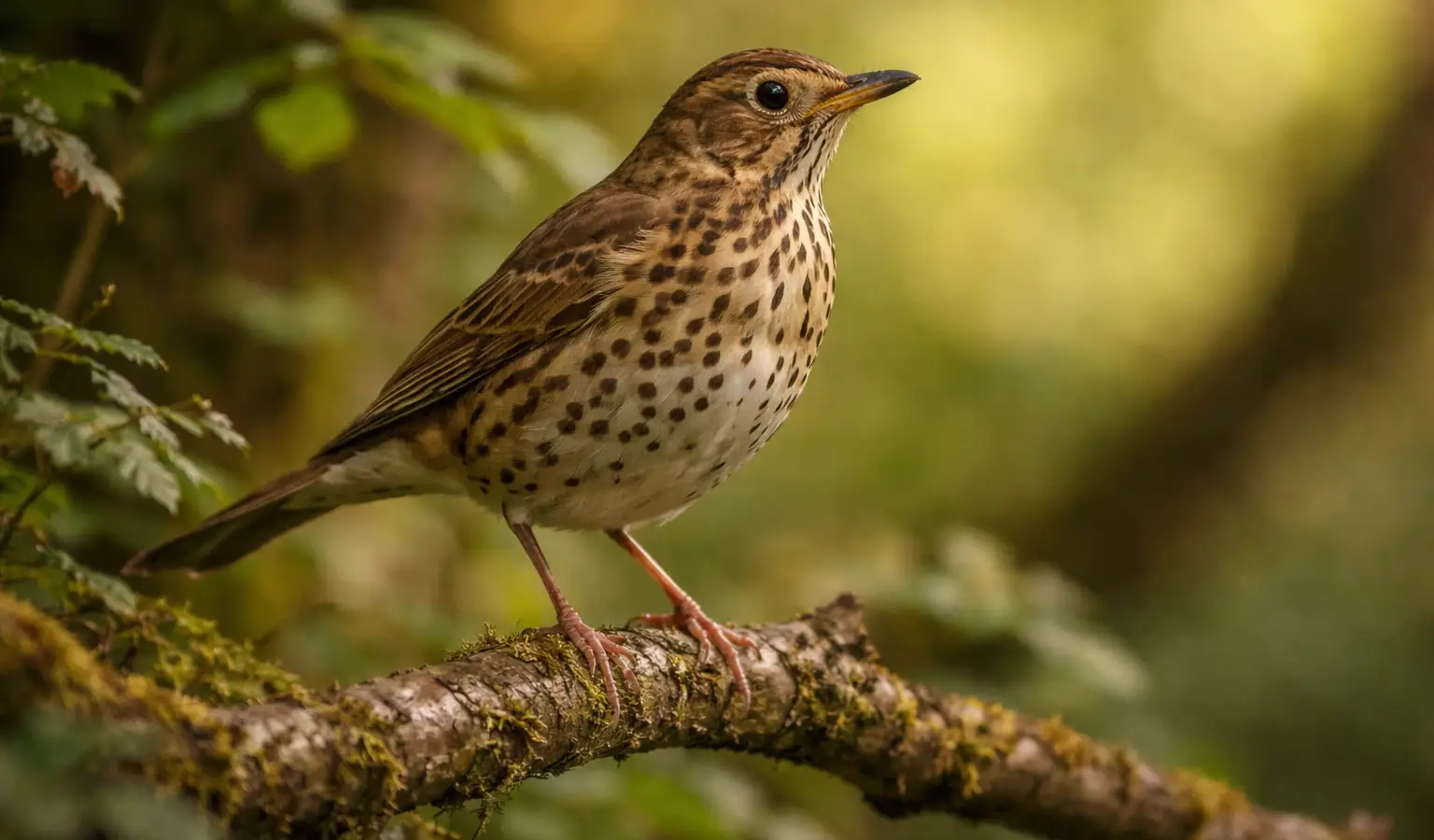
Field identification often relies on overall silhouette, underpart patterning, back color, and the contrast between breast, flanks, throat, and belly. Many thrushes show brown, olive-brown, gray-brown, or chestnut tones above, with paler underparts that may be plain, washed, or marked with spots or arrow-like mottling. The eye is usually dark and expressive, and some species show a distinct pale eyebrow, eye-ring, or warm-toned flanks.
In flight, a thrush appears fast and purposeful, with steady wingbeats and brief glides. At distance, shape and movement can be as important as plumage. Sexes are often fairly similar in many Turdus species, while juveniles may show more buff or spotted upperparts than adults. For reliable identification in the field, observers usually combine size, call, habitat, and season rather than relying on one mark alone.
Habitat and distribution
Habitat and distribution
Habitat
Thrushes favor a broad range of habitats, but most are closely tied to environments that combine cover, feeding ground, and seasonal fruit supply. Typical biotopes include deciduous and mixed woodland, forest edges, hedgerow networks, scrub, orchards, olive groves in some regions, and open plains with bushes, tree lines, or small copses. They often use transition zones rather than dense uniform cover alone.
During migration and winter, thrushes frequently select sheltered sites that reduce wind exposure and offer easy access to berries, fallen fruit, seeds, moist soil, or leaf litter rich in invertebrates. In colder weather they may concentrate in valleys, south-facing slopes, hedged farmland, and areas with persistent food resources. When ground conditions harden under frost, fruit-bearing vegetation can become especially important.
Breeding habitat varies by species within Turdus, but many prefer wooded territory with nesting sites in shrubs, trees, or dense cover and with nearby feeding areas. In practical terms, the best thrush habitat is often not the most spectacular forest block, but a varied mosaic where woodland, clearings, pasture, cultivation, and shrubby margins meet.
Distribution
The genus Turdus is widely distributed across Europe, Asia, Africa, and the Americas, but in a migratory-bird context the most relevant thrushes are those moving across Europe and the Mediterranean basin. Their occurrence can be highly seasonal. Some populations breed in northern or temperate zones and shift southward or westward in autumn, while others are resident or only partially migratory.
Local abundance may change sharply from one week to the next depending on cold fronts, wind direction, rainfall, food availability, and broader migration dynamics. Coastal belts, mountain passes, river corridors, plains with hedgerows, and well-structured farmland can all receive passage birds. In winter, concentrations may form where shelter and fruiting vegetation remain available.
Because the term thrush can refer to several species, precise distribution depends on the exact Turdus species involved. For field interpretation, it is often more useful to think in terms of passage routes, wintering zones, and feeding refuges than to assume a uniform presence everywhere within the broad range.
Lifestyle
Lifestyle and behaviour
Diet
Thrushes are omnivorous birds whose diet commonly includes fruits, seeds, and insects, with other invertebrates such as worms, larvae, beetles, snails, and small arthropods also taken when available. Their feeding ecology is notably seasonal. In mild, wet conditions they often exploit soil invertebrates on lawns, tracks, pasture edges, and leaf litter. In autumn and winter they may rely much more heavily on berries, drupes, and fallen orchard fruit.
This dietary flexibility is one reason Turdus species adapt well to mixed landscapes. Hedgerow fruits, wild berries, ivy, hawthorn, juniper, and other fleshy fruits can become critical during migration or cold spells. In cultivated areas, thrushes also use stubble, field margins, and recently worked ground where seeds and invertebrates are accessible.
Feeding behavior is usually deliberate: short hops, brief pauses, head tilts, and sudden picks from the ground or low vegetation. Seasonal condition and migration stage can influence food choice. Birds preparing for or recovering from movement often benefit from energy-rich fruit, while breeding birds generally need more animal protein for themselves and their chicks.
Behaviour
Thrush behavior is marked by caution, mobility, and a strong response to changing weather and disturbance. Most activity occurs from first light through early morning and again later in the afternoon, though feeding can continue throughout the day in quiet conditions. During migration and winter, birds may spend long periods alternating between feeding grounds and sheltered resting cover.
In the field, thrushes are often alert and quick to flush. When disturbed they may launch suddenly from the ground or low bush, fly low and direct toward cover, then drop out of sight. Others pass overhead at height during active migration, especially with favorable winds or after weather changes. Their calls are often a major clue before the bird is clearly seen.
Behavior can vary with hunting pressure, predator presence, and habitat openness. In heavily disturbed areas thrushes may feed more discreetly near dense margins and move earlier or later in the day. In calm, low-pressure settings they can be surprisingly confiding while foraging. Frost, fog, and rain also alter daily patterns by changing both visibility and access to food.
Social structure
Thrushes are often encountered singly or in small groups, especially when feeding or moving between cover patches. Loose flocking is common during migration and winter, but it is usually less cohesive than in strongly gregarious birds. Individuals may share the same feeding area without forming a tight social unit.
Outside the breeding season, these small associations can reflect local food concentration rather than stable social bonds. A fruiting hedge, orchard margin, or sheltered woodland edge may temporarily hold several birds at once, with movement in and out throughout the day. Mixed-species use of feeding areas can also occur where multiple thrush species overlap.
During breeding, social structure generally becomes more territorial, with pairs defending nesting areas and nearby feeding space to varying degrees depending on species and habitat density. This seasonal shift from loose winter tolerance to breeding territoriality is typical of many Turdus thrushes.
Migration
Migration is one of the defining features of many thrush populations. Some are strongly migratory, others partially migratory, and some largely resident depending on region. In general, autumn movement brings thrushes from northern or continental breeding areas toward milder wintering zones, while spring migration returns birds toward breeding territory.
Passage intensity is often shaped by wind, temperature drops, visibility, and food conditions. Sudden arrivals may follow cold weather farther north, while prolonged mild conditions can delay movement or spread it over time. Thrushes may travel by night, by day, or in mixed patterns depending on species and conditions, with calls often revealing migration overhead.
Where hunting seasons apply, the main period of practical interest is often October to February, when passage and wintering birds may be present. Even then, movement is rarely uniform. Some days produce obvious flights, while others mainly involve local shifts between roosting cover and feeding zones. Reading migration in thrushes requires attention to weather, moon phase, terrain funnels, and fruit availability.
Reproduction
Reproduction
In the breeding season, thrushes of the genus Turdus typically form pairs and establish territories in suitable wooded or shrubby habitat. The nest is usually placed in a tree, bush, hedge, vine tangle, or other concealed support, depending on species and local structure. Many thrush nests are cup-shaped and built from grasses, roots, twigs, and mud or compacted plant material.
The laying period varies with latitude, altitude, and climate, but spring is the main breeding season in much of their range. A clutch commonly contains several eggs, and incubation in many thrushes lasts about 13 days, though exact timing differs among species. Both parents may contribute to feeding the young after hatching, especially when chick demand rises quickly.
Breeding success depends heavily on weather, predation, and food supply. Cold, wet periods can reduce invertebrate availability and affect chick survival. Some species may attempt more than one brood in favorable years. Because the user term thrush covers several Turdus species, reproductive details should always be checked against the exact species present locally.
Field signs
Field signs
Field signs of thrush presence are often subtle but readable. The most obvious clues are calls heard at dawn, dusk, or during active migration, and feathers found near resting cover, plucking sites, or predator remains. In soft ground or frost-free margins, feeding birds may leave lightly disturbed leaf litter, small probing marks, or scratch patterns rather than clear tracks.
Look for thrush activity around berry-bearing shrubs, hedgerows, orchard edges, woodland rides, and damp feeding strips. Droppings beneath favored perches or roost edges can sometimes indicate regular use, especially where fruit forms a major part of the diet; these droppings may contain visible berry residue or seeds. Beneath fruiting trees, signs of repeated landings and short feeding visits may become apparent.
On migration days, the best sign may simply be repeated directional movement: birds crossing a line of trees, dropping into a sheltered slope, or leaving cover in short bursts after sunrise. Because thrushes are mobile and often discreet, field signs are most useful when combined with weather reading, timing, and careful listening.
Ecology and relationships
Ecology and relationships
Ecological role
Thrushes play a meaningful ecological role as both invertebrate predators and seed dispersers. By consuming berries and other fleshy fruits, they transport seeds across woodland edges, scrubland, hedges, and regenerating ground. This helps maintain plant dynamics in fragmented landscapes where mobile birds link habitats that would otherwise be more isolated.
When feeding on insects, larvae, worms, and other small prey, thrushes contribute to the regulation of invertebrate communities. They are also part of the prey base for larger predators, including birds of prey, and therefore occupy an important middle position in the food web.
Because they respond quickly to changes in fruiting success, weather, and habitat structure, thrushes can also serve as practical indicators of ecological quality at the landscape level. A well-used thrush area often reflects a productive mosaic with shelter, feeding options, and seasonal continuity.
Human relationships
Thrushes have a long relationship with people through bird observation, rural life, and, in some regions, hunting culture. Their migration has traditionally been watched closely because it reflects weather change, seasonality, and the condition of hedgerows, orchards, and woodland margins. For many birders, the movement and calls of thrushes are among the classic signs of autumn and winter.
In hunting areas, thrushes may be considered a small but valued game bird, typically pursued during migration or winter presence by local methods such as driven pass or standing post, where legal and culturally established. Interest in thrushes is often linked as much to understanding flight lines, feeding pressure, and habitat use as to harvest itself.
Thrushes can also interact with agriculture, especially around fruiting crops or orchards, though impacts are usually local and variable. At the same time, farmland with hedges, uncultivated margins, and winter food resources can strongly benefit thrush populations. Their relationship with people is therefore mixed but often constructive when habitat management is thoughtful.
Legal framework and management
Legal framework and management
Legal status
Legal status varies significantly by country, region, species, and season. Some thrushes are huntable locally under regulated frameworks, while others may be fully protected or subject to stricter rules depending on conservation assessments and migratory bird legislation. Open seasons, permitted methods, bag limits, and protected species lists can change over time.
In the context provided here, thrush is described as huntable locally, typically within a season running from October to February. However, this should never be treated as a universal rule for all Turdus species or all jurisdictions. Hunters and land managers must consult current national and local regulations before any activity in the field.
Good legal practice includes accurate species identification, respect for closed periods, awareness of protected areas, and attention to any restrictions linked to migration peaks, weather emergencies, or conservation status. Because migratory birds cross borders, regulation is often influenced by broader international frameworks as well as local law.
Management tips
For habitat management, the most effective approach is usually to maintain a diverse mosaic rather than a simplified landscape. Thrushes benefit from hedgerows, shrubby margins, small woodland patches, fruit-bearing plants, sheltered edges, and damp feeding ground where invertebrates remain accessible. Continuity of cover between feeding and resting areas is especially important in exposed plains and heavily worked farmland.
Observation is often best after weather changes. Cold fronts, fog clearance, rain followed by calm, and early frost can all alter movement and concentration. Reading the habitat means identifying where birds can feed safely, where they can sit out wind, and how they transition between those points at first light and late afternoon.
- Protect or restore native hedges and berry-producing shrubs.
- Retain edge structure between forest, scrub, and open ground.
- Avoid excessive disturbance in key roosting and feeding areas during peak migration or severe weather.
- Monitor local pressure, as repeated disturbance can shift bird use away from otherwise suitable habitat.
- Where hunting is legal, prioritize accurate identification, restraint, and current regulatory compliance.
Health-wise, managers should remain aware of general avian health issues, including avian parasites, while recognizing that most field decisions should be driven by habitat quality and lawful practice rather than assumptions about disease alone.
Fun facts
Fun facts
- The genus Turdus includes some of the best-known singing and migrating birds in the temperate world.
- Many thrushes switch seasonally from insect-rich feeding to fruit-rich feeding, which helps them cope with changing weather and migration demands.
- A migrating thrush is often detected by sound before sight; experienced observers frequently identify passage birds from brief flight calls overhead.
- Thrushes are important seed carriers, meaning a bird feeding in one hedge can help establish plants far away in another patch of habitat.
- Although often thought of as woodland birds, many thrushes make strongest practical use of edges, transition zones, and mixed farmland rather than deep forest alone.
- Their apparent abundance can be deceptive: a place that seems empty one day may hold many birds the next after a shift in wind or temperature.