
Teal
Anas crecca
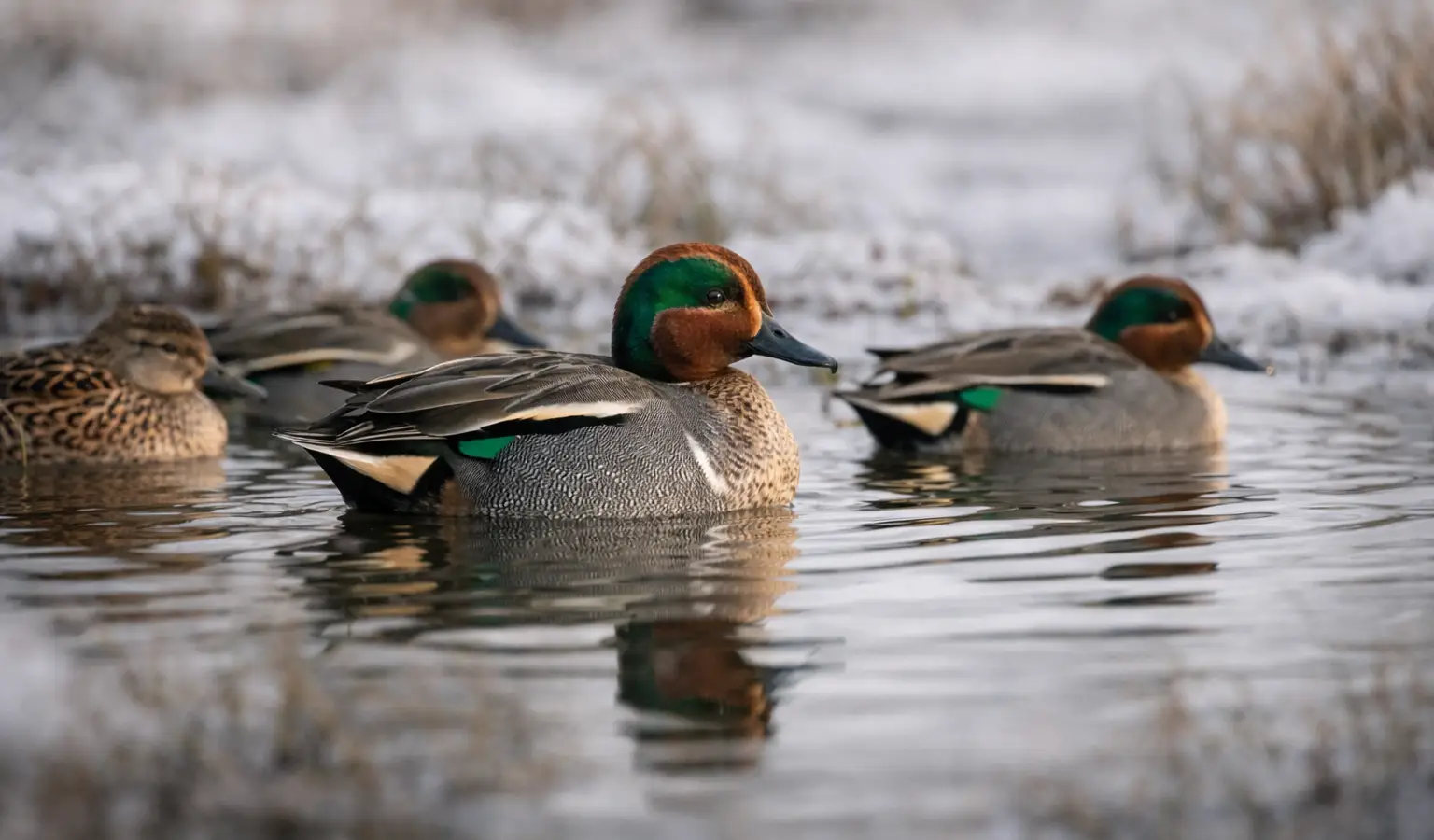
A small wetland duck, often migratory, fast and wary, hunted in some regions.
Type
Bird
Lifespan
8 years
Hunting season
September – January
Edible
Yes
Fact sheet
Teal
Scientific name
Anas crecca
Type
Bird
Meat quality
Fine meat
Edible
Yes
Lifespan
8 years
Incubation
21 days
Size
35-40 cm
Weight
300-450 g
Diet
Omnivore: insects, seeds, aquatic plants
Status
Huntable under regulations
Hunting season
September – January
Breeding season
4 / 5
Lifestyle and behaviour
Behaviour : Small flocks, discreet, very fast flight, migratory
Social structure : Small groups
Migration : Migratory
Habitat
- Wetland
Natural predators
- Fox
- Birds of prey
Hunting methods
- Hunting hide
- Driven pass
Health risks
- Avian influenza
Ecosystem role
- Invertebrate consumption
Signs of presence
- Footprints
- Feathers
Introduction
General description
Teal, most often referring in Europe to the Eurasian teal or common teal (Anas crecca), is one of the smallest dabbling ducks regularly seen on marshes, flooded meadows, ponds, lagoons, and quiet backwaters. Compact, nervous, and exceptionally quick on the wing, it is a familiar species to birdwatchers and waterfowl hunters alike. Its small size, rapid twisting flight, and habit of dropping suddenly into sheltered wetland pockets make it distinctive in the field.
Ecologically, the teal is an important wetland bird because it links shallow aquatic habitats, seed-rich mud margins, and invertebrate communities. By feeding on aquatic insects, small mollusks, seeds, and tender plant material, it helps move energy between water and shore zones. In many regions it is strongly associated with migration, appearing in greater numbers during autumn and winter passage, then redistributing again toward breeding areas in spring.
In hunting and management contexts, teal is valued as a classic small waterfowl species, but also recognized as a bird sensitive to disturbance, water levels, habitat quality, and seasonal pressure. Healthy teal populations depend on diverse wetlands with shallow feeding areas, quiet resting cover, and predictable hydrological cycles. Because local abundance can vary sharply from one season to another, observation in the field often tells more than assumptions based on calendar alone.
Morphology
Morphology
Anas crecca is a small, short-necked dabbling duck, typically around 35 to 40 cm long and often weighing roughly 300 to 450 g. It has a compact body, relatively narrow wings, and a neat profile that helps explain its very fast, agile flight. At rest, teal often appear low on the water, with a delicate bill and a rounded head.
The male in breeding plumage is especially recognizable, with a chestnut-toned head marked by a broad green eye patch bordered with pale lines. The body is finely patterned in gray, with contrasting details that can look intricate at close range. Females and eclipse males are much more subdued, showing mottled brown plumage that provides strong camouflage in reeds, sedges, and muddy wetland edges. In flight, both sexes show a dark-and-green wing speculum, though visibility depends on angle and light.
Field identification often relies less on plumage alone than on a combination of size, structure, flock behavior, and wingbeat. Compared with larger dabbling ducks, teal look lighter, tighter, and more abrupt in their turns. Their silhouette is useful in poor light: small body, quick wing action, and compact flock movement over marshes or flooded fields.
Habitat and distribution
Habitat and distribution
Habitat
Teal favor shallow wetlands with a mix of open water, mud margins, submerged food resources, and nearby cover. Productive habitat usually includes marshes, wet meadows, floodplains, oxbows, small ponds, estuarine margins, rice fields in some regions, and sheltered areas of larger lakes. They often prefer places where water depth remains modest enough to allow dabbling, tipping up, and easy access to seeds and aquatic invertebrates.
Outside the breeding season, they are frequently drawn to quiet wetlands with dense edge vegetation and low daytime disturbance. Reedbeds, sedge fringes, willow-lined backwaters, and seasonally flooded grasslands can all hold teal if food and security are present together. They commonly use one area for feeding and another for daytime loafing or roosting, especially where hunting pressure or other disturbance is significant.
Good teal habitat is rarely defined by water alone. It is the combination of shallow feeding zones, soft mud, plant diversity, invertebrate production, and refuge cover that makes a site consistently attractive. Water level fluctuation can be beneficial when it creates fresh muddy edges, but sudden drying or repeated disturbance may quickly reduce use.
Distribution
The Eurasian teal has a broad Palearctic distribution, breeding across large parts of northern and temperate Eurasia and wintering farther south and west, including much of Europe, the Mediterranean basin, parts of North Africa, the Middle East, and sections of Asia. In many countries it is primarily a migratory or wintering duck rather than a year-round resident, although some local breeding or overwintering populations occur where conditions remain suitable.
Occurrence is strongly seasonal. Numbers often build in autumn as birds arrive from northern breeding grounds, peak during migration or winter depending on region, and then decline again in late winter or spring as birds move back toward breeding areas. Severe cold, freezing wetlands, drought, and regional water availability can shift concentrations rapidly, sometimes causing large temporary gatherings in unfrozen refuges.
At local scale, distribution is patchy and highly dependent on wetland networks. A landscape with many small marshes, shallow reservoirs, flooded fields, and undisturbed backwaters may hold far more teal than a larger but simplified water body. This makes regional maps useful, but on-the-ground habitat reading remains essential.
Lifestyle
Lifestyle and behaviour
Diet
Teal are opportunistic omnivores, feeding on a mix of seeds, aquatic plant matter, and animal prey. Common food items include small seeds from wetland plants, grains where available, soft shoots, aquatic vegetation, insect larvae, adult insects, small crustaceans, worms, and other invertebrates. Their diet reflects the typical flexibility of dabbling ducks, but because they are small, they often focus on fine, abundant food resources in shallow water and on muddy edges.
Seasonal variation is important. During autumn and winter, seeds and other energy-rich plant material can become especially important, while in spring and the breeding period, protein from invertebrates often has increased value for body condition and reproduction. Chicks depend heavily on small invertebrates early in life, as these are easier to digest and crucial for growth.
Feeding usually takes place by dabbling at the surface, tipping forward to reach slightly deeper food, filtering small items from the water, or picking from exposed mud. Teal may feed at dawn, dusk, or at night in areas where daytime disturbance is high. Their use of very shallow, food-rich zones makes them sensitive to changes in water depth, eutrophication, and the loss of wetland edge structure.
Behaviour
Teal are alert, discreet, and often surprisingly difficult to approach. They spend much of the day resting or sheltering in quiet water, then shift to feeding areas during low-disturbance periods such as dawn, dusk, or nighttime. In heavily used wetlands, they may become even more crepuscular or nocturnal, minimizing movement during daylight.
When flushed, teal are famous for their speed and agility. Small flocks can explode from cover with a sharp, twisting departure, often flying low at first before climbing or swinging away. Their rapid wingbeats and synchronized turns are among the most recognizable behaviors of the species. This flight style helps them evade predators and also explains why they are often perceived as wary.
They regularly move between feeding, resting, and refuge areas over the course of a day or week. Disturbance from people, dogs, boats, shooting pressure, or repeated overflight can alter those patterns quickly. In calm wetlands they may remain visible for long periods, but in pressured landscapes they often become much harder to observe despite still being present nearby.
Social structure
Teal are generally social outside the breeding season and are commonly seen in small groups or loose flocks, though concentrations can become much larger on migration stopovers or major wintering wetlands. The provided field impression of small groups is accurate for many day-to-day observations, especially on modest ponds, narrow marsh channels, or sheltered feeding pockets.
Within these groups, spacing is often tighter during flight than on the water. Birds may sort themselves by microhabitat, with some feeding actively on the margins while others remain alert in slightly deeper water. Pair formation often begins before spring migration is complete, so winter groups may include birds already showing pair bonds.
During the breeding season, social structure shifts toward dispersed pairs and more territorial use of nesting areas, although the species is not strongly colonial. Once breeding is underway, females become much more secretive because nest success depends heavily on concealment.
Migration
Teal are widely migratory, and migration is one of the defining traits of the species across much of its range. Many birds breeding in northern and eastern areas move south or west in autumn to winter in milder wetlands. This movement often begins with the first seasonal deterioration of northern conditions, though the exact schedule depends on weather, water levels, and freeze-up.
Autumn passage may be prolonged, with birds appearing in waves rather than all at once. Winter distribution is similarly dynamic: severe frost can push teal toward coastal lagoons, spring-fed waters, estuaries, or other sites that remain open. In spring they return toward breeding grounds, sometimes rapidly when favorable winds and temperatures align.
At local scale, migration blends into short-distance movements between roosting and feeding sites. A wetland may hold teal only at dawn, dusk, or during cold snaps, then seem empty at other times. Reading these movement patterns is often more informative than assuming a site is either occupied or vacant in a fixed way.
Reproduction
Reproduction
Breeding generally takes place in spring and early summer, with timing varying by latitude, climate, and water conditions. Teal nest on the ground, usually in concealed vegetation near water, though sometimes a short distance away if cover is better. The nest is a shallow scrape lined with plant material and down.
The female lays a clutch of eggs and carries out most or all of the incubation, which commonly lasts around three weeks, broadly consistent with the provided figure of about 21 days. As with many dabbling ducks, the male typically plays little direct role once incubation is well advanced. After hatching, the ducklings leave the nest quickly and feed themselves, guided and guarded by the female.
Successful breeding depends on a combination of shallow brood habitat, abundant invertebrate food, and cover from predators such as foxes and birds of prey. Cold, flooding, drought, trampling, or nest predation can all affect local productivity. Broods often use very quiet margins rich in insect life, where vegetation offers both food and concealment.
Field signs
Field signs
Teal often leave subtle rather than dramatic field signs. Along muddy edges, small duck footprints may be visible where birds have walked between shallow water and feeding spots. These tracks are typically finer and smaller than those of larger dabbling ducks, though species-level identification from prints alone is rarely certain without context.
Feathers can sometimes be found near loafing banks, sheltered roosts, preening sites, or places where a predator has taken a bird. Surface feeding may leave lightly disturbed mud, small peck marks, or shallow dabbling traces in very soft margins. Droppings may occur on exposed mud, low banks, or frequently used resting islets, but are usually not distinctive enough on their own for confident identification.
In practice, the best signs are often behavioral and situational rather than purely physical: repeated use of a quiet inlet at dusk, sudden flushes from sedge edges, or fresh tracks around shallow seed-rich water after a night of feeding. Combining tracks, feathers, habitat reading, and direct observation gives the most reliable result.
Ecology and relationships
Ecology and relationships
Ecological role
Teal play a meaningful role in wetland food webs. By consuming aquatic invertebrates, they help regulate small prey populations and transfer nutrients through marsh and pond systems. Their feeding on seeds also contributes to the broader ecological cycling of wetland vegetation, even if the exact effects vary by plant species and local conditions.
As prey, eggs, ducklings, and sometimes adults support predators including foxes and birds of prey. This places teal in a classic middle position in the ecosystem: consumers of plants and small animals, while also serving as food for higher trophic levels. In migration periods, large numbers of teal can be an important seasonal resource for wetland predators.
Because they respond quickly to habitat quality, water regime, and disturbance, teal can also act as practical indicators of wetland condition. Their presence in good numbers often suggests a functioning mosaic of shallow water, food availability, and refuge cover, although no single species should be used as the only measure of ecosystem health.
Human relationships
Teal has long been part of human wetland culture through birdwatching, hunting, and traditional knowledge of marsh landscapes. For observers, it is a rewarding species because its movements, plumage details, and seasonal arrivals reveal much about water levels, migration timing, and habitat use. For hunters, it is a respected waterfowl species known for speed, caution, and the importance of careful shot selection and wetland reading.
The species can also intersect with farming and land management, especially in floodplain agriculture, rice-growing areas, grazing marshes, and managed wetlands. Some agricultural landscapes provide temporary feeding habitat, while others reduce habitat quality through drainage, disturbance, or loss of shallow seasonal flooding. As with many waterfowl, the relationship is mixed and strongly dependent on local practice.
Teal may also be relevant to animal health surveillance because wild ducks can be involved in the ecology of avian influenza viruses. This does not make every bird a direct hazard, but it is a reason why handling harvested or found birds should always follow good hygiene and local guidance. In culinary terms, teal is considered edible where legally harvested, though food safety and regulatory compliance remain essential.
Legal framework and management
Legal framework and management
Legal status
Legal status varies by country, flyway framework, season, and local conservation assessment. In many regions the teal is a huntable waterfowl species under defined regulations, which may include open seasons, permitted methods, bag limits, shooting hours, protected areas, and species identification requirements. The provided season of September to January may fit some jurisdictions, but readers should never assume it applies universally.
Because migratory birds are often managed through national and international rules, legal access can change in response to population trends, severe weather, disease concerns, or regional conservation measures. Protected wetland sites may impose additional restrictions even where the species itself is legally huntable.
The safest guidance is straightforward: always verify current law with the relevant wildlife authority before hunting, transporting, or possessing teal. Correct identification is especially important where similar small ducks occur, or where sex, date, or area-based restrictions may apply.
Management tips
For observation or habitat management, focus on shallow, productive wetland zones rather than only open water. Teal respond well to a mosaic of mud edges, low-depth feeding areas, scattered emergent vegetation, and undisturbed refuge cover. Seasonal water control, where appropriate and legal, can be valuable if it creates fresh feeding habitat without eliminating stable resting areas.
- Maintain quiet refuge zones with limited disturbance, especially during migration and winter concentration periods.
- Protect shallow margins rich in seeds and aquatic invertebrates.
- Avoid simplifying wetlands into deep, steep-sided basins with little edge habitat.
- Monitor water levels through the season, since teal use can change quickly with flooding, drying, or freeze conditions.
- In hunting contexts, prioritize species certainty, safe shooting conditions, and restraint when birds are heavily pressured or weather-stressed.
Good management also means reading the broader landscape. A single pond may matter less than its connection to nearby marshes, flooded grassland, and secure roost water. Where avian influenza or other wildlife health issues are a concern, managers and hunters should follow current biosecurity guidance and reporting protocols.
Fun facts
Fun facts
Despite being one of the smallest common dabbling ducks, the teal is often one of the hardest to approach because of its sharp alertness and explosive flight. Many people hear a flock rise before they clearly see it.
The scientific name Anas crecca is strongly associated with the Eurasian teal, a species admired by birders for the male's elegant head pattern and by wetland ecologists for how closely its presence tracks shallow, food-rich habitat.
Teal can make a wetland seem to change overnight. A marsh that appears nearly empty one evening may hold fresh birds the next morning after a migration movement, cold front, or shift in water conditions.