
Stock dove
Columba oenas
A small forest-dwelling pigeon with migratory behavior.
Type
Bird
Lifespan
6 years
Hunting season
September – February
Edible
Yes
Fact sheet
Stock dove
Scientific name
Columba oenas
Type
Bird
Meat quality
Tender meat
Edible
Yes
Lifespan
6 years
Incubation
18 days
Size
32-35 cm
Weight
250-350 g
Diet
Seeds, berries
Status
Huntable under regulations
Hunting season
September – February
Breeding season
5 / 6
Lifestyle and behaviour
Behaviour : Migratory, lives in pairs
Social structure : Pairs or small groups
Migration : Migratory
Habitat
- Forest
Natural predators
- Birds of prey
Hunting methods
- Blinds
- Standing post
Health risks
- Avian parasites
Ecosystem role
- Seed dispersal
Introduction
General description
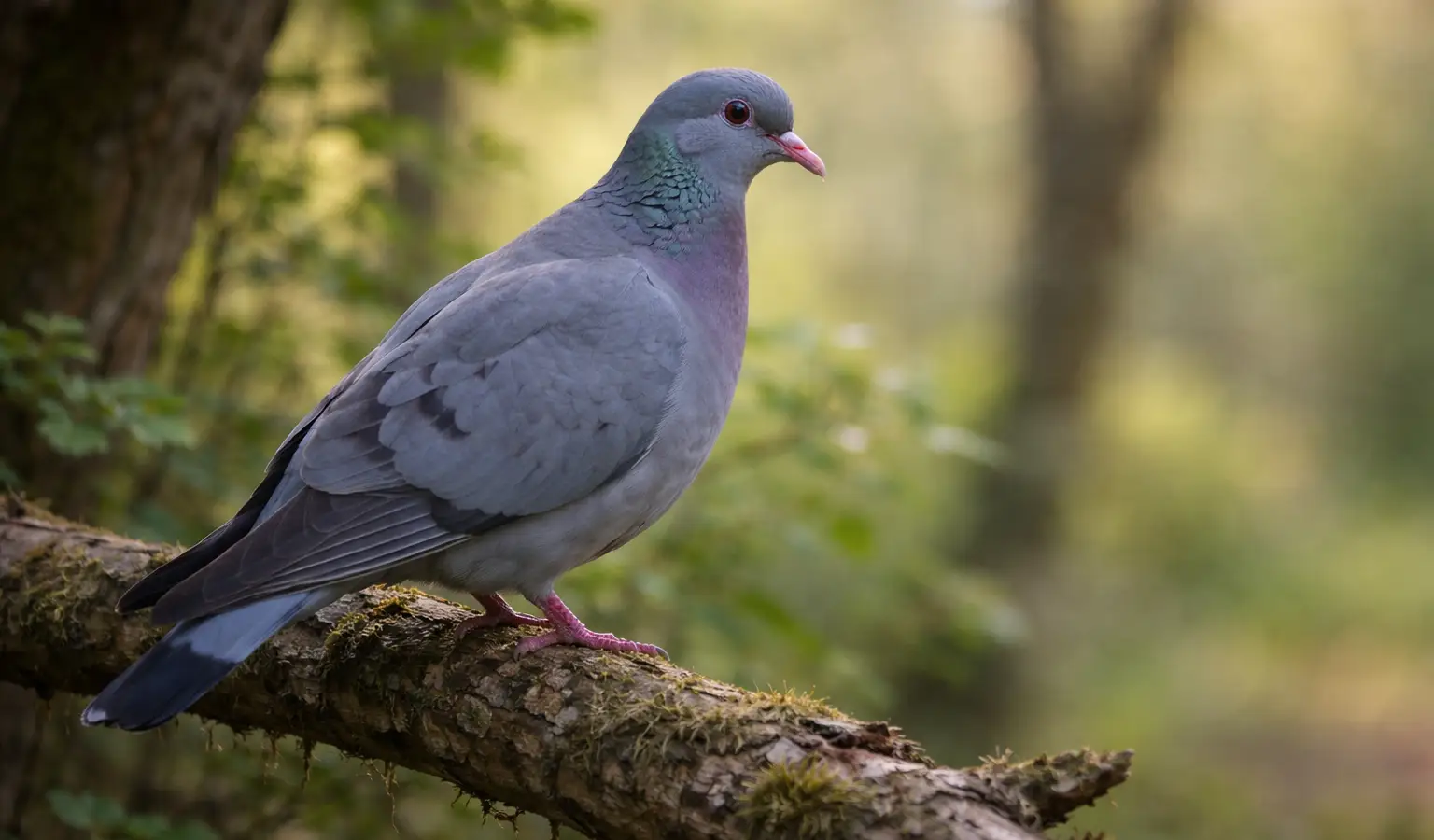
The Stock dove, Columba oenas, is a compact, medium-small wild pigeon closely associated with wooded landscapes, old trees, field edges, and traditional farmland. Smaller and subtler than the Common Wood Pigeon, it is often overlooked despite being a distinctive European bird with a quiet, understated presence. Its clean bluish-grey plumage, dark eye, and preference for tree cavities make it one of the more specialized pigeons in temperate landscapes.
Although it is listed here among migratory birds, the species shows flexible movement patterns depending on region. Some populations are clearly migratory, while others are more resident or only partially mobile outside the breeding season. This makes the Stock dove especially interesting from a field ecology perspective, because local abundance can shift with weather, food availability, and breeding habitat quality.
In ecological terms, the Stock dove contributes to seed movement across woodland and agricultural mosaics and forms part of the prey base for birds of prey. In hunting contexts, it may be legally huntable in some countries or regions under specific regulations, but it generally requires careful identification because it can be confused at distance with other pigeons and doves. For wildlife observers, land managers, and hunters alike, the species is best understood as a discreet forest-edge pigeon whose presence often signals a landscape rich in old trees, cavities, and low-disturbance feeding areas.
Morphology
Morphology
The Stock dove measures roughly 32 to 35 cm in length and commonly weighs around 250 to 350 g. It has a compact shape, relatively short tail, rounded head, and a neat, balanced silhouette in flight. The overall plumage is bluish-grey, usually plainer and less contrasting than that of the Common Wood Pigeon.
For field identification, several features are useful. The breast often shows a soft pinkish or vinous wash, the neck may display a subtle green iridescence, and the bird lacks the large white neck patches and broad white wing markings typical of the Common Wood Pigeon. The eye is dark, giving the face a gentler and less striking look than species with pale irises. The bill is short, and the wings appear dark and clean in flight, without the bold white flashes many observers expect in larger pigeons.
At distance, confusion is most likely with juvenile or distant Wood Pigeons, but the Stock dove usually looks smaller, darker-winged, and more uniform. Its flight is fast and direct, with firm wingbeats. In good light, the species often appears sleek rather than bulky, an important impression when separating it from more familiar pigeons in mixed farmland or forest-edge observation.
Habitat and distribution
Habitat and distribution
Habitat
The Stock dove favors a mosaic of forest, woodland edge, hedgerow country, parkland, and adjacent open feeding areas. It is especially associated with mature deciduous or mixed woodland containing cavities in old trees, but it can also use orchards, shelterbelts, wooded farmland, riverine woods, and occasionally old structures where suitable nesting holes exist.
Unlike some more urban-adapted pigeons, Columba oenas is strongly tied to secure nesting sites and tends to prefer quieter biotopes with a combination of cover and nearby feeding ground. It often feeds in fields, stubble, grassland, or lightly disturbed agricultural parcels, then returns to wooded areas for roosting or breeding. In many regions, habitat quality depends less on simple forest cover than on the presence of veteran trees, woodpecker holes, and a connected landscape with accessible seed-rich foraging zones.
Dense, uniform plantation forestry is often less favorable than structurally diverse woodland with glades, edges, and mature trees. Local use of habitat may shift seasonally, with birds becoming more visible in open country during feeding periods and more discreet during nesting.
Distribution
The Stock dove is widely distributed across much of Europe and extends into parts of western and central Asia. Its occurrence is uneven rather than uniform, with stronger populations in landscapes that combine old woodland, nesting cavities, and mixed farming. In some areas it remains locally common, while in others it is patchy, scarce, or declining where agricultural simplification and loss of mature trees reduce breeding opportunity.
Across its range, the species may be present year-round, seasonally augmented by migrants, or mainly encountered during passage and winter depending on latitude and local conditions. Northern and eastern populations are generally more migratory, while milder western regions may hold more sedentary or partially resident birds.
At the local scale, distribution often looks discontinuous: one valley, woodland block, or traditional agricultural zone may hold regular birds, while apparently similar nearby country holds few. This pattern usually reflects nesting-site availability, feeding access, and disturbance more than broad climate alone.
Lifestyle
Lifestyle and behaviour
Diet
The Stock dove feeds mainly on seeds, grains, small agricultural spill, green plant material, and berries when available. It forages mostly on the ground, picking food carefully rather than aggressively. Typical feeding areas include stubble fields, grazed grassland, field margins, harvested cereal plots, and open patches near woodland.
Seasonal variation is important. During autumn and winter, birds may rely more heavily on cereal grains, weed seeds, and other readily accessible plant matter in farmland. In spring and summer, they may take fresh shoots, leaves, buds, and a range of smaller seeds associated with grassland and arable habitats. In drier periods or in heavily managed agricultural systems, food distribution can become more concentrated, which may influence movement and local flocking.
Like other pigeons, the Stock dove needs regular access to safe feeding sites and drinking opportunities. Its diet links it closely to both natural seed cycles and farming practices, making harvest timing, field treatment, and ground cover important influences on local condition and abundance.
Behaviour
The Stock dove is generally a discreet, alert bird with periods of intense but often low-profile activity. It is most often active from early morning through late afternoon, with feeding flights between woodland and open ground forming a major part of its daily routine. In many places it is easier to detect in flight than on the ground, as feeding birds can blend surprisingly well into stubble, short vegetation, or shaded field edges.
Its escape behavior is typically rapid and direct. When disturbed, it lifts fast with firm wingbeats and may head straight toward tree cover, a roost site, or a known line of safe passage across the landscape. Compared with more confiding urban pigeons, it is usually cautious around repeated disturbance. During the breeding period, adults may become particularly secretive near nest sites because they use cavities rather than exposed stick nests.
Vocal activity is often one of the best clues to presence in spring. The call is a deep, resonant coo, less familiar to many people than the calls of larger pigeons, and often heard from woodland interior, old park trees, or quiet edge habitat. Outside the breeding season, behavior may become more social and more tied to predictable feeding opportunities.
Social structure
The Stock dove is often encountered in pairs or small groups, which fits well with its generally quiet and structured social behavior. During the breeding season, pairs are the core social unit, and birds show clear attachment to nesting territories centered on suitable cavities and nearby feeding routes.
Outside the nesting period, small flocks may form at productive feeding sites, communal roost areas, or migratory stopovers. Even then, the species usually appears less massively gregarious than some other pigeons. Group size varies with season, habitat openness, and local food concentration.
Its social organization is therefore best described as pair-based in spring and summer, with looser aggregation later in the year. In regions with migration or winter influxes, temporary concentrations can occur, but these are often linked more to resource availability than to strongly cohesive flock structure.
Migration
The Stock dove is a migratory or partially migratory pigeon depending on region. Northern and continental populations tend to move south or southwest in autumn, while birds in milder Atlantic or western areas may remain year-round or shift only short distances. This variability is important when interpreting seasonal presence: a local autumn increase may reflect passage rather than local breeding success alone.
Migration generally takes place from autumn into early winter, with return movement in late winter or spring. Birds often travel in small groups and may use broad fronts rather than narrow, highly visible migration corridors. Weather, frost, snow cover, and food access can strongly influence both timing and distance of movement.
During migration and winter, the species may use more open farmland than during breeding, especially where waste grain and seed resources are reliable. In practical field terms, this means the Stock dove can appear unexpectedly in areas where it is scarce in summer but regular during passage or cold-season feeding movements.
Reproduction
Reproduction
The breeding cycle of the Stock dove is closely tied to the availability of cavities. Unlike the Common Wood Pigeon, which commonly builds an open stick nest, Columba oenas usually nests in tree holes, old woodpecker cavities, hollow trunks, and sometimes crevices or suitable man-made structures. This requirement makes mature trees particularly important to the species.
Breeding generally begins in spring, though timing varies with latitude and weather. The clutch is usually small, as is typical for pigeons, most often two eggs. Incubation lasts about 18 days, shared by the adults. Young are fed with nutrient-rich crop milk in the early stage and then progressively with more solid food. In favorable conditions, more than one brood may be attempted in a season.
Average lifespan in the wild is often limited by predation, habitat pressure, weather, and hunting where permitted, though some birds can live several years; a figure around 6 years is a reasonable broad reference rather than a strict expectation for every population. Breeding success depends heavily on low disturbance around nest sites, cavity availability, and access to nearby feeding habitat.
Field signs
Field signs
Field signs of the Stock dove are often subtle. Unlike larger game species, it leaves few obvious marks on the landscape, so direct observation, flight lines, calls, and habitat reading are usually more useful than tracks alone. Birds may be found using regular routes between woodland cavities or roost trees and open feeding ground.
Useful clues include repeated low, fast commuting flights at dawn or dusk, soft but deep cooing in spring, and the presence of birds entering or inspecting cavities in old trees. Beneath favored roosts or nesting trees, small accumulations of droppings may be present, though these are not always easy to separate from those of other pigeons without context. Feeding areas may show little more than regular bird presence on short turf, stubble, or seed-rich ground.
- Flight lines: direct, repeated movements between woods and fields.
- Voice: a deep, hollow coo, often the best breeding-season clue.
- Nesting evidence: use of tree cavities, old woodpecker holes, or hollows.
- Ground sign: discreet droppings and feeding presence rather than obvious tracks.
In practice, the species is identified more by a pattern of habitat, behavior, and repeated sightings than by dramatic field sign.
Ecology and relationships
Ecology and relationships
Ecological role
The Stock dove plays a useful ecological role as a consumer and disperser of plant material, especially seeds. By moving between woodland, edge habitat, and farmland, it helps connect different parts of the landscape biologically. Its feeding activity is generally modest in impact but significant as part of a broader community of granivorous birds.
It also contributes to food webs as prey for birds of prey and other predators capable of taking medium-small pigeons. Because it depends on cavities, the species is linked to the ecological value of old trees and to woodland processes that create nesting holes, including decay and woodpecker activity.
In a management context, the Stock dove can be seen as an indicator of structurally diverse countryside: not pristine wilderness, but a functioning mosaic where mature trees, feeding ground, low-intensity edges, and seasonal movement still work together.
Human relationships
The relationship between people and the Stock dove is shaped by forestry, agriculture, birdwatching, and in some regions hunting. It is less familiar to the general public than the Wood Pigeon, partly because it is less conspicuous and less urban. For birdwatchers, it is a rewarding species because correct identification often depends on careful observation of shape, plumage detail, flight pattern, and voice.
For farmers and land managers, the species is usually a minor and localized user of farmland rather than a major agricultural issue. It benefits from traditional mixed landscapes, uncrowded field margins, and the retention of old trees. Intensive simplification of farmland can reduce feeding diversity and nesting opportunity.
In hunting culture, where legal, the Stock dove may be taken during the open season, including by methods such as blinds or standing post shooting where these are lawful and customary. Because accurate identification is essential and local conservation conditions differ, hunters are generally best served by a cautious approach that prioritizes species recognition, awareness of regional status, and restraint around breeding or staging areas. The species is considered edible, as with other wild pigeons, but hygiene and local game regulations remain important.
As with many wild birds, health concerns can include avian parasites. Routine handling precautions, clean game processing, and awareness of abnormal body condition are sensible where birds are harvested.
Legal framework and management
Legal framework and management
Legal status
The Stock dove may be huntable under regulations in some jurisdictions, but legal status varies significantly by country, region, conservation framework, and season. Reported open periods may include roughly September to February in some contexts, yet no general season should be assumed without checking current local law.
Because the species is migratory or partially migratory and may occur alongside protected pigeons or doves, compliance depends on accurate identification, approved methods, permitted dates, and any local quotas or temporary restrictions. Conservation status can also differ between national and regional scales, especially where breeding populations are sparse or declining.
The practical rule is simple: always verify the latest official regulations before any hunting activity, and consider local population sensitivity even where harvest is lawful. Outside hunting, the species may also benefit from wider protections tied to nesting habitats, tree preservation, and general bird conservation policy.
Management tips
Good Stock dove management starts with habitat structure rather than direct intervention. The most valuable measures usually include retaining mature trees, preserving cavity-bearing woodland, maintaining hedgerow networks, and ensuring there is nearby open feeding habitat. Landscapes that combine nesting security with low-disturbance foraging areas are consistently more favorable than simplified blocks of forest or intensively cleaned farmland.
From an observation or hunting perspective, reading the habitat is essential. Focus on woodland edges near grazed fields, stubble, seed-rich margins, and traditional parkland with old trees. Early-morning and late-afternoon movement can reveal regular routes. Because identification errors are possible, especially in poor light or at range, caution is more important than speed.
- Protect old trees: cavity availability is often the limiting factor for breeding.
- Maintain a mosaic: woodland, edge habitat, and open feeding ground should remain connected.
- Reduce unnecessary disturbance: repeated intrusion near nest cavities can lower breeding success.
- Watch seasonal shifts: autumn and winter use of open farmland may differ from spring breeding distribution.
- Verify regulations: management and harvest decisions must align with current local law and population status.
Where nest boxes are considered, they should be designed and placed with care, and ideally as part of a broader cavity-conservation strategy rather than as a substitute for retaining veteran trees.
Fun facts
Fun facts
The Stock dove is one of the few European pigeons strongly associated with nesting in natural cavities rather than relying mainly on an exposed stick nest. That single trait explains much about its habitat choice, distribution, and sensitivity to the loss of old trees.
Despite its plain appearance at first glance, it is often considered one of the most elegant pigeons in the field. Experienced observers value its clean grey tones, dark eye, and understated neck sheen, especially when seen well in calm morning light.
It is also a good example of how a species can be common enough to be widespread yet still remain widely misidentified. Many people see Stock doves without realizing it, particularly when they assume every grey pigeon in farmland is a juvenile Wood Pigeon or a feral bird.