
Stoat
Mustela erminea
A small agile mustelid and efficient rodent predator.
Type
Mammal
Lifespan
3 years
Hunting season
Selon réglementation
Edible
No
Fact sheet
Stoat
Scientific name
Mustela erminea
Type
Mammal
Meat quality
-
Edible
No
Lifespan
3 years
Gestation
28 days
Size
17-33 cm
Weight
100-250 g
Diet
Small rodents, birds, insects
Status
Huntable or controlled depending on country
Hunting season
Selon réglementation
Breeding season
4 / 5
Lifestyle and behaviour
Behaviour : Active, agile, hunts in burrows
Social structure : Solitary
Migration : Sedentary
Habitat
- Forest
- Farmland
Natural predators
- Fox
- Birds of prey
Hunting methods
- Trapping
Health risks
- Avian parasites
Ecosystem role
- Rodent population regulation
Introduction
General description
The stoat, Mustela erminea, is a small, highly agile mustelid best known as an efficient predator of mice, voles, and other small prey. Although light in weight, it is a bold and remarkably capable hunter, able to follow rodents into burrows, stone walls, hedge bases, and other tight cover. In many rural landscapes, the stoat is one of the most important small carnivores shaping local prey dynamics.
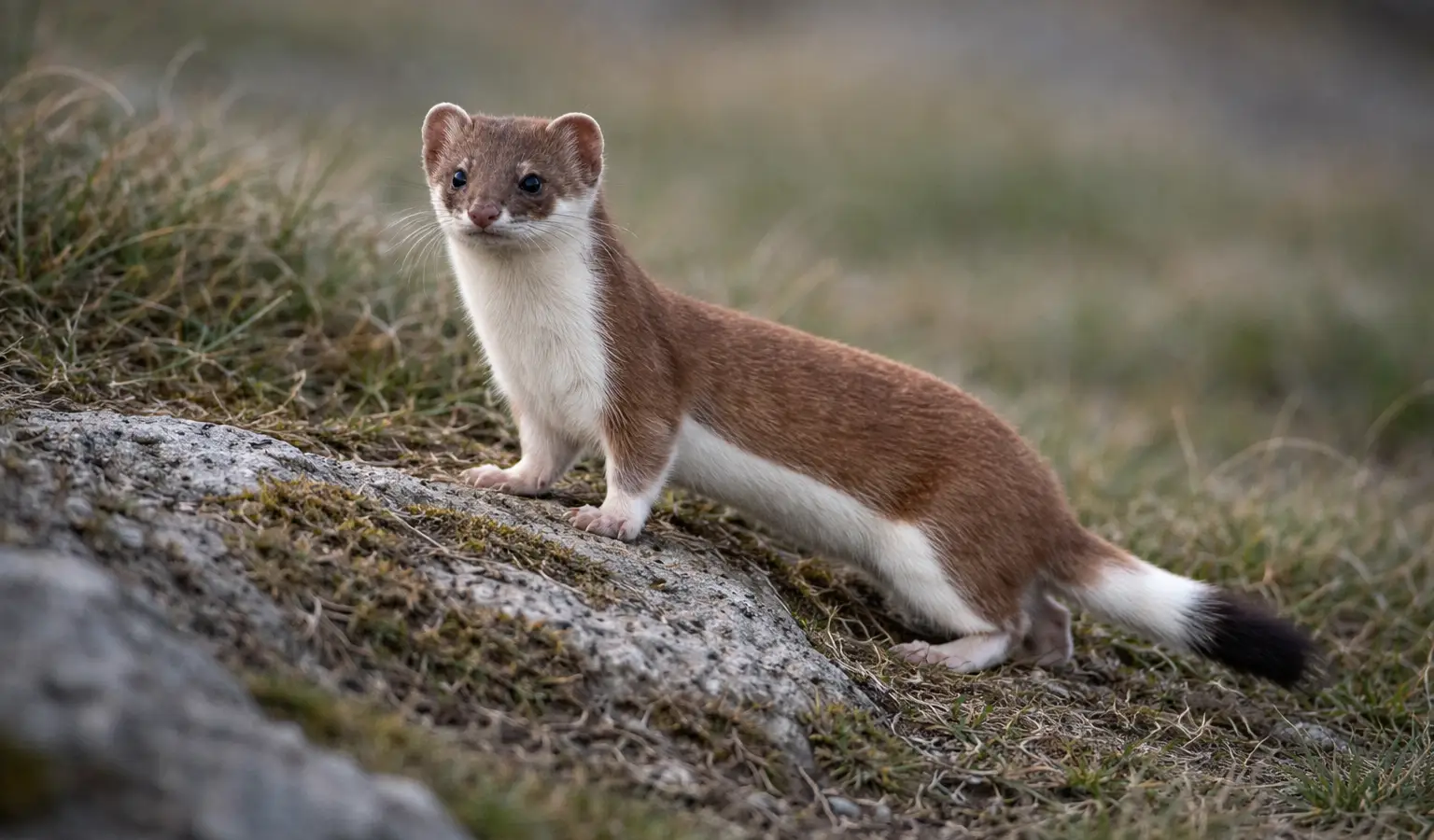
Often confused with the weasel, the stoat is typically identified by its slightly larger build and, above all, by the distinct black tip to the tail. In colder regions or at higher elevations, some populations also develop a white winter coat, historically called ermine. This seasonal change is one of the species' most recognizable adaptations, though it does not occur equally everywhere.
From a field ecology perspective, the stoat occupies an interesting middle ground: it is both beneficial and controversial. It can help regulate rodent populations in farmland, woodland edge, and rough grassland, yet it may also take gamebird chicks, nestlings, or small domestic poultry where opportunity allows. For that reason, its reputation varies greatly depending on local conservation goals, farming pressure, and wildlife management priorities.
For hunters, trappers, and wildlife watchers, the stoat is a species more often detected by fleeting movement than by prolonged observation. It appears suddenly, hunts with intense focus, and disappears just as quickly into cover. Understanding its habitat use, field signs, and legal status is therefore essential, especially because rules governing control or harvest differ widely between countries and regions.
Morphology
Morphology
The stoat is a slender, long-bodied mammal with short legs, a narrow head, rounded ears, and a relatively long neck. Typical head-body length is around 17 to 33 cm, with weight often falling between 100 and 250 g, though sex, season, and local population can influence size. Males are usually noticeably larger than females.
Its summer coat is generally warm brown on the back and head with a clean white or pale cream underside. The division between upper and lower body is often quite sharp. The most reliable field mark is the black tip on the tail, which helps separate the stoat from the smaller least weasel in most views. The tail is also proportionally longer than that of a weasel.
In winter, some stoats in colder climates turn mostly white while retaining the black tail tip. This white phase, known as ermine, is less consistent in milder regions where individuals may remain brown for much or all of the year. The animal's movement is quick, low, and elastic, with bounding progress through vegetation, stone margins, ditches, and field edges.
Habitat and distribution
Habitat and distribution
Habitat
The stoat is adaptable and uses a broad range of habitats, provided there is sufficient cover and a reliable prey base. It is commonly associated with farmland, woodland edge, hedgerows, rough grassland, scrub, young forestry, riverbanks, stone walls, and forest margins. It often favors habitat mosaics where feeding areas, shelter, and travel corridors occur close together.
In agricultural landscapes, stoats are frequently linked to vole-rich grass strips, hedge bottoms, banks, ditches, old outbuildings, and unmanaged corners. In more wooded country, they use rides, clearings, deadwood tangles, and dense understory. They may also occur in upland ground, moorland fringe, and coastal habitats where small mammals or nesting birds are accessible.
Fine-scale habitat choice is strongly influenced by prey abundance and hunting cover. Areas with dense ground vegetation, rabbit warrens, rodent burrow systems, or broken terrain can be especially attractive. Because the species is small and vulnerable to larger predators, it usually benefits from environments that combine concealment with rapid access to feeding opportunities.
Distribution
Mustela erminea has a broad Holarctic distribution, occurring across much of Europe, northern Asia, and parts of North America. Within that range, local abundance varies with climate, land use, prey cycles, and predator pressure. In many regions it is widespread but seldom seen for long, which can make it seem rarer than it actually is.
Across Europe, the stoat occurs in many rural and semi-natural landscapes, though its status can differ markedly from one country to another. In some places it remains a familiar small predator of farmland and woodland edge; in others, records are patchier or linked to specific altitude, habitat structure, or climatic conditions. Island populations and northern populations may differ ecologically from mainland lowland animals.
At the local scale, stoats are often unevenly distributed rather than uniformly present. They may be common where vole numbers are high and ground cover is well connected, but scarce in heavily simplified landscapes with little refuge. Seasonal detectability also changes, especially where snow cover or winter coat change makes observation easier.
Lifestyle
Lifestyle and behaviour
Diet
The stoat is a carnivorous specialist of small animal prey, with rodents forming a major part of the diet in many areas. Voles, mice, and similar small mammals are especially important, and the species is anatomically well suited to pursuing them into tunnels and burrows. This ability makes the stoat an efficient regulator of local rodent concentrations.
Its diet is not limited to rodents. Stoats also take small birds, eggs, chicks, young rabbits where size allows, and a variety of invertebrates such as insects. Opportunism is a key feature of the species: available prey may change with season, habitat, weather, and local abundance. In some places, nest predation can become significant during the bird breeding season.
Seasonal variation can be pronounced. During periods of vole abundance, hunting may focus heavily on small mammals in grassland or hedge networks. At other times, stoats may shift toward birds, carrion, or whatever prey is most accessible. Their high metabolic demand means they must feed frequently relative to their body size, which helps explain their intense and persistent hunting behavior.
Behaviour
The stoat is an active, restless predator with fast reactions and a highly investigative hunting style. It moves in short bounds, checks holes and cover edges, and readily enters tight spaces in pursuit of prey. This species is particularly known for hunting in burrows, among roots, under woodpiles, and through stonework where rodents shelter.
Activity can occur by both day and night, often with several short hunting bouts spread through a 24-hour period rather than one long active phase. Local rhythm may shift with disturbance, weather, prey availability, and season. In quieter places, stoats can sometimes be seen in daylight along hedge lines, banks, or field margins.
When alarmed, a stoat may freeze briefly, then dart into cover with remarkable speed. It uses vegetation, walls, drain edges, and natural linear features as secure movement routes. Despite its confidence as a hunter, it remains vulnerable to foxes and birds of prey, so caution and rapid use of cover are central parts of its daily behavior.
Social structure
The stoat is primarily solitary. Most adults live and hunt alone, maintaining individual home ranges that may overlap to some degree depending on sex, season, habitat quality, and prey density. Males generally range more widely than females, especially during the breeding period.
Social contact outside breeding is limited. Individuals communicate through scent marking, occupation of favored routes, and indirect territorial signals rather than stable group living. Resting places may include burrows, cavities, dense vegetation, or sites lined with fur and dry plant material taken from prey remains or surrounding cover.
Because this species depends on mobile hunting and dispersed prey capture, solitary spacing is an efficient strategy. Local density can rise where food is abundant, but stoats still function as independent hunters rather than forming social packs or family groups beyond the temporary association of a female with her young.
Migration
The stoat is generally considered sedentary rather than migratory. It does not undertake regular long-distance seasonal migration in the way many birds or large mammals do. Most individuals remain within a relatively stable home area linked to shelter and prey resources.
That said, movement patterns are not static. Juveniles may disperse from natal areas, and adults can shift range use in response to prey fluctuations, habitat change, disturbance, or seasonal cover. In landscapes with cyclic vole populations, local presence may seem to expand or contract as stoats track food availability.
Winter movement can also become more visible in open country, especially where snow cover reveals travel routes or where food scarcity drives wider searching. Even so, these are local or regional adjustments in space use rather than true migration.
Reproduction
Reproduction
Stoat reproduction is biologically unusual and can vary in timing depending on region. Breeding often takes place in spring or summer, but implantation may be delayed for a long period, meaning the full reproductive cycle is longer than the short apparent gestation would suggest. Because of this delayed implantation, simple gestation figures can be misleading if taken without context.
Females usually give birth in a sheltered den, often in a burrow, cavity, or thick cover lined with fur and vegetation. Litter size is variable and can be influenced by food supply, especially small mammal abundance. In good prey years, reproductive output may be higher and juvenile survival better.
Young stoats develop quickly but remain dependent on the mother during the early period. The female alone provides care, protection, and hunting instruction. Juvenile dispersal later contributes to the species' spread into surrounding habitat, especially where vacant territories or prey-rich patches are available.
Field signs
Field signs
Stoat field signs are often subtle, and direct sightings are frequently more informative than tracks alone. The species tends to use hedge bottoms, ditch lines, stone walls, bank edges, rabbit warrens, and rodent-rich rough grass as travel and hunting routes. Repeated quick movement along the same cover line can indicate regular use.
Tracks are small and can be difficult to separate from those of other mustelids without experience. In soft mud or snow, prints may show five toes, though not all are always clear. Bounding gait patterns with paired or closely grouped prints are common. Snow is often the best surface for recognizing movement corridors and active hunting loops.
Droppings are typically slender, dark, twisted, and pointed, sometimes containing fur, feathers, bone fragments, or insect remains. They may be left on stones, tussocks, logs, or other slight prominences used for scent marking. Prey remains near burrow mouths, feathers at sheltered plucking points, or sudden disturbance in vole-rich cover can also suggest stoat activity, though none of these signs is fully diagnostic on its own.
Ecology and relationships
Ecology and relationships
Ecological role
The stoat is an important mesopredator in many temperate and boreal ecosystems. Its main ecological role is the regulation of small vertebrate populations, especially rodents. By repeatedly hunting voles and mice, it can influence prey numbers, local distribution, and behavior, with indirect effects on vegetation, crop pressure, and disease dynamics associated with rodent surges.
At the same time, the stoat forms part of a wider predator network. It is both hunter and prey, feeding on smaller animals while being taken by foxes and raptors. This makes it a useful indicator of trophic balance in structurally diverse habitats where multiple predator species coexist.
Its ecological impact is context dependent. In some systems, stoats are valued for rodent control; in others, especially where vulnerable ground-nesting birds are a concern, predation pressure may be viewed differently. Sound ecological assessment therefore requires local evidence rather than a one-size-fits-all judgment.
Human relationships
Human views of the stoat are mixed and strongly shaped by land use. Farmers and land managers may appreciate its role in reducing mice and voles around field margins, stores, and rough grassland. Conversely, game managers or poultry keepers may regard it as a problem where it preys on chicks, eggs, or small captive birds.
For wildlife observers, the stoat is a charismatic but elusive species. Brief encounters are often memorable because of its speed, curiosity, and striking black-tipped tail. In winter-white populations, it also carries cultural recognition through the historic term ermine.
In hunting and pest-control contexts, the species is most often associated with trapping rather than edible use. Any intervention should be approached with care, clear identification, and awareness of legal restrictions. Misidentification with other small mustelids can create practical and legal problems, especially where protected species occur in the same landscape.
Legal framework and management
Legal framework and management
Legal status
The legal status of the stoat varies significantly by country and sometimes by region. In some jurisdictions it may be huntable, trappable, or controlled under specific conditions; in others it may be protected, seasonally regulated, or subject to animal welfare and method restrictions. The practical meaning of "pest" or "predator control" therefore depends entirely on local law.
Open seasons, permitted trapping systems, reporting requirements, and rules about property, non-target risk, and humane dispatch can all differ. Because regulation changes over time, anyone considering management should consult the most current official wildlife, hunting, or pest-control authority for their area.
Where the species is legally controlled, justification is often linked to livestock protection, game management, or conservation of vulnerable prey species. Where it is protected, the focus may be on biodiversity conservation, ethical concerns, or broader predator policy. Reliable local verification is essential before any action is taken.
Management tips
Good stoat management begins with correct identification and a clear objective. In many areas, the same habitat features that support stoats also support other valuable wildlife, so decisions should be based on evidence of actual impact rather than assumption. Read the habitat first: dense field edges, vole-rich rough grass, hedge intersections, rabbit warrens, and stone structures are the places most likely to concentrate activity.
For observation, work quietly along linear cover at first light or late afternoon, especially where prey is abundant and disturbance is low. Fresh snow, damp margins, or lightly used farm tracks can help reveal movement. Trail cameras near walls, culverts, or hedge gaps may confirm presence where visual sightings are rare.
For control, where legal and genuinely necessary, precision matters. Use only lawful methods, place devices to reduce non-target risk, and monitor them responsibly. Broad habitat simplification is rarely a balanced answer; targeted, informed action is usually more effective than indiscriminate pressure. In mixed conservation landscapes, stoat management should be integrated with prey monitoring, nesting success data, and broader predator assessment.
Fun facts
Fun facts
- The stoat's black tail tip remains visible even when the rest of the winter coat turns white.
- Its slim body allows it to follow rodents into tunnels and burrows that many larger predators cannot use.
- The word ermine refers to the stoat in its white winter coat, a form historically associated with ceremonial fur.
- Despite its small size, a stoat is a fearless and highly efficient hunter for its weight class.
- Stoats can be common in an area yet still seem rare because most sightings last only a few seconds.