
Song thrush
Turdus philomelos
A common thrush and one of the most hunted species in Europe.
Type
Bird
Lifespan
5 years
Hunting season
September – February
Edible
Yes
Fact sheet
Song thrush
Scientific name
Turdus philomelos
Type
Bird
Meat quality
Fine and tender meat
Edible
Yes
Lifespan
5 years
Incubation
13 days
Size
23-25 cm
Weight
80-100 g
Diet
Insects, worms, fruits
Status
Huntable locally
Hunting season
September – February
Breeding season
4 / 5 / 6
Lifestyle and behaviour
Behaviour : Partial migrant, small groups
Social structure : Small groups or solitary
Migration : Partial migrant
Habitat
- Forest
- Urban fringe
Natural predators
- Birds of prey
Hunting methods
- Driven pass
- Standing post
Health risks
- Avian parasites
Ecosystem role
- Invertebrate consumption
Introduction
General description
The Song thrush, Turdus philomelos, is a medium-sized thrush widely known across Europe for its rich, repetitive song and its ability to live in both wooded countryside and human-shaped landscapes. It is a familiar migratory bird in many regions, appearing in hedgerows, forest edges, orchards, gardens, and urban fringes. Although often discreet on the ground, it is one of the most recognizable thrushes once its warm brown upperparts, spotted underparts, and upright posture are noticed.
Ecologically, the Song thrush is an important consumer of invertebrates such as worms, snails, and insects, while also feeding on berries and other fruits during colder periods. This flexible diet helps it exploit changing seasonal resources and makes it a useful indicator of healthy soil life, shrub cover, and mixed habitat structure. In many rural landscapes, its presence reflects a mosaic of nesting cover, feeding ground, and sheltered movement corridors.
In hunting culture, the Song thrush holds a notable place in several European countries and is locally considered one of the traditional small migratory game birds. Its management requires attention to migration timing, local abundance, habitat quality, and legal frameworks that can vary significantly by country and region. For wildlife observers, hunters, and land managers alike, the species is a classic example of a bird whose biology is closely tied to edge habitat, seasonal food supply, and moderate landscape diversity.
Morphology
Morphology
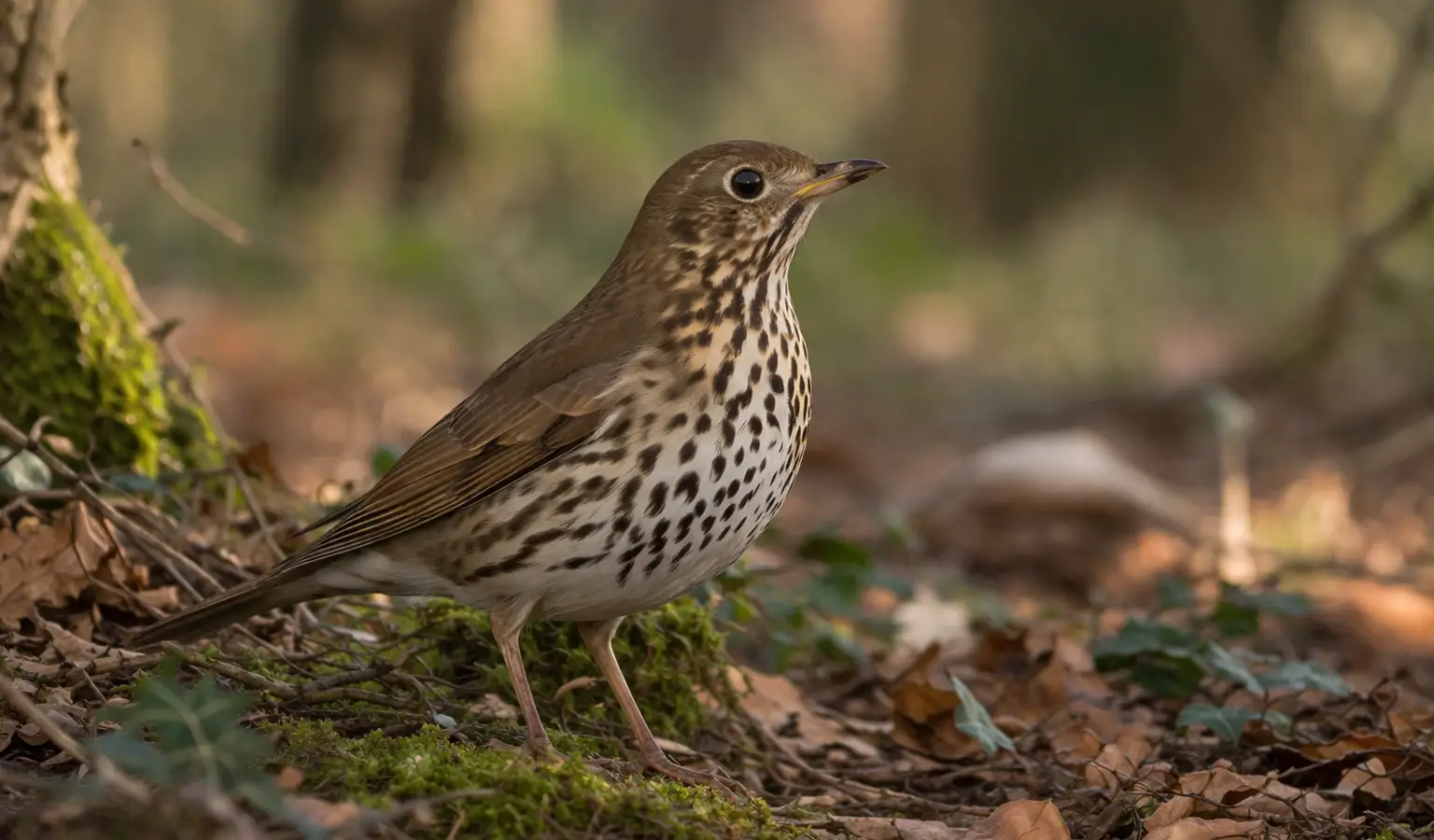
The Song thrush measures roughly 23 to 25 cm in length and commonly weighs around 80 to 100 g, making it slightly smaller and often more compact-looking than the Mistle Thrush. It shows warm brown upperparts, a pale buff to cream underside, and distinct dark arrowhead or teardrop-shaped spots across the breast and flanks. The underwing is relatively warm-toned, and the tail is medium length.
For field identification, the combination of a plain brown back and strongly spotted underparts is the main starting point. The head is fairly plain, with a subtle pale eyebrow in some individuals, but not a bold face pattern. The bill is slim and suited to probing soil and leaf litter. Legs are pinkish to flesh-colored. In posture, the bird often stands alert and upright, then makes short hops or runs while feeding.
Sexes are broadly similar in appearance, so field separation of male and female is usually difficult without behavioral context. Juveniles resemble adults but may show buff fringes and a more scaled appearance when freshly fledged. In flight, the Song thrush appears compact, direct, and purposeful, often dropping quickly into cover when disturbed.
Habitat and distribution
Habitat and distribution
Habitat
The Song thrush favors habitats that combine cover, humidity, and accessible feeding ground. It is especially associated with deciduous woodland edges, mixed forest, hedgerow networks, thickets, orchards, old gardens, parkland, and urban fringe habitats. It generally performs best where dense shrubs or young trees for nesting and shelter are close to soft ground rich in earthworms and other invertebrates.
During migration and winter, it often uses a wider range of biotopes, including olive groves, vineyards, scrub, small woodlots, riparian vegetation, sheltered farmland, and suburban green spaces. It tends to avoid very open treeless ground unless moving between patches of cover. Moist soils, leaf litter, berry-bearing shrubs, and ecotones between woodland and open feeding areas are especially valuable.
From a management perspective, the species benefits from structurally diverse landscapes rather than uniform habitat. Dense hedges, shrubby margins, lightly grazed areas, woodland understorey, and fruiting plants can all improve local holding capacity for Song thrushes during breeding or passage periods.
Distribution
Turdus philomelos is widely distributed across much of Europe and extends eastward into parts of temperate Asia. It breeds across a broad belt of suitable habitat, from Atlantic regions to central and northern Europe, and it is also present in many mountainous or cooler areas where woodland and scrub are available. In some areas it is common and familiar; in others it is more localized depending on habitat quality and seasonal movement patterns.
Its occurrence changes strongly with season. Northern and eastern populations are generally more migratory, while birds in milder western and southern regions may be resident or only partly migratory. As a result, abundance in a given area can rise noticeably during autumn and winter passage, especially in traditional migration corridors, coastal zones, sheltered valleys, and Mediterranean wintering regions.
Local density can vary from year to year according to weather, breeding success, food availability, and broader migratory conditions. For anyone studying or managing the species, it is important to distinguish between breeding presence, stopover presence, and wintering presence, as these do not always overlap in the same way.
Lifestyle
Lifestyle and behaviour
Diet
The Song thrush feeds primarily on invertebrates and fruits. Earthworms, beetles, insect larvae, small snails, and other soil or leaf-litter invertebrates form a major part of the diet, especially in the breeding season when protein demand is high. This is why damp ground, woodland litter, lawns, and lightly disturbed soils can be attractive feeding areas.
One of the species' best-known feeding behaviors is the use of a hard surface, often called an anvil, to break snail shells. This is a classic sign of Song thrush activity in some habitats. In autumn and winter, the diet broadens toward berries and soft fruits, including those from hedgerow shrubs, ivy, and orchard environments, especially when frost or dry conditions reduce access to invertebrates.
Seasonal variation is important. In spring and early summer, adults collecting food for nestlings often focus on animal prey. In colder months, fruit can become more important, though the species continues to search for worms and other invertebrates whenever soil conditions allow. This mixed diet is a key part of its adaptability across changing landscapes and seasons.
Behaviour
The Song thrush is most active during daylight, with especially visible feeding activity in the early morning and late afternoon. On the ground it alternates between alert pauses, short hops, and rapid probing movements, often working methodically through leaf litter, short grass, or damp soil. It can appear tame in gardens yet becomes cautious in heavily disturbed or hunted areas.
When alarmed, it typically flies low and fast toward dense cover, hedges, woodland edges, or thickets. In migration periods, birds may move in small loose groups, but they still rely heavily on cover and often pause in sheltered habitat before continuing onward. In exposed conditions they are usually less confiding and may flush at a greater distance.
The species is also known for a clear, repeated singing style during the breeding season, often delivered from a perch such as a tree, rooftop, or prominent branch. Outside breeding, vocal activity is reduced, and observation depends more on movement, feeding signs, and brief flight views. Weather strongly influences activity: wet, mild conditions can improve feeding opportunities, while hard frost can concentrate birds in fruit-rich or sheltered sites.
Social structure
The Song thrush is often solitary or loosely social rather than strongly flocking. During the breeding season it is mainly territorial, with pairs defending nesting and feeding space around suitable cover. Males may sing from exposed perches to advertise territory, while much of the pair's routine activity remains partly concealed within shrubs, woodland edge, or garden vegetation.
Outside the breeding season, the species becomes more tolerant of conspecifics and may be seen in small groups, especially at feeding sites, migration stopovers, roost edges, or fruiting shrubs. Even then, these gatherings are usually relatively loose and unstable rather than tightly coordinated flocks.
In wintering or passage areas, Song thrushes may associate with other thrush species in the same general habitat, but they still feed with a degree of spacing and individual wariness. Their social organization is best understood as flexible: territorial in spring, dispersed but locally concentrated in migration and winter, and strongly influenced by food distribution and shelter.
Migration
The Song thrush is a partial migrant, meaning that migration strategy differs among populations and even among individuals. Birds from colder northern and eastern regions are generally more likely to migrate, while some populations in milder western areas may remain year-round or move only short distances. This creates complex seasonal patterns in many countries, where resident birds may be joined by passage migrants and winter visitors.
Autumn movement typically builds from early season into later migration waves, depending on weather and geography. Coastal areas, mountain passes, river valleys, islands, and sheltered agricultural mosaics can all channel movement. In Mediterranean and Atlantic wintering zones, numbers may increase substantially during the colder months.
Spring migration occurs in the opposite direction as birds return to breeding territories. Timing varies with climate and annual conditions, and short-distance movements can be harder to detect than long-range migration. For management and legal interpretation, this partial migratory behavior is important, because the status of local birds may differ markedly between breeding season, migration passage, and winter residency.
Reproduction
Reproduction
The breeding season usually begins in spring, though exact timing varies with latitude, altitude, and local climate. The female builds a neat cup-shaped nest, often in a shrub, hedge, dense sapling, climber, or low tree. Song thrush nests are notable for their smooth mud-lined interior, which helps distinguish them from some other passerine nests.
A typical clutch often contains several eggs, commonly around four or five, although clutch size can vary. Incubation lasts about 13 days, and the young remain in or near the nest for a relatively short period before fledging. In favorable conditions, more than one brood may be attempted in a season, especially where food is reliable and disturbance is limited.
Breeding success depends on spring weather, nest predation, food supply, and the availability of dense nesting cover close to productive feeding ground. Prolonged cold or very dry periods can reduce invertebrate availability, which may affect chick survival. Good habitat for breeding Song thrushes therefore combines concealment, moisture, and abundant prey within a small territory.
Field signs
Field signs
Field signs of Song thrush presence are often subtle, but several clues can be useful. The most classic sign is a concentration of broken snail shells near a flat stone, path edge, stump, or other hard surface used as an anvil. Repeated use can create a small feeding station with shell fragments gathered in one spot.
On the ground, look for feeding activity in damp lawns, leaf litter, woodland rides, hedge bottoms, or soft soil where the bird has been probing for worms and invertebrates. Direct tracks are usually not easy to identify with confidence in ordinary field conditions because they are small and often overlap with signs of other small birds. Droppings may be found on perches, roost edges, or beneath fruiting shrubs, but these are not usually diagnostic on their own.
Observation signs are often more reliable than tracks: a bird dropping low into dense cover, brief upright pauses on a lawn, regular visits to berry-bearing shrubs, and repeated early-morning feeding in sheltered edges. During breeding season, song from a repeated perch can also reveal territory occupancy even when the nest remains hidden.
Ecology and relationships
Ecology and relationships
Ecological role
The Song thrush plays a meaningful role in woodland edge and mixed rural ecosystems. As a predator of worms, insects, larvae, and snails, it contributes to the regulation of small invertebrate populations and helps transfer energy from soil and litter communities into higher levels of the food web. It is also prey for various birds of prey and other predators, making it part of a broader ecological chain.
By feeding on fruits and berries, the species may also contribute to seed dispersal over short or moderate distances, especially during autumn and winter movements. Its dependence on moist soils and invertebrate-rich ground links it closely to habitat quality, vegetation structure, and local land-use practices.
Because the Song thrush responds to changes in hedgerows, understorey, pesticide pressure, and food availability, it can serve as a useful indicator species for the condition of small-scale mosaic landscapes. Healthy Song thrush numbers often reflect a balance of shelter, feeding opportunity, and seasonal continuity of resources.
Human relationships
The Song thrush has a long-standing relationship with people through farming landscapes, gardens, birdwatching, and, in some European regions, traditional hunting. Its song makes it one of the best-loved familiar thrushes in spring, while its use of orchards, lawns, hedges, and urban fringe habitats brings it close to daily human observation. In well-vegetated settlements, it can be a regular and appreciated presence.
In hunting contexts, it is locally regarded as a valued migratory game bird and may be taken where regulations permit, often during autumn and winter passage. Hunting relevance depends heavily on regional tradition, migration routes, local abundance, and annual conditions. Because the species can use the same habitats as people, its management often intersects with questions of hedge maintenance, orchard structure, hunting pressure, and disturbance.
For agriculture and gardening, the species is more often beneficial than problematic because of its invertebrate consumption, though fruit feeding can occasionally bring it into orchards or berry-growing areas. Overall, coexistence tends to be good where shrub cover, moderate disturbance, and varied vegetation are maintained.
Legal framework and management
Legal framework and management
Legal status
The legal status of the Song thrush varies by country, region, and season. In parts of Europe it is a huntable migratory bird under specific local frameworks, while in other contexts it may be protected or subject to tighter restrictions. Open seasons, permitted methods, daily bag limits, and area-specific rules can change over time and should always be checked against current national and regional regulations.
Where hunting is allowed, the season may extend broadly from September to February, but exact dates depend on local law and may be adjusted according to conservation obligations, migration timing, and administrative decisions. Legal interpretation is especially important for a partial migrant species, since breeding birds, passage birds, and wintering birds may overlap differently across territories.
Anyone observing, managing, or hunting Song thrushes should rely on up-to-date official sources rather than tradition alone. Broader bird protection law, migratory bird conventions, and habitat conservation measures may all influence what is lawful in a specific place and year.
Management tips
Good Song thrush management starts with habitat structure. Maintain or restore dense hedgerows, shrubby margins, woodland understorey, and mixed-age cover near damp feeding ground. Landscapes with abrupt simplification, excessive clearing, or a shortage of low shelter tend to be less attractive and may reduce breeding success or stopover use.
Food continuity matters. Protect areas with healthy soil life, leaf litter, and moderate moisture, and retain berry-bearing shrubs and small orchard resources for autumn and winter. In heavily managed farmland, reducing unnecessary chemical pressure and preserving field edges can help sustain invertebrate availability. In urban fringe settings, connected green patches and quiet nesting cover are often important.
For observation or hunting-related habitat reading, focus on ecotones: hedge corners, sheltered rides, orchard margins, scrubby slopes, and woodland edges near feeding ground. Pressure should remain moderate and legally compliant, especially during poor migration years or severe weather. Because local numbers can shift quickly, careful monitoring of seasonal presence is more useful than assumptions based on past habits alone.
Fun facts
Fun facts
- The Song thrush is famous for repeating short musical phrases, often two or three times, which helps distinguish its song from many other garden and woodland birds.
- Its habit of smashing snails on a stone is one of the most memorable examples of tool-like feeding behavior in a common European bird.
- The smooth mud lining inside the nest is a classic identification feature for experienced field naturalists.
- Although it may seem like a familiar resident bird, many local populations are shaped by surprisingly complex partial migration patterns.
- With a lifespan often around 5 years or less in the wild for many individuals, annual breeding success and seasonal survival are important to local population stability.