
Skylark
Alauda arvensis
A farmland bird famous for its song flight and seasonal movements.
Type
Bird
Lifespan
5 years
Hunting season
October – January
Edible
Yes
Fact sheet
Skylark
Scientific name
Alauda arvensis
Type
Bird
Meat quality
Tender meat
Edible
Yes
Lifespan
5 years
Incubation
11 days
Size
16-18 cm
Weight
35-45 g
Diet
Insects and seeds
Status
Huntable locally
Hunting season
October – January
Breeding season
4 / 5 / 6
Lifestyle and behaviour
Behaviour : Migratory, sings in flight, loose flocks
Social structure : Loose groups during migration
Migration : Partial migrant
Habitat
- Grassland
- Farmland
Natural predators
- Fox
- Birds of prey
Hunting methods
- Driven pass
- Standing post
Health risks
- Avian parasites
Ecosystem role
- Insect regulation
Introduction
General description
The Skylark (Alauda arvensis) is a small brown lark of open country, best known for its prolonged, shimmering song delivered high above fields and grassland. It is one of the classic birds of traditional farmland across much of Europe and parts of temperate Asia, where its presence is closely tied to low, open vegetation and a mosaic of cropped ground, pasture, and rough grassy areas. Although modest in appearance on the ground, the species is exceptionally distinctive in behavior, especially during the breeding season when males perform their famous song flight.
In ecological terms, the skylark is an important indicator of open-land habitat quality. Its fortunes often reflect changes in agricultural practice, vegetation structure, pesticide use, and nesting cover. Because it feeds heavily on invertebrates in the warmer months and seeds in colder periods, it links arable systems, grassland ecology, and seasonal food availability. Where skylarks remain common, they often signal a landscape that still offers some mix of feeding ground, nesting cover, and relatively low disturbance.
In wildlife observation and hunting contexts, the species occupies a distinctive place. It is a migratory bird in many regions, with some populations moving south or west in autumn while others remain more local depending on climate and food conditions. In a few areas it may still be legally huntable under local regulation, typically during the colder season, but its status varies widely by country and management framework. For readers interested in field biology, game species culture, or farmland bird conservation, the skylark stands out as a species where ecology, land use, migration, and regulation are tightly connected.
Morphology
Morphology
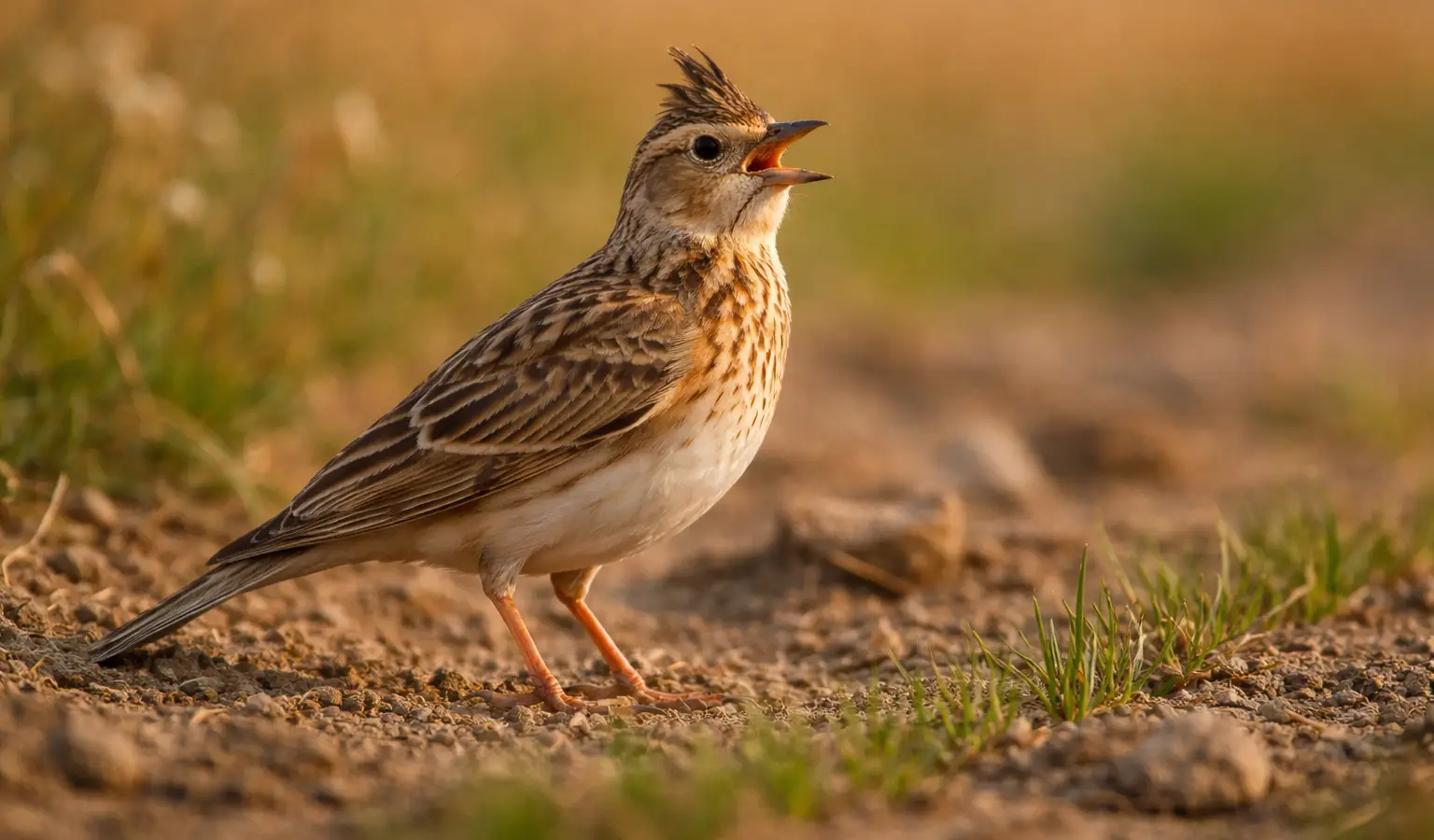
The skylark is a small, slim passerine measuring roughly 16 to 18 cm in length and often weighing around 35 to 45 g, though condition can vary by season. At first glance it looks earth-toned and understated, with heavily streaked brown upperparts, pale buff to whitish underparts, and fine streaking across the breast. This overall mottled pattern provides effective camouflage on bare soil, stubble, and dry grass.
Useful field identification features include a relatively short crest that can be raised when the bird is alert, a fairly stout bill suited to mixed feeding, and a pale eyebrow that is usually subtle rather than bold. In flight, the skylark shows broad, rounded wings and often a short tail with pale outer edges that may be glimpsed at close range. It is frequently identified more by shape, movement, and voice than by bright plumage characters.
On the ground, the species can be confused with other small brown birds of open country, but its combination of crest, streaked appearance, open-habitat preference, and especially its song helps separate it from pipits and buntings. The ascending song flight of the male is one of the most reliable identification clues in spring and early summer.
Habitat and distribution
Habitat and distribution
Habitat
Alauda arvensis is strongly associated with grassland, farmland, and other open habitats where vegetation is low enough to allow movement and visibility but dense enough in places to conceal a ground nest. It typically favors arable plains, cereal fields, hay meadows, grazed pastures, fallow ground, field margins, heaths, and dry open grasslands. Landscapes with a patchwork of bare ground, short cover, and nearby feeding areas are often especially suitable.
During the breeding season, skylarks usually select open sites away from dense woodland, tall scrub, and heavily urbanized environments. They tend to avoid habitats that become too closed, too intensively managed, or too uniformly vegetated. Very tall crops, frequent mowing at the wrong time, or simplified field structure can reduce nesting success or limit feeding access.
Outside the breeding season, they often use stubble fields, winter cereals, weedy plots, and open feeding grounds where seeds remain available. In colder weather, habitat choice may shift toward areas with accessible food and lower snow cover. The species is therefore closely tied not only to a habitat type, but also to seasonal vegetation structure and land management intensity.
Distribution
The skylark has a broad Palearctic distribution, breeding across much of Europe and extending through temperate parts of Asia. In many European countries it remains one of the best-known birds of agricultural landscapes, although abundance has declined in some regions where farming systems have intensified. Local population density can vary greatly depending on crop type, grazing pressure, field size, and the availability of uncultivated margins.
Its occurrence is patchy rather than uniform even within suitable countries. Skylarks are generally most frequent in open lowland farmland and grassland, while they are scarcer in densely forested, mountainous, or heavily urbanized areas. In some regions they are present year-round, while in others they are mainly breeders that move away or become much less visible in winter.
Autumn and winter distribution also depends on migration strategy. Some populations shift southward, while others make shorter regional movements. This means a site may hold territorial singing birds in spring, loose feeding flocks in autumn, and only irregular winter presence depending on weather and local food resources.
Lifestyle
Lifestyle and behaviour
Diet
The skylark has a mixed diet centered on insects and seeds, with seasonal adjustment according to breeding demands and food availability. During spring and summer, adults take a wide range of invertebrates such as beetles, caterpillars, spiders, flies, small larvae, and other arthropods found in crop rows, grassy swards, and bare-soil feeding patches. These protein-rich prey are especially important when adults are feeding chicks.
In autumn and winter, the species relies more heavily on seeds, grains, and other plant material. Weed seeds, spilled cereal grains, and small shoots can become important where invertebrate activity drops. This seasonal flexibility helps the skylark persist in cultivated landscapes, but it also makes the species sensitive to changes in weed flora, pesticide pressure, and winter food availability.
Foraging usually takes place on the ground, often by walking and pecking methodically through short vegetation or open soil. Fields that retain structural diversity, including rough margins and lightly disturbed feeding patches, tend to support more reliable food resources over the year.
Behaviour
The skylark is a largely diurnal bird of open ground, most active from early morning through daylight hours. Its behavior changes strongly with season. In the breeding period, males are conspicuous because of their vertical or spiraling song flights, rising high above the territory and singing continuously before descending back to cover. This display is both territorial and reproductive, and it can continue for surprisingly long periods in suitable weather.
On the ground, skylarks are alert but often rely first on camouflage rather than immediate flight. Their streaked plumage makes them difficult to detect when crouched among stubble or grass. If pressed, they flush suddenly and fly low to medium height with a direct, fluttering movement before dropping back into cover at some distance. This can make field observation challenging, especially outside the singing season.
In migration and winter, behavior becomes less territorial and more feeding-oriented. Birds may gather in loose flocks, move between open feeding areas, and spend long periods searching for seeds on the ground. Cold weather, wind, and disturbance can alter daily movement patterns, often concentrating birds in sheltered or food-rich plots.
Social structure
The social structure of the skylark is seasonally flexible. During the breeding season it is primarily organized around dispersed territorial pairs, with males defending song territories in open farmland or grassland. Nests are placed on the ground, and the pair system is centered on breeding space rather than tight flock cohesion.
Outside the breeding season, skylarks become more tolerant of one another and are often seen in loose groups during migration or in winter feeding flocks. These groups are usually not tightly coordinated like those of some highly gregarious passerines, but they do provide a practical structure for locating food and reacting to disturbance in open landscapes.
This shift from territorial breeding units to non-breeding loose aggregation is typical of many open-country birds and reflects changing pressures across the annual cycle: nesting defense in spring, then movement, feeding efficiency, and predator awareness later in the year.
Migration
The skylark is best described as a partial migrant. Some populations are strongly migratory, while others are resident or make only short-distance seasonal movements. This pattern depends on latitude, winter severity, snow cover, and the persistence of accessible feeding habitat. Birds from colder parts of the range are generally more likely to move, while those in milder areas may remain locally if food remains available.
Autumn movement often occurs from late summer into fall, with birds travelling by day in small groups or loose flocks and then using open feeding areas during stopovers. In winter, skylarks can appear in concentrations on stubble, winter cereals, and open grassland. Spring return movement is followed by reoccupation of breeding territories, when males again become highly vocal and conspicuous.
Because migration is variable, local abundance can change markedly from one season to another. A landscape may hold breeding birds, passage birds, wintering birds, or some combination of all three depending on geography and year-to-year weather conditions.
Reproduction
Reproduction
Breeding usually begins in spring, though exact timing depends on latitude, weather, and local habitat conditions. The skylark nests on the ground in a shallow depression lined with fine vegetation and concealed among grass, crop cover, or low herbaceous growth. Nest placement is one of the species' key adaptations, but it also exposes eggs and chicks to mowing, trampling, machinery, and terrestrial predators.
The clutch commonly contains several eggs, and incubation lasts about 11 days, although timing can vary slightly. After hatching, the chicks are fed mainly on invertebrates and develop quickly, as is typical for small passerines nesting in exposed environments. In favorable conditions, skylarks may attempt more than one brood in a season, especially where habitat remains suitable through spring and summer.
Breeding success depends heavily on vegetation structure and agricultural timing. Repeated disturbance, early cutting, very dense crop growth, or poor insect availability can reduce productivity. In contrast, heterogeneous farmland with varied sward height and undisturbed nesting windows generally supports better reproductive outcomes.
Field signs
Field signs
Field signs of the skylark are often subtle because it is a small, lightly built ground bird in open habitat. Tracks are usually too small and indistinct to be reliable except in very soft mud, dust, or light snow, where they may appear as fine passerine prints. Droppings are also small and generally not species-specific, so they are rarely a dependable identification tool on their own.
In practice, the best field evidence is behavioral rather than physical. Likely signs include a sudden flush from short grass or stubble, repeated use of open feeding patches, and especially the male's song flight above a field or pasture in spring. During breeding, careful observers may note repeated low descents into the same area of vegetation, which can indicate a territory or nest zone, though nests should never be approached closely because of disturbance risk.
Outside the breeding season, loose feeding flocks on stubbles, winter cereals, or open grassland are often the clearest sign of local presence. Soft calls, group flushes, and regular use of exposed feeding strips can help confirm the species where visual detection on the ground is difficult.
Ecology and relationships
Ecology and relationships
Ecological role
The skylark plays a meaningful role in open-land ecosystems and agricultural biotopes. As a consumer of many small invertebrates, it contributes to insect regulation, especially during the breeding season when adults gather large quantities of arthropods for nestlings. By feeding on seeds in autumn and winter, it also participates in seed use within farmland food webs.
It is itself an important prey species for a range of predators, including foxes and birds of prey, particularly when nests, fledglings, or winter flocks are exposed in open country. This places the skylark in a central position between lower trophic resources and higher predators.
Just as importantly, the species acts as a practical indicator of farmland ecological condition. Declines in skylark numbers often point to broader issues such as reduced insect abundance, loss of nesting structure, intensified cropping, or excessive disturbance. For land managers and field ecologists, its presence is often informative beyond the species itself.
Human relationships
The relationship between people and the skylark is unusually rich for such a small bird. It is admired by birdwatchers and naturalists for its song flight, long celebrated in literature, music, and countryside culture. For farmers and land managers, it is a familiar species of arable fields and pasture, though its nesting on the ground makes it vulnerable to modern agricultural operations.
In hunting culture, the skylark has historically been taken in some regions as a migratory game bird and is locally regarded as edible. Related hunting methods may include forms of driven pass shooting or a standing post approach where this is lawful and traditional. However, hunting relevance is now highly dependent on local regulation, conservation status, and seasonal framework, and in many places the species is fully protected or subject to strict limitations.
The skylark also intersects with public concerns about biodiversity in working landscapes. It is often cited in discussions about field margins, extensive grassland, delayed mowing, winter stubble retention, and bird-friendly crop management. In that sense, it has become both a cultural species and a practical symbol of farmland wildlife health.
Legal framework and management
Legal framework and management
Legal status
Legal status for the skylark varies significantly by country and region. In some jurisdictions it may be huntable locally under defined migratory bird regulations, while in others it is protected or subject to tighter conservation measures because of population declines or policy choices. Any legal assessment must therefore be made using current national and local wildlife law rather than broad generalization.
Where hunting is permitted, the season is often limited to autumn and winter, and the information provided here suggests a period roughly from October to January. However, open and close dates, bag limits, permitted methods, transport rules, and reporting obligations can all change. Conservation directives, regional red-list trends, and administrative decisions may also alter legal access from one year to the next.
Anyone observing, managing, or hunting skylarks should verify the most recent regulations from the competent authority before taking action in the field. That is especially important for migratory birds, where protected status, closed areas, and compliance requirements can be highly specific.
Management tips
Good skylark management begins with reading the habitat at ground level. The species generally benefits from open farmland with varied vegetation height, undisturbed nesting cover, accessible feeding patches, and a seasonal mix of invertebrate-rich and seed-rich areas. Homogeneous landscapes with dense crop cover from edge to edge are usually less favorable than mosaics that include margins, fallow strips, rough grass, and lightly disturbed open ground.
- Maintain structural diversity in arable and grassland systems rather than a single uniform sward or crop height.
- Protect nesting periods where possible by adjusting mowing, cutting, or heavy mechanical disturbance in occupied areas.
- Retain or create winter food sources such as stubble, weedy patches, or seed-bearing margins where regulations and agronomic goals allow.
- Limit unnecessary disturbance in known breeding fields during spring and early summer.
- Use local monitoring to track singing males, breeding presence, and winter flock use before making management conclusions.
For observation or lawful hunting contexts, understanding weather, crop stage, and daily movement is essential. Skylarks are easier to detect in calm mornings during the breeding season or when winter birds gather on open feeding areas. Because the species is sensitive to both habitat quality and legal context, management should always combine ecological reading with current regulation and local population trends.
Fun facts
Fun facts
The skylark's song flight is one of the most remarkable display behaviors in open-country birds. A male may sing continuously while climbing high above its territory, sometimes remaining airborne for several minutes before dropping back down.
Despite its famous voice, the bird is often surprisingly hard to see on the ground. Its streaked brown plumage blends so well with soil, dry grass, and stubble that people often hear a skylark long before they find it.
Although it is a classic farmland bird, the skylark is not simply a bird of crops. It depends on fine-scale habitat structure: too little cover exposes the nest, but vegetation that becomes too dense can also make feeding and movement difficult.
Average lifespan is often modest in the wild, and around 5 years is a reasonable reference point, but many individuals likely live much shorter lives because migration, predation, weather, and nesting risks create constant pressure.