
Rock ptarmigan
Lagopus muta
A cold-adapted high-mountain bird, locally hunted under strict management.
Type
Bird
Lifespan
7 years
Hunting season
Septembre à décembre selon réglementation locale
Edible
Yes
Fact sheet
Rock ptarmigan
Scientific name
Lagopus muta
Type
Bird
Meat quality
Lean meat
Edible
Yes
Lifespan
7 years
Incubation
25 days
Size
35-40 cm
Weight
400-600 g
Diet
Omnivore: buds, seeds, leaves, insects (mostly in summer)
Status
Hunted under local quotas
Hunting season
Septembre à décembre selon réglementation locale
Breeding season
5 / 6
Lifestyle and behaviour
Behaviour : Secretive, well-camouflaged, small groups or solitary
Social structure : Small groups or solitary
Migration : Local movements depending on snow cover
Habitat
- Mountain
Natural predators
- Birds of prey
- Arctic fox
Hunting methods
- Blinds
Health risks
- Avian parasites
Ecosystem role
- Seed dispersal
- Insect regulation
Signs of presence
- Footprints
- Feathers
- Calls
Introduction
General description
The rock ptarmigan (Lagopus muta) is a small, cold-adapted grouse of alpine and Arctic landscapes. It is best known for living above or near the tree line, where wind, snow, rock, and low vegetation shape nearly every aspect of its life. In mountain country it is one of the most specialized game birds, relying on camouflage, efficient movement over snow, and a flexible seasonal diet to survive in harsh conditions.
This species has strong ecological value in high-elevation biotopes. It feeds on buds, leaves, seeds, and summer invertebrates, and in turn supports predators such as raptors and foxes. Because it occupies exposed environments that are sensitive to weather, snow cover, and disturbance, the rock ptarmigan is also considered an informative indicator of alpine ecosystem health in many regions.
For hunters and wildlife observers, rock ptarmigan combine challenge and subtlety. They are often difficult to detect until they move, and their presence is usually revealed by tracks, feathers, or soft calls rather than obvious visual contact. Where hunting is allowed, it is typically managed cautiously through local regulations, short seasons, and quota systems intended to reflect the fragility and variability of mountain populations.
Morphology
Morphology
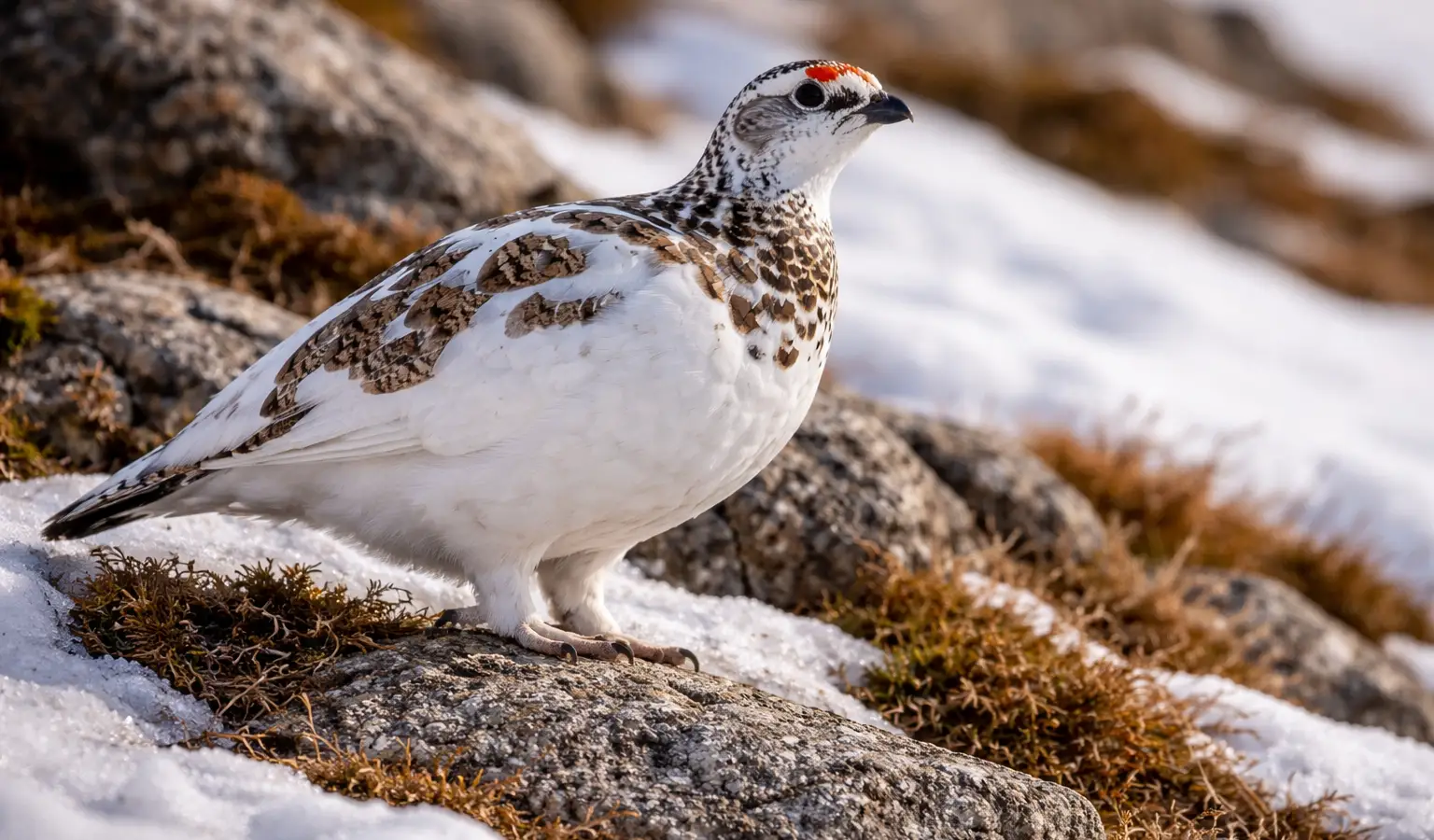
Rock ptarmigan are compact, rounded birds measuring roughly 35 to 40 cm in length and commonly weighing about 400 to 600 g, though sex, season, and local conditions can influence body mass. The overall silhouette is stocky, with a short black bill, relatively short neck, rounded wings, and feathered legs and toes that help conserve heat and improve travel on snow.
Plumage is the key to field identification. In winter, the bird is largely white, a highly effective adaptation for snowy terrain, while at other times it becomes mottled with gray, brown, black, and white tones that blend into rock, scree, lichens, and alpine vegetation. Males often show more contrasting breeding plumage and can display a red comb above the eye during the reproductive season. At close range, the dark tail and the seasonal contrast between body plumage and exposed features can help separate it from other mountain birds.
Its camouflage is so effective that identification often depends on shape, movement, and habitat context rather than color alone. A bird crouched among stones or low shrubs can disappear almost completely until it walks, flushes, or calls.
Habitat and distribution
Habitat and distribution
Habitat
The preferred habitat of the rock ptarmigan is open mountain terrain with cold exposure, sparse woody cover, and a mosaic of rock, snow patches, dwarf shrubs, grasses, sedges, and low heaths. It is most closely associated with alpine and subalpine environments, especially above the forest limit, where visibility is broad and vegetation remains low to the ground.
Good ptarmigan habitat usually combines feeding areas, shelter from wind, and safe nesting cover. Birds often use ridgelines, slopes, scree fields, snow edges, and shrub patches according to season and weather. In some areas they concentrate around places where snowmelt exposes early plant growth; in others they use windblown ground in winter to access buds and stems.
Microhabitat choice can change quickly with temperature, snow cover, disturbance, and predation pressure. Even within a single mountain massif, birds may shift between exposed rocky ground and more sheltered hollows, making habitat reading an important part of both observation and management.
Distribution
Lagopus muta has a broad circumpolar distribution across Arctic and subarctic regions, with additional populations in high mountain systems farther south. In Europe it occurs mainly in northern latitudes and isolated alpine ranges. Elsewhere, it is found across suitable cold environments of the Northern Hemisphere wherever open tundra or alpine habitat persists.
Within mountain landscapes, distribution is often patchy rather than uniform. Suitable occurrence depends on elevation, snow regime, vegetation structure, and the continuity of open high-altitude biotope. Some local populations are relatively stable in remote habitat, while others may be more fragmented where climate, recreation pressure, or habitat change reduce available alpine ground.
At a local scale, abundance can vary considerably from year to year. Harsh winters, late snow, breeding success, and predator pressure may all influence whether rock ptarmigan are regularly encountered in a given sector.
Lifestyle
Lifestyle and behaviour
Diet
The rock ptarmigan is an omnivore, but plant material forms the bulk of the diet for much of the year. It commonly eats buds, leaves, shoots, seeds, flowers, and other available alpine vegetation. In summer, insects and other small invertebrates become more important, especially for growing chicks, which need protein-rich food during early development.
Seasonal variation is essential to understanding its feeding ecology. During winter, birds rely heavily on whatever plant parts remain accessible above or through snow, including woody buds and hardy vegetation from dwarf shrubs. In spring and summer, the diet broadens as fresh green growth emerges and invertebrate availability increases. In autumn, seeds, berries where available, and late-season plant matter can contribute before winter conditions return.
Feeding often takes place in short, deliberate bouts in areas offering both food and quick concealment. Because alpine food resources can be scattered and snow-dependent, local diet composition may differ noticeably between mountain ranges and years.
Behaviour
Rock ptarmigan are generally secretive, alert, and strongly reliant on camouflage. Their first line of defense is usually immobility. A bird that feels uncertain often freezes against rock or low vegetation and becomes extremely difficult to detect. If pressure increases, it may walk off quietly, run uphill or across a slope, or flush suddenly with fast wingbeats.
Activity is shaped by weather, season, and disturbance. Birds commonly feed during calmer periods of the day and use sheltered ground during strong wind, severe cold, or intense exposure. In warm-season conditions they may move between feeding sites and resting spots across short distances, while in snow they often choose routes and positions that reduce energy loss.
Escape behavior can be subtle. Rather than making long flights immediately, rock ptarmigan may prefer short relocations to nearby cover or terrain folds. This tendency, combined with excellent plumage adaptation, explains why signs such as tracks, feathers, and calls often reveal the species before direct visual observation does.
Social structure
Outside the breeding season, rock ptarmigan are often found solitary or in small groups. These loose associations may form where feeding conditions are favorable or where winter habitat concentrates birds into limited snow-free or windblown areas. Group size can vary with season, age structure, and local population density.
During the breeding period, social organization becomes more territorial. Males may defend areas and remain more conspicuous than at other times, while females focus on nesting and brood rearing in suitable cover. After breeding, family groups can persist for a time before gradually blending into looser autumn and winter distributions.
This flexible social structure helps the species respond to a highly variable mountain environment. In exposed habitat, spacing and grouping often reflect food access, shelter, breeding condition, and predation risk more than any rigid flocking pattern.
Migration
The rock ptarmigan is not typically a long-distance migrant in the way many upland or water birds are. Instead, it makes mostly local movements depending on snow cover, exposure, food access, and seasonal weather. These shifts can be altitudinal, lateral across a mountain slope, or between ridges, basins, and windblown feeding areas.
In severe winter conditions, birds may move to terrain where vegetation remains accessible and energy costs are lower. In spring and early summer, they return to breeding habitat as snow retreats. Some populations are fairly sedentary, while others show more noticeable seasonal redistribution depending on mountain structure and climate.
For field observers, this means the species may be present within a region yet absent from a familiar area for weeks if snow and feeding conditions change. Understanding movement therefore requires reading terrain and season together rather than assuming fixed occupancy.
Reproduction
Reproduction
The breeding cycle of the rock ptarmigan begins in spring as snow retreats and alpine territories become usable again. Males display and defend breeding areas, while females select nest sites on the ground, typically in sheltered spots among stones, low shrubs, or other vegetation that provides concealment.
The nest is usually a shallow scrape lined with plant material. Clutch size can vary, but the species is capable of laying several eggs when conditions are favorable. Incubation lasts about 25 days, carried out mainly by the female, while the male may remain nearby depending on local conditions and breeding stage.
Chicks leave the nest soon after hatching and are precocial, feeding themselves under the guidance of the hen. Early brood survival depends heavily on weather, food availability, and exposure to predators. Cold, wet periods during chick rearing can be especially important in shaping annual productivity. Under good conditions, individuals may live several years, with a lifespan sometimes reaching around 7 years, although many birds will not reach that age in the wild.
Field signs
Field signs
Field signs of rock ptarmigan are often more reliable than direct sighting. The most useful clues include footprints, scattered feathers, and quiet calls in suitable alpine habitat. Tracks in snow can be particularly informative, showing repeated movement between feeding points, shelter, and roosting areas.
Look for signs along snow edges, windblown ridges, low shrub patches, rocky slopes, and other places where birds can feed while remaining hard to detect. Feathers may collect near resting sites, flush points, or places used for preening. In softer ground or patchy snow, walking routes can reveal preferred crossing lines and daily use of terrain.
Droppings, though not listed among the main signs here, may also be present near regular feeding or roosting spots and can support identification when read together with tracks and habitat. As always in mountain country, interpretation works best when multiple clues align rather than relying on a single sign.
Ecology and relationships
Ecology and relationships
Ecological role
In alpine and tundra ecosystems, the rock ptarmigan helps connect plant communities, invertebrate availability, and predator dynamics. By feeding on seeds, buds, and vegetation, it contributes to browsing pressure and may assist in seed dispersal across mountain habitat. During the warm season, its consumption of insects also contributes to insect regulation, especially at the scale of local foraging patches.
The species is also an important prey item for birds of prey and, in some northern systems, for foxes such as the Arctic fox where ranges overlap. Because its numbers can fluctuate with weather and breeding success, these predator-prey relationships may vary significantly from year to year.
As a specialized resident of cold, open ground, rock ptarmigan can also serve as a useful ecological indicator. Changes in occupancy, breeding success, or seasonal movement may reflect broader shifts in snow regime, disturbance patterns, vegetation change, or climate pressure in mountain ecosystems.
Human relationships
The relationship between people and rock ptarmigan combines wildlife observation, mountain culture, and, in some regions, carefully regulated small game hunting. Its cryptic behavior and spectacular habitat make it highly valued by birdwatchers, naturalists, and hunters alike. Encounters are often memorable precisely because the species is difficult to see and closely tied to remote, high-country terrain.
Where hunted, the bird is generally considered a sensitive quarry rather than a high-volume game species. Access is often limited by terrain, weather, and local rules, and successful pursuit usually depends on patient habitat reading rather than frequent shooting opportunities. The meat is edible and traditionally appreciated in places where legal harvest remains part of local practice.
Human disturbance can matter, especially in breeding areas or during periods of environmental stress. Repeated flushing by recreation, poorly timed access, or unmanaged pressure may affect energy balance and habitat use. For that reason, coexistence is often best supported by restraint, seasonal awareness, and respect for local conservation measures.
Legal framework and management
Legal framework and management
Legal status
Legal status varies significantly by country, region, and local conservation context. In some areas the rock ptarmigan is huntable under local quotas and closely controlled seasonal frameworks; in others it may be fully protected or subject to temporary restrictions due to conservation concerns.
Where harvest is allowed, the season is often limited to autumn or early winter, broadly corresponding in some jurisdictions to September through December, but exact dates, bag limits, access rules, and reporting obligations depend entirely on local regulation. Mountain birds can be especially sensitive to overharvest where populations are small or fragmented, so managers often use conservative approaches.
Anyone seeking to observe or hunt rock ptarmigan should verify current official rules for the specific area involved. Legal conditions may change from year to year in response to counts, breeding success, weather impacts, or broader wildlife management policy.
Management tips
Effective rock ptarmigan management starts with understanding that this is a specialist of fragile mountain habitat. Population condition can shift with snow patterns, breeding weather, predator pressure, and human disturbance, so management should remain cautious, local, and adaptive rather than fixed.
- Prioritize habitat quality: maintain quiet, connected alpine ground with a mosaic of feeding and nesting cover.
- Monitor breeding success: annual productivity can vary sharply, and poor chick survival may justify reduced pressure.
- Use conservative harvest systems: quotas, short seasons, and area-based review are often appropriate where hunting is permitted.
- Limit disturbance in sensitive periods: breeding and severe winter conditions are key times to avoid unnecessary pressure.
- Read the mountain carefully: snow cover, exposure, and vegetation structure strongly influence occupancy and detectability.
- Watch health indicators: avian parasites and general body condition can contribute to population assessment.
For observers and hunters alike, the best practice is restraint. If birds appear scarce, heavily disturbed, or concentrated in a limited refuge area, backing off is often the most responsible choice.
Fun facts
Fun facts
The name ptarmigan comes from a term linked to its feathered feet, a fitting detail for a bird that lives on snow and frozen ground.
One of its most remarkable adaptations is seasonal plumage change. Few game birds transform so completely between winter white and mottled summer tones, making the rock ptarmigan a textbook example of camouflage in action.
Even experienced mountain travelers often walk past rock ptarmigan without noticing them. A bird that seems invisible against stone or snow can suddenly appear at close range, then vanish again after only a short movement.
Because it lives in high, cold country, the rock ptarmigan is often discussed in relation to changing snow conditions and climate sensitivity, giving it importance well beyond its modest size.