
Rock partridge
Alectoris graeca
A mountain partridge of rocky slopes, hunted under management plans in some areas.
Type
Bird
Lifespan
8 years
Hunting season
September – November
Edible
Yes
Fact sheet
Rock partridge
Scientific name
Alectoris graeca
Type
Bird
Meat quality
Tasty meat
Edible
Yes
Lifespan
8 years
Incubation
23 days
Size
32-38 cm
Weight
500-650 g
Diet
Omnivore: seeds, insects, berries
Status
Huntable under management plans
Hunting season
September – November
Breeding season
4 / 5
Lifestyle and behaviour
Behaviour : Small family groups, wary, shelters among rocks
Social structure : Small family groups
Migration : Local movements on mountain slopes
Habitat
- Forest
- Mountain
Natural predators
- Fox
- Birds of prey
Hunting methods
- Blinds
- Stalking
Health risks
- Avian parasites
Ecosystem role
- Seed dispersal
- Insect regulation
Signs of presence
- Ground tracks
- Feathers
- Calls
Introduction
General description
The rock partridge (Alectoris graeca) is a compact mountain gamebird closely associated with steep, broken terrain. It is one of the classic partridges of southern and southeastern European highlands, where it lives among rocky slopes, sparse shrub cover, open woodland edges, and upland grasslands. Compared with lowland partridge species, it is especially adapted to rugged ground, using elevation, stone cover, and sharp visibility to avoid predators and disturbance.
In ecological terms, the rock partridge is an upland omnivore that links plant communities, invertebrate populations, and predator guilds. It feeds on seeds, green plant material, berries, and insects, with diet composition shifting through the year according to snow cover, breeding needs, and local food availability. Its presence often reflects a mosaic of open mountain habitat, moderate disturbance, and suitable nesting and brood-rearing cover.
Within hunting culture, the species has long been valued as a demanding small game bird because it is wary, terrain-dependent, and not easily approached. Where hunting is allowed, it is typically subject to management plans, local rules, and variable conservation concern depending on region and population trend. For wildlife watchers and field ecologists, the rock partridge is equally notable as a discreet bird whose calls, tracks, and brief uphill runs often reveal it before a full visual encounter does.
Morphology
Morphology
The rock partridge is a medium-sized partridge, generally about 32 to 38 cm long and often weighing roughly 500 to 650 g. It has a sturdy body, rounded wings, a relatively short tail, and strong legs suited to climbing broken slopes rather than sustained long-distance flight. In the field, its posture often appears low and compact when moving among stones, then suddenly upright and alert when scanning for danger.
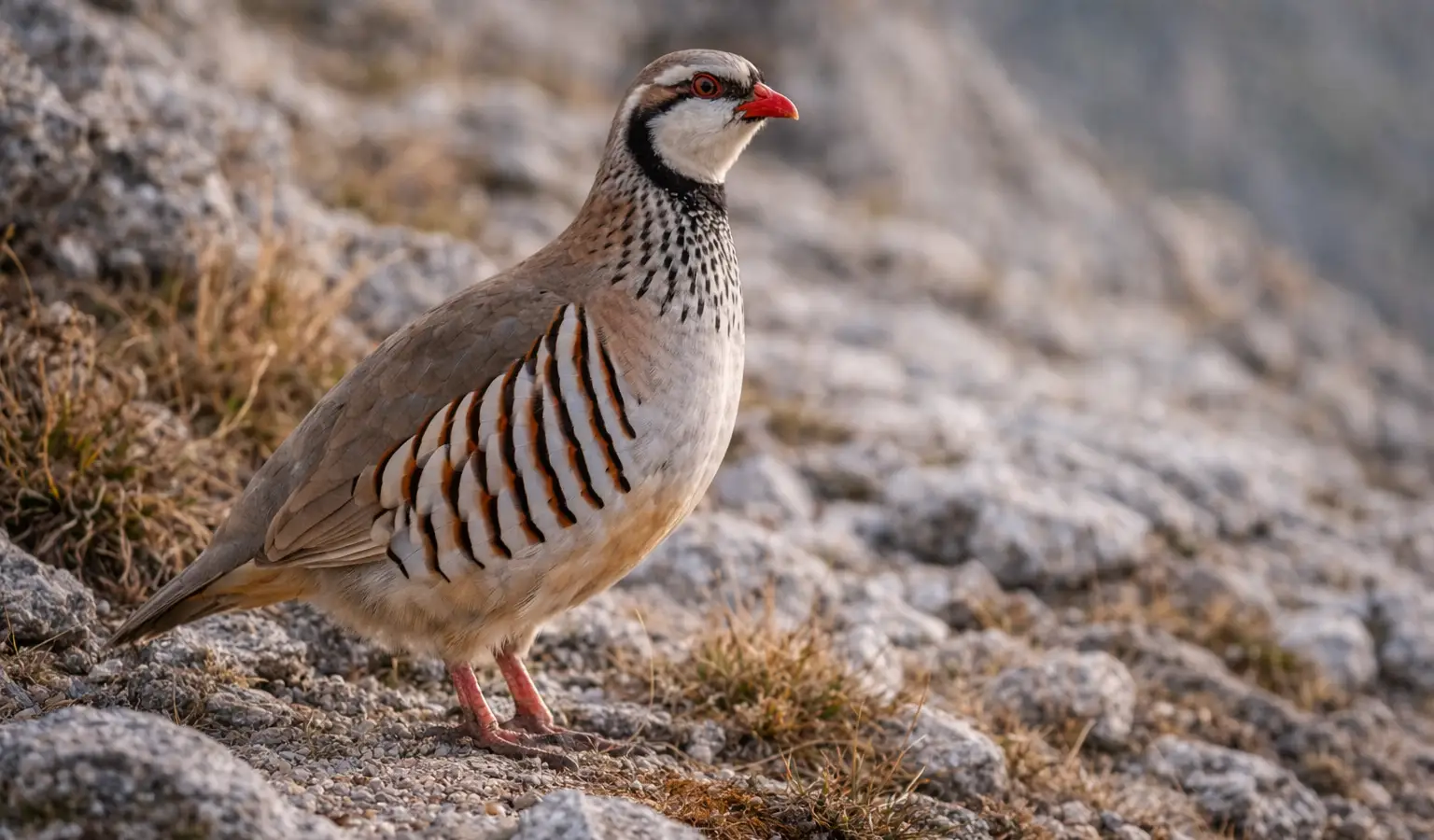
Useful identification features typically include grayish upperparts, buff to pale underparts, barred flanks, a red bill, and red legs. The face and throat pattern is especially important: the throat is pale and usually bordered by a dark line that frames the face and continues as a collar-like marking. This head pattern, together with the flank barring, helps separate Alectoris graeca from other partridge species where ranges approach or overlap. Sexes are broadly similar in plumage, although males may appear slightly larger and can show more developed spurs.
At distance, observers often notice the bird less by color alone than by silhouette and movement: a chunky upland bird that runs quickly uphill, pauses beside rock outcrops, and blends remarkably well with gray-brown mountain backgrounds.
Habitat and distribution
Habitat and distribution
Habitat
The rock partridge is primarily a bird of mountain and submontane habitats. It favors rocky slopes, scree margins, stony pastures, open grassy ridges, shrub-dotted hillsides, and broken terrain near cliffs or ledges. Although strongly tied to open ground, it usually benefits from a patchwork structure rather than bare rock alone. Scattered shrubs, low heath, rough grass, and nearby woodland edges provide feeding options, shelter from weather, and cover from predators.
Its preferred biotope often lies in landscapes where grazing, natural disturbance, and topography create a mixed structure with visibility and refuge close together. During breeding, hens generally need discreet ground cover for nesting, while broods benefit from places rich in insects and tender vegetation. In colder periods, the species may use sunnier exposures, lower slopes, or less snowbound sectors of the mountain.
Habitat quality depends not just on altitude but on openness, food availability, winter accessibility, and the degree of human pressure. Excessively dense scrub, large-scale habitat abandonment, repeated disturbance, or severe weather can reduce local suitability even where mountains remain extensive.
Distribution
Alectoris graeca is native to parts of southern and southeastern Europe, with populations associated mainly with mountainous regions. Its distribution is often described as fragmented or patchy because it follows suitable upland terrain rather than continuous lowland landscapes. It is especially linked to ranges in the Balkans, parts of the Alps and Apennines, and other rocky highland systems within its broader natural range.
Local occurrence can vary greatly according to elevation, slope exposure, habitat continuity, hunting pressure, and management quality. In some regions the species remains a characteristic bird of traditional mountain country; in others, it may be localized, reduced, or subject to close monitoring. Because several Alectoris partridges occur in Europe and management histories differ, regional identification and status assessments should be approached carefully.
For practical field use, the best search areas are often dry, open mountain slopes with a mixture of stone, grass, and low cover rather than dense forest interiors or heavily cultivated valley bottoms.
Lifestyle
Lifestyle and behaviour
Diet
The rock partridge is an omnivore with a flexible diet built around seeds, shoots, berries, and invertebrates. Plant material often forms the bulk of the adult diet for much of the year, especially seeds of grasses and other herbaceous plants, green leaves, buds, and seasonal fruits where available. Insects and other small invertebrates become particularly important during the breeding season and for growing chicks, which need concentrated protein for rapid development.
Diet shifts with altitude, weather, and season. In spring and early summer, fresh vegetation and invertebrates may be heavily used. In late summer and autumn, birds commonly exploit seeds and berries, taking advantage of upland food pulses before harsher conditions set in. During colder periods, feeding can become more constrained by snow cover, pushing birds toward exposed ground, sheltered slopes, and any accessible plant matter.
Feeding usually takes place on the ground, often in short bouts of pecking while birds remain highly vigilant. This balance between foraging and predator awareness is a defining part of rock partridge behavior in open mountain terrain.
Behaviour
The rock partridge is typically a wary, ground-oriented bird that relies first on detection, camouflage, and rapid running rather than immediate flight. Small groups often move quietly along contours, feeding and scanning in alternation. When disturbed, birds may freeze, slip behind rocks, run uphill with surprising speed, or burst into short, explosive flight before dropping back into cover.
Activity is often strongest during cooler parts of the day, especially morning and late afternoon, though local weather can strongly shape daily rhythm. In hot or heavily exposed areas, birds may reduce visible movement during the middle of the day and use shaded or broken ground. Their alertness is notable: individuals frequently pause in elevated spots to watch downslope approaches, making close observation difficult.
Vocalizations can be an important behavioral clue, particularly when family groups maintain contact or birds react to disturbance. Outside severe winter conditions, the species often remains closely tied to familiar slopes and escape routes, showing a strong relationship with terrain structure and local shelter.
Social structure
The rock partridge is commonly encountered in small family groups or loose parties outside the nesting period. After breeding, broods remain associated with the attending adult for a time, forming the covey-like groups that are often seen or flushed in late summer and autumn. Group size varies with reproductive success, habitat, and season.
During the breeding period, social structure becomes more territorial and dispersed. Pairs separate from larger groupings, and nesting females keep a lower profile in suitable cover. Even when birds are not tightly clustered, they often remain linked to the same slope systems and feeding areas, using visual contact and calls to maintain cohesion where terrain permits.
In winter or under difficult mountain conditions, birds may concentrate in favorable microhabitats, but social organization still tends to remain relatively small-scale rather than forming very large flocks.
Migration
The rock partridge is generally considered sedentary to locally mobile rather than truly migratory. Most movements are short-range shifts along mountain slopes, between elevations, or toward sunnier and less snow-covered sectors as conditions change. These local displacements can be important in winter, when snow depth and food accessibility strongly influence where birds can remain.
Seasonal movement often follows a practical mountain logic rather than a fixed migration route. Birds may use higher breeding ground during favorable periods, then drift lower or into more sheltered exposures during bad weather or heavy snow. Juvenile dispersal also contributes to local redistribution after the breeding season.
For field observers, this means the species may seem absent from a known area at one time of year yet remain present elsewhere on the same massif, concentrated in more accessible feeding and shelter habitat.
Reproduction
Reproduction
Breeding generally takes place in spring, with timing influenced by altitude and snow conditions. As mountain weather eases, pairs establish or reoccupy suitable breeding areas where nesting cover, feeding ground, and escape terrain are all close together. The nest is a shallow scrape on the ground, usually concealed among grass, stones, or low shrubs.
The female lays a clutch of eggs that is incubated for roughly 23 days, although exact timing may vary somewhat. Like other partridges, the young are precocial: they leave the nest soon after hatching and begin following the adult through brood habitat rich in insects and soft vegetation. Chick survival is often closely tied to weather during the early brood period, especially cold rain, prolonged exposure, and food access.
Reproductive output can fluctuate sharply from year to year in mountain systems. Late snow, repeated disturbance, predation, and poor brood-rearing conditions may reduce recruitment, while favorable springs can produce noticeably stronger family groups by late summer.
Field signs
Field signs
Rock partridge field signs are often subtle but readable with practice. The most useful clues include ground tracks, scattered feathers, and characteristic calls heard on calm mountain mornings or after disturbance. Tracks are usually found in dust, soft soil, light snow, or around feeding patches and watering points, showing the three forward toes typical of galliform birds.
Other signs may include droppings on favored perches or feeding zones, scratch marks where birds have searched for food, and repeated use trails across stony slopes or along contour lines. On steep ground, feathers at a flush point or beside a rock ledge can indicate a regular sheltering area. Dusting sites may also occur in dry, loose soil near cover.
When reading sign, context matters. Fresh feeding traces near low shrubs, paired with tracks moving between rock cover and open patches, are often more meaningful than any single isolated mark. Observers should also be alert to the sudden silence or alarm movement of other mountain wildlife, which can betray the presence of a hidden covey.
Ecology and relationships
Ecology and relationships
Ecological role
The rock partridge plays a useful ecological role in upland systems. By feeding on seeds and fruits, it can contribute to seed dispersal at a local scale. Through regular consumption of insects and other small invertebrates, it also participates in insect regulation, especially during the breeding season when broods forage intensively.
It is also an important prey species for mountain predators, including foxes and various birds of prey. In that sense, the rock partridge helps transfer energy from upland plant and invertebrate communities to higher trophic levels. Population changes in the species may therefore reflect broader shifts in habitat structure, weather severity, predator pressure, or land-use change.
Because it depends on structurally diverse mountain habitat, the presence of a healthy rock partridge population can also indicate a functioning mosaic of open ground, cover, feeding areas, and relatively moderate disturbance.
Human relationships
The relationship between people and the rock partridge combines hunting tradition, mountain land use, and wildlife observation. In areas where it remains huntable, it is regarded as a challenging small game bird because success depends on reading terrain, understanding wind and exposure, and locating birds that use cover intelligently. Traditional methods may include stalking and waiting near likely movement zones or natural lines of travel, always within the legal framework and local management rules.
For non-hunters, the species is valued as a discreet but emblematic bird of rocky uplands. Birdwatchers often seek it by listening for calls at dawn or by scanning open slopes from a distance to avoid disturbance. Farmers and pastoral systems can influence the species positively or negatively depending on grazing intensity, shrub encroachment, and seasonal disturbance patterns.
Because the bird is edible and historically important in some hunting cultures, it has practical as well as symbolic significance. At the same time, responsible human interaction depends on recognizing that mountain populations can be vulnerable to excessive pressure, poor breeding years, and habitat change.
Legal framework and management
Legal framework and management
Legal status
The rock partridge is best described, in many hunting contexts, as huntable under management plans, but the legal situation is highly dependent on country, region, and local population status. Open seasons, bag limits, permit requirements, and even whether hunting is allowed at all may differ considerably across its range. The season cited in some areas falls broadly from September to November, but this should never be treated as universal.
Because mountain gamebird populations can fluctuate and some local stocks may be sensitive, management often includes monitoring, restricted harvest, habitat measures, or temporary closure where necessary. Hunters and land managers should always verify current regulations from the competent authority before planning any activity.
From a conservation standpoint, legal status should be read together with local abundance, habitat quality, and the risk of confusion or interaction with other partridge populations in nearby regions.
Management tips
Good rock partridge management starts with habitat reading. Productive areas usually offer a balanced mosaic of open feeding ground, rocky refuge, brood habitat rich in insects, and winter-accessible slopes with limited snow accumulation. Maintaining this structure often matters more than any single intervention. Excessive scrub closure, repeated disturbance during breeding, and poorly timed pressure can all reduce habitat value.
- Monitor populations at local scale rather than assuming all mountain sectors hold birds equally.
- Protect nesting and brood-rearing areas from unnecessary spring disturbance where possible.
- Maintain heterogeneous upland vegetation through suitable grazing or other habitat stewardship adapted to local conditions.
- Be cautious with harvest in years following poor breeding success or severe weather.
- Use observation, calling surveys, and field sign interpretation to understand use of slopes, ridges, and shelter zones.
For hunters and observers alike, the best practical approach is to move carefully, use optics, and let the terrain guide expectations. South-facing slopes, broken grassy benches, and rocky edges near feeding cover often deserve attention, but pressure should remain proportionate to the resilience of the local population.
Fun facts
Fun facts
The rock partridge is a specialist of steep country, and much of its survival strategy is built around running uphill fast before taking wing only when necessary. This makes encounters memorable: the bird often seems to vanish into terrain that looked too open to hide anything.
Although classed as a partridge, it behaves in many ways like a true mountain bird, using sun exposure, wind shelter, and micro-topography with great precision. A hillside that looks uniform to people may contain several distinct feeding, resting, and escape zones for Alectoris graeca.
Its lifespan is often cited at around 8 years in favorable circumstances, but in the wild, survival usually depends on weather, predation, habitat quality, and annual breeding success more than on theoretical longevity alone.