
Rock dove
Columba livia
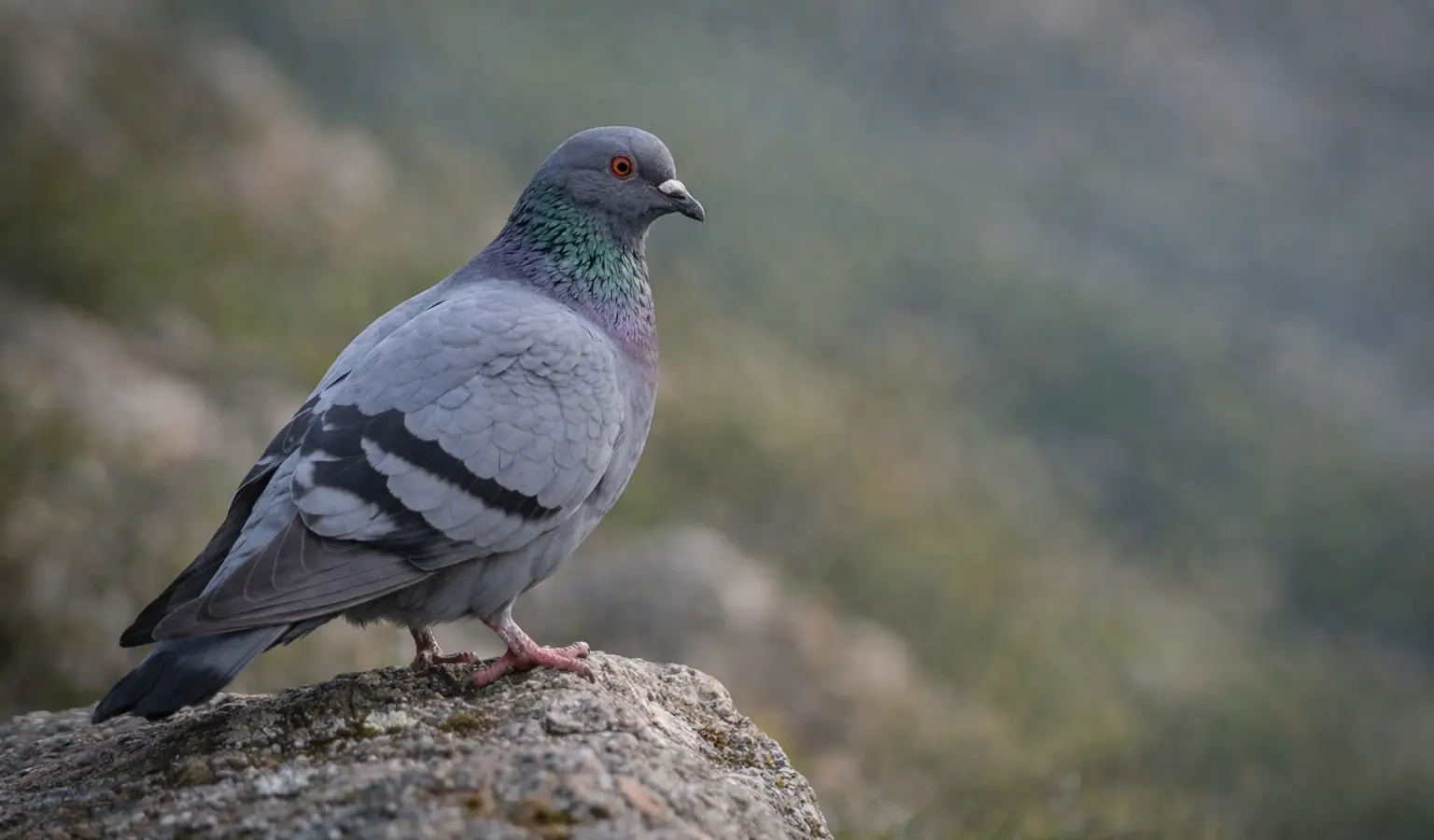
A sedentary wild pigeon living in large colonies.
Type
Bird
Lifespan
15 years
Hunting season
Toute l’année selon statut
Edible
Yes
Fact sheet
Rock dove
Scientific name
Columba livia
Type
Bird
Meat quality
Tender meat
Edible
Yes
Lifespan
15 years
Incubation
18 days
Size
34-37 cm
Weight
300-400 g
Diet
Seeds, grains
Status
Locally huntable
Hunting season
Toute l’année selon statut
Breeding season
4 / 5 / 6
Lifestyle and behaviour
Behaviour : Sedentary, colonial
Social structure : Large colonies
Migration : Sedentary
Habitat
- Mountain
- Urban fringe
Natural predators
- Birds of prey
Hunting methods
- Standing post
Health risks
- Avian parasites
- Trichomoniasis
Ecosystem role
- Residual seed cleanup
Introduction
General description
The rock dove, Columba livia, is the wild ancestral pigeon from which most domestic and feral pigeons descend. In its original form it is a hardy, medium-sized bird associated with cliffs, rocky escarpments, sea coasts, and other open places that provide ledges for nesting and broad visibility for early predator detection. It is often described as sedentary and strongly colonial, forming local concentrations where feeding areas and secure roosts occur close together.
Although many people know pigeons mainly from towns and villages, the true rock dove has long been part of natural and semi-natural landscapes. Its biology is built around regular daily movements between roosting sites, water, and feeding grounds rich in seeds and grain. This practical adaptability explains both its persistence in rugged country and its success on the urban fringe, where buildings imitate cliffs and agriculture supplies food.
From a field ecology perspective, the species is useful to understand because it sits at the intersection of wild habitats, farmland, and human settlement. It can be an important prey item for birds of prey, a consumer of waste grain and seeds, and in some regions a locally huntable game bird subject to changing legal status. For hunters and wildlife observers alike, correct identification matters, especially where wild rock doves may mix with feral pigeons or domestic escapees.
Morphology
Morphology
The rock dove is a compact, broad-chested pigeon measuring roughly 34 to 37 cm in length and commonly weighing around 300 to 400 g. It has a relatively small head, short neck, pointed wings, and a medium-length tail. In flight it appears powerful and direct, with fast wingbeats and quick changes of direction when alarmed.
Classic wild-type plumage is bluish grey with a darker head, a pale grey rump, and two distinct black wing bars. The neck often shows iridescent green and purple sheen in good light. The tail is usually grey with a dark terminal band. The bill is fairly slim, dark toward the tip, and set above a pale fleshy cere. Legs are reddish to pink.
Field identification becomes more difficult where pure wild birds mix with feral pigeons, which can show a wide range of colors and patterns derived from domestic stock. For practical identification in the field, observers should look at the combination of body shape, wing-bar pattern, habitat context, flock behavior, and nesting association with cliffs, quarries, old stone structures, or similar ledged surfaces.
Habitat and distribution
Habitat and distribution
Habitat
Rock doves prefer landscapes that combine secure roosting ledges with nearby open feeding ground. Their classic biotope includes cliffs, rocky slopes, coastal headlands, gorges, and mountain areas where natural cavities or shelves provide shelter from weather and predators. In these settings they typically feed in more open ground, including grassland edges, stubble, harvested fields, and other places where seeds can be picked from the surface.
The species also adapts readily to the urban fringe, old industrial sites, bridges, farm buildings, and villages, especially where architecture reproduces the nesting opportunities of rock faces. In agricultural regions, access to cereal fields, livestock areas with spilled grain, and water sources can strongly influence local abundance.
Habitat quality depends less on dense vegetation than on a useful arrangement of roost security, visibility, and food. Areas with repeated disturbance at nesting ledges, heavy persecution, or poor access to feeding ground may hold fewer birds even if the structures look suitable.
Distribution
Columba livia has a broad native range centered on parts of Europe, North Africa, and western to central Asia, with a much wider global presence through domestication and feral establishment. In many regions, however, separating truly wild rock doves from feral urban pigeons is not always straightforward, and occurrence maps may reflect mixed populations.
Where suitable rocky habitat exists, the species may occur locally in mountains, coastal cliffs, and dry open country. Around human settlement it is often more widespread because buildings provide abundant substitute nesting sites. In some areas it remains common year-round; in others, its status is more localized, fragmented, or complicated by hybridization with domestic and feral birds.
For practical field use, distribution is best understood at a regional scale: look for colonies near cliffs, quarries, old masonry, grain-producing farmland, and urban-rural transition zones. Local abundance can rise or fall depending on food availability, predator pressure, disease, and management context.
Lifestyle
Lifestyle and behaviour
Diet
The rock dove feeds mainly on seeds and grains, which it gathers from the ground with a steady walking gait. Cereals, weed seeds, spilled grain, and small cultivated seeds often make up much of the diet where farmland is accessible. In dry or rocky country, naturally available seed resources can be especially important outside the harvest period.
Seasonal feeding patterns usually track agricultural opportunity. Recently cut fields, stubble, grain storage areas, livestock feed spillages, and open feeding patches can attract concentrated flocks. During leaner periods, birds may range more widely to locate scattered seed sources, buds, or other small plant material, though seed remains the core resource.
Regular access to water is often important, especially in warm weather. Because the species forages in open areas, feeding sites are typically chosen where birds can detect danger early and flush quickly. This habit explains why margins, bare ground, tracks, and short vegetation are often favored over dense cover.
Behaviour
Rock doves are primarily diurnal, with a daily rhythm centered on leaving roosts after dawn, feeding in open areas, visiting water, and returning repeatedly to loafing or nesting ledges. Their behavior is often orderly and habitual, and local birds may use the same flight lines, feeding sectors, and roost entrances day after day when undisturbed.
The species is alert but not constantly nervous. In feeding flocks, some individuals usually remain more vigilant while others feed, allowing the group to react quickly to danger. When alarmed, rock doves flush explosively, producing the familiar burst of wing noise associated with pigeons. They often climb fast, wheel as a flock, and either relocate to a nearby secure perch or continue toward a known refuge.
In settled areas they may tolerate a moderate level of recurring human presence, yet they can become markedly wary where hunting pressure, repeated disturbance, or raptor activity is high. Wind, weather, and the timing of feeding opportunities also influence daily movement and visibility in the field.
Social structure
The rock dove is a strongly colonial bird. It often nests, roosts, and feeds in groups ranging from small clusters to large colonies when conditions are favorable. This social structure improves early predator detection and helps birds exploit reliable feeding areas efficiently.
Outside the breeding phase, flocking behavior is especially conspicuous. Birds may gather at roost ledges, water points, harvested fields, and grain-rich sites, then move together in coordinated flights. Pair bonds are important within the colony, but the species remains socially integrated rather than territorial in the way many solitary birds are.
At nest sites, individual pairs defend a small immediate space around the nest, while still remaining close to neighboring pairs. Colony density depends on available ledges, disturbance level, and food supply within commuting distance.
Migration
The rock dove is generally considered sedentary rather than migratory. Most birds remain tied to local roosting and breeding areas throughout the year, making regular short movements between colony sites, feeding grounds, and water rather than undertaking true seasonal migration.
That said, local dispersal does occur. Young birds may spread from natal colonies, and flocks can shift their feeding range in response to harvest, weather, disturbance, or temporary food shortages. In harsh conditions, movements may become more noticeable, but they usually remain regional rather than long-distance migratory flights.
For field observers and hunters, this means patterns are often predictable: once feeding areas, flight corridors, and roost structures are identified, birds may use them repeatedly unless conditions change.
Reproduction
Reproduction
Rock doves can breed over an extended part of the year where climate and food are favorable, and in mild conditions they may attempt several broods. The nest is usually a simple platform of twigs, stems, and debris placed on a cliff ledge, cavity, building beam, or sheltered shelf. Traditional nesting sites may be reused repeatedly.
A typical clutch contains two eggs. Incubation lasts about 18 days, with both parents taking part. After hatching, the young are fed first with nutrient-rich crop secretion often called pigeon milk, then progressively with softened seeds and other food brought by the adults.
Breeding success varies with weather, disturbance, predation, and food access. Colonies close to dependable feeding ground generally perform better than those forced to travel farther. In mixed wild-feral contexts, reproduction can also influence local genetic blending, which is a concern for the conservation of truly wild rock dove populations in some areas.
Field signs
Field signs
Field signs are often easier to detect around roosts and nesting structures than on open ground. Look for repeated white-streaked droppings on cliff ledges, rock shelves, beams, bridges, old ruins, quarry walls, and favored perches. Accumulations below ledges can reveal long-used colony sites.
Feathers, down, and light nesting debris may gather beneath occupied shelves or inside sheltered cavities. On feeding ground, signs are subtler: trampled bare patches, repeated flock use of stubble or grain spill areas, and regular flight arrivals at first light or late afternoon are often more informative than footprints alone.
Tracks can sometimes be seen in dust, mud, or snow as small three-toed bird prints, but they are usually not distinctive enough for confident identification without supporting context. In practice, the best field evidence comes from droppings, roost staining, habitual flight lines, and direct observation of birds entering or leaving ledges.
Ecology and relationships
Ecology and relationships
Ecological role
Ecologically, the rock dove functions as a widespread consumer of seeds and waste grain, contributing to residual seed cleanup in farmland and other open habitats. By removing spilled or naturally shed seed, it participates in nutrient transfer between feeding sites and roosting areas.
It is also an important prey base for several birds of prey, especially falcons, goshawks, and other avian predators capable of taking medium-sized birds in open air or around cliffs and buildings. Large pigeon colonies can therefore influence local predator activity and hunting behavior.
At the same time, dense concentrations may also facilitate parasite and disease transmission, which makes population balance and habitat context important from a wildlife health perspective. Its ecological role is therefore both beneficial and complex, especially where wild, feral, and domestic forms overlap.
Human relationships
Few birds are as closely tied to human history as the rock dove. It is the ancestor of domestic pigeons and has long been associated with settlement, food storage, transport culture, and selective breeding. Today, people encounter it in very different ways: as a wild cliff-dweller, a familiar bird of towns, a quarry-edge pigeon on the urban fringe, a prey species for raptors, or a locally huntable bird depending on jurisdiction.
In farming landscapes, rock doves and pigeon populations can be viewed ambivalently. They may help remove spilled grain, yet concentrated flocks can also feed on stored or accessible agricultural products. Around built areas, accumulation of droppings and nesting debris may create practical management issues.
For hunting relevance, the species is typically associated with observation of flight lines, feeding routines, and stand placement near regular passage routes, especially where legal and culturally established. Clear identification and awareness of local status are essential, because not all pigeon-like birds are treated the same under regulation.
Legal framework and management
Legal framework and management
Legal status
Legal status varies significantly by country, region, and by how authorities distinguish wild rock doves from feral pigeons or other pigeon species. In some places the species may be locally huntable; in others, it may be protected, regulated differently in urban settings, or affected by rules linked to conservation of native wild populations.
The indication that it may be taken throughout the year depending on status should never be treated as universal. Open seasons, permitted methods, classification as game or pest, and rules concerning transport or consumption can differ widely. Hunters and land managers should always verify current local legislation before any action.
Where concern exists over the conservation of genetically pure wild rock doves, additional caution may apply. The legal framework can also intersect with animal health measures, building management, and municipal nuisance regulations.
Management tips
Good management starts with distinguishing between wild rock dove habitat, feral pigeon concentrations, and mixed populations. Read the landscape by connecting three elements: secure ledges for roosting or breeding, open feeding ground within practical commuting distance, and dependable water. Colonies persist best where these features remain stable and disturbance is moderate.
For observation or hunting-related field reading, focus on first-light departures, late-day returns, and recurring routes between colony sites and feeding areas. Standing post setups are most effective only where flight lines are regular, legal, and safely separated from roads, buildings, and public access. Heavy disturbance can quickly shift local patterns.
Health matters should not be overlooked. Dense pigeon groups can carry avian parasites and diseases such as trichomoniasis, so hygiene, carcass handling, and concentration management are sensible precautions. Where conservation of wild-type birds is a concern, limiting conditions that encourage mixing with feral domestic pigeons may be relevant. Any management plan should remain aligned with local law and the specific status of the population involved.
Fun facts
Fun facts
- Columba livia is the original wild stock behind most domestic and feral pigeons seen around the world.
- Its apparent comfort on buildings is not accidental: walls, ledges, and bridges mimic the cliffs used by ancestral wild birds.
- Both parents help raise the young and produce crop milk, a rare and highly specialized feeding strategy among birds.
- The species can live for many years; under favorable conditions, lifespan may reach around 15 years, though many wild birds live less due to predation, disease, and other pressures.
- Fast, direct flock flight is one of its best defenses, especially against aerial predators such as falcons.