
Redwing
Turdus iliacus
A small migratory thrush often seen in flocks during autumn and winter.
Type
Bird
Lifespan
6 years
Hunting season
October – February
Edible
Yes
Fact sheet
Redwing
Scientific name
Turdus iliacus
Type
Bird
Meat quality
Fine and tender meat
Edible
Yes
Lifespan
6 years
Incubation
13 days
Size
20-22 cm
Weight
60-80 g
Diet
Insects, fruits and berries
Status
Huntable locally
Hunting season
October – February
Breeding season
5 / 6
Lifestyle and behaviour
Behaviour : Migratory, travels in flocks
Social structure : Migratory flocks
Migration : Migratory
Habitat
- Forest
- Farmland
Natural predators
- Birds of prey
Hunting methods
- Driven pass
- Standing post
Health risks
- Avian parasites
Ecosystem role
- Seed dispersal
Introduction
General description
The Redwing, Turdus iliacus, is a small migratory thrush best known across much of Europe for its autumn and winter movements. It is often encountered in loose to dense flocks moving through farmland, hedgerows, orchards, woodland edges, and berry-rich cover. Although modest in size, it is one of the most characteristic winter thrushes, especially where cold weather drives birds into open feeding areas.
This species is closely tied to seasonal movement. In many regions the Redwing is mainly a passage migrant and winter visitor rather than a breeding bird, and its numbers can change quickly with weather, food supply, and broader migration pressure. Hard frost or snow often concentrates birds in sheltered places with fruiting shrubs, soft ground, and accessible feeding opportunities.
Ecologically, the Redwing plays an important role as both an invertebrate feeder and a consumer of fruits and berries. That combination makes it relevant to nutrient cycling and seed dispersal in agricultural mosaics and woodland margins. For birdwatchers it is a classic cold-season species; for hunting cultures in areas where regulations allow harvest, it is part of the traditional suite of migratory thrushes, requiring careful identification, respect for local law, and awareness of changing conservation conditions.
Morphology
Morphology
The Redwing is the smallest of the common European thrushes, typically measuring about 20 to 22 cm in length and often weighing roughly 60 to 80 g, although body mass can vary with season and condition. Its structure is neat and compact, with a relatively slender bill, rounded body, and agile, direct flight.
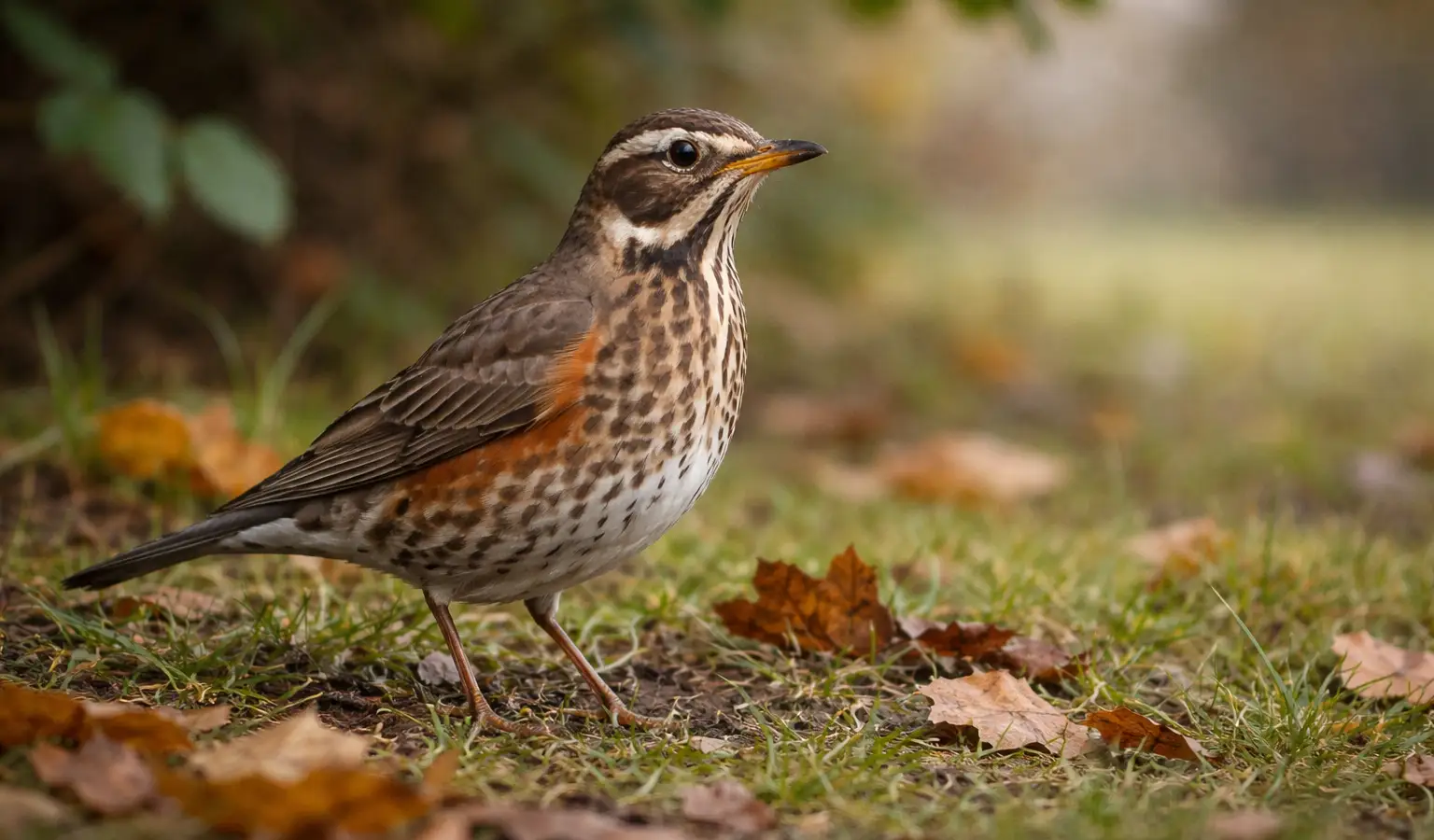
Field identification is usually based on a combination of subtle but reliable features. The upperparts are brown, the underparts pale with dark streaking on the breast and flanks, and the face shows a bold pale supercilium above a darker cheek. The most distinctive mark is the warm chestnut-red coloration on the flanks and underwing, often especially noticeable when the bird takes flight. In poor light, observers frequently notice the strong eyebrow first, then the smaller size and finer build compared with a Song Thrush.
Sexes are broadly similar in plumage, and juveniles can look slightly more patterned or scaly when freshly fledged, but age and sex separation in the field is not always straightforward. The voice is also useful for identification: migrating or disturbed Redwings often give a thin, high contact call that experienced observers quickly learn to recognize during nocturnal passage and winter flock movement.
Habitat and distribution
Habitat and distribution
Habitat
Redwings use a wide range of habitats through the year, but their needs shift between breeding and non-breeding seasons. In the breeding range they are generally associated with northern woodland, birch forest, scrub, subalpine thickets, and edge habitats where cover and feeding ground occur close together. They often favor mosaics rather than dense, closed forest alone.
During migration and winter, Turdus iliacus is strongly associated with farmland, pasture, hedgerows, orchards, forest margins, thickets, coastal fields, and any landscape that combines roosting cover with feeding areas. Soft ground is valuable when birds are probing for invertebrates, while hedges and shrubs bearing hawthorn, rowan, holly, ivy, or similar fruit can attract substantial flocks in cold weather.
Shelter matters. Redwings often avoid fully exposed ground during severe winter conditions and may concentrate in valleys, sheltered woodland edges, or mixed agricultural landscapes where wind exposure is lower and food remains available. In practical field terms, the best Redwing habitat is usually a productive edge environment rather than a uniform habitat block.
Distribution
The Redwing breeds mainly across northern Europe and into parts of the North Atlantic and western Palearctic zone, with strong populations in Scandinavia, Iceland, and across suitable northern and boreal habitats. Its winter distribution extends much farther south and west, bringing the species into large parts of temperate Europe during migration and the non-breeding season.
Occurrence varies greatly by country and by year. In some areas the Redwing is chiefly a passage migrant, in others a widespread winter visitor, and in a smaller number of regions it may also breed locally. Weather patterns, berry crops, and freezing conditions farther north can all influence arrival dates, flock size, and local abundance.
Because Redwings are highly mobile, local presence can shift abruptly. A site that is quiet one week may hold large numbers the next, especially after cold fronts or migration pulses. For anyone studying or managing this species, distribution should therefore be understood as dynamic and season-dependent rather than static.
Lifestyle
Lifestyle and behaviour
Diet
The Redwing feeds on a mixed diet of insects, other small invertebrates, fruits, and berries. Earthworms, larvae, beetles, and similar ground-dwelling prey are particularly important when soils are open and moist. This makes pastures, grazed fields, and damp margins attractive feeding areas, especially in mild conditions.
As the season advances, fruit becomes increasingly important. Redwings readily take berries from hedgerows and woodland edges, including a range of wild and cultivated fruits where available. In late autumn and winter, this plant-based component can be crucial, especially during frost, snowfall, or prolonged periods when invertebrates are less accessible.
Feeding strategy is therefore flexible. Birds may forage on the ground in open areas, then move into shrubs and trees for berries, often within the same day. This seasonal dietary shift helps explain why the species is so closely tied to mixed habitats that combine feeding lawns, rough grass, hedgerows, and fruiting cover.
Behaviour
Redwings are alert, mobile, and strongly influenced by weather, light levels, and disturbance. They often feed actively during the day in open or semi-open ground but usually remain within quick reach of cover. In winter they can appear restless, especially in exposed landscapes or under hunting pressure, flushing suddenly and moving as a flock to the next sheltered feeding area.
When disturbed, Redwings typically rise fast with a direct, purposeful flight and may circle briefly before dropping again into a hedge line, orchard edge, or distant field. Their caution can increase where they are frequently approached by people, dogs, vehicles, or predators such as birds of prey. In quieter settings they may allow closer observation while feeding, particularly in cold weather when energy demands are high.
Many movements occur at dawn, dusk, or overnight, and nocturnal migration is well known in this species. Winter flocks often spend part of the day feeding in open ground and later shift toward sheltered roosting cover. Their contact calls, flock cohesion, and tendency to move in response to changing conditions are central features of Redwing behavior.
Social structure
The Redwing is not a strongly territorial species in winter and is most often encountered in migratory or wintering flocks. Group size can range from a handful of birds to large mixed concentrations, sometimes with Fieldfares or other thrushes where feeding conditions are favorable. These aggregations are practical responses to food location, movement, and seasonal pressure rather than rigid social units.
Within flocks, individuals maintain spacing while feeding but remain loosely coordinated, particularly when alarm spreads through the group. Roosting can also be communal or semi-communal in sheltered woodland, scrub, or dense hedges. During the breeding season, pairs become more discrete and structured around nest sites, but outside that period the species is primarily known as a sociable, flock-forming thrush.
Migration
Migration is one of the defining features of the Redwing. Many populations breeding in northern Europe move south and west in autumn, reaching temperate wintering areas from roughly October onward. In the available seasonal context, hunting periods where permitted may overlap with this migration and wintering phase, often from October to February, though exact dates depend on jurisdiction.
Redwings are capable of marked irruptive or weather-driven movement. Cold snaps, frozen ground, and snow cover can push birds farther south or into coastal and lowland refuges, while mild winters may leave them more dispersed. Return migration generally begins in late winter or early spring, with birds moving back toward northern breeding territories.
Much migration occurs at night, which is why Redwings are often heard before they are seen. Passage intensity can fluctuate sharply, and local abundance may rise overnight. For field observers, migration is best understood as a combination of broad seasonal routes and short-term tactical movement driven by food and weather.
Reproduction
Reproduction
Redwing breeding takes place mainly in the northern part of the range, generally from spring into early summer depending on latitude, snow cover, and local climate. Pairs form in the breeding grounds, and nests are usually placed low in shrubs, small trees, dense cover, or occasionally on banks or among roots where concealment is good.
The female lays a clutch that is often around four to six eggs, though clutch size can vary. Incubation lasts for roughly about 13 days, and both timing and breeding success depend heavily on weather, predation, and food availability. Young are fed largely on invertebrates, which provide the protein needed for rapid growth.
In favorable conditions, some pairs may attempt more than one brood, but this can vary with latitude and season length. Breeding Redwings defend the immediate nesting area more clearly than wintering birds defend feeding ground. Average lifespan in the wild is often limited by migration hazards, predation, and environmental stress, though some individuals survive several years; a broad working figure of around 6 years may be cited, but survival is highly variable.
Field signs
Field signs
Field signs of Redwings are subtler than those of many ground mammals, so observation usually relies more on sight and sound than on tracks. The most useful sign is often the presence of feeding flocks in berry-bearing hedges, orchard margins, damp pasture, or short grass at first light and late afternoon. Birds may leave stripped berry clusters, scattered fruit remains, and disturbed leaf litter where they have been probing for invertebrates.
Under favored roosts in dense shrubs, conifers, or woodland edge cover, droppings may accumulate, often mixed with berry remains. These signs are not species-specific on their own, so they should be interpreted together with direct sightings, calls, flock size, and habitat use. On soft ground, small bird tracks may be present, but they are rarely distinctive enough to confirm Redwing without other evidence.
The best practical field sign is behavioral pattern: repeated arrival to the same feeding field, regular movement from cover to pasture, and sharp flock flushing followed by a drop into nearby hedge lines. Learning the high, thin contact call is often more useful than searching for physical traces.
Ecology and relationships
Ecology and relationships
Ecological role
The Redwing contributes to ecosystem function in several ways. As a consumer of soil invertebrates, it participates in the regulation of small prey populations and links below-ground productivity to higher trophic levels. As a berry eater, it is also an important seed disperser, helping transport seeds across farmland edges, scrub, woodland margins, and regenerating habitats.
This dual feeding role makes the species a useful indicator of habitat quality in mixed landscapes. Places that support wintering Redwings typically offer a combination of fruiting shrubs, living hedgerows, rough grass, moist feeding areas, and low disturbance. The bird itself is prey for raptors and other predators, so it also forms part of the seasonal food web for birds of prey.
Because Redwings respond quickly to weather and food shortage, their presence or absence can reflect wider ecological conditions. In practical landscape terms, healthy winter thrush populations often signal structurally diverse and biologically productive countryside.
Human relationships
People most often encounter Redwings as winter birds in fields, gardens, orchards, hedgerows, and woodland edges. They are appreciated by birdwatchers for their calls, flock movement, and seasonal arrival, which for many observers marks the transition into late autumn and winter. In fruit-growing areas they may occasionally feed on available crops, although impacts are usually local and variable rather than uniformly severe.
In hunting contexts, the Redwing has traditional relevance in some regions where migratory thrush hunting remains lawful. Methods may include observation of flightlines and legally regulated pass-shooting or waiting at standing posts, especially where birds move between feeding and roosting areas. Ethical practice depends on exact identification, restraint in poor visibility, awareness of mixed flocks, and full compliance with local game law.
The species is also a reminder of how strongly migratory birds depend on cross-border habitat continuity. Agricultural simplification, loss of hedgerows, and reduced fruiting scrub can affect the quality of wintering habitat, while disturbance and climate variation influence how and where Redwings use the landscape.
Legal framework and management
Legal framework and management
Legal status
Legal status for the Redwing varies significantly by country and sometimes by region. In some jurisdictions it may be a legally huntable migratory bird during a defined open season, while in others it is protected or subject to stricter limitations. The broad indication provided here is that it may be huntable locally, but that should never be treated as sufficient legal guidance on its own.
Anyone observing, managing, or hunting Turdus iliacus should verify current national and local regulations, including season dates, permitted methods, protected areas, bag limits, and any restrictions linked to migration, weather events, or conservation measures. Laws can change, and species that occur in mixed thrush flocks require especially careful identification before any action is taken.
Where the Redwing is harvested, sustainable practice depends on lawful timing, accurate species recognition, and caution during periods of severe weather when migratory birds may be under additional stress. Conservation and legal frameworks should always take precedence over tradition or assumption.
Management tips
For observation, conservation, or habitat management, focus on landscape structure rather than a single feature. Redwings benefit from mosaics that include hedgerows, fruiting scrub, woodland edges, rough grass, and accessible feeding ground. Retaining berry-producing shrubs and maintaining shelter belts can greatly improve the value of farmland and forest margins during migration and winter.
Reading the habitat well is essential. After frost or snow, check sheltered slopes, valley bottoms, sunny pasture edges, and hedges with persistent fruit. In mild wet weather, birds may spread across open fields to feed on soil invertebrates. Where disturbance is high, expect them to use cover-rich biotopes and to move frequently between feeding and refuge areas.
In hunting management contexts where lawful, caution is especially important because Redwings often occur with other thrushes and may move rapidly in low light. Avoid pressure on concentrated flocks during severe weather, prioritize clear identification, and consider the wider condition of migratory birds using the site. Good management is based on habitat quality, moderation, and current regulation rather than short-term opportunity.
Fun facts
Fun facts
- The Redwing is often the smallest thrush in a winter flock, but its bold pale eyebrow and rusty flanks make it surprisingly distinctive once learned.
- Many people first detect Redwings by sound during night migration, long before they see the birds at dawn.
- Its scientific name, Turdus iliacus, places it within the true thrush group, alongside several familiar woodland and farmland songbirds.
- Weather can change local Redwing numbers almost overnight, especially when northern cold pushes migrants into milder lowland areas.
- Because it feeds on both worms and berries, the Redwing links open feeding ground with hedgerow and scrub habitats in a very visible way.