
Red fox
Vulpes vulpes
An adaptable predator regulated to protect wildlife and agriculture.
Type
Mammal
Lifespan
10 years
Hunting season
Toute l'année selon statut ESOD
Edible
No
Fact sheet
Red fox
Scientific name
Vulpes vulpes
Type
Mammal
Meat quality
-
Edible
No
Lifespan
10 years
Gestation
53 days
Size
50-70 cm (corps)
Weight
5-8 kg
Diet
Small mammals, birds, insects, fruits
Status
Hunted for population control
Hunting season
Toute l'année selon statut ESOD
Breeding season
3 / 4
Lifestyle and behaviour
Behaviour : Solitary or family groups, mostly nocturnal
Social structure : Solitary, stable pairs during breeding
Migration : Sedentary, local movements
Habitat
- Forest
Natural predators
- Wolf
- Lynx
Hunting methods
- Drive hunt
- Blinds
- Stalking
Health risks
- Rabies
- Sarcoptic mange
- Echinococcosis
Ecosystem role
- Carcass cleaning
- Rodent population regulation
Introduction
General description
The red fox, Vulpes vulpes, is one of the most adaptable wild carnivores in the Northern Hemisphere. Although often associated with forests and hedgerows, it thrives in a wide range of landscapes, from mixed farmland and rough grassland to suburban edges. Its success comes from a flexible diet, discreet behavior, and a strong ability to use cover, terrain, and human-altered environments. In many regions it is both a familiar wildlife species and a closely watched predator because of its influence on small game, ground-nesting birds, and some agricultural interests.
In field ecology, the red fox occupies an important middle-predator role. It regulates rodents and scavenges carrion, yet it can also exert local pressure on vulnerable prey where nesting cover is limited or where game management objectives are high. This dual role explains why foxes are viewed with a mix of admiration, tolerance, and control effort depending on context. Population effects often vary with habitat quality, prey abundance, season, and the presence or absence of larger predators.
For hunters, land managers, and wildlife observers, the red fox is a species worth understanding rather than reducing to a simple label. It is intelligent, mobile, highly alert, and often more visible by its signs than by direct sighting. Knowledge of its movements, denning areas, feeding routes, and seasonal behavior is essential for observation, predator management, and informed coexistence.
Morphology
Morphology
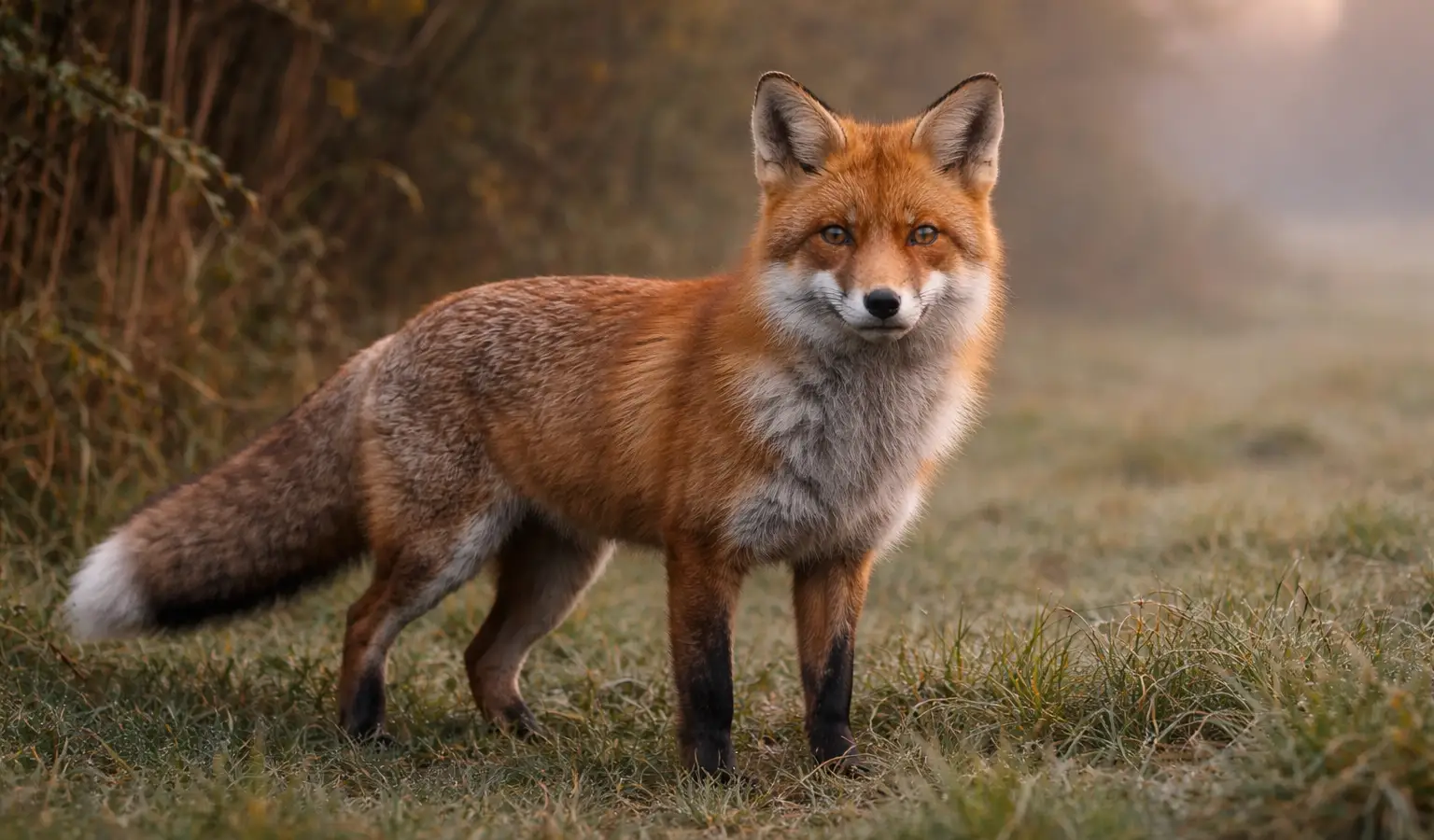
The red fox is a medium-sized canid with a slender body, pointed muzzle, large upright ears, and a long bushy tail usually carried low when moving. Adult body length commonly falls around 50 to 70 cm, with weight often in the 5 to 8 kg range, though this can vary with sex, season, food supply, and region. The tail is a key field mark, adding balance and silhouette, and often ending in a pale or white tip.
Coat color is variable. The typical form shows a rusty red to orange-brown upper body, paler underparts, darker legs, and black on the backs of the ears. Some individuals appear duller, browner, greyer, or partially melanistic, so color alone should not be the only identification feature. Compared with a domestic dog of similar size, the fox usually looks lighter, longer-bodied, finer-boned, and more narrow-chested, with a sharper face and a more flowing gait.
In the field, the combination of triangular ears, elongated muzzle, dark lower legs, and full brush tail makes identification straightforward. At distance, its movement often appears light, economical, and deliberate, especially when hunting along edges or crossing open ground.
Habitat and distribution
Habitat and distribution
Habitat
Vulpes vulpes uses an unusually broad range of habitats, but it generally does best where food, cover, and den sites occur close together. Forest edges, mixed woodland, hedgerow networks, rough pasture, scrub, field margins, young plantations, and small valleys are especially favorable. The species often prefers mosaics rather than uniform terrain, because patchy landscapes provide both prey concentration and safe movement corridors.
Although the available habitat reference here is forest, the red fox should not be seen as a strictly woodland animal. It commonly hunts in adjacent meadows, crop fields, marsh fringes, and even around farm buildings. In denser forest, fox activity often concentrates along rides, clearings, logging tracks, and ecotones where rodents and birds are easier to locate. In agricultural country, hedges, drainage ditches, embankments, and neglected corners can function as day cover and travel lines.
Dry, well-drained ground with secure cover is often favored for breeding dens, but foxes can also use banks, root systems, rocky cavities, old badger setts where legal and ecological conditions allow, or improvised earths in sheltered places. Their tolerance of disturbance is relatively high compared with many predators, provided they can remain concealed.
Distribution
The red fox has one of the widest natural distributions of any wild carnivore. It occurs across much of Europe, large parts of Asia, North Africa, and North America, and it has also been introduced in some regions outside its original range. Within suitable countries and landscapes, it is often widespread and locally common, especially in lowland mosaics of woodland, agriculture, and edge habitat.
Occurrence patterns depend on prey availability, persecution pressure, disease, road density, and habitat structure. In productive mixed landscapes, densities may be relatively high. In harsher mountain terrain, very open country, heavily urbanized sectors, or regions affected by disease outbreaks such as sarcoptic mange, local abundance can be lower or more unstable.
At a national or regional scale, the species is typically considered resident rather than migratory. Apparent absences often reflect low detectability rather than true absence, because foxes can remain surprisingly discreet even in well-used countryside.
Lifestyle
Lifestyle and behaviour
Diet
The red fox is an opportunistic omnivorous predator with a diet centered on whatever food is easiest to obtain at a given time. Small mammals, especially voles, mice, and similar rodents, are often the backbone of its diet where available. It also takes birds, eggs, insects, earthworms, carrion, and a variable amount of fruit, berries, and other plant material. This flexibility is one reason foxes persist in both wild and human-shaped environments.
Season strongly influences feeding. In spring and early summer, foxes may focus on rodents, young rabbits where present, insects, and easily captured prey needed to provision cubs. During bird nesting periods, eggs and chicks can become locally important, which is why red fox predation receives attention in gamebird and conservation management. In late summer and autumn, fruits, beetles, and scavenged resources may increase in the diet. In winter, carrion and concentrated rodent hunting can become especially significant.
Foxes usually hunt by listening, scenting, and making quick pounces on small prey. They also patrol edges, search cover methodically, and exploit short-lived food opportunities. Around settlements or farms, some individuals may use refuse, fallen fruit, pet food, or poultry if access is easy, though this varies greatly by local conditions and human behavior.
Behaviour
The red fox is mainly crepuscular and nocturnal, with peak activity often occurring from dusk into the night and again around first light. That said, daytime movement is not unusual in quiet areas, during the breeding season, when adults are feeding young, or in places where foxes have become accustomed to low-risk human presence. Activity rhythm can therefore shift with season, disturbance, weather, and food supply.
In the field, fox behavior is characterized by caution, efficient movement, and frequent use of cover. A fox may travel hedgelines, woodland edges, ditch margins, and game trails, pausing often to test the wind or listen for prey. When hunting rodents, it may stand briefly motionless, then leap forward in a steep pounce. When alarmed, it usually chooses rapid, low, direct retreat into cover rather than prolonged exposure in open ground.
Foxes are highly observant and learn quickly from repeated disturbance. They often alter routes, emergence times, and use of ground under pressure. Individuals in managed landscapes may become especially difficult to see after culling effort, drive activity, or repeated human intrusion near earths and feeding zones.
Social structure
Red foxes are often described as solitary, and for much of the year that is a useful practical summary. Many daily movements, hunting bouts, and territorial patrols are carried out alone. However, their social structure is more flexible than a simple solitary label suggests. The basic pattern is often a territorial breeding pair, sometimes with additional non-breeding individuals in areas of high food availability.
During the breeding period and while raising cubs, pair bonds and site fidelity become more obvious. Adults may share a territory centered on denning cover, feeding areas, and regular travel routes. Outside this period, direct contact between adults may be limited, and individuals can appear highly independent in the field.
Territorial marking through scent plays a major role in spacing. Social tolerance varies with density, habitat productivity, and local population turnover. In lower-density rural systems, foxes may be widely spaced and encountered as mostly solitary animals. In richer landscapes, social organization can be somewhat more complex.
Migration
The red fox is generally a sedentary species rather than a true migrant. Most adults maintain and repeatedly use a home range or territory, shifting activity within it according to food, breeding needs, cover, and disturbance. Daily and seasonal movements may be substantial, but they do not represent long-distance migration in the biological sense.
The most important movement phase is juvenile dispersal. Young foxes may leave their natal area in late summer, autumn, or winter, sometimes settling nearby and sometimes traveling much farther before establishing a territory. The scale of dispersal varies widely with habitat continuity, local fox density, mortality, and available vacant space.
Temporary local movements can also occur in response to crop harvesting, snow cover, prey peaks, disease pressure, den disturbance, or concentrated food sources. Even so, the species is best understood as resident, with flexible local ranging rather than migratory behavior.
Reproduction
Reproduction
The breeding season usually occurs in winter, though exact timing varies with latitude and climate. After a gestation of about 53 days, the vixen gives birth in spring, often in March or April in temperate areas. Litters commonly contain several cubs, but litter size can vary markedly according to food supply, female condition, age, and local population pressure.
Cubs are born blind and dependent in an underground den, often called an earth. For the first weeks, the den site is central to family activity, and adults may use more than one earth or auxiliary shelter if disturbed. The dog fox frequently contributes by provisioning the vixen and later the cubs, although family dynamics can vary.
As cubs grow, they begin appearing near the den entrance, playing, wrestling, and exploring short distances before gradually following adults farther afield. Juvenile dispersal often begins later in the year, and mortality can be high during this phase because of traffic, disease, starvation, and territorial conflict. In the wild, foxes can live around 10 years, but many individuals die much younger.
Field signs
Field signs
Red fox presence is often easier to confirm through signs than by direct observation. Tracks are typically narrow and oval, with four toes, visible claw marks, and a compact overall shape that looks more neat and elongated than many domestic dog prints. Foxes often place their feet in a straight, efficient line, especially when traveling calmly, which can create a tidy, purposeful trail along paths, rides, ditches, and field margins.
Droppings are another classic sign. Fox scat is usually twisted, tapered at one end, and often deposited in conspicuous places such as stones, tussocks, track junctions, molehills, or path centers as a territorial marker. Contents may include hair, bone fragments, berry seeds, insect remains, or feathers depending on season and diet.
Other signs include den entrances with fresh digging spoil, prey remains near resting cover, strong musky scent at marking points, flattened vegetation at lying-up spots, and repeated narrow runs through grass or scrub. Around active breeding earths, look for multiple entrances, fresh paw marks, prey scraps, and worn play areas used by cubs.
Ecology and relationships
Ecology and relationships
Ecological role
The red fox plays several ecological roles at once. It is a predator of rodents and other small animals, a scavenger of carcasses, and an occasional disperser of seeds through fruit consumption. In many agricultural and edge habitats, foxes can contribute to rodent population regulation, which may indirectly benefit crops or reduce some pest pressure.
At the same time, fox predation can affect local populations of ground-nesting birds, hares, rabbits, and other vulnerable prey, especially where habitat quality is poor or where nesting cover is fragmented. Its impact is rarely uniform across all landscapes. Weather, prey cycles, nesting success, habitat structure, and the presence of apex predators such as wolf or lynx can all influence how strongly foxes shape local wildlife dynamics.
As a mesopredator, the red fox often sits at the center of practical wildlife management debates. Its ecological importance comes not only from what it kills, but from how it links carrion use, disease dynamics, prey behavior, and competition with other carnivores.
Human relationships
The relationship between people and the red fox is complex and deeply rooted in rural life. Many people value foxes as intelligent, charismatic wildlife and enjoy observing them at field edges, in snow, or near den sites from a respectful distance. Others experience them mainly through predation on poultry, pressure on small game, or concerns about disease transmission to dogs and livestock environments.
In hunting and game management contexts, the red fox is often a focal predator species because of its potential influence on pheasants, partridges, waterfowl nests, leverets, and other vulnerable animals. Control efforts are therefore sometimes used where legal frameworks permit and where managers aim to protect wildlife production or conservation objectives. The effectiveness of such efforts depends greatly on timing, landscape structure, immigration from surrounding areas, and broader habitat quality.
Foxes also live close to human activity with remarkable discretion. They may use field margins, abandoned buildings, village fringes, or road verges while remaining largely unseen. This proximity increases both coexistence opportunities and conflict risks, especially around unsecured waste, free-ranging poultry, and domestic animal disease interfaces.
Legal framework and management
Legal framework and management
Legal status
Legal status for the red fox varies significantly by country and sometimes by region, season, and management category. In some areas it is treated as a huntable game species during defined seasons; in others it may also be subject to year-round control or classified under pest or damage-prevention regulations. Because the provided context indicates year-round take depending on ESOD status, any legal interpretation should be checked carefully against current local rules.
Methods, night activity, use of blinds, drive hunts, stalking, trapping, and den-related restrictions may all be regulated differently depending on jurisdiction. Rules can also change over time in response to disease control, conservation policy, or agricultural concerns. For that reason, readers should always consult the latest official regional texts before any intervention.
Even where the species is widely managed, legal compliance and ethical practice remain essential. Protected areas, firearm regulations, animal welfare standards, and non-target species safeguards can all affect what is permitted in the field.
Management tips
Effective fox management starts with understanding the landscape rather than relying only on occasional sightings. Focus on edges, pinch points, hedge crossings, ditch lines, woodland corners, rabbit-rich banks, and routes linking day cover to feeding ground. Observation at dawn and dusk is often more informative than random daytime searching, especially in areas with regular disturbance.
Where the objective is wildlife protection or predation reduction, timing matters. Localized control tends to be most relevant when matched to vulnerable periods such as ground-nesting season or before cubs become highly mobile, always within the law. However, predator management works best when combined with habitat measures such as improved nesting cover, brood habitat, refuge structure, and reduced artificial food sources that attract foxes.
For landowners and rural residents, practical coexistence measures include securing poultry housing, removing easy food waste, and monitoring signs around lambing areas or release pens where relevant. In disease-sensitive contexts, avoid direct contact with carcasses or suspect animals, and use hygiene precautions because foxes can be associated with rabies in some regions, sarcoptic mange, and echinococcosis concerns.
- Read the wind: foxes rely heavily on scent and often approach or travel with wind advantage.
- Watch repeated routes: regular tracks and droppings often reveal territory boundaries and feeding circuits.
- Prioritize habitat quality: prey vulnerability is often shaped as much by cover and nesting success as by fox numbers alone.
- Verify regulations: legal status, season, and permitted methods may differ sharply by locality.
Fun facts
Fun facts
- The red fox, Vulpes vulpes, has such a broad natural range that it is often considered one of the most widely distributed wild carnivores on Earth.
- A hunting fox can locate small mammals by sound alone and then perform a high pounce to pin prey under grass or snow.
- Its bushy tail is not just decorative: it helps with balance, visual signaling, and insulation when the animal rests.
- Fox coat color is more variable than many people expect, so not every red fox looks vividly red.
- Many foxes remain almost invisible in occupied landscapes because they move quietly, use edges expertly, and adjust activity to avoid disturbance.