
Pyrenean chamois
Rupicapra pyrenaica
A mountain-dwelling chamois native to the Pyrenees, managed locally.
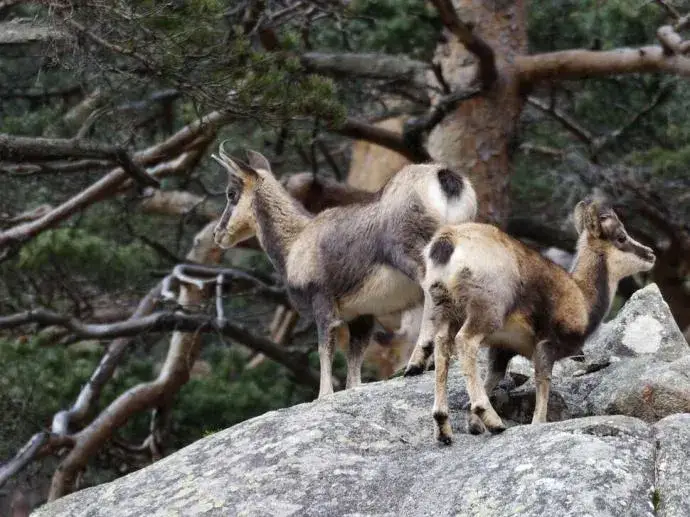
Type
Large mammal
Lifespan
12 years
Hunting season
Novembre à décembre selon quotas locaux
Edible
Yes
Fact sheet
Pyrenean chamois
Scientific name
Rupicapra pyrenaica
Type
Large mammal
Meat quality
Lean meat
Edible
Yes
Lifespan
12 years
Gestation
170 days
Size
95-125 cm
Weight
30-50 kg
Diet
Herbivore: grasses, buds, lichens
Status
Hunted locally under quotas
Hunting season
Novembre à décembre selon quotas locaux
Breeding season
11 / 12
Lifestyle and behaviour
Behaviour : Diurnal, wary, small groups or solitary
Social structure : Small groups or solitary
Migration : Limited high-mountain movements
Habitat
- Mountain
Natural predators
- Wolf
Hunting methods
- Blinds
- Stalking
Health risks
- Intestinal parasites
Ecosystem role
- Seed dispersal
Signs of presence
- Tracks on rocks
- Droppings
Introduction
General description
The Pyrenean chamois, Rupicapra pyrenaica, is a nimble mountain ungulate native to the Pyrenees and one of the emblematic big game species of this range. Known locally in much of the French Pyrenees as the isard, it is closely tied to steep ground, alpine grasslands, rocky ledges, subalpine scrub, and broken forest edges where agility and vigilance are essential to survival. For many observers, the species represents the classic silhouette of high mountain wildlife: compact, sure-footed, alert, and constantly attentive to wind, terrain, and disturbance.
Ecologically, the Pyrenean chamois is an important herbivore in mountain biotopes. By grazing and browsing a wide variety of plants, it helps shape vegetation structure and participates in mountain nutrient cycles. It also forms part of the prey base available to large predators where these occur, including the wolf in some areas. Its presence often reflects a landscape that still retains enough rugged refuge, seasonal forage, and relative quiet to support specialized mountain fauna.
In hunting and wildlife management contexts, the isard holds strong cultural importance. It is generally managed locally through regulated harvest systems, often with quotas, season dates, and area-specific rules intended to match pressure to population conditions. Because mountain populations can be influenced by weather, winter severity, disturbance, disease, and habitat quality, good management relies on careful monitoring rather than assumptions. The species is therefore relevant not only as game, but also as an indicator of mountain ecosystem health and stewardship.
Morphology
Morphology
The Pyrenean chamois is a medium-sized mountain bovid with a compact body, relatively short neck, slender legs, and excellent balance on steep slopes. Adults are typically around 95 to 125 cm in body length and often weigh roughly 30 to 50 kg, though size can vary with sex, age, condition, and local environment. Both sexes carry permanent black horns that rise vertically before curving backward into a distinct hook, a key field mark for identifying chamois at distance.
Its coat changes seasonally. In the warmer months, the pelage is generally shorter and lighter, often reddish-brown to brown, while in winter it becomes darker, denser, and more insulating. A pale face with darker markings, including a contrasting stripe running from the muzzle toward the eyes, helps give the head its characteristic expression. The body is built more for agility than bulk, and the stance often appears tight, balanced, and spring-loaded, especially when the animal pauses on exposed rock to scan its surroundings.
Field identification often depends on the combination of shape and movement as much as color. The isard usually appears smaller and lighter than domestic livestock encountered in mountain country, with a more refined head, short tail, and quick, elastic gait. When alarmed, it can climb or descend abrupt rock faces with remarkable speed, often using narrow shelves or broken ground that many other large mammals would avoid.
Habitat and distribution
Habitat and distribution
Habitat
Rupicapra pyrenaica is fundamentally a species of mountainous terrain. Its preferred habitat includes alpine and subalpine grasslands, rocky escarpments, cliff systems, scree, open ridges, shrub-covered slopes, and mosaics of forest edge and open pasture. It typically favors landscapes that provide both forage and immediate escape cover. In practical terms, the best Pyrenean chamois habitat is not simply high elevation, but steep, broken country where visibility, shelter, and access to seasonal food resources come together.
Use of habitat often changes with season, weather, snow cover, human disturbance, and local population density. During favorable conditions, animals may feed in open mountain meadows, grassy benches, and sunny slopes. In harsher weather or under pressure, they may shift toward more rugged ground, sheltered faces, krummholz, or upper woodland margins. South-facing slopes can be important in cold periods where snow melts earlier, while cooler and more vegetated areas may be used in warmer months.
The Pyrenean chamois is especially well adapted to biotopes where terrain itself is a form of protection. Areas with repeated disturbance, heavy infrastructure, or intense recreational pressure may alter how and when animals use otherwise suitable ground. As a result, the most productive habitat is often a patchwork of feeding areas, bedding cover, wind-sheltered hollows, and secure rocky escape routes.
Distribution
The Pyrenean chamois is native to the Pyrenees, the mountain chain forming a natural border between the Iberian Peninsula and the rest of western Europe. Its range is centered on high and mid-elevation mountain sectors across the Franco-Spanish Pyrenean arc, with local occurrence shaped by topography, protection history, hunting management, and habitat continuity. Within this range, it may be common in some valleys and massifs yet more scattered or localized in others.
Distribution is not uniform even within apparently suitable country. The species tends to occupy sectors that combine rocky security with accessible forage, and densities may shift over time according to winter conditions, disease events, disturbance, and harvest policy. Local abundance can therefore differ markedly between neighboring mountain units. Readers looking for precise occurrence should always treat regional maps as broad guides and rely on current local wildlife data where available.
The common name Pyrenean chamois and the local term isard are both widely used in search and field contexts. In practical wildlife terms, when people refer to chamois in the Pyrenees, they are usually speaking about Rupicapra pyrenaica rather than the Alpine chamois of other mountain systems.
Lifestyle
Lifestyle and behaviour
Diet
The Pyrenean chamois is an herbivore that feeds on a varied mountain diet including grasses, sedges, forbs, buds, shoots, leaves, and, in some conditions, lichens and other sparse high-elevation resources. Its diet changes with season, plant availability, snow cover, altitude, and grazing pressure. In productive periods, it often selects fresh and nutritious growth from alpine and subalpine vegetation. In less favorable periods, it may rely more on woody browse, evergreen material, or lower-quality forage that remains accessible.
Spring and early summer usually offer abundant young vegetation, an important phase for rebuilding body condition after winter and for females raising kids. In late summer and autumn, feeding remains important as animals accumulate reserves before colder weather. During winter, snow depth and crust conditions can strongly influence access to food, sometimes pushing animals toward windblown slopes, exposed ridges, forest edges, or southern aspects where forage remains partially available.
Because the species lives in nutrient-limited mountain systems for much of the year, feeding strategy is closely linked to movement and risk. The isard often balances food quality against exposure, choosing patches where it can graze while still maintaining a rapid escape route. This trade-off is a central feature of Pyrenean chamois ecology and helps explain its repeated use of transitional terrain between open feeding areas and rocky refuge.
Behaviour
The Pyrenean chamois is generally diurnal, with activity often concentrated in the morning and late afternoon, although local weather, hunting pressure, recreation, and season can shift these patterns. In hot or disturbed conditions, animals may become more discreet during the middle of the day, bedding on shaded slopes, windy ridges, or elevated resting sites with a broad view of surrounding terrain. In calmer conditions, they may remain visible for longer feeding bouts in open areas.
Behaviorally, the isard is known for being wary and highly responsive to visual movement, scent, and unusual sound. Alert individuals frequently stop to scan, test the wind, and assess escape routes. Once disturbed, they may leave with a series of rapid bounds, then pause on higher ground to look back. Their use of steep broken slopes is not random; it is a defensive strategy that reduces vulnerability and gives them multiple lines of retreat.
Daily behavior is often structured around a rhythm of feeding, rumination, resting, and repositioning according to light, wind exposure, and perceived risk. In poor weather, animals may remain in sheltered folds or below ridge crests. In clear mountain conditions, they are often easier to observe from distance on feeding slopes and rocky shelves. Even so, repeated disturbance can make groups more secretive and push them into less obvious terrain, especially in hunted areas.
Social structure
Pyrenean chamois are often seen in small groups or alone, and their social organization tends to be flexible rather than rigid. Females, kids, and younger animals commonly form small nursery or mixed groups, especially outside the rut, while adult males may be solitary or loosely associated in small bachelor units for part of the year. Group size can vary with season, habitat openness, forage distribution, and local disturbance.
This social structure reflects mountain living. In steep and patchy habitat, small groups can feed efficiently while still remaining mobile and vigilant. Large aggregations are less typical than in some open-country ungulates, although temporary concentrations may occur where forage, topography, or weather channel animals into favorable sectors. Visual contact and shared vigilance appear important, but spacing between individuals often remains adaptable.
During periods of reproductive activity, social patterns can shift as adult males become more attentive to females and more intolerant of rivals. Outside those periods, separation by sex and age class may be more evident. For field observers, this means the type of group encountered can provide clues about season, local pressure, and habitat use.
Migration
The Pyrenean chamois is not a long-distance migrant in the way some large ungulates are, but it does make limited high-mountain movements linked to season, snow, forage, and disturbance. In many areas, these are best described as altitudinal or local shifts rather than true migration. Animals may use higher open slopes, ridges, and alpine pastures in favorable periods, then move to lower, more sheltered, or more exposed snow-free sectors as winter conditions intensify.
These movements are often subtle and highly terrain-dependent. A group may shift only a short distance on the map while moving into a very different microhabitat in ecological terms: from windswept grass to forest edge, from open basin to rocky buttress, or from a northern face to a sunnier slope. This makes local habitat reading more important than assuming broad seasonal rules apply everywhere equally.
Juvenile dispersal and small-scale redistribution can also shape local occurrence over time. However, the species generally remains tied to the mountain systems where it was born, showing fidelity to suitable sectors as long as habitat, security, and forage remain available.
Reproduction
Reproduction
The reproductive cycle of the Pyrenean chamois follows a seasonal mountain pattern. Mating generally takes place in late autumn to early winter, though exact timing may vary somewhat by altitude and local conditions. During this period, adult males increase their movements around female groups, display more interest in conspecifics, and may engage in posturing, pursuit, or short confrontations linked to breeding access.
Gestation lasts about 170 days. Births therefore usually occur in spring, when improving weather and new plant growth increase the chances of kid survival. Most females give birth to a single kid, which is typical for the species, although variation is biologically possible. Females often use relatively secure terrain for parturition and early rearing, where visibility and escape cover reduce risk to the newborn.
Young chamois grow quickly but remain dependent on maternal care during their first months. Spring and early summer forage quality is particularly important at this stage. Reproductive success can be influenced by female body condition, winter severity, disturbance, and population health. In mountain ungulates, even modest shifts in climate, snow persistence, or disease pressure can affect recruitment from one year to the next.
Field signs
Field signs
Field signs of the Pyrenean chamois are often subtle because of rocky terrain, but several clues can help confirm presence. Tracks on rocks may be hard to read clearly, yet on softer patches of soil, damp ground, snow, or fine scree, the hoofprints usually appear small, narrow, and pointed compared with many domestic ungulates. Repeated passage can create discreet traversing lines across steep slopes, especially where animals move between bedding shelves, feeding patches, and escape routes.
Droppings are one of the more reliable indicators. They are typically dark pellets, often deposited in small clusters at feeding or resting sites. Fresh pellet groups on ridges, grassy ledges, or sheltered hollows can indicate recent use. Observers should also look for cropped mountain vegetation, narrow access paths entering rocky ground, polished or regularly used passage points, and bedding spots in protected terrain with good visibility.
Because the species is wary, direct visual signs may appear before physical ones. Scanning rocky horizons, meadow margins, and cliff bases with optics is often more effective than trying to track continuously on hard mountain substrate. In snowy periods, sign interpretation becomes easier, and movement corridors between feeding areas and secure cover may stand out much more clearly.
Ecology and relationships
Ecology and relationships
Ecological role
As a native mountain herbivore, the Pyrenean chamois plays a meaningful role in Pyrenean ecosystems. Through selective grazing and browsing, it influences plant communities, especially in alpine and subalpine habitats where growing seasons are short and vegetation can be sensitive to repeated use. Its feeding helps redistribute nutrients across slopes and may contribute to ecological processes such as seed dispersal, whether directly through plant material passage or indirectly through movement across varied terrain.
The species also helps connect trophic levels. Chamois can serve as prey for large predators where present, including the wolf, and carcasses provide food for scavengers in mountain systems. In this way, the isard is part of a wider ecological network rather than an isolated game species. Its health, abundance, and distribution can reflect broader conditions affecting mountain wildlife, from snow dynamics to habitat fragmentation and disease.
Because it occupies rugged country that is often less altered than lowlands, the Pyrenean chamois is sometimes viewed as a useful indicator of the integrity of high mountain landscapes. Changes in its local abundance or behavior may signal shifts in disturbance, habitat quality, winter stress, or management effectiveness.
Human relationships
The relationship between people and the Pyrenean chamois is shaped by mountain tradition, wildlife observation, pastoral land use, and regulated hunting. In many parts of the Pyrenees, the isard has long been part of local culture and is valued both as a symbol of wild mountain country and as a managed big game species. For hikers, naturalists, and photographers, seeing chamois on a distant ridge is often one of the defining wildlife experiences of the range.
At the same time, the species shares habitat with livestock systems, seasonal grazing, trails, and recreational use. Most coexistence is indirect, but pressure can accumulate when disturbance is repeated in key feeding or refuge areas. Disease exchange with domestic ungulates is a concern often discussed in mountain wildlife management, even if the level of risk varies by place and circumstance. Health issues such as intestinal parasites may also affect condition, especially where stressors overlap.
In hunting contexts, the Pyrenean chamois is typically pursued through demanding mountain methods such as stalking and waiting from vantage points or blinds where legal and appropriate. Ethical practice depends heavily on accurate identification, awareness of terrain, shot restraint, and respect for local quotas. Because mountain populations can be locally sensitive, responsible human use is closely tied to careful observation and conservative management.
Legal framework and management
Legal framework and management
Legal status
The Pyrenean chamois is generally not treated as an unregulated species. In many areas it is hunted locally under quotas or other controlled frameworks designed to match harvest to population status and management objectives. Open seasons, permit systems, sex or age class allocation, and area-specific restrictions may differ substantially between jurisdictions, reserves, and hunting units.
The season indicated in the provided context is November to December depending on local quotas, but this should never be taken as universally applicable across the entire range. Mountain game regulations can change from year to year according to counts, reproductive performance, conservation concerns, disease issues, or administrative decisions. Some sectors may also have stricter protection, special access rules, or no-hunting zones.
For that reason, anyone researching the legal status of Rupicapra pyrenaica should verify current rules with the relevant local authority or official hunting federation before field activity. The most useful general principle is that Pyrenean chamois management is local, adaptive, and regulation-dependent rather than uniform across all mountain areas.
Management tips
Good Pyrenean chamois management starts with reading the mountain correctly. Productive habitat is usually a mosaic rather than a single vegetation type: feeding slopes close to rock, sheltered winter sectors, low-disturbance bedding areas, and secure movement corridors between them. Managers and field observers should pay attention to snow exposure, slope aspect, grazing pressure, and human presence, because these factors strongly influence how animals distribute themselves over relatively short distances.
Where the species is hunted, conservative quota setting and regular population monitoring are essential. Counts should ideally be interpreted with caution, since visibility in mountain terrain can be highly variable. Recruitment, sex ratio, age structure, winter mortality, and signs of poor body condition can all improve decision-making beyond simple raw numbers. Health surveillance matters as well, particularly where parasites, disease events, or contact with domestic stock may affect local populations.
- Prioritize quiet refuge zones in steep terrain, especially during harsh weather and the breeding period.
- Assess habitat quality across seasons, not only during summer visibility peaks.
- Limit disturbance in key feeding and nursery areas where repeated human pressure may alter movement.
- Use local data when adjusting quotas; neighboring valleys may not support the same harvest level.
- In field observation or hunting, focus on wind, light, and terrain security rather than covering ground unnecessarily.
For practical mountain work, caution is always part of management. The species may be resilient in suitable habitat, but local populations can respond quickly to cumulative stress from severe winters, disturbance, disease, or poorly calibrated harvest pressure.
Fun facts
Fun facts
- The local name isard is deeply associated with the French Pyrenees and is often used as naturally as the term Pyrenean chamois.
- Both male and female Pyrenean chamois carry horns, unlike deer, which makes silhouette and horn shape especially useful for identification.
- Its hooked horns are permanent structures, not antlers, so they are not shed each year.
- The species is exceptionally adapted to steep ground and can cross narrow rocky ledges that seem unusable to larger, heavier ungulates.
- Although often seen as a high-altitude animal, its most important seasonal movements may be quite short in distance but very significant in terms of shelter and forage.
- With a lifespan around 12 years in many contexts, older animals may show changes in body shape, coat appearance, and behavior that experienced mountain observers learn to notice.