
Polecat
Mustela putorius
A discreet carnivore of rural landscapes, sometimes classified as a pest.
Type
Mammal
Lifespan
6 years
Hunting season
Selon réglementation
Edible
No
Fact sheet
Polecat
Scientific name
Mustela putorius
Type
Mammal
Meat quality
-
Edible
No
Lifespan
6 years
Gestation
42 days
Size
35-45 cm
Weight
700-1200 g
Diet
Small mammals, birds, insects
Status
Huntable or controlled depending on country
Hunting season
Selon réglementation
Breeding season
3 / 4 / 5
Lifestyle and behaviour
Behaviour : Nocturnal, territorial, discreet
Social structure : Solitary
Migration : Sedentary
Habitat
- Forest
- Farmland
Natural predators
- Fox
- Birds of prey
Hunting methods
- Trapping
- Shooting
Health risks
- Avian parasites
- Rabies
Ecosystem role
- Rodent population regulation
Introduction
General description
The polecat, Mustela putorius, is a small wild mustelid of hedgerow country, woodland edges, rough grassland, marshy cover, and mixed farmland. Although often discreet to the point of being overlooked, it is one of the characteristic medium-sized predators of traditional rural landscapes in much of Europe. It is best known for its elongated body, dark coat, pale facial markings, and strong musky odor, all classic traits of a true polecat rather than a domestic ferret.
As a predator, the polecat occupies an important middle position in the food web. It hunts small mammals, takes birds when the opportunity arises, and may consume insects, amphibians, eggs, or carrion according to season and local availability. This flexible feeding ecology helps explain why it can persist in varied biotopes, from forest margins to livestock country, provided it finds cover, prey, and denning opportunities.
In wildlife management and hunting culture, the polecat has long held an ambiguous status. In some areas it has been seen as a useful controller of rodents; in others it has been treated as a pest because of occasional predation on poultry, game birds, or rabbits kept in enclosures. That mixed reputation still shapes how the species is discussed today, especially where predator control, biodiversity conservation, and small-game management overlap.
For field naturalists, the polecat is a rewarding but challenging species to observe. It is mostly nocturnal, moves low and quickly through cover, and often leaves only indirect signs such as musky droppings, tracks in mud, or prey remains around farm buildings, ditches, and hedge networks. Understanding the species means reading habitat structure as much as seeing the animal itself.
Morphology
Morphology
The European polecat is a compact but elongated carnivore, typically measuring about 35 to 45 cm in body length, with a relatively short-legged, flexible build adapted to moving through dense vegetation, burrows, stone piles, and narrow cover. Adults commonly weigh around 700 to 1,200 g, though body mass varies with sex, season, and local food conditions. Males are generally larger and more robust than females.
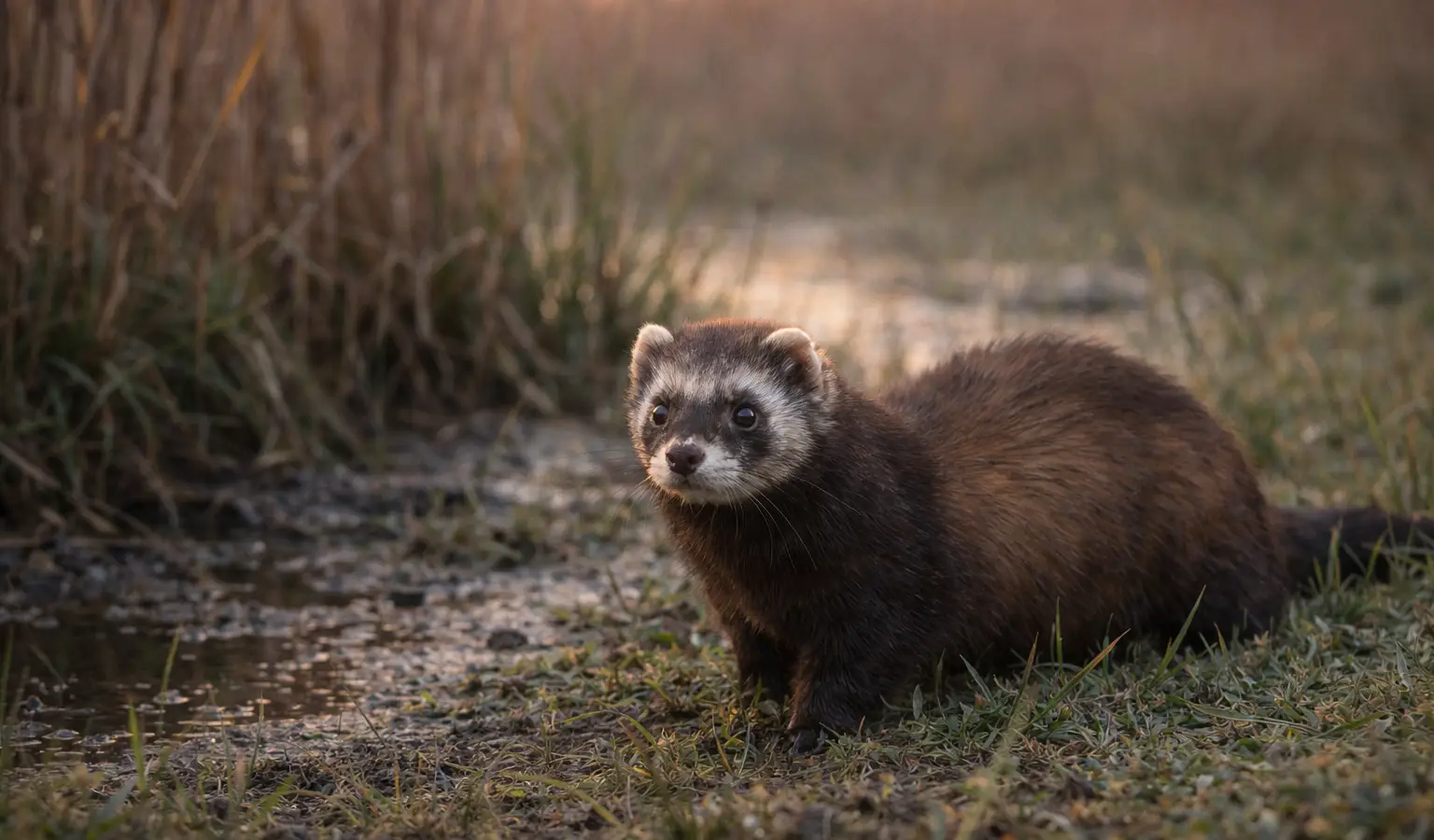
Its coat is usually dark brown to blackish, with a lighter underfur that can give the body a slightly frosted appearance in good light. The head often shows the most useful identification features: a pale muzzle, lighter ear margins, and a contrasting facial mask. The tail is fairly bushy and uniformly dark. Compared with the stoat or weasel, the polecat is heavier, broader-headed, and much darker overall. Compared with the pine marten, it is lower to the ground, shorter-legged, and less elegant in silhouette.
Field identification sometimes becomes more difficult where hybridization with feral ferrets occurs. Some individuals may show paler coats, broader facial markings, or altered proportions. Even so, a wild-type polecat usually looks darker, more cryptic, and more powerfully built than a domestic ferret gone feral. A strong musky scent from scent glands is also characteristic, especially around resting sites or when the animal is alarmed.
Habitat and distribution
Habitat and distribution
Habitat
Polecats favor structurally rich habitats rather than a single narrow environment. The best areas usually combine cover, prey, and quiet access routes: hedgerows, scrub belts, woodland edges, rough pasture, marshy ditches, stream corridors, old orchards, abandoned buildings, and mixed farmland mosaics. In many regions, a landscape with broken cover and small-scale habitat diversity supports more regular use than large, open, intensively managed fields with few refuges.
Although often associated with rural farmland, the species also uses forest margins, wet meadows, reedbeds, and river valleys. Wet habitats can be especially valuable where amphibians, water voles, rats, or other prey are available. Polecats are opportunistic in their shelter choices and may den in rabbit burrows, hollow logs, dense bramble patches, stone heaps, drainage structures, or old outbuildings.
Habitat quality depends not only on vegetation but also on disturbance and connectivity. Thick hedges, uncultivated margins, ditch systems, and ecotones allow polecats to move while remaining concealed. Landscapes simplified by hedge removal, road fragmentation, or repeated heavy disturbance may still be crossed, but they tend to offer poorer daily security and fewer hunting opportunities.
Distribution
Mustela putorius is native to much of western and central Europe, with distribution varying according to historical persecution, habitat change, road mortality, and local conservation trends. In some countries the polecat remains widespread in suitable lowland rural landscapes; in others it is patchier, recovering, or locally scarce. Presence can be underestimated because the species is nocturnal and naturally discreet.
Within its range, occurrence is often uneven rather than continuous. River valleys, traditional farmland, wetland mosaics, and areas with dense hedgerow networks may hold regular populations, while highly urbanized zones, exposed uplands, or heavily simplified agricultural plains may support fewer animals. Local abundance may also fluctuate with rabbit numbers, vole cycles, amphibian availability, and control pressure.
Records should be interpreted carefully where feral ferrets or polecat-ferret hybrids occur, since field reports may mix the two. Distribution maps are therefore most reliable when supported by roadkill records, camera trapping, genetic work, or confirmed observations from experienced surveyors.
Lifestyle
Lifestyle and behaviour
Diet
The polecat is a carnivorous generalist with a strong preference for small vertebrate prey. Its core diet often includes small mammals such as voles, mice, rats, and rabbits where available. It also takes birds, especially ground-nesting or roosting individuals that can be caught at close quarters. Insects and other invertebrates may form a secondary part of the diet, particularly when seasonally abundant.
Diet varies with habitat and time of year. In wet environments, amphibians can become important prey during certain periods. Around farms, barns, and feed stores, polecats may exploit rodents attracted by grain or livestock activity. In hedge-and-pasture country, they often work field margins, ditches, rabbit cover, and dense undergrowth where prey movements are predictable. Carrion and eggs may be taken opportunistically.
This flexibility is one reason the species adapts to many rural biotopes. However, prey choice also explains conflict with people. A polecat that gains access to unsecured poultry, penned game birds, or rabbit hutches can cause noticeable losses, even though such events do not represent the full ecological picture of the species. In most wild settings, it is primarily a hunter of naturally available small prey.
Behaviour
The polecat is mainly nocturnal and crepuscular, with peak activity often concentrated from dusk through the night. During daylight it usually remains hidden in dense cover, burrows, hollow spaces, or sheltered buildings. In quiet areas, occasional daytime movement may occur, especially during the breeding season, cold weather, or when females are feeding young.
Its movement style is low, fluid, and deliberate, alternating between quick exploratory runs and pauses to scent-check likely cover. Polecats use linear features such as hedges, ditch edges, reed margins, walls, and fence lines as travel corridors. They are alert, secretive animals that rely heavily on concealment, scent, and close-range hunting rather than open pursuit over long distances.
When disturbed, a polecat usually seeks immediate cover instead of exposing itself in the open. It may slip into a hole, thick bramble, culvert, or bank vegetation. If cornered, it can defend itself sharply and release a strong-smelling secretion. This discreet, territorial, mostly night-active behavior is why many people live near polecats without ever knowingly seeing one.
Social structure
Polecats are generally solitary outside the breeding period. Adults maintain individual home ranges that may overlap to some degree, but they do not usually form stable social groups. Males often range more widely than females, especially during the mating season, and contact between adults is typically brief and functional rather than social in the broader sense.
Females with dependent young are the main temporary family unit. The mother uses one or several den sites and moves the litter if disturbance, parasites, or prey conditions make relocation useful. Young remain with her through early development before dispersing. During this period, local activity can become more noticeable near productive hunting cover.
Territorial behavior is expressed through scent marking and routine use of favored paths, resting places, and hunting circuits. Because the species is elusive, this social structure is often inferred from tracks, droppings, camera records, and seasonal patterns rather than direct repeated observation.
Migration
The polecat is considered a sedentary species rather than a migrant. Adults typically occupy and repeatedly use a home range centered on feeding areas, shelter sites, and secure movement corridors. Seasonal shifts can occur within that range, especially in response to prey abundance, water levels, breeding activity, or winter shelter needs, but these are local movements rather than true migration.
Dispersal is most significant in young animals leaving the maternal area. Juvenile dispersal helps recolonization and genetic exchange, but it also increases exposure to roads, control pressure, dogs, and unfamiliar habitat. In fragmented agricultural landscapes, successful movement often depends on hedges, ditches, riparian strips, and other connected cover.
For practical field interpretation, the polecat should be thought of as a resident predator with variable nightly and seasonal movements, not as a species that undertakes long-distance annual migrations.
Reproduction
Reproduction
The breeding cycle of the polecat usually begins in spring, though exact timing varies with latitude and local climate. After mating, gestation is around 42 days. Females give birth in a concealed den, often using burrows, cavities under roots, dense vegetation, or sheltered farm structures where disturbance is limited and access to prey is good.
Litter size can vary, but several young are typical. The kits are born blind and dependent, and the female provides intensive care during the early weeks. As they grow, she gradually increases hunting effort and may bring prey back to the den area. Later in the season, juveniles begin exploring nearby cover and learning to forage before eventual dispersal.
Reproductive success depends strongly on food supply, shelter quality, weather, and disturbance. In poor prey years or heavily disturbed landscapes, breeding outcomes may be lower. In richer lowland habitats with abundant small mammals or rabbits, local recruitment can be much stronger.
Field signs
Field signs
Field signs of polecat presence are often subtle but useful when read in context. Tracks are small mustelid prints with five toes, usually clearer in mud, sand, soft ditch edges, or light snow than on hard ground. The gait often appears as paired or bounding impressions along linear cover such as hedges, banks, drains, or walls. Print size and stride can help separate polecat from smaller weasels, though exact identification is not always straightforward from tracks alone.
Droppings are often one of the best clues. Polecat scats are typically dark, twisted, tapered, and strongly musky, sometimes containing fur, feathers, bone fragments, insect remains, or bits of amphibian material depending on diet. They may be left on paths, at crossing points, near den approaches, under cover edges, or on slightly raised features used as scent-marking points.
Other signs include prey remains near sheltered feeding spots, musky odor around resting places, disturbed feathers near a roost site, and repeated use of rabbit burrows, culverts, stacked materials, or outbuilding corners. Camera traps placed along ditch lines, hedge gaps, and building edges often confirm presence better than casual daytime searching.
Ecology and relationships
Ecology and relationships
Ecological role
The polecat plays a meaningful role as a mesopredator in European rural ecosystems. By feeding on voles, mice, rats, young rabbits, and other small animals, it contributes to the natural regulation of prey populations. In some farming contexts this predation can be beneficial, especially where rodent pressure affects feed stores, buildings, or field margins.
Its ecological role is broader than simple rodent control. The species links wetland, woodland edge, and farmland food webs, transferring energy across habitats through predation and scavenging. It also serves as prey for larger predators such as foxes and some birds of prey, particularly when young or exposed in open ground.
Because polecats respond to prey cycles, habitat structure, and disturbance, their presence can indicate a landscape that still retains cover, trophic complexity, and relatively functional ecological connections. At the same time, as with many medium predators, local impacts can be viewed differently depending on whether the observer prioritizes biodiversity, poultry security, or small-game production.
Human relationships
Human relationships with the polecat are mixed and often shaped by local experience. Farmers, keepers, and rural residents may appreciate its role in catching rodents, yet conflict can arise where hens, pigeons, game birds, or domestic rabbits are poorly protected. The species has therefore long occupied a difficult space between tolerated predator, valued wild carnivore, and suspected pest.
For wildlife observers, the polecat is an emblematic but rarely seen mammal of traditional countryside. Most encounters come from camera traps, road casualties, tracks, or night-time glimpses along lanes and ditch systems. Because it is not generally considered edible game and is not usually sought for food, interest in the species is more often tied to predator management, biodiversity monitoring, or legal control questions than to harvest use.
Good coexistence depends heavily on prevention. Secure poultry housing, protected feed areas, and careful management of small captive animals reduce conflict more effectively than reacting after losses occur. In regions where populations are recovering, public understanding has also improved, with more recognition of the polecat as a native carnivore rather than merely a nuisance species.
Legal framework and management
Legal framework and management
Legal status
The legal status of the polecat varies significantly by country, region, and management framework. In some places it may be protected or partially protected; in others it may be huntable, trappable, or subject to control under specific pest or predator regulations. The practical meaning of "huntable or controlled" can differ widely, including closed seasons, permitted methods, property-specific rules, and strict conditions linked to damage prevention.
Because regulations change over time, no single legal summary is reliable everywhere. Anyone dealing with polecats in a hunting, trapping, pest-control, or conservation context should check the current national and local rules, including protected-species lists, trapping certifications, firearm restrictions, animal welfare provisions, and any requirements related to proof of damage.
Where identification may be confused with ferrets, martens, or other mustelids, legal caution is especially important. Misidentification can lead to unlawful actions against protected wildlife. For that reason, field certainty and up-to-date regulation should always come before intervention.
Management tips
For observation or survey work, focus on connected cover: hedgerows, drainage ditches, woodland edges, marsh margins, old farm buildings, and rabbit-rich banks. Search for tracks after rain, inspect likely crossing points, and look for scats where paths narrow or habitat funnels movement. Night-time camera trapping is often the most efficient non-invasive way to detect polecats.
From a habitat management perspective, landscapes with thick hedges, rough margins, wet features, and reduced unnecessary disturbance are generally more favorable to the species and to many of its prey. Maintaining ecological connectivity matters, especially in farmland where cover has been simplified. Old denning opportunities such as root plates, stone heaps, and quiet outbuildings can also be important.
Where conflict exists, prevention is more effective than broad assumptions about predator pressure. Secure poultry at night, reinforce enclosures, block easy access under sheds, and reduce attractants such as exposed feed or unmanaged carcass waste. If legal control is being considered, species identification, local regulation, animal welfare standards, and the actual source of damage should all be verified first.
Fun facts
Fun facts
- The domestic ferret is widely believed to descend from the polecat, which is why the two can look similar and may even hybridize in some areas.
- A polecat can seem to vanish in open country because it naturally travels tight to cover, using ditches, hedge bottoms, and banks like hidden corridors.
- Its musky scent is so distinctive that experienced field workers sometimes recognize a recently used shelter before they see any tracks.
- Although often described as a forest or farmland predator, the species can make surprisingly good use of wetlands, especially where amphibians and waterside rodents are plentiful.
- Many confirmed records come from roadkill, which shows both how secretive the animal is and how important roads can be as a source of mortality.