
Northern shoveler
Spatula clypeata
A wetland duck with a distinctive spoon-shaped bill used for filtering food, often migratory.
Type
Bird
Lifespan
7 years
Hunting season
September – January
Edible
Yes
Fact sheet
Northern shoveler
Scientific name
Spatula clypeata
Type
Bird
Meat quality
Decent meat
Edible
Yes
Lifespan
7 years
Incubation
24 days
Size
45-50 cm
Weight
450-600 g
Diet
Omnivore: plankton, insects, seeds
Status
Huntable under local regulations
Hunting season
September – January
Breeding season
4 / 5
Lifestyle and behaviour
Behaviour : Filters water with its bill, lives in groups, surface-feeds
Social structure : Groups
Migration : Migratory
Habitat
- Wetland
Natural predators
- Birds of prey
Hunting methods
- Hunting hide
Health risks
- Avian parasites
Ecosystem role
- Water filtration
Signs of presence
- Footprints
- Feathers
Introduction
General description
The Northern shoveler, Spatula clypeata, is a distinctive dabbling duck of marshes, ponds, flooded grasslands, shallow lakes, and other productive wetlands. It is best known for its broad, spoon-shaped bill, a specialized feeding tool that allows it to strain tiny food items from the water. Although often grouped with other surface-feeding ducks, the shoveler is easy to separate in the field once its bill shape, feeding style, and compact silhouette are understood.
This waterfowl species is both an important wetland bird and a relevant quarry species in areas where waterfowl hunting is regulated. For birdwatchers, it is one of the more rewarding ducks to identify because sex, season, plumage, and behavior all offer useful clues. For hunters and wetland managers, the Northern shoveler is closely tied to shallow, food-rich habitats with abundant aquatic invertebrates and seeds, making it a good indicator of productive marsh conditions.
Ecologically, the Northern shoveler contributes to the functioning of wetlands through intensive filter-feeding and by moving energy between invertebrate, plant, and bird communities. In hunting and field ecology contexts, it is often associated with migration periods, mixed duck flocks, and calm feeding zones in sheltered water. Its presence can reveal much about water depth, nutrient availability, and the seasonal quality of a wetland biotope.
Morphology
Morphology
The Northern shoveler is a medium-sized duck, typically around 45 to 50 cm in length and often weighing roughly 450 to 600 g, though body mass can vary with sex, age, and season. The most important identification feature is the oversized spatulate bill, which appears noticeably wider at the tip than at the base. Even at a distance, this bill gives the head a unique front-heavy profile.
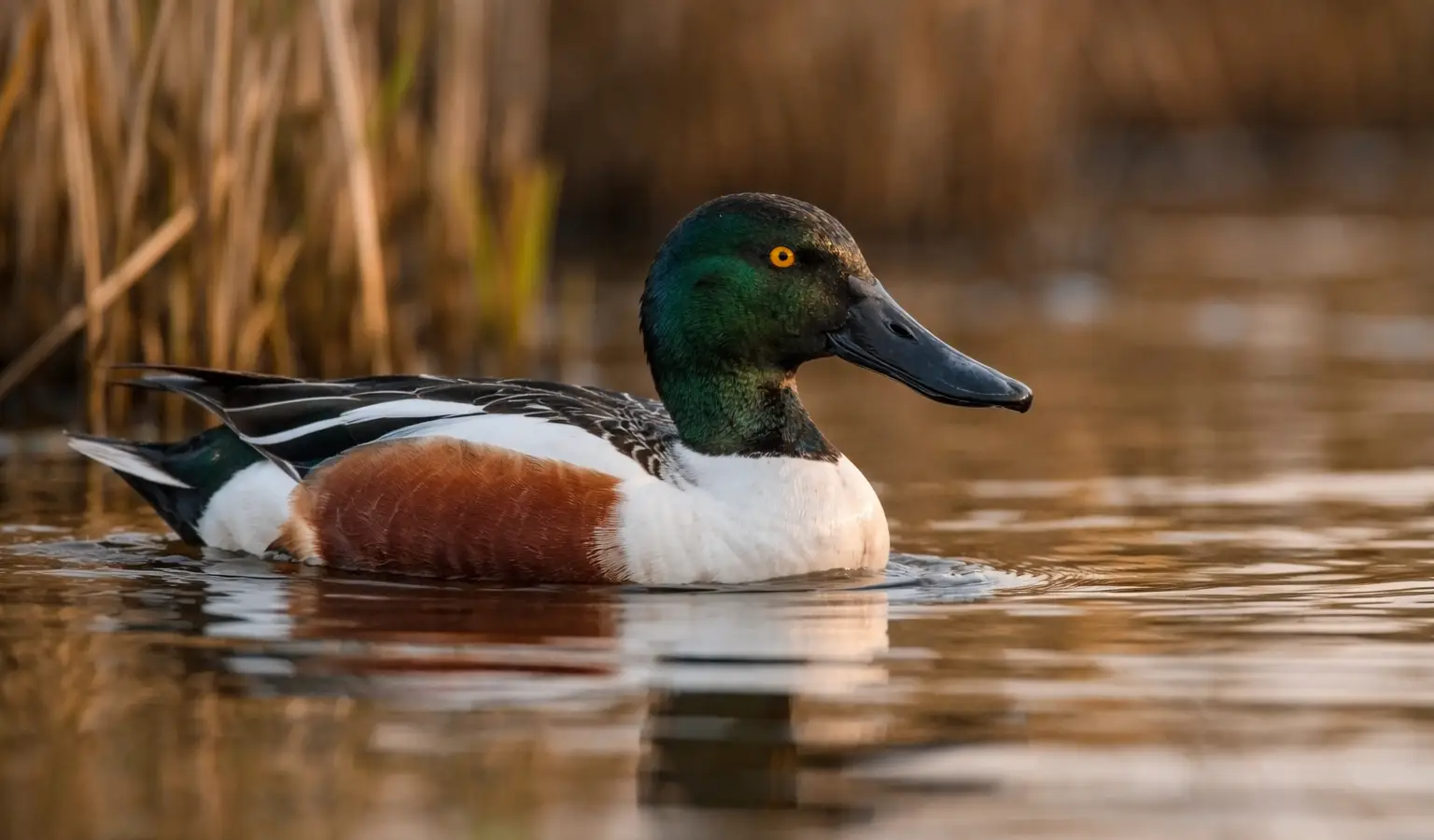
Adult males in breeding plumage are especially striking, with a dark green head, bright yellow eye, white breast, rich chestnut flanks, and a dark back. Females are mottled brown overall, providing camouflage in marsh vegetation, but they still show the same unmistakable bill shape. In flight, both sexes may show blue forewing coverts and green wing patches, which can help with identification among mixed flocks of dabbling ducks. Compared with mallards or teal, shovelers often look slimmer through the neck and more specialized around the head and bill.
Juveniles resemble females but are generally less crisply marked. At rest on the water, the species often appears slightly low-slung, and when feeding it frequently swings its bill side to side near the surface. That feeding posture is often as useful for identification as plumage itself.
Habitat and distribution
Habitat and distribution
Habitat
The Northern shoveler favors shallow wetlands with abundant food suspended in the water column or concentrated near the surface. Typical habitat includes marshes, lagoons, flooded meadows, ponds, oxbows, drainage basins, rice fields, and the edges of shallow lakes. It is especially attracted to wetlands with quiet water, soft mud, and rich growth of aquatic vegetation.
Among dabbling ducks, this species shows a marked preference for nutrient-rich sites where small invertebrates, planktonic organisms, and seeds are readily available. During migration and winter, it may use estuarine margins, managed impoundments, sewage lagoons, and other artificial wetlands when food conditions are favorable. It often avoids very deep, fast, or heavily disturbed water compared with more adaptable generalist ducks.
For breeding, it typically selects marshy landscapes with emergent cover nearby, as nesting females benefit from concealed ground sites not far from water. Wetland structure matters: shallow shelves, sheltered inlets, and zones with intermittent open water and plant cover are usually more suitable than uniform, barren basins.
Distribution
Spatula clypeata has a broad Holarctic distribution. It breeds across much of northern North America, Europe, and Asia, especially in temperate and subarctic wetland regions. In many parts of its range it is strongly seasonal, occupying northern breeding areas in spring and summer before moving southward to wintering grounds.
During migration and winter, the Northern shoveler can be found across a wide belt extending into southern Europe, Africa, southern Asia, Central America, and parts of northern South America. Local abundance varies greatly depending on water conditions, regional weather, hunting pressure, wetland management, and annual productivity. In some areas it is common and conspicuous; in others it is an irregular or locally concentrated migrant.
Occurrence patterns often shift with rainfall, drought, freezing conditions, and water-level management. Because the species responds quickly to favorable shallow feeding habitat, numbers can change noticeably from one season to the next at the same site.
Lifestyle
Lifestyle and behaviour
Diet
The Northern shoveler is an omnivorous filter-feeding duck whose diet commonly includes plankton, aquatic insects, larvae, small crustaceans, mollusks, seeds, and other plant material. Its specialized bill is lined with fine comb-like structures called lamellae, which allow it to sift tiny food particles from the water and surface mud more efficiently than most other dabbling ducks.
Animal matter is often especially important during the breeding season and in other nutritionally demanding periods, when protein-rich prey can support body condition and reproduction. Outside the breeding season, seeds and other plant foods may become more prominent, though the exact balance depends on habitat type and food availability. In managed wetlands and flooded agricultural areas, shovelers may exploit seed resources as well as invertebrate blooms.
Feeding usually takes place in shallow water, where birds skim the surface, tip forward, or sweep the bill from side to side. They may also feed in tight circles, sometimes with other shovelers, a behavior thought to help concentrate food particles in the water.
Behaviour
The Northern shoveler is generally a diurnal waterfowl species, though feeding activity may increase at dawn, dusk, or under quiet low-disturbance conditions. It is often alert but less obviously aggressive than some dabbling ducks, spending long periods feeding, loafing, preening, and shifting between nearby wetland compartments.
Its most characteristic behavior is surface filtering. Rather than simply grabbing larger items from the surface, shovelers actively strain water through the bill while swimming slowly. They frequently feed in groups and may rotate in circles or align closely with one another while foraging. This specialized behavior is one of the best field marks for observers.
When disturbed, the species usually flushes cleanly from open water or wetland edges and may circle before leaving the area. In hunted or heavily pressured wetlands, birds often become more cautious, using sheltered zones, resting farther from banks, and shifting feeding times. During migration and winter, daily patterns can include movement between secure roosting waters and productive feeding sites.
Social structure
The Northern shoveler is typically a social duck for much of the year. Outside the nesting period it often occurs in pairs, small groups, or larger mixed flocks with other dabbling ducks. Feeding aggregations can be especially noticeable where shallow food-rich water is concentrated.
During the breeding season, pair bonds form and males often remain near females through the early nesting phase, although the female takes the lead in incubation and brood care. Social spacing becomes more important in nesting habitat, but even then the species is not strictly solitary across the wider wetland landscape.
In migration and winter, group living offers advantages in locating food and detecting danger. Flock size varies with habitat quality, disturbance, season, and local population density.
Migration
The Northern shoveler is a migratory species across much of its range. Many populations move southward in autumn from northern breeding grounds and return in spring, though the exact timing depends on latitude, weather, ice conditions, and regional wetland availability. In broad terms, hunting-season occurrence in some regions is strongest from early autumn into midwinter, often corresponding to passage and wintering movements.
Migration is commonly linked to shallow water conditions rather than simple geography alone. Birds may stage at productive stopover wetlands where food is abundant, then redistribute when freeze-up, drought, disturbance, or habitat changes reduce feeding opportunities. Mild winters can leave some birds farther north, while severe cold may push concentrations southward or toward coastal refuges.
At a local scale, shovelers may also make short-distance movements between roosting sites and feeding wetlands. This makes their presence somewhat dynamic, especially in managed marsh systems and agricultural floodplains.
Reproduction
Reproduction
Breeding usually begins in spring after birds return to suitable nesting wetlands. Courtship may involve vocalization, head movements, and display postures similar to those of other dabbling ducks, though timing varies by latitude and annual conditions. The nest is typically placed on the ground in concealed vegetation, often close to water but sometimes at a modest distance if cover is better.
The female lays a clutch of eggs and carries out most or all incubation. The incubation period is commonly around three to four weeks; a value near 24 days is often cited, though some variation is possible. As with many ducks, the down-covered young leave the nest soon after hatching and begin feeding themselves under the female's guidance.
Brood survival depends heavily on wetland quality, water stability, predation pressure, weather, and the availability of insect-rich shallow habitat. Productive marshes with secure cover and abundant invertebrates generally provide the best conditions for successful recruitment.
Field signs
Field signs
Field signs of the Northern shoveler are usually subtle compared with those of larger terrestrial game, but careful wetland reading can still reveal its presence. The most obvious signs are direct visual clues: small to medium duck footprints in soft mud, scattered feathers at resting or preening sites, and surface-feeding disturbances in sheltered shallow water. Because shovelers often feed by sweeping and filtering at the surface, they may leave faintly disturbed patches where the water appears repeatedly worked over.
Tracks are typical duck prints with webbing, best seen on muddy margins, exposed flats, or recently receded shorelines. On their own, these tracks are difficult to separate confidently from those of other small to medium dabbling ducks, so they should be interpreted alongside habitat, flock observations, and timing. Feathers near loafing banks, marsh edges, or roost sites can be more informative when matched with local species presence.
Observers should also watch for behavior-based signs: groups resting in calm backwaters, birds circling while feeding, and repeated use of shallow vegetated inlets. In heavily used wetlands, droppings may accumulate at loafing spots, though they are rarely diagnostic to species.
Ecology and relationships
Ecology and relationships
Ecological role
The Northern shoveler plays a notable ecological role in wetland food webs. By filtering plankton, small invertebrates, and organic particles from shallow water, it helps transfer energy from highly productive aquatic systems into bird biomass. Its feeding can also influence the distribution of tiny organisms in localized wetland patches.
As both consumer and prey, the species links multiple trophic levels. Eggs, ducklings, and sometimes adults may be taken by birds of prey and other predators, while the shoveler itself relies on healthy populations of aquatic invertebrates and seed-producing wetland plants. In that sense, it is both a beneficiary and an indicator of functioning marsh habitat.
Because shovelers respond well to shallow, nutrient-rich wetlands, their abundance can reflect habitat productivity, water management quality, and seasonal food availability. They are therefore of interest not only to birdwatchers and hunters but also to wetland ecologists and managers.
Human relationships
The Northern shoveler has a longstanding relationship with people through wetland observation, conservation, and regulated hunting. It is a familiar species to birdwatchers because it is distinctive, often visible in the open, and frequently present in mixed duck assemblages during migration and winter. For hunters, it is a recognized game duck in places where harvest is legal and seasonally managed.
As an edible waterfowl, it may be taken for the table, although culinary quality is sometimes considered variable and can depend on diet, habitat, and field handling. In productive marshes with clean food resources, condition may differ from that of birds using eutrophic or artificial waters. As with all wild game, proper handling, local health guidance, and awareness of avian parasites or disease risk are important.
The species also benefits from wetland restoration, water-level management, and habitat mosaics that support invertebrate production. In agricultural regions, it may use flooded fields and managed impoundments, creating both opportunities for observation and a need for balanced waterbird management.
Legal framework and management
Legal framework and management
Legal status
The Northern shoveler is widely treated as a huntable waterfowl species under local or national regulations, but the exact legal status varies by country, flyway, and management framework. Open seasons, bag limits, permitted methods, protected areas, and reporting obligations may all differ. In some regions, hunting may occur roughly from September to January, but readers should always verify current official rules before any field activity.
Because migratory birds are managed through seasonal frameworks, legal access is closely tied to dates, licensing, species identification, and wetland-specific restrictions. Protected reserves, non-toxic shot requirements, and transport rules may also apply. Misidentification risk within mixed duck flocks is a practical legal concern, especially in low light or fast shooting conditions.
Conservation status at a broad scale does not automatically determine local hunting legality. Population trends, drought, habitat loss, and regional management objectives can influence regulations over time, so current government sources remain the only reliable authority.
Management tips
Good Northern shoveler habitat management begins with shallow, food-rich water. Wetlands that provide a mosaic of open feeding zones, soft muddy margins, emergent cover, and seasonal water-level variation tend to be more attractive than deep uniform basins. Managers aiming to support this species should pay attention to invertebrate productivity, seed availability, and the timing of flooding and drawdown.
For observation or hunting-related field reading, focus on sheltered wetland compartments, marsh edges, and calm flats where birds can filter-feed efficiently. Shovelers often favor less disturbed corners of a wetland during the day, especially where pressure is regular. Reading wind, light, water depth, and recent disturbance can be more useful than simply scanning open water at random.
- Maintain or restore shallow wetland shelves and gently sloping margins.
- Preserve a mix of open water and vegetated cover.
- Limit unnecessary disturbance at key roosting and feeding areas.
- Monitor water quality and avoid management that eliminates invertebrate-rich shallows.
- Use careful species identification in mixed duck flocks, especially during legal harvest seasons.
Where hunting occurs, restraint during periods of concentrated pressure can help reduce repeated disturbance and keep wetlands functional for both wildlife and sustainable use.
Fun facts
Fun facts
The Northern shoveler's bill is not just large-looking; it is a highly specialized filtration tool lined with fine lamellae that work almost like a sieve.
This species is famous for feeding in circles. Small groups may spin on the water to concentrate food, creating one of the most unusual foraging displays among dabbling ducks.
Although often overshadowed by mallards and teal in public familiarity, Spatula clypeata is one of the easiest ducks to identify once the bill shape is learned.
Its scientific placement has changed over time in modern taxonomy, and it is now widely placed in the genus Spatula rather than the older genus Anas.
In the field, many people first notice the male's bright colors, but experienced observers often identify the species even faster by behavior than by plumage.