
Northern pintail
Anas acuta
An elegant dabbling duck found across European wetlands, often migratory.
Type
Bird
Lifespan
8 years
Hunting season
September – January
Edible
Yes
Fact sheet
Northern pintail
Scientific name
Anas acuta
Type
Bird
Meat quality
Fine meat
Edible
Yes
Lifespan
8 years
Incubation
24 days
Size
45-55 cm
Weight
400-600 g
Diet
Omnivore: insects, seeds, aquatic plants
Status
Huntable under regulations
Hunting season
September – January
Breeding season
4 / 5
Lifestyle and behaviour
Behaviour : Flocks, migratory, discreet, surface-feeding
Social structure : Groups
Migration : Migratory
Habitat
- Wetland
Natural predators
- Fox
- Birds of prey
Hunting methods
- Hunting hide
- Driven pass
Health risks
- Avian influenza
Ecosystem role
- Aquatic plant consumption
Signs of presence
- Footprints
- Feathers
Introduction
General description
The northern pintail presented here is commonly understood as a slim, elegant wetland duck associated with shallow marshes, flooded grasslands, lagoons, and open freshwater or brackish wetlands. In field use, the name pintail usually refers to a long-necked dabbling duck valued by birdwatchers and waterfowl hunters for its graceful silhouette, wary nature, and regular seasonal movements. The scientific name provided in this profile is Mareca penelope, although readers should note that common names and scientific naming must always be checked carefully in local field guides and regulations.
As a waterfowl species, the pintail occupies an important place in wetland ecosystems. It feeds mainly at the surface or by tipping forward in shallow water, taking plant matter, seeds, and small invertebrates. This makes it both a consumer of aquatic vegetation and a user of productive marsh habitats where food availability changes with water depth, season, disturbance, and temperature.
For hunters and wildlife observers, the pintail is a species of strong practical interest because it combines beauty, migratory behavior, and sensitivity to habitat quality. It may appear in mixed duck flocks during autumn and winter, often using open water for safety and nearby feeding areas at dawn, dusk, or at night. Its presence can indicate functioning wetlands with varied edges, shallow feeding zones, and relatively limited disturbance.
From a management perspective, pintails are closely tied to water regime, feeding opportunities, and secure resting areas. Seasonal pressure, cold weather movements, and regional differences in abundance can all affect local occurrence. Good species knowledge therefore depends on reading the habitat, understanding migration timing, and recognizing that numbers may fluctuate widely from one wetland system to another.
Morphology
Morphology
The pintail is best recognized by its refined proportions. It is a medium-sized dabbling duck, with an approximate body length of 45 to 55 cm and a generally light build, often around 400 to 600 g in the data provided here, though body mass can vary with sex, age, condition, and season. The overall impression is of a long-bodied, long-necked waterfowl with a clean, streamlined profile.
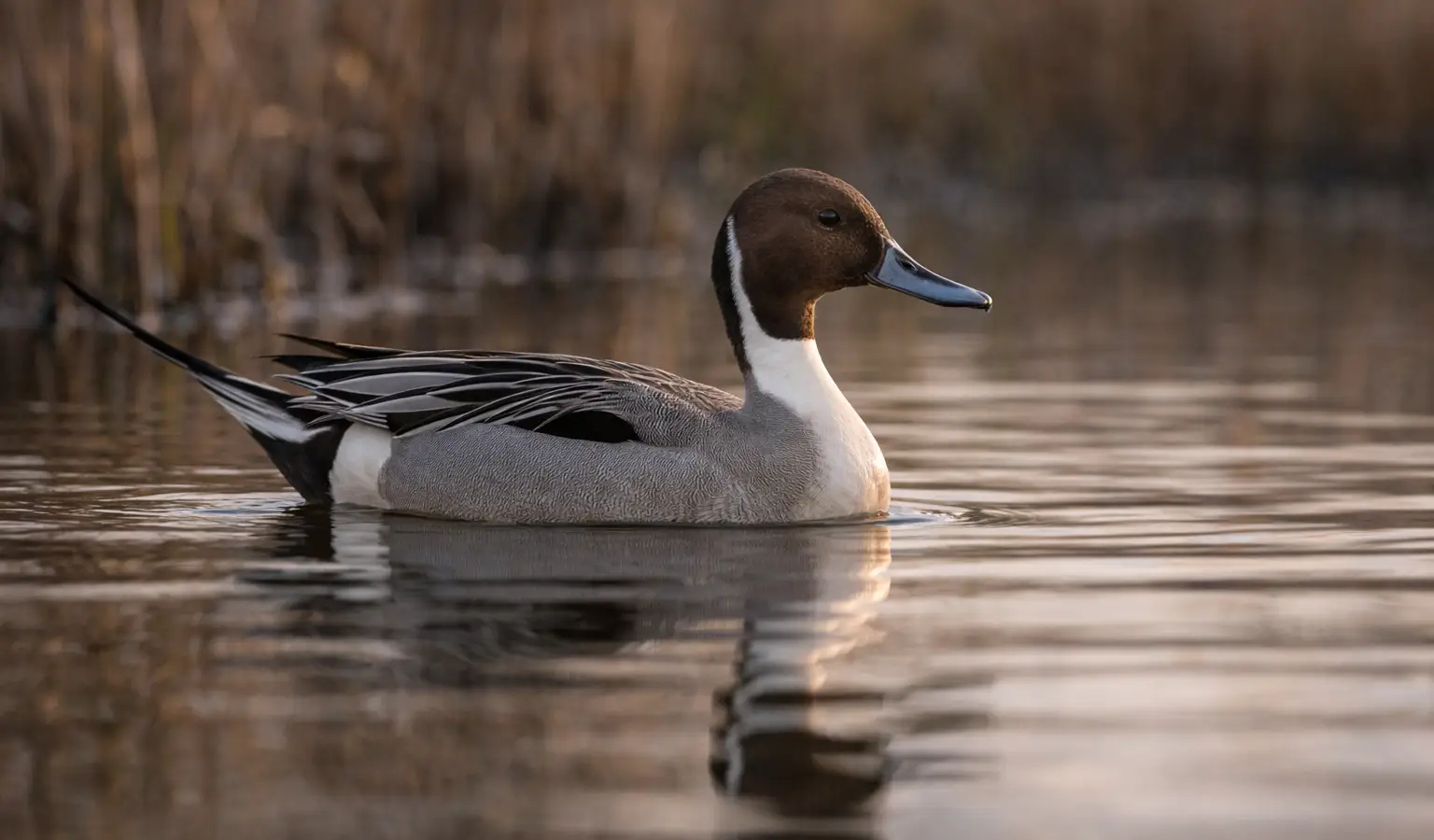
In the field, key identification features include a relatively narrow body, pointed rear profile, and an elegant neck that often looks longer than that of many other ducks using the same marsh. The head shape appears neat and balanced rather than blocky. Plumage details can vary by sex, age class, molt stage, and light conditions, so structure and silhouette are often more reliable than color alone at distance.
When swimming, the bird tends to sit lightly on the water and can appear sleek and alert. In flight, it usually shows a fast, direct, agile movement pattern typical of a wary dabbling duck. Observers often pick it out by the combination of long neck, refined body line, and pointed rear end, especially when compared with stockier mallard-type ducks.
Tracks at the water's edge are duck-like and webbed rather than highly distinctive to species, so visual identification usually relies more on silhouette, flock composition, call, and habitat use than on footprints alone. Feathers found at roosts or feeding margins may confirm waterfowl use, but they are not always enough for certain species-level identification without experience.
Habitat and distribution
Habitat and distribution
Habitat
The pintail is primarily a wetland bird. It favors shallow, food-rich aquatic habitats where it can feed by dabbling, surface-grazing, or tipping up in the water. Productive marshes, floodplains, wet meadows, reed-edged pools, lowland ponds, estuaries, and sheltered coastal lagoons can all hold birds at different times of year. It generally benefits from wetlands that combine open water with quiet edges and extensive shallow zones.
Habitat choice often shifts with season. During migration and winter, pintails may gather on larger wetlands that provide both security and access to feeding areas. During the breeding period in suitable regions, they tend to use quieter marsh mosaics, flooded grassland, and low-disturbance wetland complexes with nearby nesting cover. In colder weather, ice cover and water level changes can quickly alter their local distribution.
This duck often does best where there is a balance between resting areas and feeding habitat. Shallow water with submerged or emergent vegetation, seed-producing plants, mud margins rich in invertebrates, and adjacent fields or wet grasslands can all increase habitat value. Excessive disturbance, repeated flushing, rapid drainage, or poor water management can reduce use even when a wetland appears suitable at first glance.
For practical field reading, the best pintail habitat is usually not just any pond, but a broader wetland biotope with gentle gradients, seasonal flooding, secure loafing water, and feeding margins that remain accessible through autumn and winter.
Distribution
The pintail is associated with wetlands across a broad Palearctic range, with occurrence shaped by breeding latitude, wintering conditions, flyway patterns, and local habitat availability. In much of Europe, it is encountered mainly as a migratory or wintering waterfowl, though regional breeding may occur where suitable undisturbed wetlands exist.
Its abundance is often uneven. Some coastal marshes, estuaries, inland floodplains, and major migration stopovers may hold regular seasonal numbers, while other apparently suitable wetlands receive only brief passage birds or irregular visits. Cold spells, drought, flooding patterns, and hunting or recreational disturbance can all shift local presence from year to year.
During autumn and winter, birds may concentrate in key wetland systems and mixed waterfowl areas. In spring, many move onward toward more northerly or suitable breeding grounds. Because movement dynamics vary by flyway and weather, local observations should always be interpreted in a regional context rather than assuming a fixed annual pattern.
For searchers asking where to see or hunt pintail, the most reliable answer is: look to established wetland landscapes with known migratory duck passage, shallow feeding water, and relatively secure roosting zones. Local status can range from regular to scarce depending on geography and annual conditions.
Lifestyle
Lifestyle and behaviour
Diet
The pintail is an omnivorous dabbling duck with a diet centered on seeds, aquatic plant material, and small animal prey. The short diet data provided here mentions insects, seeds, and aquatic plants, which fits the general feeding ecology of a wetland duck using shallow productive water. It typically feeds at the surface, while upending, or by picking items from mud and vegetation.
Plant foods often include seeds of marsh plants, tender shoots, and other available aquatic vegetation. Animal matter may include aquatic insects and their larvae, small invertebrates, and other protein-rich prey taken especially when such resources are abundant. Seasonal shifts matter: birds may rely more heavily on seeds and plant matter in some autumn and winter situations, while invertebrates can become especially important during breeding and chick rearing because of their nutritional value.
Feeding conditions are closely tied to water level and habitat structure. Very deep water reduces access to many food items, while shallow flooded areas, muddy margins, and newly inundated vegetation can be highly productive. Agricultural stubbles or wet fields near marshes may also be used in some regions, especially when they offer waste grain or accessible plant food, though reliance on farmland varies locally.
From a management viewpoint, a wetland that holds pintails well usually offers diverse feeding strata: shallow water, soft margins, seed-producing plants, and low disturbance during key feeding periods at dawn, dusk, and night.
Behaviour
Pintails are generally alert, discreet, and responsive to disturbance. The short behavior data describes flocks, migration, and surface-feeding, which matches the species well as a cautious wetland bird that often prefers to keep open sight lines and enough distance from perceived danger. Compared with more tolerant ducks, it may flush early if repeatedly pressured.
Daily activity often follows a pattern of resting on open or safer water during part of the day and moving to feed during low-light periods, especially at dawn, dusk, or after dark. This can make the species seem absent from a site by day even when birds are using the wider marsh system regularly. Weather, moonlight, disturbance, and hunting pressure can all influence these rhythms.
When threatened, pintails usually rely first on vigilance and distance. If pushed, they tend to leave quickly and cleanly, often with direct, purposeful flight. On heavily used wetlands they may become even more selective, favoring refuge water by day and feeding only when disturbance drops. This behavior is important both for observation and for any management intended to retain birds on a site.
In mixed flocks, they are often calm but watchful. Their behavior reflects adaptation to open wetland environments where early detection of predators such as foxes or birds of prey is a major survival advantage.
Social structure
The pintail is mainly a social waterfowl species, commonly seen in pairs during the breeding period and in groups or larger flocks outside it. The source data indicates a group-based social structure, which is typical for migratory dabbling ducks using feeding and roosting areas collectively.
During migration and winter, birds may gather with others of their own species or join mixed assemblies of ducks on favorable wetlands. Flock size depends on habitat quality, disturbance, weather, and the stage of migration. On small sites they may appear only in loose groups, while major wetlands can concentrate far larger numbers under suitable conditions.
Pair bonds usually become more evident as the breeding season approaches. Even then, use of shared marsh systems remains common, especially where habitat is patchy. Outside breeding, social grouping helps with vigilance and information-sharing about safe water and productive feeding areas.
For field observers, social structure matters because isolated birds may be less typical than small mobile groups or mixed duck flocks moving between roost and feeding zones.
Migration
The pintail is a migratory waterfowl species, and movement is one of the main reasons its local abundance can change so quickly. The available data identifies it as migratory, which fits its broad ecological pattern: birds move between breeding areas, stopover wetlands, and wintering grounds in response to season, temperature, water conditions, and food access.
Autumn migration often brings birds into temperate wetlands, estuaries, and floodplain systems, while late winter and spring movements gradually shift them back toward breeding areas. Severe frost can trigger sudden displacement toward ice-free water, and temporary flooding can create short-lived concentrations in newly suitable feeding habitat.
Migration is not always a simple straight-line movement. Pintails may stage for days or weeks where feeding is good and disturbance is manageable, then continue when weather or competition changes. Some wetlands therefore hold only passage birds, while others function as regular wintering sites or key stopovers.
For field use, the most important point is timing: marshes that seem empty one week can hold pintails after a cold front, a change in water level, or the arrival of broader flyway movements. Understanding migration requires repeated observation across the whole season rather than a single visit.
Reproduction
Reproduction
The breeding cycle of the pintail follows the seasonal availability of shallow wetlands, cover, and food for chicks. Nesting generally takes place on the ground near water or within the wider wetland landscape, often in concealed vegetation that offers some protection from weather and predators. As with many dabbling ducks, reproductive success can vary greatly with water levels, predation pressure, spring temperatures, and disturbance.
The source data gives a value of 24 for gestation, which in birds is better understood as an approximate incubation period rather than gestation. That figure is broadly consistent with the incubation span expected in many ducks. The female typically undertakes most incubation duties, while ducklings hatch covered in down and leave the nest relatively quickly to feed. Young birds depend on suitable shallow nursery habitat rich in invertebrates and sheltered margins.
Breeding output changes strongly between years. Flooded spring habitat can improve nesting opportunity and brood survival, whereas late cold, drought, trampling, mowing, or high nest predation can reduce success. Foxes and avian predators may affect both eggs and young, especially where cover is limited or nesting sites are exposed.
For habitat managers, successful reproduction depends less on a single nest site than on a whole breeding landscape: secure cover, stable water nearby, abundant chick food, and low disturbance through incubation and brood rearing.
Field signs
Field signs
Field signs of pintail presence are usually indirect and best interpreted alongside direct observation. The most useful signs mentioned in the source data are footprints and feathers. Along muddy edges, shallow drawdown margins, and soft wet ground, webbed duck tracks may reveal recent use of a feeding or resting area. On their own, such prints rarely allow certain identification to pintail, but they do show waterfowl activity and movement direction.
Feathers can sometimes be found at roost margins, preening sites, or places where a predator has taken a bird. As with tracks, feather evidence is often more useful for confirming general duck presence than for definitive species diagnosis unless the finder has good experience with plumage structure and coloration.
Other practical signs include regular use of quiet open water, fresh feeding disturbance in shallow margins, and concentrations of droppings on favored loafing spots or banks. Resting zones may show repeated entry and exit points, especially where birds move between safe water and nearby feeding ground under low light.
Because pintails are mobile and often discreet by day, the best field sign is usually a pattern: tracks on a muddy edge, feathers in a sheltered corner, and repeated dawn or dusk flights into the same marsh compartment. Reading these signs together gives a much more reliable picture than any single clue.
Ecology and relationships
Ecology and relationships
Ecological role
The pintail contributes to wetland function as both a consumer and a link in aquatic food webs. By feeding on seeds, aquatic plants, and invertebrates, it helps transfer energy from productive shallow-water habitats into broader ecological systems. The short ecological note available mentions aquatic plant consumption, which is an important part of its role, though its diet is not limited to vegetation alone.
Its foraging can influence the use of seed resources and small invertebrate communities at a local scale, especially in shallow feeding areas used repeatedly by groups. At the same time, the species serves as prey or potential target for predators such as foxes and birds of prey, particularly eggs, ducklings, or vulnerable individuals.
Because pintails depend on healthy marsh mosaics, their presence often reflects wetland quality, water regime, and feeding opportunity. They are not a perfect indicator on their own, but regular use by pintails generally suggests a functioning biotope with open water, shallow margins, and enough security to support migratory waterfowl.
In conservation and management discussions, dabbling ducks like the pintail help demonstrate why seasonal flooding, habitat heterogeneity, and disturbance control matter for entire wetland communities, not only for one species.
Human relationships
The pintail has a strong relationship with people through birdwatching, wetland management, and regulated waterfowl hunting. It is widely appreciated for its elegant appearance and often features prominently in migration counts and field identification interest. On well-managed wetlands, it can be one of the more sought-after species for observation because its presence often coincides with dynamic seasonal marsh conditions.
In hunting contexts, the species is relevant where legally huntable under local regulations. The source data mentions hide hunting and driven pass shooting, both of which fit traditional waterfowl situations in some regions. However, success depends heavily on lawful access, species identification certainty, season timing, weather, and especially the bird's cautious response to disturbance. Pintails can quickly abandon heavily pressured wetlands.
The species may also interact indirectly with agriculture, particularly where flooded fields, wet grassland, or stubbles near marshes provide feeding opportunities. These relationships can be positive when agricultural landscapes retain water and edge structure, but drainage, disturbance, and habitat simplification generally reduce value.
Health considerations matter as well. Like other waterfowl, pintails can be associated with avian influenza risk in broader disease surveillance contexts. Standard hygiene, carcass handling precautions, and compliance with wildlife health guidance are sensible where hunting or close contact with wild birds occurs.
Legal framework and management
Legal framework and management
Legal status
The available data describes the pintail as huntable under regulations. In practice, legal status for any waterfowl species depends on country, region, flyway status, population trends, protected area rules, bag limits, approved methods, and the exact dates set by current wildlife law. The season information provided here, from September to January, should therefore be treated as a general indication rather than universal legal advice.
Anyone seeking to hunt, transport, possess, or market this species must verify the up-to-date rules in their own jurisdiction before the season begins and again if emergency disease measures or conservation restrictions are introduced. This is especially important for migratory birds, since temporary closures, species-specific restrictions, non-toxic shot requirements, and wetland access rules may apply.
Protected status may also vary according to site designation. A species that is legally huntable in one context may still be fully protected in certain reserves, refuge zones, or internationally important wetland areas. Accurate identification is essential wherever similar duck species occur together.
Good legal practice includes checking open seasons, authorized hunting methods, local bag rules, ammunition regulations, transport requirements, and any biosecurity notices linked to avian influenza or other wildlife health issues.
Management tips
Managing for pintail use begins with habitat quality rather than with short-term attraction. Maintain a mosaic of shallow feeding water, undisturbed resting areas, and vegetated margins. Wetlands with gentle depth gradients, seasonal flooding, and accessible food in the upper water column are generally more valuable than deep, steep-sided ponds.
Limit repeated disturbance where possible. Pintails are often sensitive to pressure, and frequent flushing from boating, uncontrolled access, shooting intensity, or other disruption can shift birds to alternative sites. Refuge zones, quiet day-roost water, and predictable low-disturbance periods can improve site fidelity during migration and winter.
Water management is often decisive. Drawdowns that expose feeding mud at the wrong time, or conversely water levels that become too deep for dabbling, can sharply reduce habitat value. In breeding landscapes, secure nesting cover near suitable brood habitat is important, and broad-scale wetland integrity matters more than isolated small features.
- Observation tip: watch at first and last light to understand how birds use the site.
- Habitat tip: prioritize shallow productive margins, flooded grassland, and safe open water.
- Pressure tip: avoid excessive disturbance if the goal is to retain birds consistently.
- Health tip: report unusual mortality and follow avian influenza guidance where relevant.
- Compliance tip: always verify current regulations before any hunting activity.
For hunters and wildlife managers alike, the best long-term strategy is not simply to look for birds, but to maintain the wetland conditions that make pintail presence possible across the whole season.
Fun facts
Fun facts
The pintail is often regarded as one of the most elegant dabbling ducks because its body shape looks unusually refined compared with many broader, heavier-built waterfowl.
Although it may appear calm on open water, it is often a very wary bird. On pressured wetlands, this alert temperament can make it seem scarce even where habitat is otherwise suitable.
Its seasonal presence can change rapidly. A marsh that held no pintails during one visit may attract them after fresh flooding, a cold snap elsewhere, or a burst of migration movement.
Like many wetland ducks, the pintail tells a bigger ecological story: when this kind of bird uses a marsh regularly, it often means water depth, food, cover, and disturbance levels are coming together in the right balance.