
Northern lapwing
Vanellus vanellus
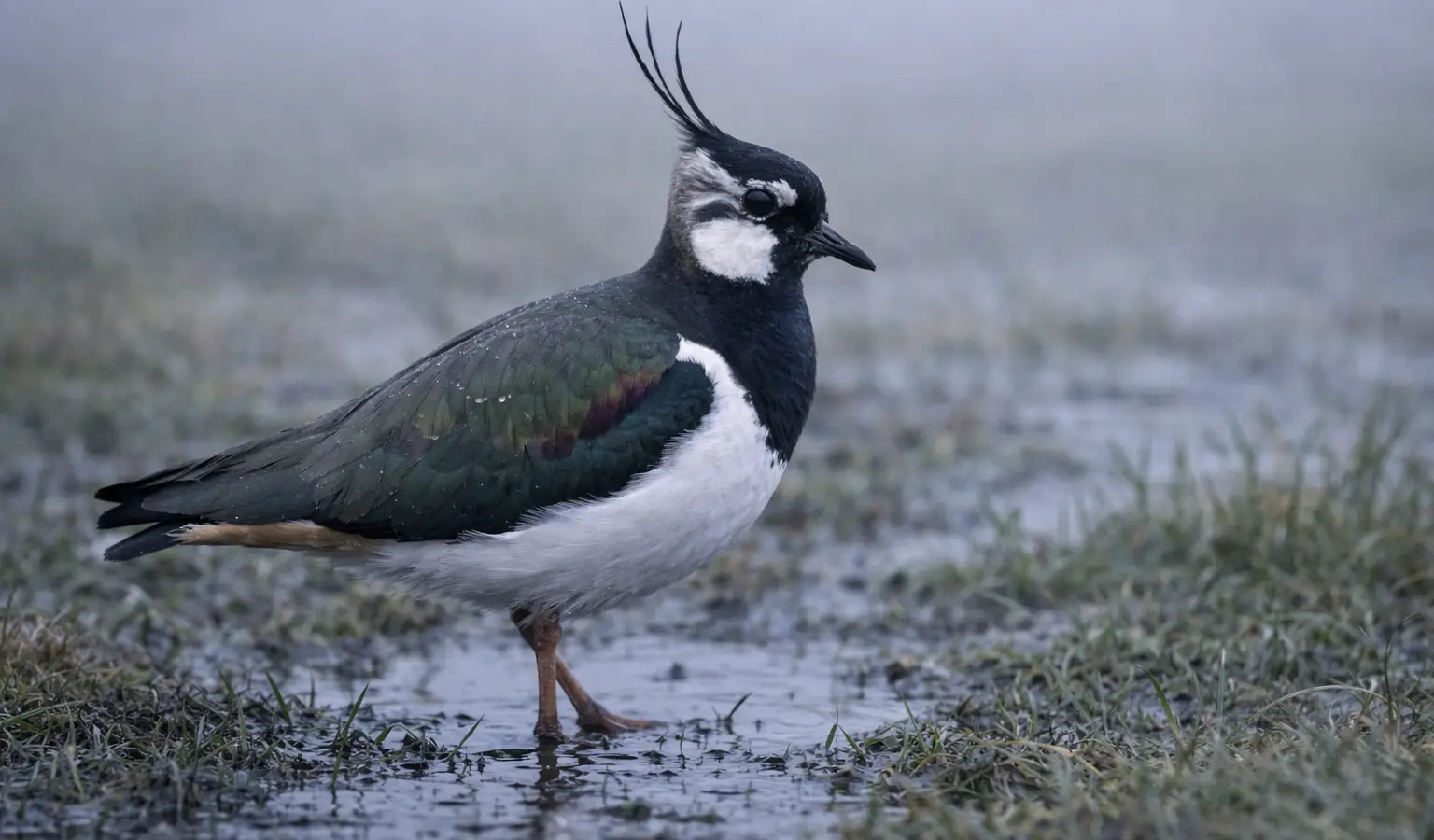
A wader of fields and wetlands, easily recognized by its crest.
Type
Bird
Lifespan
10 years
Hunting season
October – January
Edible
Yes
Fact sheet
Northern lapwing
Scientific name
Vanellus vanellus
Type
Bird
Meat quality
Fine meat
Edible
Yes
Lifespan
10 years
Incubation
25 days
Size
28-32 cm
Weight
150-200 g
Diet
Invertebrates: worms, insects, mollusks
Status
Highly regulated hunting
Hunting season
October – January
Breeding season
4 / 5 / 6
Lifestyle and behaviour
Behaviour : Flies in flocks, loud calls
Social structure : Groups
Migration : Partial migrant
Habitat
- Farmland
- Wetland
Natural predators
- Fox
- Birds of prey
Hunting methods
- Driven pass
Health risks
- Avian parasites
Ecosystem role
- Insect regulation
Signs of presence
- Calls
Introduction
General description
The Northern lapwing (Vanellus vanellus) is a medium-sized wader of open country, best known for its rounded wings, slow buoyant flight, dark-and-white patterning, and elegant crest. Although often associated with wetlands, it is equally a bird of damp grassland, grazed pasture, floodplain meadows, and traditional farmland. In many regions it is one of the most recognizable field birds of late winter and spring, both because of its conspicuous display flights and its sharp, carrying calls.
Ecologically, the lapwing sits at the meeting point between farmland wildlife and wetland bird life. It feeds mainly on soil and surface invertebrates, linking its fortunes closely to ground moisture, grazing pressure, drainage, and agricultural timing. Where mixed farming, wet meadows, and shallow feeding areas persist, Northern lapwings can still gather in impressive flocks outside the breeding season.
In hunting culture, the species has historically been known in some parts of Europe as a game bird, but modern management and conservation concerns have made the subject highly regulated and often restricted. Today, the Northern lapwing is at least as important as an indicator of open-land habitat quality as it is in any hunting context. For observers, land managers, and rural communities, it remains a classic species for reading the health of farmland and marsh-edge biotopes.
Morphology
Morphology
The Northern lapwing measures roughly 28 to 32 cm in length and typically weighs around 150 to 200 g. It has a compact body, relatively broad rounded wings, fairly short legs for a wader, and a distinctive wispy crest that immediately helps with field identification. In good light, the upperparts show a glossy green and purple sheen, while the underparts are mostly white with a contrasting dark breast.
In flight, the species is especially easy to recognize. The wings appear broad and rounded rather than narrow and pointed, giving the bird a flapping, almost moth-like flight action at times. The bold black-and-white wing pattern and slow, elastic wingbeats are useful marks at distance. The face shows dark markings, and the tail has contrasting white and dark sections visible in flight.
Sexes are broadly similar, though males often show a slightly longer crest and stronger contrast in breeding condition. Juveniles are usually duller and less glossy than adults, with more subdued plumage tones. On the ground, a feeding lapwing often stands quite upright, then lowers to probe or pick prey from soft soil, mud, or short vegetation.
Habitat and distribution
Habitat and distribution
Habitat
Vanellus vanellus favors open habitats with good visibility, low vegetation, and access to moist ground. Typical habitat includes wet grassland, floodplain pasture, marshy meadows, fallow fields, plowed land, stubble, and coastal or inland wetlands. It generally avoids dense cover, woodland, and heavily overgrown sites because it relies on open sightlines to detect danger and to move freely while feeding.
Breeding habitat is often tied to short swards, bare patches, or sparsely vegetated ground where nests can be placed directly on the surface. Damp pasture and lightly managed agricultural mosaics can be especially valuable. Outside the nesting season, Northern lapwings may use a wider range of feeding and roosting areas, including harvested fields, muddy field margins, shallow pools, estuarine edges in some regions, and flooded farmland.
Habitat quality depends strongly on water regime and management timing. Drainage, early mowing, repeated disturbance, and intensive cultivation can reduce breeding success or feeding opportunities. By contrast, shallow seasonal wetness, mixed farming structure, and moderate grazing often create the mosaic that lapwings use most effectively.
Distribution
The Northern lapwing is widely distributed across much of Europe and extends into parts of temperate Asia. Its status varies considerably by region: in some areas it remains a familiar farmland and wetland bird, while in others it has declined because of habitat change, drainage, and agricultural intensification.
Occurrence is often strongly seasonal. Breeding populations are concentrated in suitable open lowland landscapes, especially where wet grassland or traditional farmland remains. In autumn and winter, birds may gather in larger flocks and shift toward milder areas, coastal plains, floodplains, and lowland agricultural districts. Harsh frost or snow can trigger notable local movements, sometimes concentrating birds in the few areas where feeding remains possible.
Across its range, local abundance can fluctuate markedly from year to year depending on weather, water levels, breeding conditions, and land use. For practical field understanding, the species is best thought of as a widespread but unevenly distributed bird of open, moist ground rather than a uniformly common one.
Lifestyle
Lifestyle and behaviour
Diet
The diet of the Northern lapwing consists mainly of invertebrates, especially earthworms, beetles and other insects, larvae, and small mollusks. It feeds by walking over open ground, visually locating prey or probing and pecking in soft soil. Moisture is a major factor because many preferred food items become easier to access in damp pasture, mud, or recently wetted fields.
Seasonal variation matters. During the breeding period, adults often rely heavily on protein-rich invertebrates to maintain condition and to provision growing chicks, which feed actively on small surface prey. In colder months, lapwings continue to exploit worms and soil invertebrates where the ground remains workable, but prolonged frost can sharply reduce feeding opportunities and force movements to more favorable areas.
On farmland, stubble, recently tilled plots, grazed grassland, and muddy field edges can all provide useful feeding conditions. The species is therefore closely tied to land management that keeps prey accessible near the ground surface rather than hidden beneath dense vegetation or sealed by dry, compacted soils.
Behaviour
Northern lapwings are active, alert birds of open country, usually easiest to notice by their flight and voice. They often rise suddenly in groups, wheel over fields with broad, deliberate wingbeats, and give repeated calling notes that carry far across pasture or marsh. Their vigilance is one reason they favor landscapes with open views and relatively little tall cover.
When feeding, they move steadily across short vegetation or bare damp ground, alternating between brief pauses and quick pecks. In unsettled weather or under disturbance, they may gather tightly, then flush and circle before resettling. Their escape behavior can be fluid and unpredictable, especially in winter flocks using broad farmland landscapes.
During the breeding season, behavior becomes much more conspicuous. Males perform striking aerial displays involving rolling, swooping, and calling over territory. Adults near a nest or chicks can become highly demonstrative, using alarm calls, low flights, and distraction behavior to draw predators away. Outside breeding, birds are generally more gregarious and less territorial.
Social structure
The species is typically social for much of the year. Outside the breeding period, Northern lapwings often occur in groups ranging from loose feeding parties to sizeable flocks, especially on wintering grounds or migration stopovers. These aggregations improve vigilance and help birds exploit favorable feeding patches across open farmland and wetland edges.
In the nesting season, the social structure shifts toward dispersed breeding pairs, though suitable habitat may support loose colonies or neighborhood-style spacing where several pairs nest within visible range of one another. Even then, each pair maintains a defended area around the nest site and reacts strongly to nearby threats.
This mix of seasonal flocking and territorial breeding is one of the defining traits of the species. It explains why the lapwing may appear highly communal in winter but strongly site-attached and defensive in spring.
Migration
The Northern lapwing is generally considered a partial migrant. Some populations are resident or only locally mobile, while others move southward or westward in autumn and winter. The extent of migration depends strongly on breeding latitude, severity of winter weather, and the availability of unfrozen feeding ground.
Cold spells are especially important in shaping movement. Birds occupying inland farmland may depart rapidly when snow cover or frozen soil prevents feeding, concentrating instead in coastal lowlands, milder agricultural regions, estuaries, or wetlands with softer ground. In more temperate areas, local flocks may remain through much of the winter if conditions stay favorable.
Autumn passage and winter movements can make the species seem suddenly abundant in some areas and scarce in others. This flexible response to weather is a practical point for both birdwatchers and field managers trying to understand seasonal presence.
Reproduction
Reproduction
Breeding usually begins in spring, with timing influenced by latitude, local climate, and ground conditions. The nest is a simple scrape on open ground, often in short grass, bare soil, or lightly vegetated wet meadow and farmland. Concealment comes less from cover than from the bird's choice of open terrain and the cryptic appearance of eggs and incubating adults.
Clutch size is commonly around four eggs, though variation occurs. Incubation lasts about 25 days, shared mainly by the pair depending on local conditions. After hatching, chicks leave the nest quickly and are precocial, feeding themselves under parental guidance. They remain vulnerable to cold, flooding, mowing, cultivation, trampling, and predation by foxes and birds of prey.
Breeding success depends heavily on disturbance levels and habitat management during the nesting window. Wet springs can improve food availability but may also flood low-lying nest sites. Dry conditions can reduce prey access for chicks. Adult Northern lapwings may live up to around 10 years, although survival varies widely in the wild.
Field signs
Field signs
The most reliable field sign is often the call. Northern lapwings are vocal birds, especially when alarmed, displaying, or moving in flocks, and their ringing calls often reveal them before they are seen. Over open fields, repeated calling combined with slow, rounded wingbeats is one of the quickest ways to identify the species.
Visual signs include loose flocks standing in open pasture, muddy margins, flooded fields, or short-cropped grassland. Feeding birds leave little in the way of obvious sign compared with larger waterfowl, but close observation may show small probing marks in soft ground where they have been taking worms or surface invertebrates. Roost sites are usually open, level areas with broad visibility rather than sheltered cover.
Nests are difficult to detect because they are simple ground scrapes and should not be searched for closely during the breeding season due to disturbance risk. Instead, territorial calling, repeated circling, sudden alarm reactions, and distraction flights are better indicators that breeding birds are present nearby.
Ecology and relationships
Ecology and relationships
Ecological role
The Northern lapwing plays a meaningful role in open-land ecosystems as a consumer of invertebrates and a characteristic bird of wet grassland and mixed farmland. By feeding on worms, insects, larvae, and other small prey, it contributes to insect regulation and to the transfer of energy from soil invertebrate communities into the wider food web.
Its eggs, chicks, and sometimes adults also support predators such as foxes and birds of prey, making the species part of broader predator-prey dynamics in agricultural and wetland landscapes. Because lapwings are sensitive to water management, vegetation height, and disturbance, their presence often signals habitat structure that can benefit other ground-nesting birds and wet meadow wildlife as well.
For this reason, the species is often treated as an indicator of farmland and floodplain ecological quality. Where lapwings breed successfully, conditions may also suit a wider suite of open-ground biodiversity.
Human relationships
The relationship between people and the Northern lapwing is shaped by agriculture, wetland management, field observation, and in some regions a historical hunting tradition. Farmers and land managers influence the species more than almost any other user group, because drainage, mowing dates, tillage schedules, grazing intensity, and spring disturbance directly affect nesting and feeding conditions.
For birdwatchers and rural naturalists, the lapwing is one of the classic species of open country, valued for its display flight, voice, and seasonal flock movements. In hunting contexts, it has been regarded as edible and has sometimes been taken where lawful, often during an autumn to winter season, with methods such as driven pass shooting in areas where regulations allow. However, modern pressure on populations means that hunting relevance is now often secondary to conservation and careful local assessment.
Coexistence is best achieved through practical habitat management: preserving wet features, avoiding unnecessary disturbance during breeding, and maintaining open feeding areas. In many landscapes, the future of Vanellus vanellus depends less on direct persecution than on whether working farmland can still provide suitable breeding and foraging structure.
Legal framework and management
Legal framework and management
Legal status
The legal status of the Northern lapwing is highly regulated and can vary significantly by country, region, and year. In some places the species is fully protected; in others, limited hunting may exist under strict seasonal frameworks, bag limits, or temporary restrictions. The season mentioned in some contexts runs from October to January, but this should never be treated as universally valid.
Because the species has undergone declines in parts of its range, legal treatment is often influenced by conservation status, population trends, and local management objectives. Protected areas, migratory bird frameworks, and national wildlife laws may all apply. Hunters and land users should therefore verify current local regulations before any action, including rules on methods, transport, reporting, and closed areas.
From a practical standpoint, the Northern lapwing is a species for which caution is essential. Regulatory changes can occur, and legality in one jurisdiction does not imply legality in another.
Management tips
For observation or habitat reading, focus on open farmland and wet grassland with short vegetation, shallow surface water, and soft feeding ground. Recently grazed pasture, floodplain meadows, muddy edges, and lightly managed arable mosaics are often more productive than uniformly tall or heavily drained fields. In winter, check areas that remain unfrozen after cold weather.
For land management, retaining or restoring wet features is usually one of the most useful measures. Shallow pools, damp hollows, controlled flooding, and reduced drainage can improve prey access and brood habitat. Moderate grazing often helps maintain the low sward structure that lapwings prefer, while avoiding intensive spring operations in known nesting areas can reduce nest losses.
- Delay mowing or disruptive field work where breeding is confirmed.
- Maintain open visibility and avoid rapid encroachment by dense vegetation.
- Protect key feeding patches during frost and wet-season concentration periods.
- Consider predator pressure in a broader habitat-management framework rather than as a single-factor explanation.
In hunting-related contexts, extreme caution is warranted. Because status and legality vary, good management starts with current regulation checks, accurate identification, and awareness of local population trends.
Fun facts
Fun facts
The English name lapwing is often linked to the bird's distinctive, wavering flight style, which looks loose and floppy compared with the direct flight of many other species.
The Northern lapwing's crest is one of the simplest field marks in European open-country birding: even a brief view can be enough if the silhouette is clear.
Its display flights are among the most dramatic of any farmland wader, combining acrobatics, calling, and territorial advertisement over open ground.
Although often grouped mentally with wetland birds, Vanellus vanellus is equally a bird of farmland biotopes, making it a key species at the boundary between agricultural management and wetland ecology.