
Muskrat
Ondatra zibethicus
An invasive aquatic rodent that can damage banks and dikes.
Type
Rodent
Lifespan
4 years
Hunting season
Toute l'année
Edible
No
Fact sheet
Muskrat
Scientific name
Ondatra zibethicus
Type
Rodent
Meat quality
-
Edible
No
Lifespan
4 years
Gestation
28 days
Size
40-60 cm (corps)
Weight
700-1500 g
Diet
Aquatic plants, bark, roots
Status
Huntable / controlled (invasive) depending on country
Hunting season
Toute l'année
Breeding season
3 / 4 / 5
Lifestyle and behaviour
Behaviour : Nocturnal, aquatic, invasive
Social structure : Loose colonies
Migration : Sedentary
Habitat
- Wetland
- River
- Lake
Natural predators
- Fox
- Birds of prey
- Mink
Hunting methods
- Trapping
Health risks
- Avian parasites
- Leptospirosis
Ecosystem role
- Riverbank degradation
- Aquatic ecosystem imbalance
Introduction
General description
The muskrat, Ondatra zibethicus, is a semi-aquatic rodent native to North America that has been introduced widely into Europe and parts of Asia. In many regions where it is not native, it is treated as an invasive species because of its ability to colonize wetlands, canals, ponds, rivers, and drainage systems. Although often mistaken for a large rat at first glance, the muskrat is a specialized water-adapted rodent with a strong association with marsh vegetation and soft banks.
For wildlife observers, the species is notable for its discreet but regular presence around reedbeds, ditches, and slow-flowing water. For land managers, farmers, and water-control authorities, it is better known for burrowing into banks, levees, and dikes, which can weaken structures and accelerate erosion. This dual identity explains why muskrat profiles often appear in both natural history and pest management contexts.
In the field, muskrat activity is especially relevant where waterways are engineered or where wetland restoration, fish production, crop protection, or flood-control infrastructure are important. It is generally nocturnal or crepuscular, though daytime observation is possible in quiet areas. Because it feeds heavily on aquatic vegetation and can occur at locally high density, Ondatra zibethicus may alter plant communities and contribute to wider ecological imbalance where populations are not naturally regulated.
Morphology
Morphology
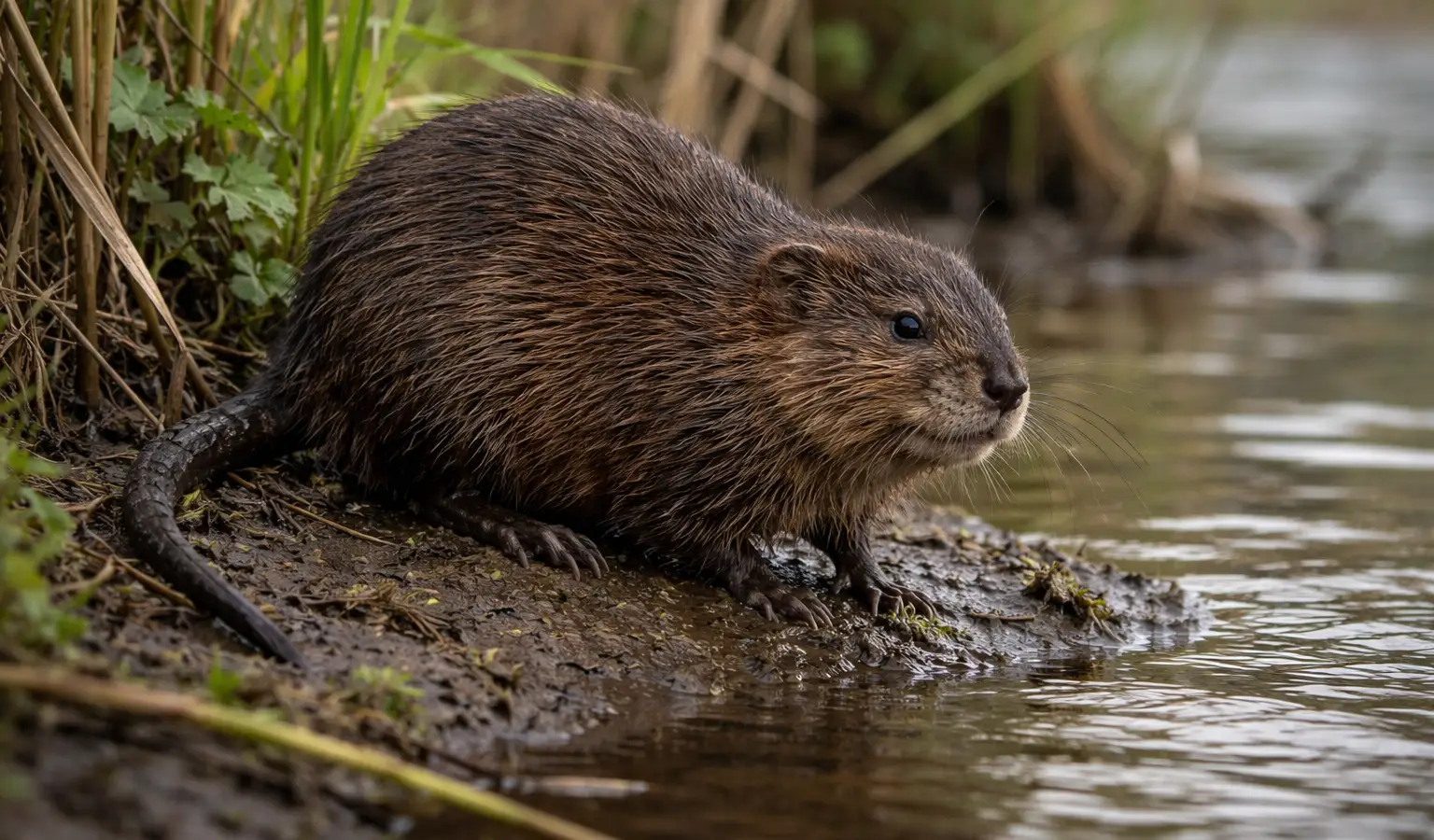
The muskrat is a medium-sized aquatic rodent with a heavy body, short neck, small ears partly hidden in the fur, and a long, laterally flattened tail that is one of the best field marks. Body length commonly falls around 40 to 60 cm when the tail is included in overall impression, and adults often weigh roughly 700 to 1,500 g, though size varies with age, season, and local conditions.
The coat is usually dark brown to chestnut-brown above and somewhat paler below, often appearing sleek when wet. The hind feet are large and adapted for swimming, while the forefeet are smaller and more dexterous for feeding and digging. Unlike the beaver, the muskrat has no broad paddle tail; unlike the brown rat, it is more strongly tied to water and has a distinctly compressed tail rather than a round one. In good light, its swimming posture is also characteristic: the body sits low in the water and the tail trails behind, sometimes creating a narrow surface line.
Habitat and distribution
Habitat and distribution
Habitat
Muskrats prefer wetlands, lakes, rivers, canals, ponds, marshes, drainage ditches, and slow-moving water bodies with abundant emergent or bank-side vegetation. They do particularly well where cattails, reeds, sedges, rushes, and other aquatic plants provide both food and cover. Soft earthen banks are especially favorable because they allow excavation of burrows with underwater entrances.
In heavily modified landscapes, the species readily uses artificial habitats such as irrigation channels, fish ponds, flood-control systems, and agricultural drainage networks. Habitat quality is often highest where water levels remain fairly stable and vegetation is dense, but muskrats can also persist in more open environments if food and bank structure are suitable. Their presence tends to be most problematic where natural waterways meet embankments, road verges, dikes, or pond walls vulnerable to tunneling.
Distribution
Ondatra zibethicus is native to much of North America, where it occupies a broad range of freshwater habitats. It was introduced to several parts of Europe and Asia, primarily through fur-farming and deliberate or accidental releases, and has since established wild populations in many countries.
Current distribution varies by region because local climate, wetland connectivity, predator pressure, disease, and control programs can strongly influence abundance. In parts of Europe, the muskrat is now widespread but patchy, often concentrated along river valleys, marsh systems, canals, and lowland agricultural water networks. In some areas, sustained trapping and control have reduced numbers locally, while recolonization can still occur from nearby wetlands.
Lifestyle
Lifestyle and behaviour
Diet
The muskrat is primarily herbivorous and feeds mainly on aquatic plants, roots, shoots, rhizomes, bark, and other soft plant material. Common food items include emergent vegetation such as reeds, rushes, sedges, and similar marsh plants. It may also consume the bark and roots of waterside shrubs or young woody plants, especially where preferred aquatic forage is limited.
Diet can vary with season, water level, and habitat type. During the growing season, fresh green vegetation usually dominates. In colder periods or in heavily grazed wetlands, muskrats may rely more on stored plant parts, underground roots, and tougher material. Although mainly vegetarian, they may occasionally take animal matter such as small invertebrates, mollusks, or carrion, but this is generally a secondary part of the diet rather than the core feeding strategy.
Behaviour
Muskrats are usually nocturnal to crepuscular, with much feeding and movement concentrated around dusk, night, and early morning. In quiet areas, especially during cooler weather or where disturbance is low, they may also be active by day. They are strong swimmers and spend much of their time moving along banks, through vegetation channels, or between feeding stations and burrow entrances.
When alarmed, a muskrat typically dives quickly and escapes underwater or into dense cover. It often prefers familiar routes along reed margins, ditch edges, and bank contours rather than crossing open ground for long distances. Individuals can appear surprisingly routine in their movement patterns, repeatedly using the same feeding sites, haul-outs, and water passages. In cold regions, activity continues through winter, provided water remains accessible beneath ice or around openings.
Social structure
The muskrat generally lives in a loose colony structure rather than in tightly organized social groups. Several individuals may occupy the same wetland sector, especially where food and bank sites are abundant, but each adult often maintains a limited home range and some degree of spacing around nesting or denning areas.
Social tolerance varies with season, habitat quality, and population density. Breeding pairs may show localized territoriality, while juveniles disperse from natal areas as they mature. In productive wetlands, signs of multiple muskrats can accumulate in a small area, yet this does not necessarily mean strongly cooperative social behavior. The species is better understood as locally clustered around suitable water habitat than as truly communal.
Migration
The muskrat is generally considered sedentary. It does not undertake true seasonal migration in the way many birds or large mammals do. Most individuals remain tied to a relatively limited wetland, pond, ditch network, or river margin as long as water, food, and cover remain available.
That said, dispersal is important to the species' spread. Young muskrats, and sometimes adults displaced by crowding, flooding, drought, freezing conditions, or control pressure, may move along connected waterways to colonize new habitat. These movements are usually local to regional rather than migratory, but they are highly significant from a management standpoint because recolonization can occur quickly in connected drainage systems.
Reproduction
Reproduction
Muskrats are capable of rapid population growth under favorable conditions. Breeding commonly begins in late winter or spring and may continue through much of the warm season, depending on climate and food availability. The gestation period is about 28 days, and females can produce multiple litters per year where conditions are good.
Litter size varies, but several young per litter are typical. The young are born in nests located in burrows or in vegetation houses built above the waterline in some habitats. Juveniles grow quickly and may disperse within the same season. This high reproductive potential is one reason muskrat numbers can rebound quickly after local reduction if nearby source populations remain present.
Field signs
Field signs
Useful muskrat field signs are usually found close to water. Look for burrow entrances in soft banks, often at or just below the waterline, along with collapsed edges, fresh spoil, or subtle erosion where tunnels have weakened the soil. Regular feeding sites may contain cut stems, clipped aquatic plants, and small feeding platforms made of vegetation.
Other signs include narrow swim channels through reeds, repeated access points where animals climb onto the bank, and droppings deposited on logs, mud, or low platforms near the water. Tracks can sometimes be seen in soft mud: the hind feet are larger than the forefeet, and tail drag marks may appear between prints. In winter or in calm marshes, dome-like houses of vegetation may be present in some habitats, though many populations rely mainly on bank burrows rather than conspicuous lodges.
Ecology and relationships
Ecology and relationships
Ecological role
In its native range, the muskrat can function as a normal part of wetland ecology, influencing vegetation structure and providing prey for predators such as foxes, mink, and birds of prey. Its feeding may create openings in dense marsh vegetation, and its lodges or burrows can alter microhabitats used by other species.
In introduced or heavily modified landscapes, however, that ecological role may become problematic. Intensive feeding pressure can reduce aquatic plant cover, and burrowing can accelerate riverbank degradation, weaken dikes, and disturb pond margins. Where densities are high, muskrats may contribute to broader aquatic ecosystem imbalance, especially in artificial water systems that were not built to absorb chronic digging and bank collapse.
Human relationships
The relationship between people and muskrats depends strongly on region and context. In some places they have historical value through the fur trade, and they may still be of interest to trappers and wetland observers. In many agricultural and water-management landscapes, however, the species is better known as a pest because its burrows can damage levees, canals, embankments, and fish ponds.
Muskrats can also create sanitation and health concerns in some environments. Contact with contaminated water, carcasses, or wet ground around active colonies may increase exposure risk to diseases such as leptospirosis, and wetland environments may also host parasites of veterinary or public-health concern. For this reason, handling, trapping, and carcass disposal should always be approached with care, proper hygiene, and compliance with local guidance.
In hunting and control contexts, muskrat management is usually more closely associated with trapping and targeted removal than with conventional sporting pursuit. Because it is not generally regarded as an edible game species in many regions, the practical focus is often infrastructure protection, invasive-species control, and wetland damage limitation.
Legal framework and management
Legal framework and management
Legal status
Legal status varies considerably by country, region, and management authority. In some jurisdictions, the muskrat is classified as an invasive alien species and may be subject to year-round control. In others, it may be listed as huntable, trappable, regulated as a pest, or managed under specific waterway protection rules. The practical season given locally may extend through the entire year where damage prevention is the main objective.
Because regulations can differ on trapping methods, ownership permissions, transport, carcass handling, and reporting obligations, anyone dealing with muskrats should check current local law rather than relying on general summaries. This is especially important near protected wetlands, public waterways, or areas where non-target species such as water voles, otters, or native marsh fauna may also occur.
Management tips
Effective muskrat management starts with careful habitat reading. Focus on slow-water sections, vegetated banks, culverts, ditches, pond walls, and levees with soft soils where fresh burrowing is most likely. Repeated inspection is important because early signs of occupation are easier to address than advanced tunnel networks or bank failures.
- Survey at low light: dawn and dusk often reveal movement, swimming lines, and active feeding spots.
- Check structural weak points: dikes, irrigation edges, fish ponds, road embankments, and drainage channels deserve priority.
- Watch for recolonization: connected waterways allow rapid return even after local removal.
- Differentiate species carefully: be sure signs are not from native or protected semi-aquatic mammals.
- Use legal, targeted methods: trapping is the most commonly referenced control tool, but methods must match local regulation and animal-welfare requirements.
- Handle with hygiene in mind: gloves, clean equipment, and safe carcass disposal reduce disease risk.
Long-term results usually depend on coordinated control across a wider water network rather than isolated action at a single pond or bank section. Where infrastructure protection is the main goal, integrating surveillance, rapid intervention, and habitat-based risk assessment is often more effective than occasional reactive removal.
Fun facts
Fun facts
The muskrat's scientific name, Ondatra zibethicus, reflects the musky scent produced by scent glands, especially noticeable in breeding animals. That odor is one reason behind the English common name.
Despite being called a muskrat, it is not a true rat. It belongs to a different rodent lineage and is much more specialized for life in wetlands.
Its tail is not just a visual field mark: the flattened shape helps with swimming and makes the animal look very different from a brown rat when seen clearly on open water.
Muskrats can have a major impact far beyond their body size. A relatively small rodent is capable of causing outsized damage when repeated burrowing undermines dikes, canal banks, and pond edges.