
Ibex
Capra ibex
A wild mountain goat of Europe, often protected or strictly regulated.
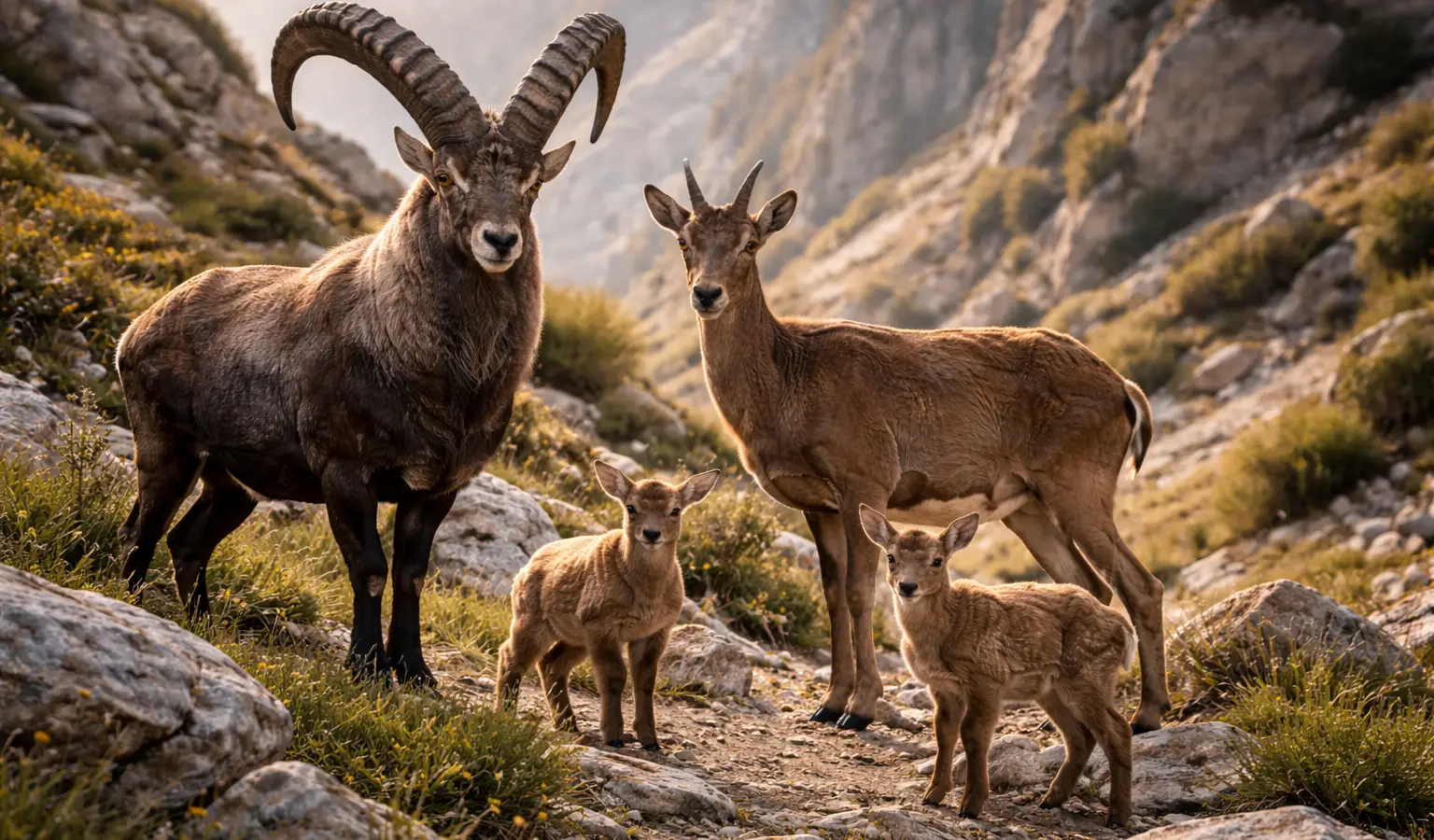
Type
Large mammal
Lifespan
13 years
Hunting season
Novembre à décembre très réglementée
Edible
Yes
Fact sheet
Ibex
Scientific name
Capra ibex
Type
Large mammal
Meat quality
Lean meat
Edible
Yes
Lifespan
13 years
Gestation
170 days
Size
120-150 cm
Weight
60-120 kg
Diet
Herbivore: grasses, leaves, lichens, shoots
Status
Protected or strictly regulated depending on country
Hunting season
Novembre à décembre très réglementée
Breeding season
11 / 12
Lifestyle and behaviour
Behaviour : Diurnal, hardy, excellent climber, lives in groups
Social structure : Groups separated by age and sex
Migration : Limited altitudinal movements
Habitat
- Mountain
Natural predators
- Wolf
Hunting methods
- Blinds
Health risks
- Intestinal parasites
Ecosystem role
- Seed dispersal
Signs of presence
- Tracks on rocks
- Droppings
Introduction
General description
The Alpine ibex, Capra ibex, is one of Europe’s most emblematic mountain ungulates. Often referred to simply as the ibex in a European context, it is a wild goat adapted to steep, rocky country where few large mammals move with equal confidence. Its combination of heavy build, specialized hooves, and dramatic horns makes it instantly recognizable in high-elevation landscapes. For wildlife observers, mountain hunters, and field ecologists, the species represents a classic example of adaptation to alpine terrain.
Ibex populations occupy a distinctive ecological niche in mountain biotopes, feeding on grasses, herbs, shoots, and other sparse vegetation available across cliffs, alpine meadows, and broken slopes. Their daily movements help connect feeding areas, mineral sites, bedding ledges, and seasonal elevation bands. In places where populations are established and well managed, ibex can be a visible and important component of mountain ecosystems, influencing vegetation use patterns and serving as prey for large predators such as wolves where those predators occur.
From a hunting and management perspective, the ibex has unusual status among European big game. After severe historical declines, many populations were protected, reintroduced, and carefully regulated. As a result, hunting relevance varies widely by country and sometimes by local mountain unit: in some areas the species is strictly protected, while in others harvest may be allowed only under tightly controlled quota systems, limited seasons, and age- or sex-specific management plans.
Morphology
Morphology
The ibex is a large, powerfully built mountain goat with a compact body, strong shoulders, relatively short neck, and sturdy legs designed for climbing. Adults commonly measure about 120 to 150 cm in body length, and weight can vary widely with sex, age, season, and local conditions, often ranging from roughly 60 to 120 kg. The coat is generally brown to gray-brown, becoming thicker and often duller in winter, while the underparts may appear somewhat paler.
Field identification is especially easy in adult males because of their massive backward-curving horns with prominent ridged fronts. Females also carry horns, but they are much slimmer, shorter, and more delicate in appearance. Males are usually larger, heavier in the chest and neck, and visually more imposing even at long distance. The head profile is goat-like but robust, and the legs end in highly specialized cloven hooves with a hard outer rim and a more gripping inner surface, an important adaptation for traction on rock.
At a distance, posture and movement are often as useful as color for identification. Ibex tend to stand securely on ledges, move deliberately across broken slopes, and use terrain that would challenge most other hoofed mammals. In mixed mountain fauna, the combination of heavy body, horn shape, and preference for exposed rocky faces usually separates Capra ibex from chamois and domestic goats.
Habitat and distribution
Habitat and distribution
Habitat
Ibex are strongly associated with mountainous habitat, especially steep rocky slopes, cliff systems, broken ridgelines, avalanche corridors, alpine grasslands, and subalpine transition zones where escape terrain is always close. Their preferred biotope generally combines three elements: secure rock for refuge, open feeding areas, and seasonal access to water, minerals, and shelter from severe weather.
They are often seen using sunny slopes, high meadows, craggy outcrops, and windswept terrain where snow cover may be lighter in winter. In warmer months they may feed in productive alpine pastures and rest on elevated ledges that provide wide visibility. In colder periods they can shift toward lower but still rugged slopes, south-facing exposures, or areas where snow depth remains manageable. Dense forest is usually less favored than open mountain ground, although woodland edges and sparse montane cover may be used during movement or adverse weather.
Good ibex habitat is therefore less about a single elevation and more about terrain structure. The species depends on vertical relief, visibility, and immediate access to escape routes. Where human disturbance is frequent, ibex may concentrate in quieter cliff sectors and become more selective in daily habitat use.
Distribution
Capra ibex is native to the European Alps and is closely tied to alpine mountain systems. The core distribution today includes several Alpine countries, although local abundance, continuity of range, and legal treatment differ from one jurisdiction to another. Present occurrence is shaped not only by natural habitat but also by conservation history, reintroduction programs, and long-term management decisions.
Historically, the species suffered severe declines from overhunting and pressure in accessible mountain zones. Modern populations in many areas descend from remnant groups and subsequent restoration efforts. As a result, ibex distribution can be fragmented, locally dense in protected massifs, and absent from otherwise suitable habitat where recolonization has not occurred or where barriers limit expansion.
Outside the main Alpine range, some populations may exist through reintroduction or localized establishment, but status should always be checked at regional level. For practical field use, the ibex is best understood as a mountain specialist of high rocky terrain in parts of continental Europe rather than a broadly distributed generalist ungulate.
Lifestyle
Lifestyle and behaviour
Diet
The ibex is an herbivore that feeds mainly on grasses, sedges, alpine herbs, leaves, shoots, and other available mountain vegetation. Its diet changes with season, snow conditions, plant growth stage, and local habitat quality. During spring and summer, individuals often take advantage of fresh green growth in alpine meadows and open slopes, selecting nutrient-rich forage when it is most abundant and digestible.
In autumn, feeding may broaden to include tougher plants, late-season herbs, dwarf shrubs, and residual pasture growth. In winter, when deep snow and limited vegetation reduce options, ibex can rely more heavily on browse, dry grasses, lichens, evergreen material, and exposed patches where wind or sun has opened access to forage. This seasonal flexibility is important for survival in nutrient-poor mountain environments.
Mineral intake can also matter, especially in rocky habitats where natural salt or mineral sites attract repeated use. Grazing and browsing patterns may vary between sexes and age classes because body size, social grouping, and seasonal range use affect where animals feed and how far they travel between forage and secure resting terrain.
Behaviour
Ibex are primarily diurnal and are often most active in the morning and late afternoon, with resting periods during the middle of the day, especially in warm weather. They are hardy, alert animals that balance feeding needs with security. In exposed country they rely on keen vision, elevated vantage points, and rapid access to cliffs rather than concealment alone.
One of the defining behaviors of the species is its exceptional climbing ability. Ibex move confidently across rock faces, narrow ledges, unstable scree, and steep grassy slopes. When disturbed, they often choose upward or cross-slope escape routes into terrain that reduces pursuit risk. Their flight response is usually practical rather than chaotic: animals may stop repeatedly to look back, regroup on secure shelves, or move as a line through familiar escape corridors.
Weather, snowpack, tourist pressure, livestock presence, and hunting disturbance where legal can all influence daily patterns. In heavily frequented mountain areas, ibex may become more cautious around trails and feeding zones, using inaccessible ground during peak disturbance periods and shifting activity toward quieter hours.
Social structure
Ibex typically live in groups structured by age and sex. Adult males often form bachelor groups outside the breeding season, while females, yearlings, and kids commonly remain in nursery-type groups. Very old males may spend more time alone or in small loose associations, especially outside the rut.
This separation is not absolute, but it is a useful pattern for field observation. Male groups may occupy somewhat different slopes, elevations, or feeding areas than female groups depending on season, forage conditions, and disturbance. During the breeding period, these social divisions break down more visibly as mature males seek out female groups.
Group size varies with terrain, visibility, season, and local population density. In open alpine ground, ibex often benefit from collective vigilance, while the ruggedness of their habitat allows groups to spread out across ledges and feeding benches without fully losing cohesion.
Migration
Ibex do not usually undertake long-distance migrations in the way some open-country ungulates do, but they often make clear altitudinal movements linked to season, snow cover, forage access, and thermal conditions. In general, animals tend to use higher feeding areas during the growing season and somewhat lower or more sun-exposed slopes during winter, while still remaining within rugged mountain terrain.
These movements are often localized and highly dependent on slope aspect, wind exposure, avalanche conditions, and the distribution of safe rock refuges. In some mountain systems, daily vertical movement between feeding and resting sites can be as important as broader seasonal shifts. Heavy snow may compress ibex into smaller wintering sectors where forage remains accessible.
Young males may also disperse from natal areas as they age, contributing to population spread where habitat corridors exist. However, steep terrain, fragmented mountain blocks, roads, and human disturbance can influence how easily local populations expand or mix.
Reproduction
Reproduction
The ibex breeding cycle is adapted to mountain seasonality. Rutting usually occurs in late autumn to early winter, though exact timing can vary somewhat with region and climatic conditions. During this period, mature males join female groups and compete for access to receptive females through displays, posturing, close following, and sometimes physical clashes.
Gestation lasts about 170 days. Most births therefore occur in spring to early summer, when improving weather and fresh plant growth provide better conditions for lactating females and newborn kids. Females generally give birth to a single kid, with twins being less common. Birth sites are usually chosen in steep, secure terrain that offers protection from disturbance and predators.
Young ibex are mobile surprisingly quickly but remain dependent on the mother for milk, protection, and movement decisions during early life. Kid survival can be influenced by late snow, cold wet weather, forage quality, predation pressure, and the overall condition of the female. Sexual maturity and full social status are reached gradually, with horn growth and body development continuing over several years, especially in males.
Field signs
Field signs
Ibex field signs are often subtle compared with those of forest ungulates, but in the right terrain they are readable. Tracks may be found on dusty paths, soft alpine soil, snow, or small sediment patches between rocks. The print is cloven and relatively narrow, with a pointed, agile shape suited to steep ground. On hard rock, complete tracks may be absent, so repeated passage is often inferred from scuffed ledges, polished access lines, and regular use of traversing routes.
Droppings are one of the most practical signs. They typically appear as small dark pellets, often deposited in feeding zones, bedding shelves, trail junctions, or below favored resting ledges. Concentrations of pellets can indicate repeated occupation of a secure slope segment or seasonal use area.
Additional clues include hair caught on rough stone or low shrubs, cropped alpine vegetation, compact bedding spots on sheltered ledges, and well-used approach routes to mineral sites or water. In snow, observation can become much easier because tracks reveal direction of travel, group size, and the relationship between feeding patches and escape terrain.
Ecology and relationships
Ecology and relationships
Ecological role
In mountain ecosystems, the ibex functions as a large alpine herbivore that helps shape vegetation use across meadows, rocky grasslands, and shrub-transition zones. By grazing and browsing selectively, it contributes to plant turnover, affects the structure of some alpine communities, and redistributes nutrients through droppings across slopes and resting areas.
Ibex may also play a role in seed dispersal, both externally and through movement between feeding sites, though the scale of this effect depends on habitat and plant species. As a prey resource, they can be important to large carnivores such as wolves where predator populations overlap their range. Kids and weakened individuals are generally more vulnerable than healthy adults in secure terrain.
Because the species is closely tied to mountain habitat quality, ibex can also serve as a useful indicator of the condition and connectivity of alpine landscapes. Population performance may reflect broader ecological pressures including severe winters, disease, disturbance, and changing vegetation patterns under climate change.
Human relationships
The relationship between people and ibex combines conservation history, mountain culture, wildlife observation, and in some regions highly controlled hunting. Few big game species in Europe illustrate recovery as clearly: many ibex populations exist today because remnant animals were protected and later used in reintroduction or reinforcement programs.
For hikers, photographers, and naturalists, ibex are among the most sought-after mountain mammals because they are visible, charismatic, and strongly associated with dramatic terrain. In pastoral landscapes, interactions with livestock are usually more indirect than direct, but shared use of alpine range can raise management questions about disease transmission, disturbance, and grazing overlap in some areas.
Where hunting is legally authorized, it is generally limited, selective, and embedded in strict management frameworks. The species is edible, but harvest is not a routine or widespread opportunity in the way it is for more common ungulates. In practical terms, ibex are more often encountered as a protected emblem of mountain wildlife than as ordinary huntable game.
Legal framework and management
Legal framework and management
Legal status
The legal status of the ibex is highly dependent on country, region, and local management unit. In many places, Capra ibex is protected or subject to strict regulation because of its historical decline and conservation value. Even where populations are now established, harvest may be allowed only under quota systems, special permits, age-class planning, and close biological monitoring.
The season, where legal, is often narrow and tightly supervised; a late autumn to early winter framework is sometimes used, but exact dates differ substantially by jurisdiction. Any reference to hunting season should therefore be treated as local rather than universal. Readers should always consult current national and regional wildlife laws, protected-area rules, and species-specific regulations before planning observation, stalking access, or any hunting activity.
Protected status may also interact with park boundaries, reserve designations, transboundary mountain rules, and weapon or access restrictions. Because ibex management is often conservation-led, legal compliance and local guidance are essential.
Management tips
Effective ibex management starts with reading mountain habitat as a connected system rather than focusing only on animal counts. Productive feeding slopes, cliff refuge, winter exposure, rutting areas, and low-disturbance resting sites all matter. Monitoring should pay attention to sex ratio, age structure, kid recruitment, winter survival, and local concentration patterns, especially in isolated populations.
- Prioritize quiet refuges: Repeated disturbance from recreation, infrastructure, or unmanaged access can displace ibex from high-quality habitat.
- Watch winter pressure: Deep snow, poor forage access, and unnecessary disturbance can have outsized effects on body condition and survival.
- Track health indicators: Body condition, fecal load, and visible signs of intestinal parasites or other disease issues should be monitored where feasible.
- Coordinate with livestock management: In shared alpine range, disease risk and grazing overlap deserve attention.
- Use cautious harvest policy where legal: Because many populations are conservation-dependent or closely managed, quotas and age/sex selection should remain science-based.
For field observation, the most useful tactic is often to glass early and late from a stable vantage point, reading sun exposure, ledge systems, and access routes before moving. In hunting contexts where legal, blinds or carefully chosen observation points may be relevant, but mountain safety, shot ethics, retrieval difficulty, and local law are especially important with a cliff-dwelling species.
Fun facts
Fun facts
- The Alpine ibex is one of the clearest examples of a European mountain mammal brought back from the brink through protection and reintroduction.
- Its hooves are specialized for grip, allowing secure movement on rock faces that appear nearly impossible to cross.
- Both sexes carry horns, but the male’s heavy ridged horns are among the species’ most striking identification features.
- Horn growth can provide useful clues about age class, which is one reason ibex are often managed with more precision than many other big game animals.
- Even though ibex look at home on bare cliffs, they still depend heavily on nearby feeding areas with enough plant productivity to sustain them through the mountain year.