
Hazel grouse
Tetrastes bonasia
A small, elusive forest grouse, hunted only very locally depending on country.
Type
Bird
Lifespan
7 years
Hunting season
October – December
Edible
Yes
Fact sheet
Hazel grouse
Scientific name
Tetrastes bonasia
Type
Bird
Meat quality
Fine meat
Edible
Yes
Lifespan
7 years
Incubation
24 days
Size
35-40 cm
Weight
350-450 g
Diet
Omnivore: seeds, buds, insects
Status
Hunted only very locally
Hunting season
October – December
Breeding season
5 / 6
Lifestyle and behaviour
Behaviour : Solitary or in pairs, moves through understory
Social structure : Solitary or pairs
Migration : Resident
Habitat
- Forest
Natural predators
- Fox
- Birds of prey
Hunting methods
- Blinds
Health risks
- Avian parasites
Ecosystem role
- Seed dispersal
- Insect regulation
Signs of presence
- Ground tracks
- Feathers
- Calls
Introduction
General description
The Hazel grouse, Tetrastes bonasia, is one of the smallest and most secretive woodland grouse in Europe and parts of temperate Asia. Unlike more conspicuous open-country game birds, it is a bird of dense forest structure: quiet, cryptic, and often overlooked even where it is still present. It typically lives close to cover, using understory vegetation, saplings, mixed-age woodland, and forest edges within larger wooded landscapes.
Ecologically, the Hazel grouse is a useful indicator of structurally diverse forest habitat. Its presence often suggests a mosaic of cover, food plants, and relatively low disturbance at the right scale. Because it feeds on buds, seeds, green plant material, and invertebrates depending on the season, it links shrub and tree regeneration, insect dynamics, and the food web of predators such as foxes and birds of prey.
In hunting culture, the species has a much more limited role than larger grouse or partridges. In many areas it is fully protected or only hunted very locally under strict regulation. Even where legal, it is generally considered a specialist small game bird of quiet forest country rather than a widespread quarry species. For most people, the Hazel grouse is more often encountered as a challenging bird to observe than as a regular hunting species.
Morphology
Morphology
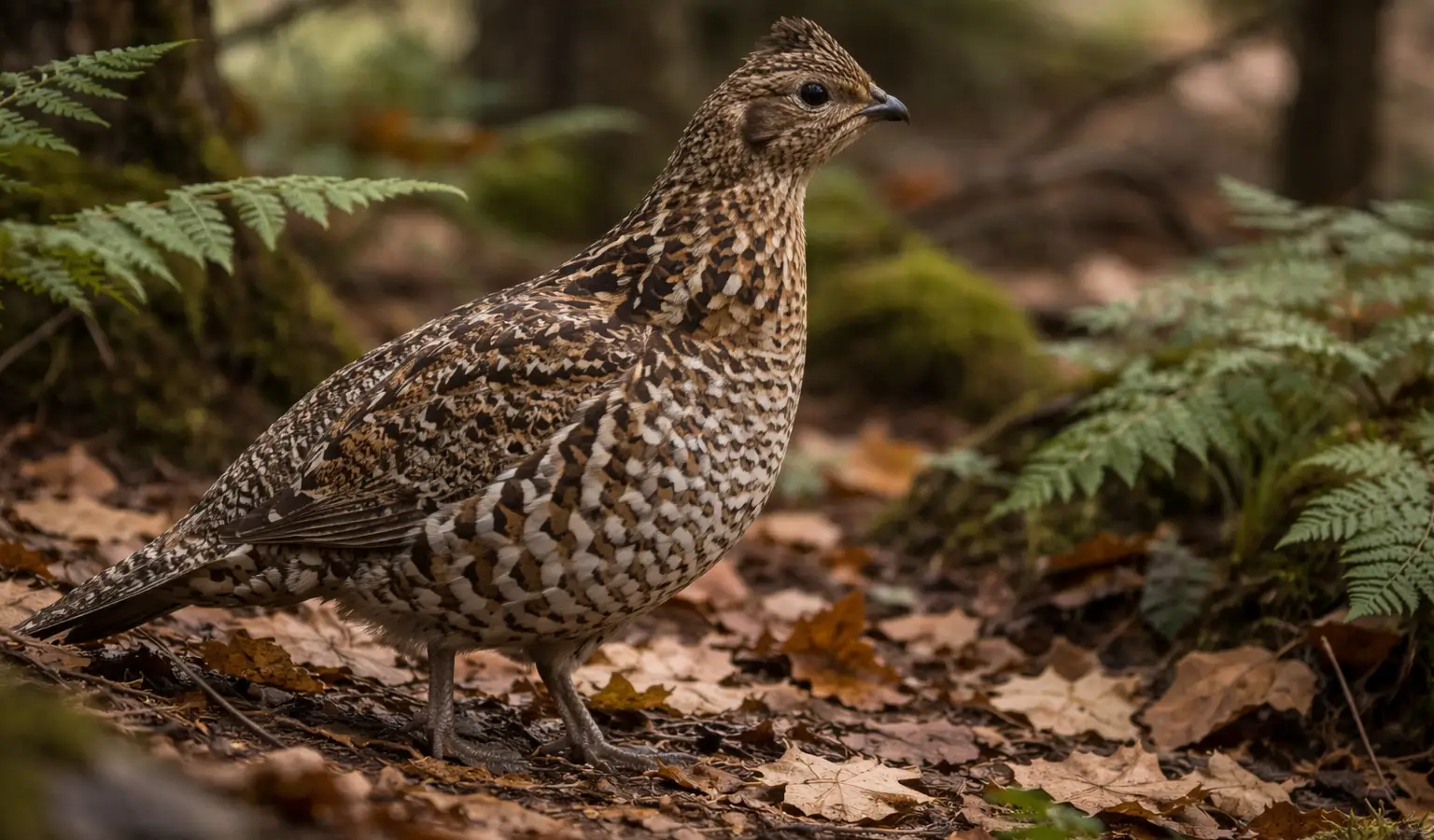
The Hazel grouse is a compact, short-tailed forest grouse measuring roughly 35 to 40 cm in length and often weighing around 350 to 450 g. It has a rounded body, relatively small head, and broad wings adapted for sudden, explosive flight through woodland cover. At a glance, its shape is neat and understated rather than heavy or long-bodied.
Its plumage is intricately patterned in gray, brown, rufous, black, and buff tones, giving excellent camouflage against bark, leaf litter, and low branches. The upperparts are mottled and barred, while the underparts show finer patterning. Males usually show a darker throat patch bordered with lighter tones, while females tend to be subtler and slightly less contrasted. Both sexes have a modest crest that may be raised when alert.
For field identification, the key combination is size, woodland setting, cryptic barred plumage, and a tendency to stay low in cover. In poor light it can be confused with other small forest galliforms only where ranges overlap, but its compact silhouette and preference for dense understory are strong clues. Most sightings are brief, often of a bird slipping away or flushing suddenly from close range.
Habitat and distribution
Habitat and distribution
Habitat
Hazel grouse habitat is closely tied to forest biotopes with dense low cover and varied vegetation structure. The species is most often associated with mixed woodland, moist deciduous-conifer mosaics, young regeneration patches, alder and birch stands, spruce forest with a rich understory, and edges where shrubs, saplings, and herbaceous growth provide both concealment and food. It generally avoids very open landscapes and may be less common in large, simplified forest blocks with little understory.
Good habitat usually combines several elements at once: thermal cover, escape cover, access to buds and seeds, and brood-rearing areas rich in insects. Forest rides, small glades, streamside woodland, patchy regrowth after disturbance, and uneven-aged stands can all be important. Seasonal use may shift slightly within a home area, with birds selecting sheltered feeding zones in winter and denser, food-rich ground cover during breeding and brood season.
At a practical level, the Hazel grouse favors places where visibility is short and movement can remain discreet. Woodland structure matters as much as tree species composition. A forest that looks extensive on a map may still be poor if it lacks shrub layers, edge complexity, and small-scale habitat diversity.
Distribution
Tetrastes bonasia has a broad Palearctic distribution extending across parts of Europe and deep into temperate Asia. In Europe, its occurrence is mainly tied to suitable forest belts, especially in central, eastern, and northern regions, with more fragmented or localized populations farther west and south. Its range is not uniformly occupied; even within apparently suitable regions, presence may be patchy according to forest continuity, habitat quality, and local land use history.
In some countries the Hazel grouse remains a native but thinly distributed woodland bird of remote or well-structured forest zones. In others it has declined or become restricted to mountain, boreal, or less disturbed landscapes. Observation rates are often lower than true presence might suggest because the species is quiet, sedentary, and easy to miss.
Local abundance can vary significantly. Small isolated populations may be vulnerable to habitat fragmentation, repeated disturbance, and predator pressure, while larger continuous forest systems may support more stable occupancy. For practical field expectations, regional knowledge is essential; broad range maps alone can overstate how easy the bird is to find.
Lifestyle
Lifestyle and behaviour
Diet
The Hazel grouse is an omnivore with a diet that changes noticeably by season. Plant food is especially important for much of the year and includes buds, shoots, leaves, catkins, seeds, berries where available, and other soft vegetation. In winter and early spring, tree and shrub buds can become particularly important, especially in cold forest conditions when ground foods are limited.
During warmer months, the diet broadens to include more invertebrates such as insects and their larvae. This seasonal shift is especially important for growing chicks, which generally require protein-rich animal food during early development. Productive brood habitat therefore depends not just on cover, but also on a healthy invertebrate base in the forest floor and low vegetation layer.
Feeding behavior is usually discreet and local. Birds often forage on the ground in sheltered patches or pick buds and plant material from low branches. Diet composition can vary by region, altitude, forest type, and weather pattern, so exact food use may differ across the species' range.
Behaviour
Hazel grouse behavior is defined by caution, concealment, and short-range movement through woodland cover. The species is often described as solitary or found in pairs, moving quietly through understory vegetation rather than spending time in exposed openings. Much of its daily activity is concentrated around feeding and low-intensity movement between nearby shelter, feeding spots, and resting areas.
When disturbed, the bird often relies first on stillness and camouflage. If pressure becomes too close, it may slip away on foot through dense cover or flush suddenly with a rapid burst of wingbeats. These flushes are usually brief and direct, often ending in another patch of protective cover rather than prolonged flight. This escape strategy makes the species difficult to approach and easy to overlook.
Activity rhythm may shift with season, weather, and local disturbance. In colder periods, birds may use sheltered microhabitats and conserve movement. In breeding season, territorial and pair-related behavior becomes more pronounced, while outside that period the species still tends to remain discreet and resident within a familiar forest area.
Social structure
The Hazel grouse has a relatively simple social structure compared with more gregarious upland game birds. It is most often encountered alone or in pairs, especially in suitable woodland where individual birds or pair bonds use small, cover-rich territories. Stable pair association is a notable aspect of the species in many populations.
Outside the breeding season, family groups may persist temporarily after hatching, but large flocks are not typical. As young birds disperse, social organization returns to a more dispersed pattern centered on individual space use and access to food and cover. This low-density, non-conspicuous social system is one reason the species can seem rare even in occupied habitat.
Territorial behavior is generally subtle and expressed through spacing, vocal signals, and regular use of preferred cover rather than obvious open display grounds. Social interactions therefore tend to be hidden within vegetation and are more often inferred from distribution and calling than directly observed.
Migration
The Hazel grouse is generally considered a resident species rather than a migrant. Most birds remain within the same broad forest landscape throughout the year, using local movements to track food, shelter, and seasonal cover. This sedentary pattern is typical of a woodland bird adapted to stable home ranges and close familiarity with escape cover.
That said, some short-distance dispersal does occur, especially by juveniles after the breeding season. These movements are important for colonizing nearby habitat and maintaining gene flow between suitable forest patches. In fragmented landscapes, however, dispersal may be limited by open ground, roads, intensive land use, or simple lack of connected cover.
Winter movement is usually modest and linked more to microhabitat selection than to true migration. Birds may shift into denser stands, sheltered slopes, or bud-rich areas, but they do not undertake regular long-distance seasonal journeys in the way migratory game birds do.
Reproduction
Reproduction
The breeding cycle of the Hazel grouse begins in spring, when pairs occupy or reinforce territories within suitable forest habitat. Courtship is relatively discreet compared with that of some other grouse species, fitting the bird's secretive woodland lifestyle. Nesting usually takes place on the ground in a concealed site, often sheltered by low vegetation, roots, fallen timber, or dense understory.
The female lays a clutch of eggs and undertakes most of the incubation, which commonly lasts around 24 days, although timing can vary slightly. After hatching, chicks leave the nest quickly and begin feeding under close maternal guidance. Early brood survival depends heavily on warm, sheltered conditions, abundant insect food, and low disturbance.
Reproductive success can fluctuate strongly from year to year. Cold, wet weather during hatch and brood-rearing periods may reduce chick survival, while poor forest structure can limit both nesting concealment and food availability. In favorable habitat, the species can maintain local populations, but productivity is often sensitive to habitat quality and seasonal conditions.
Field signs
Field signs
Finding Hazel grouse field signs requires slow observation in the right forest structure. The most useful clues include ground tracks, scattered feathers, and distinctive calls in suitable habitat. Because the bird is light and discreet, sign is often subtle and easy to miss unless conditions are favorable.
Tracks may appear on soft soil, mud, snow, or damp forest paths, usually showing a small game bird print with forward toes and a light overall impression. Fresh snow can be especially useful for reading movement between feeding and shelter areas. Feathers may be found at dusting sites, roost spots, or predator plucking points, though identification should be made carefully where other woodland birds occur.
Other indirect signs can include localized feeding on buds, scratch marks in leaf litter, small droppings in sheltered feeding areas, and repeated use of quiet edge cover. In practice, habitat reading is often as important as sign itself: if the understory is dense, mixed, and calm, the chances of meaningful sign increase.
Ecology and relationships
Ecology and relationships
Ecological role
The Hazel grouse plays several useful roles in forest ecosystems. As a feeder on seeds, buds, shoots, and berries, it participates in plant use patterns that reflect forest regeneration and shrub dynamics. Through the consumption and movement of plant material, it may contribute in a modest way to seed dispersal, particularly within local woodland systems.
Its use of insects and other invertebrates, especially during the chick stage, also links it to insect regulation and the broader health of forest-floor food webs. At the same time, the species is prey for predators such as foxes and birds of prey, making it an important intermediate component between vegetation, invertebrates, and higher trophic levels.
Because it is sensitive to forest structure, the Hazel grouse is also ecologically meaningful as a habitat-quality indicator. Where it persists, woodland often retains a level of layering, edge diversity, and understory productivity that benefits many other birds, mammals, and invertebrates.
Human relationships
Human relationships with the Hazel grouse vary widely by region. For birdwatchers and field naturalists, it is a prized observation species because seeing one usually means reading forest habitat well and moving carefully. Its elusive nature gives it a special status among woodland birds: more often searched for than actually seen.
In hunting contexts, the Hazel grouse belongs to the small game tradition in some countries, but its role is generally limited. It is not a broadly hunted species across its range, and in many places it is fully protected or subject to strong restrictions. Where a legal season exists, it tends to be highly local, often linked to specific management frameworks and low hunting pressure. The available season mentioned for some contexts is roughly October to December, but this should never be generalized without checking current local regulations.
The species can also be affected by forestry practices, recreational disturbance, road access, and habitat fragmentation. Careful woodland management often matters more to its future than direct exploitation. For rural communities and forest users, coexistence usually depends on maintaining quiet, structurally rich woodland rather than any intensive intervention focused on the bird alone.
Legal framework and management
Legal framework and management
Legal status
The legal status of the Hazel grouse is highly variable between countries and sometimes within subnational jurisdictions. In many parts of its range, it is protected or effectively unavailable as a hunting species. In other areas, it may be hunted only very locally under seasonal rules, bag limits, or site-specific management plans.
Because woodland grouse regulations can change in response to population trends, habitat concerns, and monitoring results, no general statement should be treated as sufficient for compliance. Anyone interested in hunting, handling, or even using calls for field work should consult the most recent national and local wildlife regulations.
Beyond hunting law, the species may also benefit indirectly from forest conservation rules, protected-area designations, and biodiversity policies aimed at maintaining mixed-age woodland and reducing fragmentation. Practical legal interpretation should always be local, current, and conservative.
Management tips
Good Hazel grouse management starts with habitat structure rather than species-specific manipulation. The priority is to maintain or restore forest mosaics with dense understory, young regeneration, shrub layers, edge transitions, and a mix of tree ages and species. Uniform stands with little ground cover are usually less favorable than patchy, diverse woodland.
Disturbance should be considered carefully, especially during breeding and brood-rearing. Repeated recreational pressure, intensive forestry operations at sensitive times, and excessive opening of tracks or access routes can reduce the sense of security this species depends on. In fragmented areas, improving connectivity between suitable forest patches may matter as much as improving any single stand.
- Retain mixed-age cover and low vegetation.
- Protect quiet nesting and brood habitat in spring and early summer.
- Favor woodland diversity over large simplified blocks.
- Monitor presence cautiously through calls, tracks, and habitat occupancy rather than excessive disturbance.
- Where hunting is legal, keep pressure conservative and linked to reliable local population knowledge.
For observers, hunters, and land managers alike, the key lesson is restraint: the Hazel grouse responds best to subtle, habitat-led management and low pressure.
Fun facts
Fun facts
The Hazel grouse is often heard or flushed before it is clearly seen, which is one reason it has a reputation as a woodland specialist's bird. Its camouflage is so effective that a motionless bird at close range can blend almost completely into bark, shadow, and leaf litter.
Unlike some grouse famous for dramatic open displays, Tetrastes bonasia is a bird of understatement. Much of its life happens in the half-light of understory cover, where pair bonds, feeding, and daily movement are carried out quietly and with remarkable precision.
Although it is classed as edible and has a place in traditional small game culture in a few areas, for many modern wildlife enthusiasts the real value of the Hazel grouse lies in what it reveals about forest quality. Seeing one often means the habitat still retains the layered, living complexity that many woodland species need.