
Goose
Anser anser
A large bird of wetlands and farmland, known for long-distance migrations.
Type
Bird
Lifespan
20 years
Hunting season
October – January
Edible
Yes
Fact sheet
Goose
Scientific name
Anser anser
Type
Bird
Meat quality
Strong-flavoured meat
Edible
Yes
Lifespan
20 years
Incubation
28 days
Size
75-90 cm
Weight
2.5-4 kg
Diet
Herbivore: aquatic plants, grasses, seeds
Status
Huntable but strictly regulated
Hunting season
October – January
Breeding season
4 / 5
Lifestyle and behaviour
Behaviour : Long migrations, strong family groups, flies in formations
Social structure : Tight family groups
Migration : Long-distance migratory
Habitat
- Grassland
- Wetland
Hunting methods
- Blinds
- Driven pass
Health risks
- Avian influenza
Ecosystem role
- Wetland grazing
Signs of presence
- Footprints
Introduction
General description
The goose covered here is the greylag goose, Anser anser, a large, powerful waterfowl of marshes, lakes, floodplains, estuaries, and surrounding farmland. It is one of the best-known wild geese in Eurasia and is widely recognized by its broad body, long neck, heavy bill, and strong, purposeful flight. In many regions, the word “goose” is used broadly for several species, but Anser anser remains especially important because it is the ancestral wild form of many domestic geese and a key species in wetland and agricultural landscapes.
As a game bird, the greylag goose has long held significance in traditional waterfowl hunting, especially during autumn and winter movements when flocks shift between roosting waters and feeding fields. It is equally important to birdwatchers and wetland managers because its presence often reflects the quality of open feeding areas linked to safe resting sites. Large wintering groups can become highly visible and locally influential, shaping vegetation through grazing pressure and attracting strong public interest.
Ecologically, the species is a classic grazer of wetland edges and grassland mosaics. It links aquatic and terrestrial habitats through daily movement, nutrient transfer, and selective feeding. Because populations can vary greatly by flyway, climate, protection history, and agricultural opportunity, the status of greylag geese may range from scarce and localized to abundant and highly conspicuous depending on region.
Morphology
Morphology
The greylag goose is a large, heavy-bodied goose measuring roughly 75 to 90 cm in length and commonly weighing about 2.5 to 4 kg, though local variation occurs. It shows a robust chest, thick neck, broad wings, and a relatively blunt tail. At rest it looks deep-bodied and strong rather than slender.
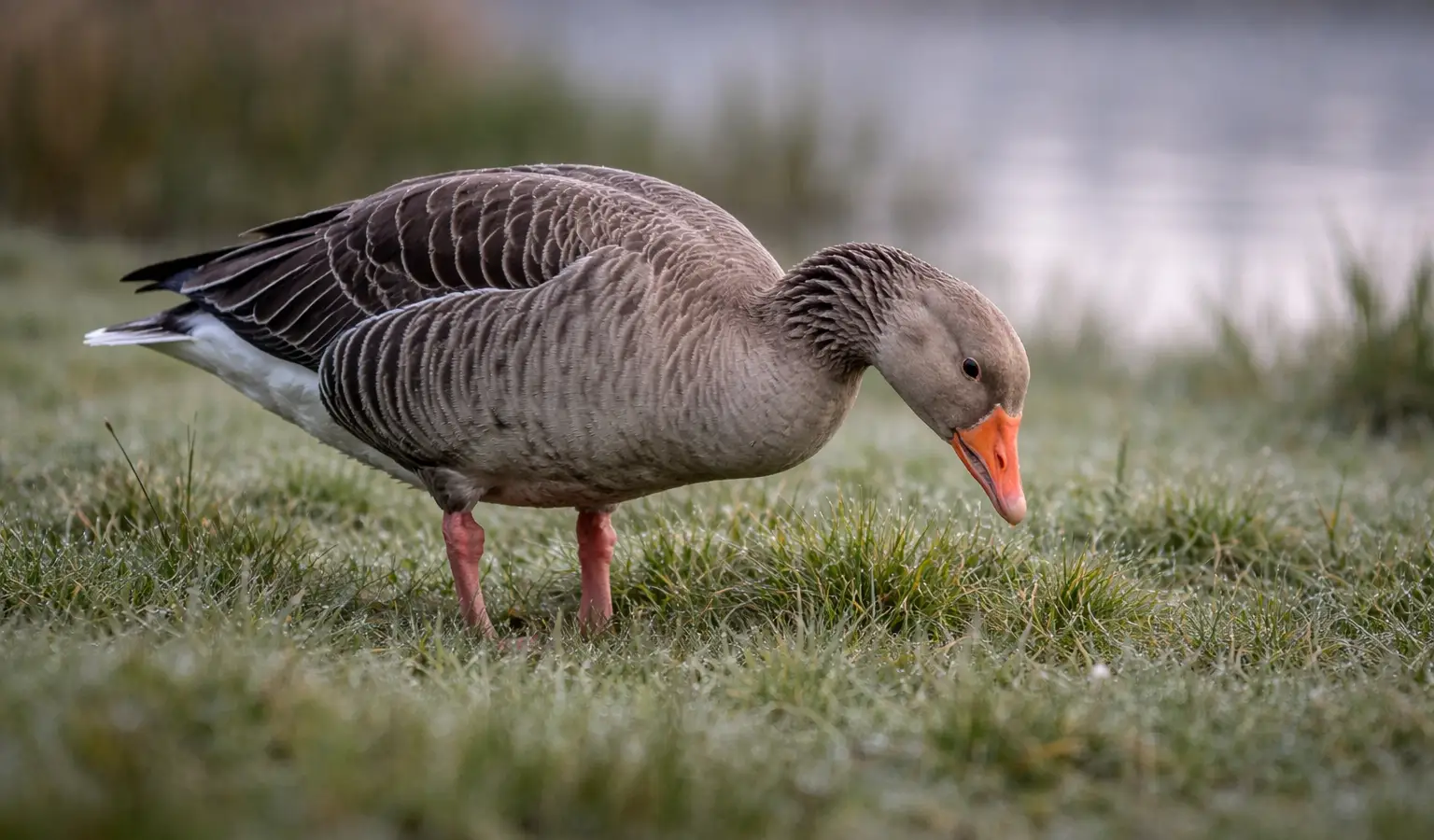
Plumage is mostly grey-brown with paler and darker tones that create a scaled appearance on the body. The underparts are generally lighter, and many adults show variable dark markings on the belly. The head and neck usually appear paler grey than the body, without the strong contrast seen in some other goose species. The bill is typically pink to orange-pink and rather bulky, an important field mark, while the legs are pinkish. In flight, the wings appear broad and steady, and the bird shows a heavy, direct silhouette with an extended neck.
For field identification, observers often rely on a combination of size, thick neck, bulky pinkish bill, grey overall coloration, and loud, resonant calls. Compared with some other geese, the greylag often looks less sharply patterned and more uniformly powerful. Juveniles are duller and usually lack the stronger adult belly markings.
Habitat and distribution
Habitat and distribution
Habitat
Anser anser favors a mosaic of wetlands and open feeding land. Core habitat includes marshes, reed-fringed lakes, reservoirs, slow river valleys, flooded meadows, coastal lagoons, and estuarine margins. It also makes heavy use of grasslands, stubble fields, winter cereals, and other farmland close to secure water.
The species depends strongly on the combination of two habitat functions: safe roosting or loafing water, and productive feeding areas within practical flying distance. In many places, daytime or nighttime patterns shift according to disturbance, weather, and hunting pressure. Geese may roost on open water for security and feed on pasture, grain fields, or wet grassland during low-disturbance periods.
Outside the breeding season, habitat use can become broader, especially where agricultural land offers abundant food. During nesting, birds tend to prefer quieter wetland sectors with cover, islands, reedbeds, sedge margins, or inaccessible shorelines that reduce predation and disturbance.
Distribution
The greylag goose is native across much of the Palearctic, with breeding and seasonal occurrence extending across parts of Europe and western to central Asia. Its exact distribution pattern is shaped by local wetland availability, winter severity, flyway traditions, and reintroduction or recovery history in some countries.
Some populations are strongly migratory, while others are partly migratory or increasingly sedentary, especially where winters have become milder and food remains available year-round. In western and central Europe, the species is now widespread in many suitable wetlands and agricultural districts, with winter concentrations sometimes far exceeding local breeding numbers.
Occurrence is often seasonal. Birds may be scarce or absent in some breeding zones during winter, then highly visible during migration and wintering periods farther south or west. Local abundance can therefore change sharply across the year, which is important for both field observation and management planning.
Lifestyle
Lifestyle and behaviour
Diet
The greylag goose is primarily herbivorous. Its diet includes aquatic plants, emergent vegetation, grasses, sedges, shoots, roots, seeds, grain, and other plant material gathered in wetlands or nearby farmland. Grazing is especially important, and flocks can feed intensively on short grass, young cereals, pasture, and harvested fields.
Season strongly influences food choice. During the breeding period, birds often exploit fresh green growth and wetland vegetation rich in nutrients. In autumn and winter, they may shift more heavily toward agricultural foods such as spilled grain, winter crops, and improved grassland, where feeding efficiency can be high. Local conditions determine whether aquatic feeding or field grazing dominates.
Like many geese, they feed methodically, clipping vegetation with the bill and often leaving visibly grazed patches. Their digestive system is adapted to bulky plant matter, but food quality still matters, so birds often select productive feeding sites with tender growth and predictable access.
Behaviour
Greylag geese are highly alert, social, and responsive to disturbance. They spend much of the day alternating between feeding, loafing, maintenance behavior such as preening, and scanning for danger. In hunted or frequently disturbed landscapes, they may become especially wary and adjust movement times toward dawn, dusk, or night.
On the ground, they often feed in open areas that allow early detection of threats. Sentinels within a flock may keep their heads raised while others graze. When alarmed, the group may stretch necks, call loudly, bunch together, and either walk toward water or take off in a coordinated flush. Their escape flight is strong and sustained rather than erratic.
In flight, greylag geese are famous for traveling in lines, wavering skeins, or V formations that improve group cohesion and aerodynamic efficiency. Calls are an important part of daily life, helping maintain contact between mates, family members, and larger flocks. Birds quickly learn regular disturbance patterns, feeding schedules, and safe approach routes between water and fields.
Social structure
The social structure of the greylag goose is built around strong pair bonds and close family cohesion. Pairs may remain together for long periods, and both adults are involved in guarding and leading young. After hatching, family groups often stay tightly organized, with goslings moving, feeding, and resting under close parental supervision.
Outside the breeding season, these family units merge into larger flocks. Even within big winter aggregations, family ties may remain visible in spacing, synchronized movement, and calling. This layered social organization helps explain the species’ coordinated flight, rapid alarm response, and strong flock memory regarding traditional roosts and feeding grounds.
Social rank can influence access to feeding spots and secure positions within groups. Larger flocks provide more eyes for predator detection, but geese still maintain personal space and use body posture, neck extension, and vocalization to regulate interactions.
Migration
The greylag goose is best described as a long-distance migrant in many parts of its range, although not all populations behave the same way. Traditional migratory movements connect northern or continental breeding grounds with milder wintering areas farther west or south. Autumn migration often builds from local dispersal into broader flyway movement, while spring migration returns birds to breeding wetlands.
Migration intensity depends on frost, snow cover, food access, and local security. Severe cold can push birds rapidly into more temperate zones, whereas mild winters may allow some populations to remain close to breeding areas. This flexibility has become increasingly noticeable in parts of Europe.
Daily movement is also a major part of the species’ ecology. Even outside true migration, greylag geese often commute between roost waters and feeding fields, sometimes over considerable distances. Understanding this routine is essential for observation, census work, and practical management.
Reproduction
Reproduction
The breeding season typically begins in spring, though timing varies with latitude, weather, and local conditions. Greylag geese usually nest on the ground in concealed or semi-concealed spots near water, often among reeds, sedges, tall grass, shrubs, or on islands. The nest is built mainly from plant material and lined with down.
The female lays a clutch of several eggs, and incubation lasts about 28 days. During this period, the male often remains nearby, acting as a guard and warning of danger. After hatching, goslings are precocial: they leave the nest quickly and begin feeding under parental care. Access to quiet wetlands with soft vegetation and shallow margins is especially important for brood survival.
Young birds grow through summer while adults undergo molt, a period when flight ability may be reduced. Family groups usually remain together well beyond hatching, and juvenile recruitment can vary substantially depending on weather, water levels, disturbance, predation, and feeding conditions.
Field signs
Field signs
Field signs of greylag goose presence are often easy to detect once a site is used regularly. Footprints in soft mud, wet soil, sand, or shallow shoreline sediment are among the clearest clues. Tracks show a broad webbed foot and can be found along pond edges, flooded meadows, muddy gateways, and grazed margins between water and field.
Droppings are also a common sign, especially on feeding grassland, roost banks, and approach routes. Heavily used pasture may show clipped vegetation, trampled patches, and repeated entry paths where birds move between loafing and feeding areas. Feathers may be found at roosts, molting sites, or plucking points.
Auditory signs are often as important as visual ones. Loud calling from overhead skeins, contact calls from roost waters at dawn, and repeated commuting flights can reveal a nearby flock before the birds are seen. At favored resting sites, flattened vegetation and concentrated droppings may indicate regular use.
Ecology and relationships
Ecology and relationships
Ecological role
Greylag geese play an important ecological role as large herbivores in wetland and grassland systems. Through repeated grazing, they influence plant structure, productivity, and the height of swards used by other animals. Their feeding can create short, open patches in meadows and marsh edges, sometimes increasing habitat heterogeneity.
They also move nutrients between aquatic roosts and terrestrial feeding zones through droppings and daily travel. In wetlands, this can contribute to nutrient cycling, though the scale and effect depend on flock size and site sensitivity. As consumers of seeds and vegetation, they are part of broader food web processes tied to seasonal productivity.
Where numbers become high, their ecological role can shift from beneficial natural grazing to substantial local pressure on crops, fragile wetland vegetation, or heavily used resting sites. For that reason, the species is often central to discussions about balancing conservation, habitat capacity, and human land use.
Human relationships
The relationship between people and the greylag goose is long-standing and complex. It is valued as a wild bird for observation, photography, and seasonal spectacle, especially during migration and winter flocking. Its calls, flight formations, and family behavior make it one of the most recognizable geese in the field.
It also has direct relevance to hunting culture in areas where waterfowl hunting is legal and regulated. Hunting methods may include blinds near flightlines or feeding areas and pass shooting where lawful, always requiring strong species identification and awareness of local restrictions. Because geese are intelligent, social, and responsive to pressure, ethical hunting practice depends heavily on careful preparation, concealment, safe shooting conditions, and respect for changing regulations.
At the same time, greylag geese can come into conflict with agriculture where grazing pressure affects pasture, cereals, or newly established crops. Management therefore often involves coexistence measures, scaring, refuge areas, population monitoring, and adaptive regulation. From a public health perspective, wild waterfowl can be associated with avian influenza surveillance, so handling and biosecurity precautions matter when birds are found sick or dead.
The species is edible and has traditional culinary value in some areas, but all harvest and transport must follow current wildlife, hygiene, and animal health rules.
Legal framework and management
Legal framework and management
Legal status
The greylag goose is huntable in some jurisdictions but remains strictly regulated, and legal status can differ greatly by country, region, season, flyway, and population status. Open seasons often fall in autumn and winter; in the context provided here, a hunting period from October to January is relevant, but readers should always verify the exact current dates locally.
Protected areas, reserve rules, species lists, bag limits, non-toxic shot requirements, methods of take, and shooting hours may all apply. Some areas distinguish between resident and migratory populations or impose special measures where conservation concerns, crop damage, or public safety issues exist.
Because goose identification can be difficult in mixed flocks, legal compliance depends on certainty before shooting. Regulations may also change in response to disease control, population trends, or international migratory bird agreements. The only safe guidance is to consult the latest official national and local regulations before any hunting, handling, transport, or management action.
Management tips
Useful management starts with reading the habitat as a connected system rather than focusing on a single field or pond. The key question is where geese feed, where they roost safely, and how they move between those places through the season. Regular observation at dawn and dusk can reveal flightlines, pressure points, and shifts caused by weather, water level, or disturbance.
- Protect or restore quiet roost water linked to open feeding land if the goal is to support stable use.
- Monitor grazing pressure on sensitive grassland, young crops, or vulnerable wetland vegetation before problems become severe.
- Use local counts and repeated observation rather than assumptions, because goose numbers can change quickly with migration and cold weather.
- In hunting contexts, avoid excessive disturbance that displaces birds broadly and reduces both ethical opportunity and site fidelity.
- Where avian influenza is a concern, avoid handling sick or dead birds without following official biosecurity guidance.
For land managers, a balanced approach often works best: maintain refuge and feeding capacity where appropriate, reduce unnecessary disturbance, coordinate actions across neighboring properties, and adapt decisions to population trend, agricultural impact, and conservation obligations. In mixed-goose areas, accurate identification should remain a constant priority.
Fun facts
Fun facts
The greylag goose, Anser anser, is widely regarded as the wild ancestor of many domestic goose breeds, which gives it an unusual cultural importance alongside its ecological value.
Its famous V-shaped flight formations are not just visually striking. They also help maintain flock contact and can improve travel efficiency during long-distance movement.
Greylag geese are known for strong family bonds, and young birds may stay with their parents for an extended period after hatching, learning feeding grounds, roost sites, and movement routines.
Although often seen as birds of marshes and lakes, they are equally creatures of working landscapes, and some of the most reliable winter observations come from open farmland near secure water.
With good conditions, individuals can live many years; a lifespan around 20 years is possible, which helps explain how experienced birds can build detailed knowledge of seasonal routes and safe habitats.