
Garganey
Spatula querquedula
A small migratory duck of wetlands, hunted under strict rules in some regions.
Type
Bird
Lifespan
6 years
Hunting season
August – September
Edible
Yes
Fact sheet
Garganey
Scientific name
Spatula querquedula
Type
Bird
Meat quality
Fine meat
Edible
Yes
Lifespan
6 years
Incubation
21 days
Size
35-40 cm
Weight
300-400 g
Diet
Omnivore: insects, seeds, small invertebrates
Status
Huntable but strictly regulated
Hunting season
August – September
Breeding season
5 / 6
Lifestyle and behaviour
Behaviour : Small flocks, migratory, discreet
Social structure : Small groups
Migration : Migratory
Habitat
- Wetland
Natural predators
- Fox
- Birds of prey
Hunting methods
- Driven pass
Health risks
- Avian influenza
Ecosystem role
- Invertebrate consumption
Signs of presence
- Footprints
- Feathers
Introduction
General description
The Garganey, Spatula querquedula, is a small, elegant dabbling duck of marshes, flooded meadows, shallow ponds, and reed-fringed wetlands. It is one of the most distinctly migratory teals in the Palearctic, breeding across parts of Europe and western to central Asia and wintering mainly in Africa and southern Asia. For many birdwatchers and wetland managers, the species is notable for its discreet habits, seasonal appearance, and strong dependence on productive, shallow wetland systems.
Although it is smaller and often less conspicuous than larger ducks, the Garganey has real ecological importance as a consumer of aquatic invertebrates, seeds, and other small food items found in richly structured marsh habitat. Its presence often reflects the quality of spring and summer wetlands, especially sites that combine shallow feeding water, emergent vegetation, and relative tranquility during breeding or stopover periods.
In hunting contexts, the Garganey occupies a sensitive place. It may be legally huntable in some regions, but generally under strict regulation and with close attention to season, migration timing, and conservation considerations. Because it is a long-distance migrant and can be locally scarce or variable from year to year, careful identification and a strong awareness of current rules are essential.
Morphology
Morphology
The Garganey is a small waterfowl species, typically around 35 to 40 cm in length and often weighing roughly 300 to 400 g. It has the compact build typical of teals, with a relatively slim neck, neat head profile, and narrow bill suited to dabbling and filtering small food items from the water surface and mud.
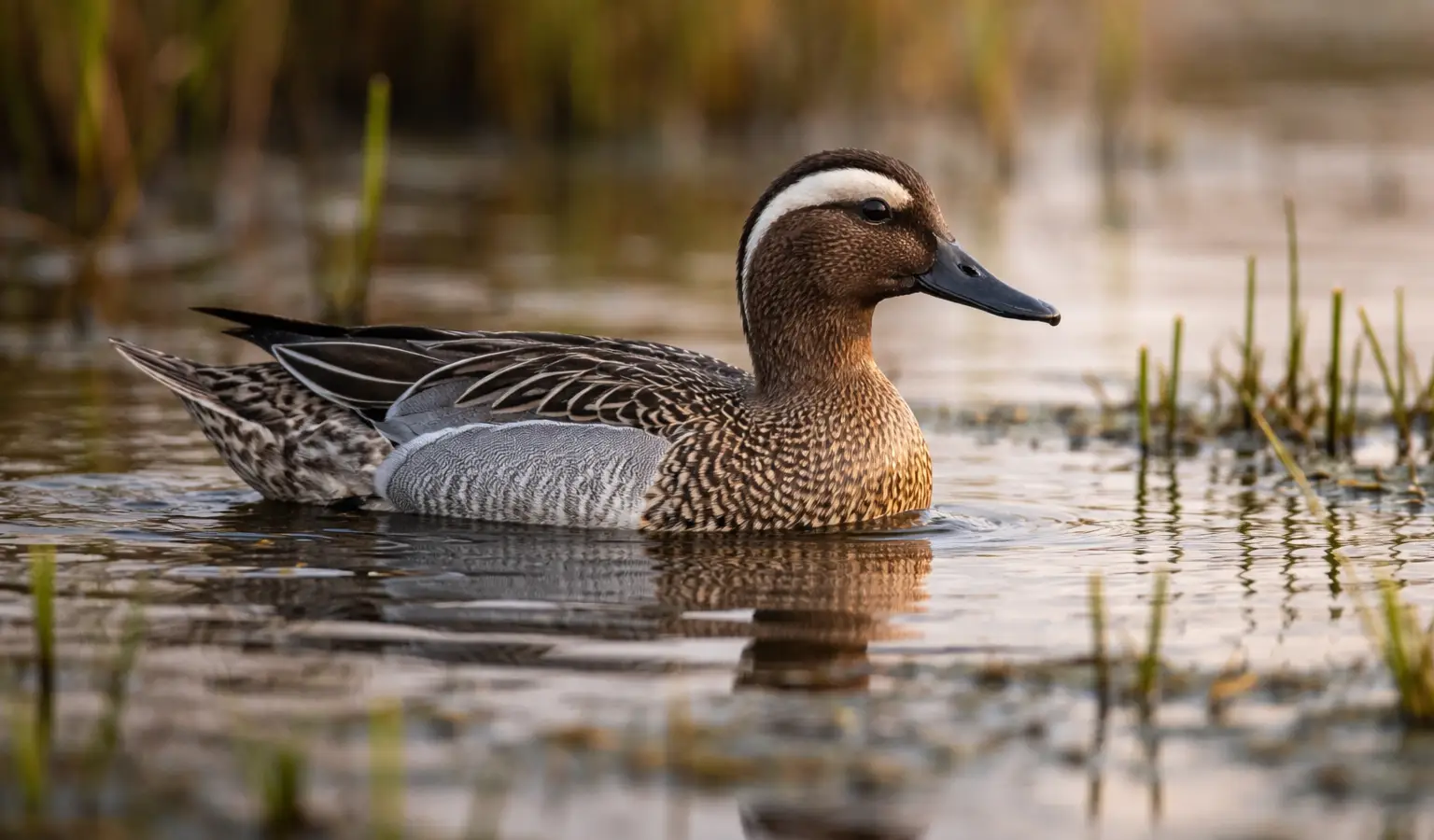
The breeding male is especially distinctive. At a glance, the most useful field mark is the bold white crescent or sweeping stripe above the eye, running from the bill area toward the nape against a darker chestnut-brown head. The body appears finely patterned in gray, brown, and black, giving a crisp, refined look when seen well. In flight, the upperwing can show a pale blue-gray forewing panel and contrasting speculum tones, though these may be subtle depending on light and distance.
Females and non-breeding birds are much more subdued and can resemble other small dabbling ducks, especially teals. They are generally mottled brown with a paler face pattern and less striking contrast. Juveniles are similarly muted. In poor viewing conditions, identification may require attention to structure, behavior, wing pattern in flight, and the species' preference for sheltered wetland edges rather than open expanses alone.
Habitat and distribution
Habitat and distribution
Habitat
The Garganey is closely tied to wetland habitat, especially shallow freshwater environments with a rich edge structure. It favors marshes, floodplain pools, wet grasslands, reedbeds, irrigation ponds, oxbows, and temporary flooded depressions. During breeding, it often selects quiet waters with abundant emergent vegetation and nearby cover, where birds can feed in shallow zones while remaining difficult to detect.
Outside the breeding season, the species also uses a wider range of wetlands, including lagoons, reservoirs with sheltered margins, rice fields, inundated plains, sewage lagoons in some areas, and coastal marshes where salinity is not excessive. What matters most is often the combination of shallow water, food availability, and low disturbance.
Habitat quality for Garganey tends to improve where wetlands retain seasonal fluctuation rather than being over-drained or converted into uniform open water. Mixed vegetation, mud edges, invertebrate-rich shallows, and lightly flooded herbaceous cover are often particularly valuable. Heavy disturbance, repeated mechanical clearance of margins, or abrupt water-level changes during breeding can reduce site suitability.
Distribution
Spatula querquedula breeds across a broad but patchy belt from western Europe through eastern Europe and into temperate Asia. Its breeding distribution is uneven, and local abundance can vary greatly depending on rainfall, wetland condition, and land-use patterns. In some western parts of Europe it is scarce and localized, while in eastern areas and parts of Eurasia it may be more regular where extensive marsh systems remain.
During migration, the Garganey can appear over a wide geographic area and is often encountered at staging wetlands in spring and late summer. It winters mainly in sub-Saharan Africa, with additional wintering areas in South Asia and parts of Southeast Asia. Because of this long migratory cycle, regional presence is strongly seasonal rather than year-round.
Occurrence patterns should always be read in context. A site that holds birds reliably one year may be almost empty the next if water conditions shift. Likewise, passage numbers can rise sharply during favorable migration windows, especially where shallow feeding wetlands are available.
Lifestyle
Lifestyle and behaviour
Diet
The Garganey is an omnivore with a diet centered on small aquatic food resources. It commonly takes insects and their larvae, tiny crustaceans, mollusks, worms, and other small invertebrates, along with seeds and soft plant material gathered from the water surface, the upper water column, or muddy edges. This flexible feeding strategy helps the species exploit productive shallow wetlands during breeding, migration, and wintering periods.
Seasonal variation is important. In spring and during the breeding season, animal prey such as aquatic insects and other invertebrates can be especially valuable because they provide concentrated protein for egg production and chick growth. Later in the season and during migration, seeds and other plant-based items may make up a larger share of the diet, depending on what is available locally.
Like other dabbling ducks, Garganey usually feeds by tipping forward, dabbling at the surface, sieving fine food from the water, or picking items from mud and vegetation. It is most efficient in shallow, food-rich zones rather than deep open water.
Behaviour
The Garganey is generally a discreet, wary, and rather quiet duck, especially outside close observation conditions. It often uses cover well, keeping near reed lines, sedge margins, flooded grass, or secluded pools. Compared with more confiding species on heavily used waters, it can be easy to overlook unless birds are flushed or seen during active feeding periods.
Daily activity often peaks in calmer periods such as early morning and evening, though feeding can occur throughout the day where disturbance is low. During migration, birds may spend long periods resting on sheltered wetlands and then feed intensively in shallow margins. When alarmed, they tend to leave quickly and directly, often flying low at first before gaining height.
In hunting relevance, this discreet behavior means Garganey are rarely a species of obvious, prolonged exposure. Their small size, rapid flight, and resemblance to other small ducks make careful identification essential. Pressure from repeated disturbance may cause birds to shift feeding areas, shorten stopover duration, or use wetlands mainly at low-light periods.
Social structure
The Garganey is most often encountered in small groups, pairs, or loose flocks rather than in very dense concentrations, although larger gatherings can occur at migration stopovers or on favorable wintering wetlands. Social structure changes through the annual cycle.
During the breeding season, pairs become more localized and use selected sectors of marsh or shallow wetland habitat. Even then, breeding territories are not always obvious to casual observers because the species remains secretive in vegetated environments. After breeding, birds may gather more loosely in small flocks, especially where feeding conditions are good.
On passage and in winter quarters, Garganey may associate with other dabbling ducks, particularly teals and similar-sized species, while still maintaining a tendency toward sheltered, productive edges. Group size is often shaped by habitat extent, water depth, disturbance, and the concentration of food.
Migration
The Garganey is a strongly migratory duck and is often described as one of the most long-distance migratory species among the Eurasian dabbling ducks. Many populations leave breeding areas after summer and move south toward African or southern Asian wintering grounds. This movement pattern makes its seasonal status highly variable across much of its range.
Migration timing depends on region, weather, water availability, and breeding success. Late summer and early autumn movements can be significant, which is why management and hunting regulations often treat the species cautiously during this period. Spring passage can also be marked, with birds using staging wetlands to rest and rebuild reserves before reaching breeding areas.
Not every bird follows exactly the same route or schedule. Drought, flooding, wind patterns, and habitat change along flyways can alter stopover use from year to year. For observers and managers, productive shallow wetlands with low disturbance are especially important during migration because they function as refueling sites.
Reproduction
Reproduction
The breeding cycle usually begins in spring after arrival on breeding grounds, though exact timing varies with latitude, water conditions, and local climate. The female builds a well-concealed nest on the ground, typically in dense herbaceous cover close to shallow water. Good nesting cover is important because the species relies heavily on concealment.
A clutch commonly contains several eggs, and incubation is carried out mainly by the female. The value given here of about 21 days fits the general duck pattern, though actual incubation length may vary somewhat by conditions and source. Once hatched, the ducklings leave the nest quickly and feed themselves under the female's guidance, as in other dabbling ducks.
Breeding success depends strongly on stable shallow water, abundant invertebrate food, and limited disturbance or predation pressure. Foxes and birds of prey can take adults, eggs, or young in some circumstances, and nest losses may increase where wetlands are fragmented or cover is poor. Broods need a mosaic of open feeding patches and protective vegetation to survive well.
Field signs
Field signs
Field signs of Garganey are often subtle, because this is a light, mobile duck of soft wetland margins rather than a species that leaves heavy, obvious traces. The most likely signs in the field are footprints on exposed mud, scattered feathers at roosting or preening sites, and visual clues such as repeated use of sheltered shallow edges, flooded grass, or reed-fringed inlets.
Tracks resemble those of other small ducks: webbed prints with three forward-pointing toes and a relatively small overall size. On soft mud, prints may appear in short feeding lines along the water edge or in concentrated patches where birds have loafed or entered and left the water repeatedly. Identification from tracks alone is rarely certain unless combined with direct observation.
Other useful signs include surface disturbance in very shallow feeding areas, droppings at favored resting spots, and the sudden flush of small ducks from concealed margins at dawn or dusk. In practical terms, the best way to confirm Garganey presence is usually a combination of habitat reading, timing during migration or breeding season, and careful visual identification rather than reliance on tracks alone.
Ecology and relationships
Ecology and relationships
Ecological role
The Garganey plays a useful role in wetland ecosystems as a consumer of aquatic invertebrates and seeds. By feeding on insect larvae, small crustaceans, and other invertebrates, it participates in the transfer of energy from shallow-water food webs into higher trophic levels. Its foraging also reflects the biological productivity of marshes, floodplain pools, and lightly vegetated shallows.
As both a predator of small aquatic organisms and a potential prey item for foxes and birds of prey, the species occupies a middle position in the wetland food web. It also contributes to the broader ecological value of seasonal wetlands by being part of the migratory bird assemblage that depends on these habitats across continents.
Because the Garganey responds to water levels, vegetation structure, and food abundance, its presence can serve as a practical indicator of functional wetland habitat. Healthy populations usually depend on wetlands that remain biologically rich, structurally diverse, and connected across migration routes.
Human relationships
The relationship between people and the Garganey is shaped mainly by wetland management, bird observation, and regulated hunting. For birdwatchers, it is a sought-after species because the drake is striking in spring plumage and the species often appears only seasonally. For wetland managers, its presence can signal the importance of shallow, productive, low-disturbance marsh habitat.
In hunting culture, the Garganey has relevance as a small migratory duck, but it is not a species that should be treated casually. Its identification requires care, especially when females, juveniles, or mixed flocks of small dabbling ducks are involved. Because migration timing can overlap with open seasons in some places, ethical restraint and accurate species recognition are particularly important.
Human land use can affect the species positively or negatively. Traditional extensive wetland landscapes, managed floodplains, and well-timed water retention may help maintain feeding and breeding habitat. By contrast, drainage, excessive disturbance, pollution, and abrupt water-level management can reduce habitat quality. Avian influenza is also a relevant health concern in waterfowl contexts, especially where large concentrations of birds occur.
Legal framework and management
Legal framework and management
Legal status
The Garganey is often subject to strict regulation where hunting is permitted. Legal status varies significantly by country and sometimes by region, reflecting local conservation priorities, migration timing, and population trends. In some jurisdictions it may be huntable during a limited season, while in others it may be fully protected or subject to additional restrictions.
The season information provided here indicates a hunting period around August to September in at least some contexts, but readers should not rely on generalized dates. Because the species is migratory and can be sensitive to timing, hunters and managers must always consult current local law, annual decrees, flyway-based rules, protected area regulations, and species-specific restrictions before any activity.
Beyond hunting law, the Garganey may also be affected by wetland protection rules, international migratory bird agreements, and site-based conservation measures. In practice, legal compliance depends on up-to-date local verification, not on broad species summaries.
Management tips
Good Garganey management begins with wetland structure. Favor shallow water mosaics, gradual shorelines, seasonal pools, emergent vegetation, and quiet feeding margins rather than uniform deep basins. Wetlands that hold water through key breeding and migration periods, while still exposing some mud and productive shallows, tend to be more useful than heavily simplified sites.
Limit disturbance in sensitive sectors, especially during spring settlement, nesting, brood rearing, and major migration stopovers. Repeated flushing from reed edges and shallow feeding flats can reduce habitat use even where food remains abundant. Buffer zones, carefully planned access, and restrained timing of maintenance work can improve conditions substantially.
For observation or hunting-related field practice, accurate identification is non-negotiable. Small dabbling ducks can be difficult to separate in poor light, mixed flocks, or eclipse plumage. Managers should also monitor water levels, food-rich invertebrate habitat, vegetation succession, and local disease alerts such as avian influenza. Where conservation and harvest coexist, adaptive management based on current counts and legal updates is the safest approach.
Fun facts
Fun facts
- The Garganey is one of the few Eurasian ducks that routinely makes very long migrations to winter far south of its breeding range.
- The breeding male's white eyebrow-like stripe is one of the best identification features among small ducks.
- Despite being called a teal in many field contexts, the Garganey now sits in the genus Spatula, reflecting modern taxonomic revisions.
- It often prefers shallow, richly vegetated wetland edges, which is why birders may hear or flush it before they get a clear view.
- Its presence at a marsh can change quickly from year to year, making it a good reminder of how dynamic seasonal wetlands really are.