
Gadwall
Mareca strepera
A dabbling duck of wetlands, often in flocks and partially migratory depending on region.
Type
Bird
Lifespan
8 years
Hunting season
September – January
Edible
Yes
Fact sheet
Gadwall
Scientific name
Mareca strepera
Type
Bird
Meat quality
Decent meat
Edible
Yes
Lifespan
8 years
Incubation
24 days
Size
45-55 cm
Weight
450-600 g
Diet
Omnivore: seeds, aquatic vegetation, insects
Status
Huntable under regulations
Hunting season
September – January
Breeding season
4 / 5
Lifestyle and behaviour
Behaviour : Flocks, surface-feeding, generally quiet and discreet
Social structure : Groups
Migration : Partially migratory
Habitat
- Wetland
Natural predators
- Birds of prey
Hunting methods
- Hunting hide
- Driven pass
Health risks
- Avian influenza
Ecosystem role
- Aquatic plant consumption
Signs of presence
- Footprints
- Feathers
Introduction
General description
The Gadwall, Mareca strepera, is a medium-sized dabbling duck of marshes, ponds, shallow lakes, floodplain wetlands, and sheltered estuaries. It often receives less attention than more brightly marked waterfowl, yet it is one of the more refined and ecologically interesting ducks in temperate wetland systems. In the field, Gadwall are typically seen feeding on the surface or tipping up in shallow water, often in loose flocks, and they are known for a discreet manner rather than flashy display.
As a waterfowl species, the Gadwall occupies an important place in wetland food webs. It consumes a large share of aquatic plant material, especially outside the breeding season, while also taking insects and other small invertebrates when nutritional demands change. This makes it both a consumer of wetland vegetation and a participant in nutrient transfer between shallow water, mud edges, and surrounding cover.
For birdwatchers, the species is valued as a subtle identification challenge, especially because the male is elegant but understated. For hunters and wetland managers, Gadwall are relevant because their presence often reflects the quality of shallow feeding habitat, cover, and seasonal water conditions. In many regions it is a legally huntable duck under strict waterfowl regulations, with hunting interest shaped by migration timing, local abundance, and wetland management.
Morphology
Morphology
The Gadwall measures roughly 45 to 55 cm in length and commonly weighs about 450 to 600 g, making it a fairly compact dabbling duck. Its structure is balanced and neat, with a relatively slender bill, rounded head, and a clean, smooth body profile on the water. In flight it appears quick and direct, with fairly rapid wingbeats.
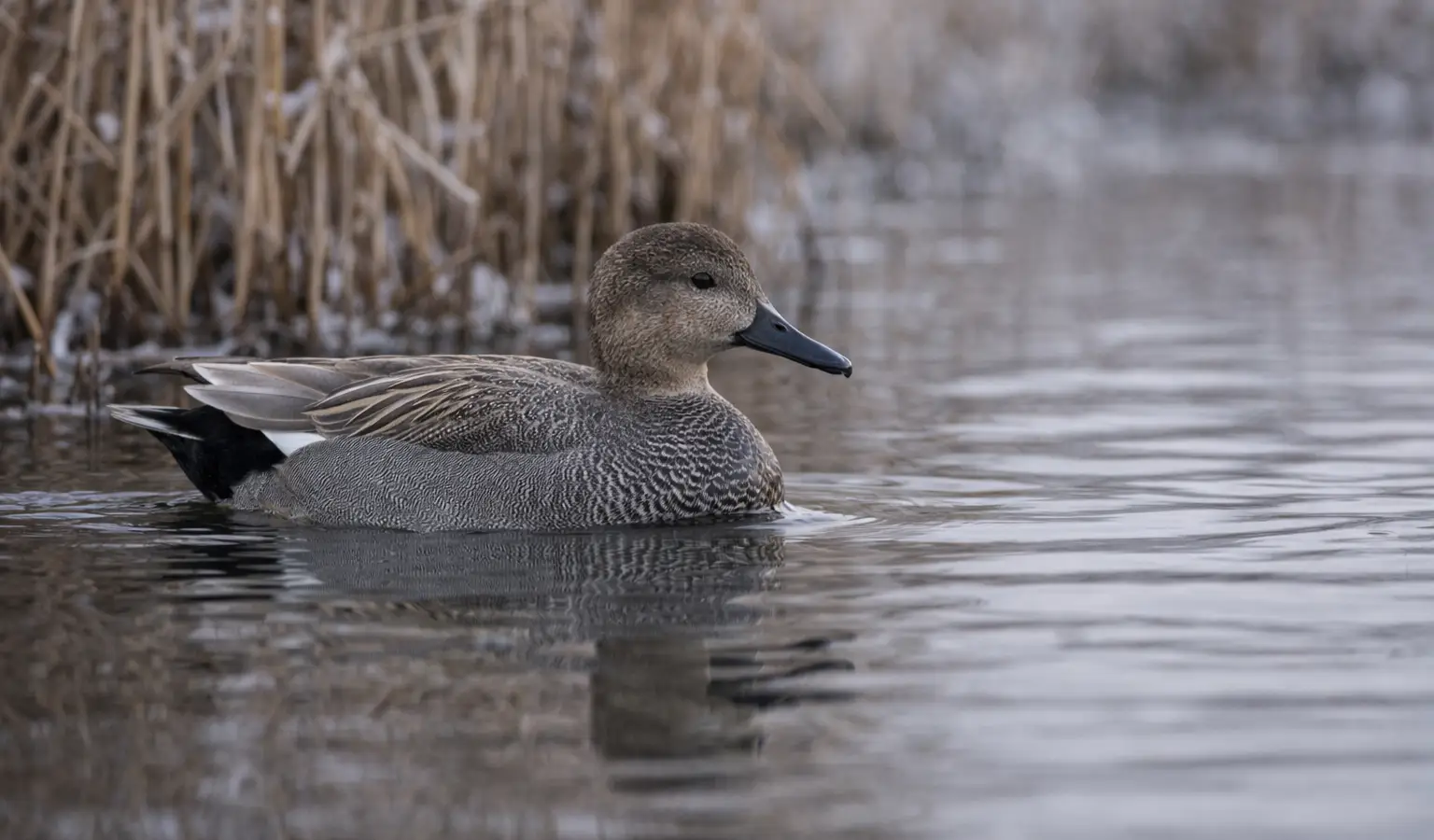
The drake is one of the most subtly patterned ducks in Europe and many other parts of its range. At a distance it can look gray-brown, but closer views reveal intricate vermiculated plumage, a black rear end, and a distinctive white wing patch that can be very useful in flight or on the water. The female Gadwall resembles a plain mottled brown duck and can be confused with female Mallard at first glance, but usually looks slimmer, more refined, and less heavily marked in the face. Both sexes tend to show a rather neat, understated appearance compared with many other ducks.
Field identification often depends on combination clues rather than one bright feature alone: shape, muted coloration, the white speculum area, and behavior all help. The voice is also less conspicuous than in some other dabbling ducks, fitting the species' generally quiet reputation.
Habitat and distribution
Habitat and distribution
Habitat
Gadwall favor wetland habitats with shallow water, abundant emergent or submerged vegetation, and relatively calm feeding areas. They are especially associated with marshes, reed-fringed ponds, oxbows, lagoons, managed impoundments, lowland lakes, and quiet sections of reservoirs. Outside the breeding season they may also use brackish waters, coastal lagoons, and sheltered estuaries where food and disturbance levels are suitable.
During the breeding period, the species often selects wetlands that combine open feeding water with nearby dense cover for nesting. Grass, reeds, sedges, low shrubs, or other concealment near water can be important. In winter, habitat choice is strongly linked to food accessibility, water depth, and disturbance. Gadwall often prefer productive areas rich in aquatic plants and seeds rather than very deep or fast-moving waters.
Water regime matters. Stable or seasonally favorable water levels can improve feeding opportunities, while extreme drying, abrupt flooding, or heavy human pressure may reduce local use. In managed wetlands, the species often responds well to habitat mosaics that include shallow water, vegetated edges, and resting zones with limited disturbance.
Distribution
Mareca strepera has a broad distribution across much of the Northern Hemisphere. It breeds in parts of Europe, Asia, and North America, with local abundance varying greatly according to wetland availability, climate, and conservation history. In some regions it is widespread and regular; in others it is more localized, concentrating in suitable lowland wetlands and migration stopovers.
Its occurrence is often seasonal. Northern and continental breeding populations may move south or west in autumn, while birds in milder areas can remain year-round or shift only short distances. As a result, the Gadwall may be present as a breeder, winter visitor, migrant, or all three depending on the region. Numbers often rise noticeably during passage and winter in major wetland complexes.
At the local scale, distribution can change from year to year with rainfall, habitat management, freezing conditions, and food supply. Wetland restoration and managed marshes have supported the species in some areas, while habitat loss, drainage, or repeated disturbance can reduce regular use.
Lifestyle
Lifestyle and behaviour
Diet
The Gadwall is an omnivore, but compared with some other dabbling ducks it often relies heavily on plant food, especially aquatic vegetation. Leaves, stems, seeds, pondweeds, algae, and other soft wetland plant material can make up a major share of the diet, particularly in autumn and winter. It also consumes seeds from marsh plants and may feed along shallow margins where plant matter is easy to reach.
Animal food becomes especially important during periods of higher protein demand, such as pre-breeding and brood-rearing. At these times Gadwall may take insects, larvae, small aquatic invertebrates, mollusks, and other tiny prey available in shallow water or among vegetation. Ducklings depend strongly on invertebrate-rich feeding areas early in life, as is typical for many waterfowl.
Feeding is usually done by dabbling, surface picking, or tipping up rather than diving deeply. Seasonal diet composition can vary by habitat, water level, and local food availability, so populations using coastal lagoons, inland marshes, or agricultural wetlands may not feed in exactly the same way throughout the year.
Behaviour
Gadwall are generally quiet, discreet, and less demonstrative than many other ducks. They are often active in calm periods of the day, especially early morning and late afternoon, though feeding and movement can continue throughout daylight and sometimes into low-light conditions where disturbance is low. In open wetlands they regularly alternate between feeding, resting, loafing, and short local flights between secure zones.
When alert, the species tends to rely on caution and distance rather than obvious display. Flocks may lift off quickly if pressured, often departing low and fast before circling or relocating to quieter water. Compared with some more vocal dabbling ducks, Gadwall can be surprisingly unobtrusive, which is one reason they are sometimes overlooked in mixed waterfowl groups.
Outside the nesting season they are commonly seen in flocks, sometimes associating with other ducks on feeding and roosting waters. Their surface-feeding behavior, use of vegetated shallows, and tendency to rest in relatively undisturbed areas are useful clues for both observation and management.
Social structure
The Gadwall is usually a group-living waterfowl species outside the breeding season. Autumn, winter, and migration periods often bring flocks ranging from small loose parties to larger concentrations where habitat conditions are favorable. These groups may include only Gadwall or mixed assemblies with Mallard, Wigeon, Teal, Pintail, and other wetland birds.
During breeding, social organization becomes more dispersed. Pairs form and occupy suitable nesting areas, although the species is not strongly territorial in the same way as some aggressively defended waterbirds. Nesting birds may still occur relatively close together where habitat is productive and cover is abundant, but actual nest sites are usually concealed and more solitary than winter flock behavior would suggest.
After breeding, birds gather again in post-breeding and migration groups, and social structure shifts back toward flocking, communal resting, and shared feeding areas.
Migration
The Gadwall is partially migratory. Some populations move considerable distances between breeding and wintering grounds, while others remain resident or shift only locally depending on climate and wetland conditions. This flexibility is one of the species' key ecological traits.
In colder northern or continental regions, autumn movement typically increases as wetlands freeze or food becomes less accessible. Birds then concentrate in milder lowlands, coastal wetlands, estuaries, and ice-free inland waters. Spring migration returns them toward breeding areas, though timing varies with latitude, weather, and annual water conditions.
At the local scale, movement can be subtle rather than dramatic. Gadwall may relocate between feeding marshes and day roosts, or abandon a site temporarily after disturbance, hunting pressure, freezing, or water-level change. This means that apparent abundance at one wetland can shift rapidly across a landscape even when the wider regional population remains present.
Reproduction
Reproduction
The breeding cycle usually begins in spring, with pair formation often established during winter or early migration periods. The female selects a nest site on the ground, typically well hidden in grasses, reeds, sedges, or low cover near water, though not always immediately at the shoreline. Concealment is important because eggs and incubating females are vulnerable to predation.
The nest is a shallow cup lined with vegetation and down. A clutch commonly contains several eggs, though exact clutch size can vary with region and condition. Incubation lasts about 24 days, carried out mainly by the female. Once hatched, ducklings leave the nest quickly and follow the hen to feeding areas, where access to shallow, invertebrate-rich habitat is especially important for growth and survival.
Breeding success can vary widely with water conditions, weather, predation pressure, and disturbance. In productive marsh years, recruitment may be good; in drier or heavily disturbed conditions, nesting output can decline. Lifespan is often modest in the wild, though some individuals may live several years, and a figure around 8 years is a reasonable broad reference rather than a guaranteed norm.
Field signs
Field signs
Field signs of Gadwall are often subtle, as with many ducks, but a careful observer can still find useful evidence of regular presence. The most obvious clues are direct sightings in shallow wetland feeding areas, especially where birds loaf quietly along vegetated margins or in mixed dabbling duck flocks.
On muddy edges, one may find footprints showing the typical webbed track of a medium-sized duck. These are not always easy to assign to Gadwall alone unless supported by context, size, habitat, and accompanying observations. Feathers at resting places, plucking sites, or shoreline roosts can also indicate use of an area, although feather identification requires care.
Other signs include feeding disturbance in shallow vegetation, flattened resting spots in marginal cover, droppings near loafing banks, and repeated flight lines between secure water and feeding zones. Because Gadwall are discreet, patient observation at dawn or dusk often reveals more than tracks alone.
Ecology and relationships
Ecology and relationships
Ecological role
Within wetland ecosystems, the Gadwall plays a meaningful role as both herbivore and opportunistic invertebrate feeder. Its consumption of aquatic plants helps shape how plant biomass is used in shallow waters, while its feeding on insects and other small prey links it to invertebrate productivity and seasonal nutrient cycles.
As prey, eggs, ducklings, and sometimes adults can be taken by various predators, including birds of prey and other wetland predators depending on the life stage and habitat context. The species therefore forms part of broader food-web dynamics in marshes and shallow lakes.
Because Gadwall often respond to vegetation structure, shallow-water conditions, and disturbance levels, they can also serve as a useful indicator of functional wetland habitat. Regular presence of feeding and breeding birds may suggest good-quality marsh structure, while long-term decline at a site can point to habitat simplification, reduced food resources, or excessive pressure.
Human relationships
The Gadwall has a mixed but generally moderate relationship with people. It is appreciated by birdwatchers for its elegant but understated appearance and by wetland managers as a species associated with productive marsh habitat. In areas with active waterfowl culture, it is also recognized as a game duck and may be harvested where regulations allow.
Its hunting relevance is often tied to marsh management, migration timing, and the species' preference for quieter feeding waters. Typical methods may include hunting from a hide or during legal pass shooting where permitted, although local practices and ethics vary widely. Because the species can be discreet and less vocal than some ducks, successful observation or lawful hunting often depends on careful reading of movement, wind, feeding areas, and disturbance patterns.
The species may also intersect indirectly with agriculture through use of flooded fields or managed wetlands, though it is not usually treated as a major conflict species. As with other waterfowl, health concerns such as avian influenza matter in surveillance, handling, and broader wildlife-livestock interfaces. Where the bird is taken for food, it is considered edible, but safe handling, proper identification, and compliance with health guidance are essential.
Legal framework and management
Legal framework and management
Legal status
The Gadwall is often classified as a huntable waterfowl species under regional or national regulations, but the exact legal status depends on country, flyway agreements, local conservation rules, and annual management decisions. Open seasons, bag limits, permitted methods, protected areas, and ammunition restrictions can all differ significantly from one jurisdiction to another.
The season indicated here, roughly September to January, should be understood only as a broad reference and not as legal advice. Some areas may have shorter or different dates, and others may apply additional conditions linked to species identification, wetlands protection, or migratory bird frameworks. Hunters and observers should always verify current official rules before any field activity.
Outside hunting law, the species may also be covered by wetland conservation measures, migratory bird treaties, site-based protections, and disease-control protocols. Legal compliance matters not only for harvest but also for disturbance, access, transport, and handling.
Management tips
For habitat management, the most useful principle is to maintain a mosaic of shallow, productive wetland conditions. Gadwall respond well to areas that combine open water, submerged or emergent vegetation, secure loafing zones, and nesting cover nearby. Stable but varied water levels often support the plant growth and invertebrate production that benefit the species through different seasons.
- Preserve shallow feeding shelves and vegetated margins rather than managing wetlands only for deep open water.
- Retain undisturbed resting areas, especially during migration and winter when repeated pressure can displace flocks.
- Support nesting cover near water with grasses, sedges, reedbeds, or similar concealment.
- Monitor changes in use across seasons, since Gadwall may shift rapidly with freezing, drought, hunting pressure, or food availability.
- Where hunting occurs, prioritize accurate species identification and measured disturbance to avoid unnecessary pressure on mixed waterfowl concentrations.
For field observation, look for quiet, plant-rich marshes and pay attention to subtle movement rather than expecting noisy concentrations. For hunting or wildlife management contexts, success usually comes less from intensity and more from reading habitat, weather, and routine movement corridors with restraint and consistency.
Fun facts
Fun facts
- The male Gadwall is often called one of the most underrated ducks in the field because its beauty is built from fine pattern and subtle contrast rather than bold color.
- The white wing patch is one of the best identification features and can stand out clearly when the bird flies or stretches.
- Although it is a dabbling duck, the Gadwall often eats a higher proportion of aquatic vegetation than many people expect.
- Its quiet and discreet behavior means experienced observers often notice it by shape, posture, and habitat choice before they hear it.
- In many wetlands, finding Gadwall in good numbers is a sign that shallow vegetated feeding habitat is functioning well.