
Fieldfare
Turdus pilaris
A migratory thrush that often winters in large flocks.
Type
Bird
Lifespan
7 years
Hunting season
October – February
Edible
Yes
Fact sheet
Fieldfare
Scientific name
Turdus pilaris
Type
Bird
Meat quality
Fine and tender meat
Edible
Yes
Lifespan
7 years
Incubation
13 days
Size
25-27 cm
Weight
80-110 g
Diet
Insects and fruits
Status
Huntable locally
Hunting season
October – February
Breeding season
4 / 5
Lifestyle and behaviour
Behaviour : Winter migrant, lives in groups
Social structure : Large winter flocks
Migration : Winter migrant
Habitat
- Forest
- Farmland
Natural predators
- Birds of prey
Hunting methods
- Driven pass
- Standing post
Health risks
- Avian parasites
Ecosystem role
- Seed dispersal
Introduction
General description
The Fieldfare, Turdus pilaris, is a medium-sized migratory thrush best known for its winter flocks, chattering calls, and habit of feeding across open country near woodland edges. In much of Europe it is a familiar cold-season bird, arriving from more northern and eastern breeding grounds to use farmland, hedgerows, orchards, pastures, and forest margins. It is often noticed before it is studied closely: a restless flock lifting from a berry-bearing hedge or dropping into a field is a classic winter scene.
Although sometimes overshadowed by other thrushes, the Fieldfare has real ecological importance. It feeds heavily on invertebrates when available and turns strongly to fruits and berries in autumn and winter, helping move seeds across the landscape. This makes it both a consumer of seasonal resources and a useful seed disperser in semi-open habitats.
In hunting and wildlife management contexts, the species is relevant mainly as a locally huntable migratory bird in some jurisdictions, usually during the autumn and winter period. Its value lies not only in harvest where lawful, but also in what it reveals about habitat quality, winter food supply, migration timing, and disturbance pressure. For birdwatchers, land managers, and hunters alike, the Fieldfare is an excellent indicator of how open land and wooded edges function together during the colder months.
Morphology
Morphology
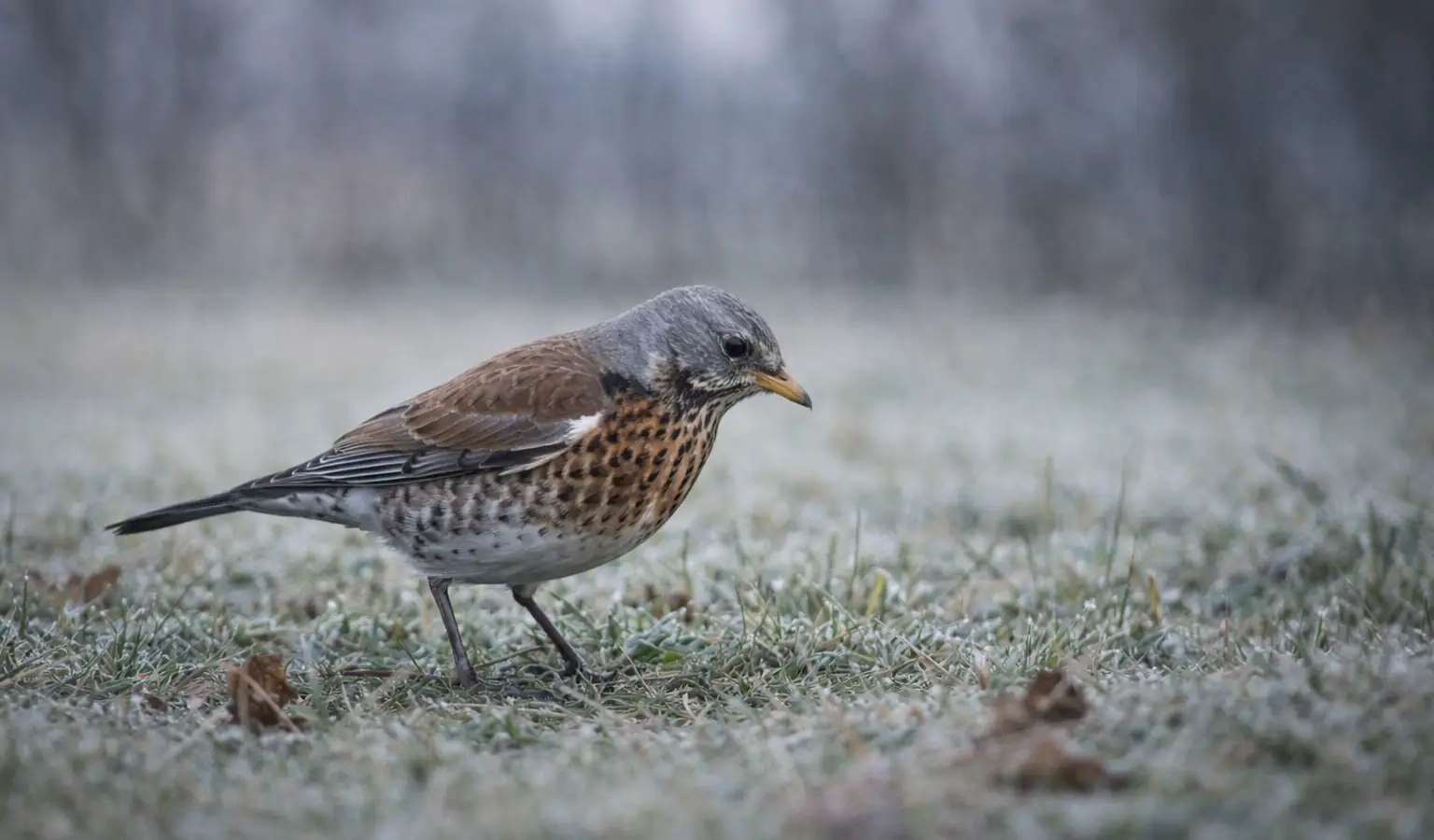
The Fieldfare measures roughly 25 to 27 cm in length and commonly weighs about 80 to 110 g, making it slightly larger and longer-winged in appearance than some other thrushes. In the field, it is often identified by its combination of a grey head and nape, warm chestnut-brown back, dark tail, and boldly spotted underparts. The breast is usually washed with buff or orange tones, while the belly becomes paler toward white.
The bill is fairly strong, typically yellowish with a darker tip outside the breeding season, and the legs are dusky. In flight, the bird can look compact but energetic, with quick, direct wingbeats. Flocks often show a pale grey rump and back contrast that helps separate them from Song Thrushes or Redwings at a distance.
Sexes are broadly similar, which can make field separation difficult without close views. Juveniles resemble adults but may appear slightly duller and less crisply marked. Good identification often depends on the whole silhouette and color pattern rather than on one single feature.
Habitat and distribution
Habitat and distribution
Habitat
Fieldfares use a broad range of habitats, but they are especially associated with forest edges, farmland, hedgerow networks, orchards, meadows, grazed pastures, and mixed agricultural landscapes. They favor places where open feeding ground lies close to cover, roosting sites, or fruiting shrubs. In winter, this edge habitat pattern is often more important than any single vegetation type.
During the breeding season in their core nesting range, they commonly use open woodland, birch and conifer stands, wooded wetlands, scattered trees near bogs, and forest clearings. In wintering areas, however, they are often tied to food availability. Soft ground rich in worms and beetles attracts them to grassland and plowed fields, while cold spells can push flocks toward berry-rich hedges, rowan trees, hawthorn, mistletoe-bearing trees, and orchards.
The species tolerates human-shaped landscapes reasonably well if disturbance remains moderate and feeding opportunities are abundant. It is not strictly a deep-forest bird; instead, it does best in mosaics where movement between feeding areas and refuge is easy.
Distribution
Turdus pilaris breeds mainly across northern and eastern Europe and extends eastward into parts of northern Asia. It is especially associated with cooler regions, where it nests in woodland and semi-open country. In western and southern Europe, its status is more often that of a passage migrant or winter visitor, although local breeding has occurred in some areas and may expand or contract over time.
In winter, Fieldfares spread south and west, sometimes in very large numbers when weather conditions on the breeding grounds or along migration routes encourage broader movement. Their presence can vary greatly from year to year. Some winters bring heavy influxes into farmland and orchards, while milder conditions farther north may reduce the number reaching more southerly areas.
Local distribution is therefore strongly seasonal. A landscape that holds no Fieldfares in summer may host substantial flocks from late autumn through winter. This shifting pattern is central to understanding the species in both observation and management contexts.
Lifestyle
Lifestyle and behaviour
Diet
The Fieldfare has a seasonally flexible diet centered on invertebrates and fruits. In mild conditions it feeds actively on earthworms, insect larvae, beetles, and other small ground-dwelling prey taken from pasture, damp meadows, field edges, and recently worked soil. This animal food is especially important in the breeding season, when protein demand rises.
In autumn and winter, fruits and berries become increasingly important. Rowan, hawthorn, holly, juniper, ivy, elder, apples, and other soft fruits may be taken depending on local availability. Flocks can strip favored berry sources quickly, especially during frost or snow when ground feeding becomes harder.
Feeding strategy changes with weather. On soft, unfrozen ground, birds often spread out across grassland and feed methodically. During prolonged cold, they concentrate in shrubs, orchards, and woodland edges where persistent fruit offers reliable energy. This ability to switch between invertebrate-rich and fruit-rich food sources is one reason the species succeeds across varied winter landscapes.
Behaviour
Fieldfares are active, vigilant, and often noisy birds, especially outside the breeding season. Winter flocks spend much of the day moving between feeding areas and safe perches, with periods of concentrated ground foraging followed by sudden group flights. Their calls are an important part of their behavior: harsh, chattering notes often signal contact, agitation, or collective alertness.
On the ground they can appear purposeful and brisk, advancing in short runs and pauses while scanning for prey. In open fields they usually maintain a strong awareness of risk, and a single alarmed bird can trigger an immediate flush of the entire flock. After disturbance, Fieldfares may circle, shift to a nearby tree line, or relocate to another feeding patch rather than returning at once.
In severe weather they often become more tightly tied to sheltered feeding areas and fruiting trees. Roosting may occur in wooded cover or dense stands that offer some protection from wind and predators. Overall, their daily rhythm is shaped by light, temperature, food accessibility, and disturbance pressure.
Social structure
The Fieldfare is notably social for much of the non-breeding period. It often occurs in large winter flocks, sometimes mixed with other thrushes such as Redwings, but usually maintaining clear in-group coordination. These flocks improve predator detection and help birds locate feeding patches across broad farmland landscapes.
Within winter groups, individuals spread out while feeding yet remain loosely connected by voice and visual contact. Movement can be fluid, with birds joining or leaving local aggregations according to food supply, weather, and migration timing. This flexible flocking behavior is one of the species' most visible traits.
During breeding, social structure changes. Fieldfares may nest in loose colonies or neighborhood groupings more readily than some other thrushes, especially where suitable trees and good feeding habitat occur together. Even then, territorial behavior around nests remains important.
Migration
The Fieldfare is a classic winter migrant in many parts of western and southern Europe. Birds breeding farther north and east move southwest or west in autumn, with arrivals often building from October onward. Peak presence depends heavily on weather patterns, food conditions, and the severity of early cold on the breeding grounds.
Migration is not always uniform. Some years produce marked influxes, while in other years birds remain farther north if conditions stay open and food remains accessible. This means local abundance can fluctuate strongly from season to season. Movements may continue through winter, with flocks redistributing during frost, snow cover, or fruit depletion.
Spring departure typically occurs from late winter into early spring, though timing varies by latitude and annual conditions. For field observers, the species is best understood not as a fixed resident but as a mobile bird whose presence reflects larger regional patterns of climate, food, and migratory momentum.
Reproduction
Reproduction
The breeding season generally begins in spring in the northern and eastern parts of the range. Fieldfares usually build a sturdy cup nest in a tree or shrub, often at moderate height, using grasses, twigs, mud, and finer lining materials. Unlike strictly solitary thrushes, they may nest in loose colonies where local conditions are favorable.
The female commonly lays a clutch of several eggs, often around five or six, though this can vary. Incubation lasts about 13 days in many cases, after which both parents may contribute to feeding the chicks. Nestlings are supplied largely with invertebrates, especially worms and insect prey, which support rapid growth.
Breeding success depends on food availability, weather, and predation pressure. Birds of prey and nest predators can affect outcomes, and poor spring conditions may reduce productivity. Lifespan can reach around 7 years in some individuals, though many wild birds will live for shorter periods due to the normal risks of migration and predation.
Field signs
Field signs
Fieldfare sign is subtler than that of larger ground birds, but several clues can reveal its presence. In winter, the most obvious sign is often not a track but the feeding pattern itself: disturbed grass patches where birds have probed for worms, berry-bearing hedges suddenly stripped of fruit, or regular use of orchard margins and pasture edges.
Droppings may accumulate beneath favored roosts, perches, or fruiting trees. Around berry sources they can be dark, moist, and fruit-stained, sometimes with visible seed remains. In open frosty ground, tracks are small and bird-like, usually three-toed forward with a rear toe, but they are rarely distinctive enough on their own for confident identification unless supported by direct observation.
Auditory signs are often more reliable than physical traces. Flock contact calls overhead, sudden harsh chatter from a hedge line, or a mass flush from a meadow edge are classic indicators. Feathers at a plucking site may occasionally point to predation by a raptor, especially in areas where winter thrush flocks feed regularly.
Ecology and relationships
Ecology and relationships
Ecological role
The Fieldfare plays a useful ecological role as both an invertebrate predator and a seed disperser. By feeding on soil invertebrates, it participates in the seasonal regulation of small prey populations in grassland and farmland. By consuming berries and soft fruits, it helps transport seeds across woodland edges, hedgerows, scrub patches, and disturbed ground.
Its flocks also form part of the winter food web. They are preyed upon by birds of prey, especially where open feeding areas leave them exposed during takeoff and landing. In this way the species links fruiting shrubs, ground invertebrate communities, agricultural habitats, and avian predators.
Because Fieldfares respond quickly to harsh weather and shifting food resources, their local abundance can also reflect the functional quality of winter habitat mosaics. Landscapes with shelter, berry supply, and accessible foraging ground are more likely to support stable winter use.
Human relationships
The relationship between people and the Fieldfare is shaped by season and landscape. In rural areas it is a well-known winter bird of orchards, hedges, meadows, and cultivated land. Farmers and landowners may notice flocks feeding on pasture or taking advantage of fruit resources, while birdwatchers value the species as one of the characteristic thrushes of the colder months.
In some regions, the Fieldfare is also relevant to traditional thrush hunting where legally permitted. Hunting methods associated with local practice may include standing post or forms of driven pass, especially during migration and winter movement. Because the species is flocking, alert, and weather-sensitive, hunting pressure and disturbance can alter how long birds use a feeding area.
As a table bird it has historically been considered edible in places where harvest is lawful, but its contemporary importance is often broader than consumption alone. It is also a species of strong observational interest, particularly for those reading migration, cold-weather bird movement, and the quality of mixed farmland habitats.
Legal framework and management
Legal framework and management
Legal status
Legal status varies significantly by country and region, so the Fieldfare should always be treated as a species requiring local regulatory verification. In some areas it may be huntable during a defined autumn and winter season, while in others it may be fully protected or subject to strict conditions linked to migratory bird law.
Where hunting is authorized, the season may fall broadly between October and February, but dates, methods, bag limits, protected zones, and transport rules can differ. Changes in international agreements, national bird protection rules, and annual conservation measures may also affect legality from one year to the next.
Anyone observing, managing, or hunting Fieldfares should consult current official regulations rather than relying on tradition or outdated information. This is especially important for migratory thrushes, whose legal treatment can be more nuanced than that of resident game species.
Management tips
For observation, conservation-minded land management, or lawful hunting where permitted, the key to Fieldfare use is understanding the habitat mosaic. The species responds well to landscapes that combine short grass or accessible feeding ground with nearby hedges, woodland edges, shelterbelts, or fruiting trees. Reading these transitions is often more productive than focusing on one habitat block in isolation.
- Maintain or value hedgerows, scattered trees, and berry-producing shrubs as winter food and refuge.
- Retain open foraging areas such as pasture, meadow, and lightly disturbed farmland where invertebrates remain accessible.
- Pay attention to frost, snow cover, and wind exposure, as these strongly influence daily movement and flock concentration.
- Limit unnecessary disturbance at key feeding and roosting sites if the goal is sustained winter presence.
- Where hunting is legal, confirm current season dates, permitted methods, and protected-species identification to avoid confusion with other thrushes.
- Monitor bird health generally in flocking situations, since avian parasites and other condition-related issues can occur in wild bird populations.
Good management for Fieldfares often overlaps with broader farmland biodiversity management. A winter landscape rich in cover, food continuity, and low-intensity edge structure tends to support not only this thrush, but many other migratory and resident birds as well.
Fun facts
Fun facts
- The Fieldfare is one of the few thrushes many people first notice as a flock rather than as a single bird.
- Its scientific name, Turdus pilaris, belongs to the same genus as several familiar thrushes, but its grey-and-chestnut pattern makes it unusually distinctive.
- In hard winter weather, Fieldfares can switch rapidly from feeding on worms in pasture to feeding almost entirely in berry-bearing trees and hedges.
- Breeding birds may nest in loose colonies, which is less solitary than many people expect from a thrush.
- A field full of feeding Fieldfares can empty in seconds when one bird gives the alarm.