
Fallow deer
Dama dama
An elegant deer widely introduced across Europe.
Type
Large mammal
Lifespan
12 years
Hunting season
October – February
Edible
Yes
Fact sheet
Fallow deer
Scientific name
Dama dama
Type
Large mammal
Meat quality
Tender meat
Edible
Yes
Lifespan
12 years
Gestation
230 days
Size
140-180 cm
Weight
30-100 kg
Diet
Herbivore: grasses, leaves, acorns, fruits
Status
Huntable depending on country and quotas
Hunting season
October – February
Breeding season
10 / 11
Lifestyle and behaviour
Behaviour : Diurnal, gregarious, active at dawn and dusk
Social structure : Herds; sexes often separate outside rut
Migration : Local movements based on resources
Habitat
- Forest
- Plains
Natural predators
- Wolf
Hunting methods
- Drive hunt
- Stalking
Health risks
- Intestinal parasites
Ecosystem role
- Seed dispersal
- Vegetation regulation
Signs of presence
- Footprints
- Droppings
Introduction
General description
The fallow deer, Dama dama, is a medium-sized deer widely recognized for its elegant outline, variable coat patterns, and broad, palmated antlers in mature males. Native to parts of the eastern Mediterranean region but introduced across much of Europe and beyond, it has become one of the most familiar deer species in many estates, mixed farmland landscapes, parks, and semi-wild woodlands. In field terms, it sits between the smaller roe deer and the heavier red deer, combining adaptability with a distinctly social character.
Fallow deer are important both as a wildlife species and as a big game animal. They are often valued for observation, photography, venison, and hunting, but they can also create management challenges where populations become dense. Their feeding pressure may influence woodland regeneration, crops, and understory structure, so their presence is not just decorative: it has real ecological and land-use consequences.
Searches about fallow deer often focus on identification, habitat, rutting behavior, tracks, and hunting season, and for good reason. Dama dama is a species whose appearance and behavior change strongly with season, sex, age, and local pressure. In some areas it is highly visible in open fields at dawn and dusk; in others it becomes discreet, using woodland cover and moving mainly during low-disturbance periods.
Morphology
Morphology
Fallow deer are built more lightly than red deer but more robustly than roe deer. Body length commonly falls around 140 to 180 cm, and adult weight varies widely with sex, age, and local habitat quality, often from roughly 30 to 100 kg. Males, known as bucks, are clearly larger and heavier than females, called does.
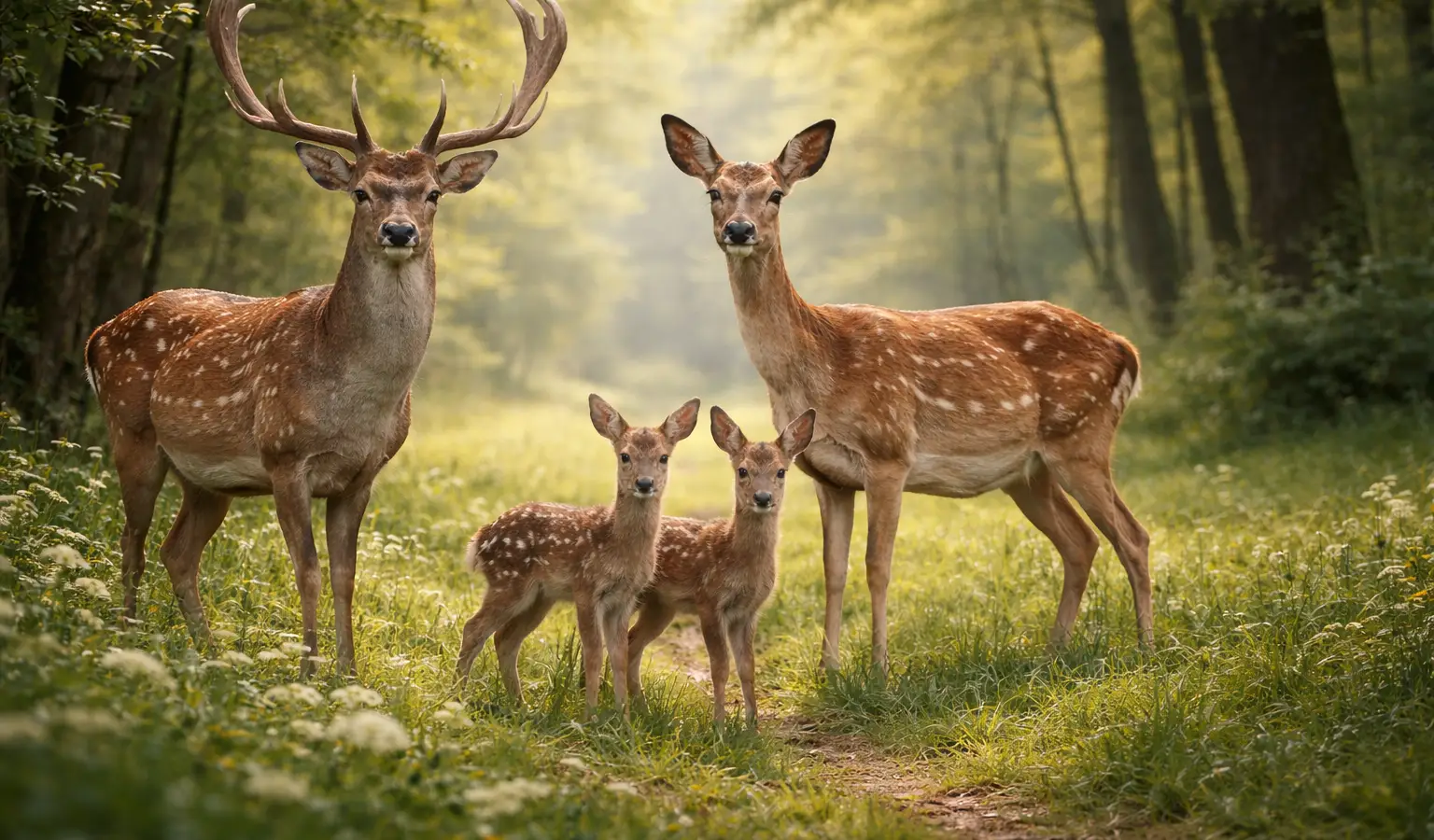
One of the most useful identification features is the coat. Many fallow deer show a warm brown summer coat marked with pale spots and a darker dorsal line, while the winter coat usually becomes greyer and less vivid. There is also considerable color variation, including darker, very pale, or nearly black individuals in some populations. The rump patch is typically pale and bordered by darker markings, and the tail is relatively long for a deer, with a dark stripe that stands out when the animal moves away.
Mature bucks develop distinctive palmated antlers, broadening toward the top rather than remaining only branched and pointed. Younger bucks may carry simpler antlers before full development. The head appears somewhat wedge-shaped, the neck thickens in the rut, and the overall gait is springy and agile. In the field, this combination of spotted coat, long tail, and shovel-like antlers makes fallow deer one of the easier deer species to identify when seen well.
Habitat and distribution
Habitat and distribution
Habitat
Fallow deer prefer a mosaic of woodland cover and open feeding areas. They do especially well in landscapes that combine forest edges, glades, meadows, crop fields, hedgerows, and quiet resting cover. This edge-rich structure gives them security during the day and easy access to grasses, herbs, browse, mast, and agricultural forage.
Although often associated with broadleaf woodland, they are flexible and can live in mixed forest, parkland, rolling plains, and some Mediterranean or temperate lowland habitats. They usually favor areas where visibility, shelter, and food are all available within short daily movements. Dense, continuous forest with little understory diversity may be less attractive than fragmented woodland with openings and ecotones.
At a finer scale, local habitat use changes by season and disturbance level. In autumn and winter, they may concentrate around mast-producing woods, sheltered slopes, or fields with residual forage. In heavily disturbed areas, they tend to spend more daylight hours in cover and emerge later to feed. Good fallow deer habitat is therefore not just about forest or plains in a broad sense, but about how cover, feeding opportunity, water, and human pressure are arranged across the landscape.
Distribution
Dama dama has a complex distribution history. It is widely believed to be native in parts of the eastern Mediterranean region, but it has been translocated by people for centuries, first as a game and ornamental species and later for hunting estates and semi-free-ranging populations. As a result, it is now established across many parts of Europe and in additional regions outside Europe.
In Europe, fallow deer are especially well known in the United Kingdom, Ireland, central Europe, parts of western Europe, and some southern European landscapes, though status and abundance vary markedly by country and even by local district. Some populations are free-ranging and self-sustaining, while others remain associated with fenced properties, historic parks, or managed estates.
Distribution is therefore best understood as patchy but often locally strong. In suitable lowland habitat with mild winters, mixed woodland, and agricultural feeding opportunities, populations can increase rapidly if management is light. In harsher, more fragmented, or heavily hunted areas, densities may remain lower and distribution more localized.
Lifestyle
Lifestyle and behaviour
Diet
Fallow deer are herbivores with a flexible diet that includes grasses, broadleaf plants, leaves, buds, shoots, acorns, chestnuts where available, fruits, agricultural crops, and other seasonal plant material. They are often described as mixed feeders, able to graze and browse according to habitat, season, and plant availability.
In spring and early summer, they commonly take fresh grasses and nutrient-rich forbs. During summer, they may continue feeding in open areas and also use woodland edges for herbs, leaves, and soft vegetation. In autumn, mast such as acorns can become important where oak woodland is present, while fallen fruits and crop residues may also be used. Winter diets often shift toward tougher browse, remaining grasses, evergreen material in some regions, and whatever forage remains accessible under local weather conditions.
Diet selection changes with population density and feeding pressure. Where fallow deer are numerous, they may heavily use preferred food plants and increasingly exploit secondary resources. This has practical implications for habitat management, forestry, and farming, especially in young plantations, regenerating woodland, and field margins.
Behaviour
Fallow deer are typically diurnal to crepuscular, with much activity concentrated at dawn and dusk. In landscapes with limited disturbance, they may be visible feeding in the open during daylight. Where human presence, hunting pressure, or repeated disturbance is high, they often become more discreet, delaying emergence and using cover more carefully.
They are alert animals with good vision, hearing, and scent awareness. When suspicious, they tend to pause, raise the head, test the air, and rely on group vigilance before moving off. Escape behavior varies with terrain: they may bound into woodland, slip along edge cover, or move in a coordinated run toward familiar refuge zones. Compared with some other deer, fallow deer often use habitual movement corridors between bedding and feeding areas.
Season strongly shapes behavior. In autumn, the rut transforms male activity, with bucks becoming more territorial or site-faithful around rutting stands. In winter, feeding and energy conservation become more important, especially in colder climates. During warm weather, they may spend more time in shade or sheltered woodland during the middle of the day and feed more actively during cooler periods.
Social structure
Fallow deer are distinctly gregarious. Much of the year they form herds or loose groups, and it is common for the sexes to separate outside the breeding season. Doe groups often include females with young of the year, while bucks may occur alone, in small bachelor groups, or in larger male aggregations depending on season and local population structure.
Group size can vary greatly. In open feeding areas with little disturbance, sizeable herds may gather, especially in autumn or winter. In more wooded or pressured settings, animals may remain in smaller, less conspicuous units. Social organization is therefore flexible rather than rigid, but herd living is a core feature of the species.
During the rut, this calm separation changes. Mature bucks compete for access to females and may defend rutting territories or display areas, especially in populations where traditional rut sites are established. Vocalization, posture, scent marking, and short confrontations all contribute to breeding hierarchy and access to does.
Migration
Fallow deer are generally considered non-migratory, but they do make local and seasonal movements tied to food, cover, weather, and disturbance. Rather than undertaking long-distance migration in most regions, they shift between feeding grounds, resting cover, rutting areas, and wintering zones within a familiar home range or landscape block.
These movements can become more pronounced in agricultural areas, where deer may travel regularly between woodland shelter and open fields. During the rut, bucks may focus strongly on established breeding locations. In winter, snow cover, cold exposure, and forage access can compress deer into more favorable sectors, especially sheltered woodland edges or lowland feeding areas.
Juvenile dispersal also contributes to local range expansion. Young animals, particularly males in some populations, may leave their natal groups and settle elsewhere if habitat and hunting pressure allow. So while fallow deer are not classic migrants, movement ecology remains important for understanding distribution, observation patterns, and management.
Reproduction
Reproduction
The breeding season of fallow deer usually takes place in autumn, most often from October into early November depending on region and climate. This is the rut, when bucks become much more vocal and active, often occupying favored rutting stands, wallows, or display areas. They advertise their presence with characteristic groaning calls, scent, and repeated movement within a relatively small area.
After mating, gestation lasts about 230 days. Most fawns are born in late spring to early summer, a timing that generally matches improving forage conditions and better cover for concealment. Females usually give birth to a single fawn, with twins considered uncommon compared with single births.
Young fawns spend their earliest period hidden in vegetation while the mother feeds nearby and returns regularly. As the fawn strengthens, it begins following the doe and integrating into female groups. Reproductive success depends on body condition, habitat quality, disturbance, predation risk, and overall population density, so breeding performance can vary noticeably between regions and years.
Field signs
Field signs
Fallow deer leave a range of useful field signs for trackers, wildlife watchers, and hunters. The most obvious are footprints and droppings. The tracks show the typical cloven hoof shape of a deer, relatively neat and pointed, though size overlaps with other species depending on substrate and age of the animal. In soft ground, repeated use can create clear runs between bedding cover and feeding areas.
Droppings are usually dark, oval to pellet-shaped, and often found in clusters along feeding zones, woodland rides, field edges, and resting areas. Their exact appearance varies with diet: pellet form tends to be firmer in drier feeding periods, while richer or wetter forage can change consistency.
Additional signs include browsing on shoots and low branches, trampling in access trails, hair caught on fences or rough bark, and rut-related disturbance in autumn. During the breeding season, bucks may leave pawed ground, scent-marked areas, and signs of repeated occupation around rut stands. In quiet woodland, watching edge transitions at dawn or dusk near fresh tracks and droppings is often one of the best ways to confirm regular fallow deer use.
Ecology and relationships
Ecology and relationships
Ecological role
Fallow deer play a significant ecological role as medium to large herbivores. Through grazing and browsing, they influence plant composition, understory structure, woodland regeneration, and the balance between open and shrubby vegetation. At moderate density, this can help maintain habitat heterogeneity; at high density, it may suppress regeneration of preferred tree and shrub species.
They also contribute to seed dispersal, both externally on the coat and through ingestion and defecation of some plant material. Their droppings return nutrients to the soil, and their repeated use of tracks, resting places, and feeding zones helps shape micro-patterns of disturbance in the landscape.
Fallow deer are also part of broader food webs. Although adult animals have relatively few natural predators in many modern European settings, wolves may prey on them where ranges overlap. Fawns are more vulnerable than adults. In ecosystems where predators are absent or scarce, human management often becomes the main factor regulating density and ecological impact.
Human relationships
Few deer species are as closely tied to human history in Europe as the fallow deer. For centuries it has been moved, protected, hunted, enclosed, and admired in royal parks, estates, forests, and managed hunting landscapes. Today it remains important for wildlife watching, venison production, and recreational hunting, especially in areas where established populations are healthy.
Its relationship with people is not always simple. In some places, fallow deer are considered an attractive and culturally valued game species. In others, high numbers can lead to browsing damage in forestry, crop losses, competition over habitat resources, vehicle collisions, and tension between landowners, conservation interests, and hunters.
From a hunting perspective, fallow deer are relevant because they are social, habitat-sensitive, and strongly influenced by pressure. Drive hunts and stalking are both used depending on terrain, season, and local regulations. As game meat, they are considered edible and often appreciated for producing good venison. Health considerations, such as intestinal parasites and standard game meat hygiene, remain part of responsible handling.
Legal framework and management
Legal framework and management
Legal status
The legal status of fallow deer varies by country, region, and management framework. In many places it is a huntable big game species, but hunting is typically controlled by season, quotas, sex or age class rules, land status, and sometimes population objectives. The broad indication often given is that it is huntable depending on country and quotas, which is a useful summary but not a substitute for checking current local law.
Because many populations are introduced rather than strictly native, regulatory treatment can differ sharply. Some authorities manage fallow deer as a valued game species, while others may apply tighter control where ecological impact, crop damage, or non-native status is a concern. Rules can also differ between free-ranging animals, fenced estates, and park populations.
Anyone involved in observation, management, or hunting should therefore verify the exact legal framework for the relevant jurisdiction, including open season, permitted hunting methods, carcass transport rules, tagging or reporting obligations, and any disease surveillance requirements. Seasons often fall from autumn into winter, and a commonly cited hunting period is roughly October to February, but local variation matters.
Management tips
Good fallow deer management starts with reading the habitat rather than only counting animals. Focus on the relationship between woodland refuge, open feeding areas, water, mast production, travel corridors, and disturbance. Repeated observation at dawn and dusk along edges, rides, and field margins can reveal movement patterns, herd composition, and seasonal shifts in use.
Population management should remain linked to local habitat carrying capacity. Where browsing pressure is high, warning signs may include poor woodland regeneration, repeated use of the same feeding zones, damage to young trees, and increasing use of crops. In such cases, management often needs to balance deer numbers with forestry, farming, biodiversity, and welfare objectives. Where densities are lower, protecting quiet cover and maintaining a diverse habitat mosaic may be more important than population reduction.
- Monitor tracks, droppings, and browsing pressure regularly, not just deer sightings.
- Pay special attention to autumn rut sites and winter feeding concentrations.
- Use caution when interpreting abundance from open-field counts alone; woodland use can hide animals effectively.
- Coordinate management across neighboring properties when deer move freely between habitats.
- For hunting contexts, adapt stalking or drive strategies to wind, cover, pressure history, and safe shot opportunities under local law.
Any intervention should remain lawful, proportionate, and informed by local ecology. In landscapes with predators such as wolves, or where disease and parasite burdens are relevant, management planning may need to account for additional factors beyond simple harvest numbers.
Fun facts
Fun facts
- The fallow deer is one of the few deer in Europe whose mature males usually carry broad, palmated antlers rather than purely branching antlers.
- Its coat is highly variable: spotted, dark, pale, and even nearly black animals can occur in the same broader species.
- Fallow deer bucks are famous for their rutting groans, a deep vocal sound that can carry through woodland in autumn.
- The species has a long cultural history in parks, estates, and hunting landscapes, which explains why its modern distribution is so strongly shaped by human translocations.
- Despite their elegant appearance, fallow deer are tough and adaptable animals that can thrive in a wide range of semi-open habitats if food, cover, and low enough mortality are available.