
European turtle dove
Streptopelia turtur
A farmland and woodland-edge migratory dove known for long-distance migration.
Type
Bird
Lifespan
5 years
Hunting season
Très réglementée
Edible
Yes
Fact sheet
European turtle dove
Scientific name
Streptopelia turtur
Type
Bird
Meat quality
Fine meat
Edible
Yes
Lifespan
5 years
Incubation
15 days
Size
25-28 cm
Weight
100-150 g
Diet
Seeds and small fruits
Status
Highly regulated hunting
Hunting season
Très réglementée
Breeding season
5 / 6 / 7
Lifestyle and behaviour
Behaviour : Long-distance migrant, discreet, often in pairs
Social structure : Pairs
Migration : Long-distance migratory
Habitat
- Forest
- Plains
Natural predators
- Birds of prey
Hunting methods
- Standing post
Health risks
- Avian parasites
Ecosystem role
- Seed dispersal
Signs of presence
- Feathers
- Calls
Introduction
General description
The European turtle dove, Streptopelia turtur, is a small migratory dove of farmland mosaics, woodland edges, hedgerow country, and lightly wooded plains. It is one of the most distinctive migratory birds of the western Palearctic, recognized not only by its warm-scaled plumage and purring call, but also by its long seasonal journey between European breeding grounds and wintering areas in sub-Saharan Africa. Compared with larger and more urban-adapted doves, the turtle dove is often more discreet, more closely tied to traditional rural landscapes, and more sensitive to habitat change.
From an ecological point of view, the European turtle dove is closely associated with seed-rich environments and structurally varied cover. It uses a combination of feeding areas, often open ground or stubble with accessible seeds, and nearby shrubs, trees, or woodland margins for resting, nesting, and shelter. This dependence on mixed habitat is one reason the species is so often discussed in relation to farmland management, hedgerow conservation, water availability, and wider landscape quality.
In wildlife observation and hunting culture, the turtle dove occupies a special place because it combines strong field character with high conservation concern in many parts of its range. It is still a game bird in some jurisdictions, but hunting is highly regulated and, in some places, suspended or prohibited depending on local population status and current management decisions. For readers seeking a practical species profile, the key themes are clear: the European turtle dove is a long-distance migrant, a bird of traditional agricultural landscapes, and a species whose future is closely linked to habitat quality, migration survival, and careful regulation.
Morphology
Morphology
The European turtle dove is a slim, elegant dove measuring roughly 25 to 28 cm in length and commonly weighing about 100 to 150 g. It is noticeably smaller and more delicate than the common wood pigeon and usually appears lighter, narrower-winged, and more refined in shape. In flight it shows pointed wings and a fairly long tail, giving it a swift, purposeful silhouette.
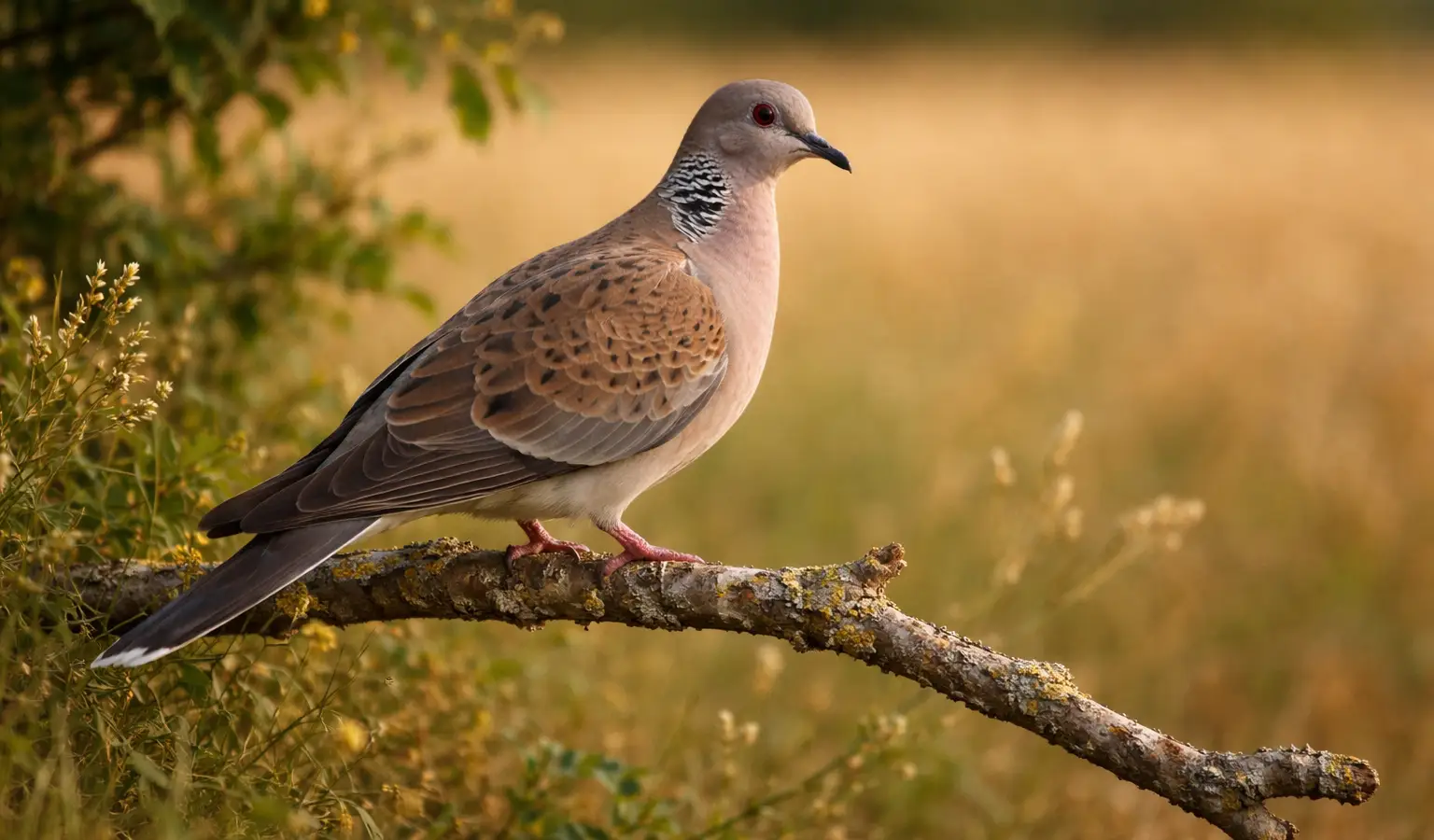
Its plumage is one of the best field marks among European doves. The upperparts are warm brown to chestnut, heavily patterned with black centers that create a scaled appearance across the wing coverts. The neck sides show striking black-and-white barred patches, a classic identification feature when viewed well. The breast is typically pinkish to vinous, fading to a paler belly. The tail is dark with white outer edges that can be visible in flight or when the bird fans its tail on landing.
The head is relatively small, the bill dark and slender, and the eye often appears dark with a subtle pale orbital ring. Sexes are broadly similar in the field, while juveniles usually look duller and less crisply marked, with weaker neck patch definition. Voice is also important for identification: the soft, rolling purr of the turtle dove is often easier to detect than the bird itself in dense edge habitat.
Habitat and distribution
Habitat and distribution
Habitat
The preferred habitat of the European turtle dove is a varied rural biotope that combines feeding grounds with nearby cover. Typical breeding habitat includes open farmland with hedgerows, scrubby field margins, orchards, woodland edges, riparian thickets, scattered trees, and lightly wooded plains. It tends to do best in landscapes that are neither completely closed forest nor overly simplified open monoculture.
For feeding, the species often uses open ground where seeds are accessible, such as stubble, fallows, sparse field margins, tracks, and dry weedy patches. For nesting and concealment, it relies on dense shrubs, hedges, bramble tangles, young trees, copses, shelterbelts, and the edges of deciduous or mixed woodland. Access to water can also matter, especially in warm periods, because turtle doves may visit drinking sites regularly.
Habitat quality depends not just on the presence of trees, but on structure, seed availability, and low disturbance during the breeding season. Intensive agricultural systems with reduced weed flora, few hedgerows, and limited unmanaged margins are generally less favorable. By contrast, landscapes with a fine-grained mix of cover, feeding patches, and quiet nesting sites are more likely to support regular breeding pairs.
Distribution
Streptopelia turtur breeds across parts of Europe, western Asia, and North Africa, though its abundance and local stability vary markedly by region. In much of Europe it is considered a widespread but declining migratory breeding bird, especially associated with warmer lowland and mid-altitude areas that provide suitable farmland and edge habitat.
Its occurrence is strongly seasonal in most of its European range. Birds usually arrive in spring, occupy breeding territories through late spring and summer, and depart again from late summer into autumn. During migration, the species may appear in stopover zones beyond its core breeding habitats, especially where food, cover, and water are available.
Wintering takes place mainly in sub-Saharan Africa. Because the species crosses several countries and ecological barriers during migration, local populations are influenced not only by conditions on the breeding grounds but also by what happens along migratory flyways and in winter quarters. Regional status can therefore differ, and anyone looking at current occurrence or management should consult the latest national or flyway-level assessments.
Lifestyle
Lifestyle and behaviour
Diet
The European turtle dove feeds primarily on seeds and small fruits, with a strong preference for small seeds collected from the ground. Wild seeds from annual plants, weeds, grasses, and herbs are especially important, and in many areas traditional farmland flora historically provided much of its food supply. It may also take small cultivated seeds where available, though dependence on crop types varies by region and season.
During the breeding season, accessible seed-rich feeding areas near nesting cover are especially valuable. Adults commonly forage on bare or sparsely vegetated ground, field edges, fallows, tracks, and stubbles. Small berries or soft plant material may be taken opportunistically, but the species is generally more granivorous than many casual observers realize.
Seasonal food availability matters greatly. In landscapes where herbaceous weeds are scarce because of intensive cultivation, repeated mowing, or herbicide use, turtle doves may struggle to find consistent feeding resources. This link between diet and habitat management is central to modern conservation and game management discussions around the species.
Behaviour
The European turtle dove is generally a discreet and alert bird, often more often heard than seen. It is most active during calm periods of the day, particularly early morning and later afternoon, when it may feed on open ground, visit water, or move between cover and feeding sites. In warm weather it can become less conspicuous during the middle of the day, using shaded perches in trees or dense shrubs.
Its flight is fast and direct, with quick wingbeats and a neat, agile profile. When disturbed, it usually lifts sharply and heads toward nearby trees, hedgerows, or woodland edge cover rather than circling high for long periods. Individuals may perch quietly for extended periods, making visual detection difficult even in areas where the species is present.
During the breeding season, behavior often centers on pair bonding, territory use, nest attendance, and repeated feeding commutes. Calling males may advertise from exposed but not overly prominent perches, often within edge habitat. Despite this, the species rarely gives the impression of being noisy or overtly conspicuous compared with some other doves. Its caution, seasonal presence, and tendency to use cover are all important for field observation.
Social structure
The European turtle dove is commonly associated with pairs during the breeding season. A male and female usually form a breeding unit linked to a nesting territory or at least a localized breeding area that includes nest cover, nearby feeding opportunities, and access routes to water. This pair-based structure is one of the clearest social features of the species in spring and summer.
Outside the core nesting period, social behavior can be more flexible. Small loose groups may gather at productive feeding sites, migration stopovers, or watering points, especially where suitable resources are patchy and concentrated. Even so, the species often appears less gregarious than some larger pigeons and doves.
On passage and in pre-migratory periods, local aggregations may occur, but these should be understood as resource-based concentrations rather than tight social flocks in all circumstances. In practical field terms, observers often encounter turtle doves singly, in pairs, or in small temporary groups depending on season and habitat conditions.
Migration
The European turtle dove is a true long-distance migrant. Most breeding birds leave Europe and nearby breeding regions in late summer or autumn and migrate south to wintering areas in sub-Saharan Africa. In spring they return northward to breed, often following broadly traditional flyways shaped by geography, climate, and stopover opportunities.
This migration is one of the defining features of the species and one reason its conservation is complex. Population performance depends not only on breeding habitat in Europe but also on safe passage across migration corridors and suitable conditions in African wintering grounds. Pressure at any point in this annual cycle can affect survival and recruitment.
Migration timing varies with region and weather. Some areas see turtle doves only as passage birds, while others host breeding pairs for several months. During migration, birds may use feeding and resting sites opportunistically, especially where seeds, water, and sheltered edge habitat are available. The species is therefore highly mobile at a continental scale but quite selective at the local habitat scale.
Reproduction
Reproduction
Breeding generally begins in spring after arrival on the breeding grounds, with timing influenced by latitude, weather, and local habitat conditions. Courtship includes display flights, calling, and mutual pair behavior. The nest is typically a light, rather flimsy platform of twigs placed in a shrub, hedge, dense climber, or small tree, usually with some concealment but often not very high above the ground.
A normal clutch is usually two eggs, as in many doves. Incubation lasts about two weeks, often close to the 14 to 16 day range, and both adults are involved in breeding duties. After hatching, the young are fed by the parents and remain in the nest for a relatively short period before fledging. If conditions are favorable, more than one brood may be attempted in a season, although success varies with weather, disturbance, predation, and food supply.
Breeding success depends heavily on the combination of safe nesting cover and nearby foraging habitat. Nests may be vulnerable to predators, agricultural disturbance, and prolonged poor weather. Because the species is a migrant with a limited breeding window, lost time or repeated nest failure can have significant effects on annual productivity.
Field signs
Field signs
Field signs of the European turtle dove are often subtle. The most reliable sign is frequently the call: a soft, rolling, purring phrase delivered from a perch in a tree, hedge, or woodland edge during the breeding season. In suitable habitat, hearing the call repeatedly from the same area can be one of the best indicators that a pair is established nearby.
Visual clues include brief low flights between feeding ground and cover, birds perched quietly on exposed dead twigs or shaded lateral branches, and small accumulations of feathers at plucking sites if an individual has fallen prey to a raptor. Feeding areas may be hard to diagnose from ground sign alone because turtle doves pick small seeds discreetly and leave limited obvious disturbance compared with larger ground-feeding birds.
Nests are usually too concealed and too sensitive to be sought directly except in legitimate research or management contexts. At watering points, observers may detect regular visits in warm weather, especially early or late in the day. In practice, the best field approach is to combine habitat reading, seasonal timing, and attentive listening rather than searching for tracks or conspicuous droppings.
Ecology and relationships
Ecology and relationships
Ecological role
The European turtle dove plays a meaningful role in seed dynamics within farmland and edge ecosystems. As a granivorous bird that moves between feeding and resting areas, it can contribute to seed dispersal at local scales, while also participating in the broader ecological use of weedy, herb-rich ground layers that support many other birds and insects.
It is also part of the prey base for birds of prey and other predators, particularly at vulnerable moments such as nesting, fledging, or migration stopovers. In this sense, the species helps connect trophic levels across agricultural and woodland-edge systems.
Just as importantly, the turtle dove is often treated as an indicator species for the ecological condition of traditional mixed farmland. Where it persists well, there is often some combination of structural diversity, seed-rich ground, cover, and water. Its decline in many regions has therefore drawn attention to wider changes in agricultural landscapes, not just to the status of one migratory dove.
Human relationships
The relationship between people and the European turtle dove is shaped by farming, landscape history, birdwatching, and hunting. In many rural regions it has long been associated with traditional low-intensity agriculture, hedgerows, orchards, and mixed field systems. For bird observers, it is a prized spring and summer species because of its subtle beauty, soft purring song, and strong migratory symbolism.
In hunting culture, the turtle dove has historically been recognized as a game bird in parts of its range, sometimes taken from a standing post during lawful open seasons where permitted. However, this relevance now sits alongside serious conservation concern in many areas, and the species is frequently cited in debates about sustainable harvest, flyway management, and the cumulative effects of hunting pressure, habitat loss, and migration mortality.
From a farming and land management perspective, the species benefits from practices that maintain seed-bearing plants, uncultivated margins, hedges, scrubby nesting cover, and clean water access. As a result, the turtle dove often serves as a bridge species in public discussion, linking wildlife conservation, game management, and the quality of agricultural landscapes.
Legal framework and management
Legal framework and management
Legal status
The legal status of the European turtle dove is best described as highly regulated, and in some places more restrictive than that. Regulations vary significantly by country, flyway, and year. In several jurisdictions, hunting has been reduced, suspended, or prohibited because of population decline or precautionary management. In others, any legal harvest is typically subject to strict seasonal limits, quota systems, adaptive management measures, or close monitoring.
The species is protected under a range of national and international conservation frameworks applicable to migratory birds, but the exact practical consequences differ by region. Anyone concerned with hunting, possession, transport, or conservation obligations should not rely on general summaries alone. Current legal status should always be checked against the latest national legislation, regional decrees, and competent wildlife authority guidance.
Because policy around Streptopelia turtur can change in response to updated population assessments, it is especially important to verify rules before the season. What was lawful in one year or one area may not remain so in another.
Management tips
Management for European turtle dove habitat should focus on restoring the landscape combination the species needs: safe nesting cover, accessible seed-rich feeding habitat, and reliable water nearby. Practical measures often include maintaining or replanting hedgerows, allowing scrubby edges to develop in places, protecting woodland margins from excessive simplification, and retaining small copses, thorny cover, and structurally diverse field boundaries.
Food supply is often the limiting factor in modern farmland. Managers should pay close attention to uncultivated margins, weedy plots, fallows, and low-disturbance patches that produce small seeds through spring and summer. In some contexts, agri-environment measures or targeted seed plots may help, but local suitability depends on climate, soil, farming calendar, and the surrounding habitat matrix.
Observation and hunting-related caution are equally important. Where the species is present, disturbance around likely nesting cover should be minimized during breeding. Any legal hunting framework should be followed with extreme care, and where doubt exists, avoidance is the responsible choice. Good turtle dove management is not just about protecting a nest site; it is about reading the wider territory, movement corridors, seasonal pressure, and the full annual cycle of a declining migratory bird.
Fun facts
Fun facts
- The European turtle dove is one of the few well-known European doves that is strongly long-distance migratory, spending the breeding season in Europe and wintering in sub-Saharan Africa.
- Its scientific name, Streptopelia turtur, reflects the soft purring sound that has made the bird culturally recognizable for centuries.
- Unlike more urban pigeons and doves, the turtle dove is closely tied to traditional rural habitat structure, especially hedgerows, scrub, and seed-rich feeding ground.
- The species is often easier to detect by voice than by sight, because perched birds can remain remarkably still and blend into woodland-edge cover.
- Its conservation story has made it an important reference species in discussions about migratory bird management, farmland biodiversity, and the balance between legal harvest and population recovery.