
Eurasian wigeon
Mareca penelope
A common migratory duck in Europe, often seen in large flocks on lakes and wetlands.
Type
Bird
Lifespan
8 years
Hunting season
September – January
Edible
Yes
Fact sheet
Eurasian wigeon
Scientific name
Mareca penelope
Type
Bird
Meat quality
Tasty meat
Edible
Yes
Lifespan
8 years
Incubation
24 days
Size
40-50 cm
Weight
450-600 g
Diet
Omnivore: aquatic grasses, seeds, insects
Status
Huntable under regulations
Hunting season
September – January
Breeding season
4 / 5
Lifestyle and behaviour
Behaviour : Migratory, large flocks, flies high, often surface-feeding
Social structure : Groups
Migration : Migratory
Habitat
- Wetland
Natural predators
- Birds of prey
Hunting methods
- Hunting hide
- Driven pass
Health risks
- Avian influenza
Ecosystem role
- Wetland grazing
Signs of presence
- Footprints
- Calls
Introduction
General description
The Eurasian wigeon, Mareca penelope, is a medium-sized dabbling duck and one of the most familiar migratory waterfowl across Europe and parts of Asia. It is especially well known in autumn and winter, when flocks gather on lakes, flooded meadows, estuaries, sheltered bays, and marshes. In many regions it is valued both as a birdwatching species and as a traditional quarry species where waterfowl hunting is legally practiced under seasonal regulations.
This duck stands out among waterfowl for its grazing habits. While many ducks are closely associated with shallow aquatic feeding, the Eurasian wigeon often behaves almost like a small goose, feeding on short grass, aquatic vegetation, and wetland plants. That habit gives it a distinct ecological role in wetland grazing systems, where it can influence plant structure and make visible use of open shorelines, wet pastures, and flooded fields.
For field observers, the species is often first noticed by its compact flocks, whistling calls, and steady, purposeful flight. For hunters and wetland managers, it is a classic indicator of productive, undisturbed feeding areas with accessible water and nearby grazing ground. Its seasonal abundance, flocking behavior, and reliance on functional wetlands make the Eurasian wigeon an important species for understanding waterfowl movement, habitat quality, and the effects of disturbance across the landscape.
Morphology
Morphology
The Eurasian wigeon measures roughly 40 to 50 cm in length and commonly weighs about 450 to 600 g, making it a compact, neatly built duck with a rounded head, relatively short neck, and pointed wings. In flight it appears brisk and agile, often traveling in tight groups.
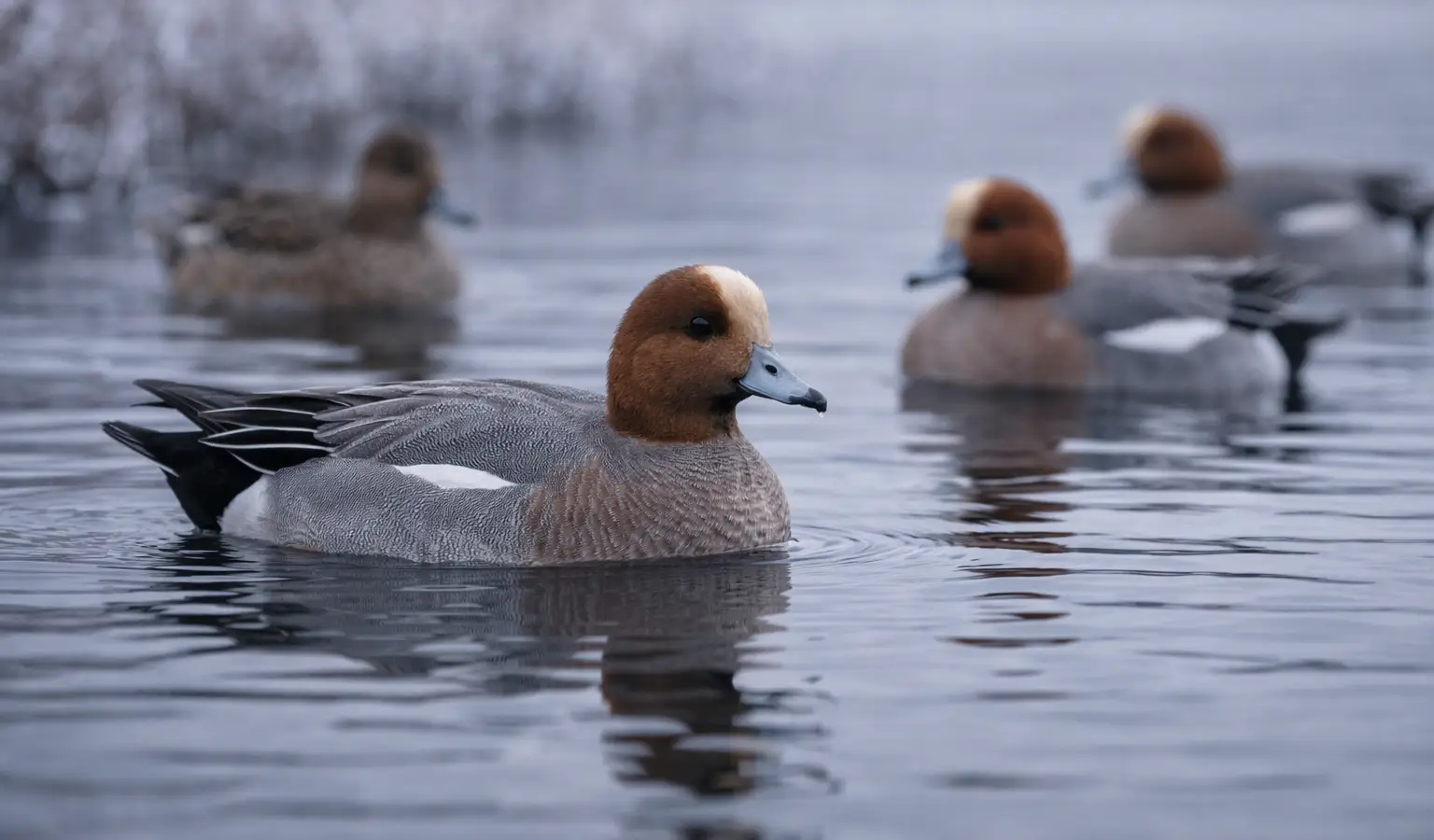
The adult male in breeding plumage is distinctive: a chestnut-toned head, creamy to yellowish forehead and crown, gray body, pinkish breast, and a conspicuous white shoulder patch that can be striking at rest and in flight. The bill is small and bluish-gray with a dark tip. The female is subtler and more variable, generally mottled brown with a softer head pattern and a more cryptic overall appearance that blends well into marsh and shoreline cover. Both sexes show a white belly and darker rear, and both can show a pale wing patch in flight.
Outside the breeding season, eclipse and immature plumages can make identification less obvious, especially at distance. Even then, structure helps: the Eurasian wigeon usually looks compact and elegant, with a small bill and rounded profile compared with many other dabbling ducks. Its call is also highly useful for identification, particularly the male's clear whistling note, which often gives away a flock before plumage details are visible.
Habitat and distribution
Habitat and distribution
Habitat
The Eurasian wigeon favors a broad range of wetland habitats, but it shows a clear preference for open water associated with accessible feeding margins. Typical habitat includes shallow lakes, marshes, ponds, flooded grasslands, river backwaters, estuaries, coastal lagoons, wet meadows, and low-disturbance reservoirs. In winter, it often concentrates in places where water remains open and nearby vegetation is easy to graze.
A key habitat feature for this species is the combination of roosting water and feeding ground. Wigeon frequently rest on open water by day or during disturbance, then move to shallow edges, mud margins, short grass, or flooded fields to feed. Sites with aquatic grasses, sedges, algae, or nutritious pasture nearby can hold large numbers.
During breeding, the species generally uses northern wetlands with adjacent cover, often in association with tundra, taiga, moorland pools, wet grassland, and shallow freshwater basins. It usually benefits from landscapes that offer both nesting concealment and productive brood-rearing water. In migration and wintering periods, its habitat use becomes broader, but it still tends to favor wetlands with low to moderate disturbance and reliable food resources.
Distribution
Mareca penelope breeds mainly across the northern Palearctic, from Iceland and the British Isles east across Scandinavia, northern Europe, and large areas of Russia into Asia. It is primarily a migratory species, with many birds leaving breeding grounds as conditions deteriorate in autumn.
In winter, Eurasian wigeon are widely distributed across western and southern Europe, around the Mediterranean, parts of the Middle East, northern Africa, and south into parts of Asia. In Europe it is often one of the characteristic winter ducks of coastal marshes, inland lakes, estuaries, and wet agricultural landscapes. Occurrence can vary strongly by region, depending on cold weather, water levels, hunting pressure, and the availability of feeding habitat.
Large seasonal movements are normal, and local numbers may change rapidly during migration peaks or hard frost. In some places the species is common and predictable; in others it appears mainly as a passage migrant or winter visitor. Small numbers also occur as vagrants outside the usual range, but the species is chiefly associated with the major Eurasian flyways.
Lifestyle
Lifestyle and behaviour
Diet
The Eurasian wigeon is best described as an opportunistic omnivore with a strong leaning toward plant material. Its diet commonly includes aquatic grasses, pondweeds, sedges, shoots, leaves, seeds, and other soft wetland vegetation. It also takes small invertebrates such as aquatic insects, larvae, and other animal matter, especially when protein demand is higher.
Season matters. During autumn and winter, many wigeon feed heavily on grassland and aquatic plants, often grazing on shorelines, wet pastures, and flooded fields. In milder conditions they may spend long periods cropping short vegetation, which is one reason they are frequently seen in open, grazed landscapes. In spring and during breeding, invertebrates can become more important, particularly for females and growing young.
Most feeding is by dabbling, tipping, surface-picking, or grazing rather than deep diving. The species often exploits shallow, productive margins and can shift between freshwater and brackish systems depending on local food availability. Where conditions are favorable, large flocks may repeatedly use the same feeding zones until disturbance, water change, or depletion causes movement.
Behaviour
The Eurasian wigeon is generally a social, alert, and mobile duck. It is often active at dawn, dusk, and night, especially in areas with regular disturbance. During the day, birds may loaf in rafts on open water, preen, sleep, or make shorter feeding movements if conditions remain quiet.
When feeding, wigeon commonly surface-feed, graze, or tip up in shallow water rather than dive. Their behavior can look calm and methodical, but they remain watchful, especially in exposed wetlands. At the first sign of threat they tend to move as a group, either paddling away into safer water or lifting quickly into fast, direct flight. Flocks can climb high and travel efficiently between resting and feeding sites.
Compared with some other ducks, the Eurasian wigeon often shows a balance of openness and caution: it likes visible water, open shorelines, and broad feeding areas, but repeated pressure can make it more nocturnal, more distant, and harder to approach. Seasonal weather, local hunting activity, and predator presence all influence how openly the species uses a site.
Social structure
The Eurasian wigeon is strongly gregarious outside the breeding season. In migration and winter it often forms small parties, loose feeding groups, or large dense flocks numbering from dozens to many hundreds of birds where habitat is favorable. Mixed flocks with other dabbling ducks are common, but wigeon often maintain distinct social cohesion within the larger assembly.
Pair formation usually begins before the birds return fully to breeding areas, and wintering flocks may include established or forming pairs. During breeding, social spacing increases, and birds become more dispersed across suitable nesting habitat. Even then, the species is not always strongly territorial in the way some waterfowl are, and breeding density can depend on habitat structure and local conditions.
After breeding, birds regroup during molt, migration, and winter concentration periods. This flexible social structure helps the species exploit changing wetland resources while also benefiting from collective vigilance in open landscapes.
Migration
The Eurasian wigeon is a clearly migratory waterfowl species. Many populations breed in northern latitudes and move south or southwest in autumn as breeding wetlands cool, food availability changes, or ice begins to form. Migration can involve long-distance movements across countries and flyways, linking Arctic, boreal, temperate, and coastal wetland systems.
Autumn passage often builds from late summer into fall, with winter concentrations developing where feeding habitat, open water, and mild conditions persist. In many hunting calendars the main season falls from September to January, which overlaps with migration and wintering use in parts of Europe, though exact dates depend on national and local regulation. Severe cold can trigger sudden secondary movements, pushing birds toward coasts, estuaries, or more southerly wetlands.
Spring migration returns birds toward breeding grounds, sometimes rapidly when weather windows are favorable. Not all populations move in the same way or over the same distance, and local residency may occur in some mild regions, but the species remains broadly defined by seasonal movement and shifting wetland use.
Reproduction
Reproduction
The breeding season typically begins in spring after arrival on northern nesting grounds. Pairs often form in late winter or during migration. The female selects a nest site on the ground, usually well concealed in vegetation near freshwater such as pools, marsh edges, wet meadows, or low cover close to shallow feeding areas.
The nest is a simple depression lined with plant material and down. A typical clutch often contains several eggs, commonly in the mid to upper single digits, though exact numbers vary. Incubation lasts about 24 days, carried out mainly by the female. During this time the male may remain nearby early on but usually becomes less involved as incubation progresses.
Ducklings leave the nest soon after hatching and feed themselves under the female's guidance. They rely on shallow productive water with shelter and abundant invertebrate life during early growth. Breeding success can vary widely from year to year depending on water conditions, spring weather, predation, and disturbance. Like many ducks, the Eurasian wigeon may have reduced productivity in poor wetland years and better recruitment when nesting cover and brood habitat are both intact.
Field signs
Field signs
Field signs of Eurasian wigeon are often easier to detect around feeding margins than in deep marsh cover. One of the best clues is their voice: males give a clear whistling call that can carry across open water and wet grassland, especially when flocks are moving or settling. This sound is often one of the quickest ways to locate birds before visual confirmation.
On soft mud, wet sand, or silty shorelines, tracks may appear as typical duck footprints with three forward-pointing toes and webbing. On heavily used feeding edges, repeated prints can create trampled paths between loafing water and grazing areas. Because many ducks leave similar tracks, footprints alone are rarely diagnostic, but they gain value when combined with habitat, flock behavior, and calls.
Additional signs include clipped grass in wet meadows, droppings in resting or grazing zones, feather traces on favored loafing banks, and regular use of shallow shoreline shelves. On quiet waters, observers may also note flock patterns: compact rafts by day and directional evening departures toward pasture or shallow feeding sites.
Ecology and relationships
Ecology and relationships
Ecological role
The Eurasian wigeon plays an important role in wetland ecosystems as a grazing and browsing waterfowl species. By feeding on aquatic plants, young shoots, and wet grassland vegetation, it contributes to plant turnover and can influence the structure of shoreline and marsh-edge communities. In some systems this grazing pressure helps maintain open feeding lawns and affects how vegetation recovers through the season.
It also contributes to food-web dynamics by consuming invertebrates and by serving as prey, especially for birds of prey and other wetland predators when birds are vulnerable, concentrated, or young. Because it moves between feeding areas, roosts, and wetlands across broad distances, the species may also aid in dispersal processes such as transporting small propagules or nutrients between sites.
As a migratory duck sensitive to water levels, disturbance, and habitat productivity, the Eurasian wigeon is also a useful indicator species. Strong numbers often reflect functioning wetland mosaics with adequate food and secure resting water, while declines in local use can signal broader habitat or pressure issues.
Human relationships
The Eurasian wigeon has a long relationship with people through wetland use, birdwatching, and traditional waterfowl hunting. It is widely appreciated by observers for its handsome plumage, vocal flocks, and seasonal presence on accessible lakes and marshes. In hunting culture, it is regarded as a classic quarry duck in regions where harvest is lawful and managed, especially from hides or on pass flights near feeding and roosting routes.
Because the species often grazes wet pastures and flooded agricultural margins, it can come into contact with farming landscapes. Usually this relationship is neutral or moderate, but local concentrations may draw attention where birds feed repeatedly on improved grassland. At the same time, agri-wetland habitats can provide important substitute feeding grounds when natural marsh vegetation is limited.
Human influence on the species is strongly tied to wetland quality. Drainage, shoreline disturbance, water pollution, repeated pressure, and loss of shallow feeding habitat can reduce site attractiveness. Conversely, well-managed wetlands, controlled disturbance, and habitat mosaics that combine secure water with feeding edges often benefit the species and many other waterfowl.
As with other wild birds, handling harvested or sick individuals should be hygienic and cautious because diseases such as avian influenza can circulate in waterfowl populations. Consumption is part of local hunting traditions where legal and properly managed, and the species is considered edible.
Legal framework and management
Legal framework and management
Legal status
The Eurasian wigeon is generally considered a huntable waterfowl species in a number of European jurisdictions, but its legal status depends entirely on country, region, flyway commitments, and current conservation rules. Open seasons, permitted methods, bag limits, protected areas, and temporary restrictions can vary significantly from one place to another.
Where hunting is allowed, the season may commonly fall in the autumn to mid-winter period, and the provided context indicates September to January. However, those dates should never be assumed universally. Hunters and land managers should always consult the latest national and local regulations, including rules on wetlands, non-toxic shot, transport, identification obligations, and protected species that may occur in mixed flocks.
Conservation status at broad scale does not remove the need for local caution. Severe weather closures, disease controls, reserve protections, and flyway-level management measures may affect access and legality. Sound practice requires correct identification, awareness of regional population trends, and strict compliance with current law.
Management tips
Good Eurasian wigeon habitat management starts with reading the wetland as a connected system rather than focusing only on open water. The species benefits most where there is a practical link between secure resting water and accessible feeding habitat such as shallow vegetated margins, wet grassland, flooded pasture, or low-disturbance mud edges.
- Maintain a mosaic of open water, shallow shelves, and grazable margins rather than steep, uniform banks.
- Protect quiet roosting zones, especially during migration peaks and cold-weather concentration periods.
- Manage disturbance carefully; repeated pressure can shift feeding into darkness and reduce site fidelity.
- Preserve or restore aquatic vegetation and seasonal flooding patterns where feasible.
- Monitor mixed flocks closely for correct identification and for signs of disease or unusual mortality.
- Coordinate habitat work with wider wetland management because water level, nutrient balance, and surrounding land use strongly affect use by wigeon.
For observers and hunters alike, understanding daily movement is important. Birds may roost on larger open water by day and move to feeding ground at dawn, dusk, or night. Reading wind, frost, water depth, and recent disturbance often explains why one wetland suddenly holds birds while another nearby remains quiet.
Fun facts
Fun facts
The Eurasian wigeon is one of the few ducks that often looks and feeds more like a small goose, regularly grazing on short grass as well as taking food from the water surface.
The male's whistling call is so characteristic that many people identify the species by sound before they study plumage details.
Large winter flocks can transform a wetland visually and acoustically, with birds resting in dense rafts and then lifting off in coordinated waves when disturbed.
Although it is a dabbling duck, the Eurasian wigeon is often associated with open, tidy feeding lawns and flooded meadows rather than only thick marsh vegetation, which makes its habitat use particularly visible to careful field observers.