
Eurasian magpie
Pica pica
An opportunistic corvid classified for population control.
Type
Bird
Lifespan
15 years
Hunting season
Périodes ESOD
Edible
No
Fact sheet
Eurasian magpie
Scientific name
Pica pica
Type
Bird
Meat quality
-
Edible
No
Lifespan
15 years
Incubation
18 days
Size
45-50 cm
Weight
200-250 g
Diet
Omnivore: insects, small animals, seeds, fruits
Status
Huntable for control
Hunting season
Périodes ESOD
Breeding season
3 / 4 / 5
Lifestyle and behaviour
Behaviour : Opportunistic, family groups
Social structure : Territorial family groups
Migration : Sedentary
Habitat
- Forest
- Plains
- Urban fringe
Natural predators
- Fox
- Birds of prey
Hunting methods
- Shooting
Health risks
- Avian parasites
- Avian influenza
Ecosystem role
- Insect regulation
- Organic waste cleaning
Introduction
General description
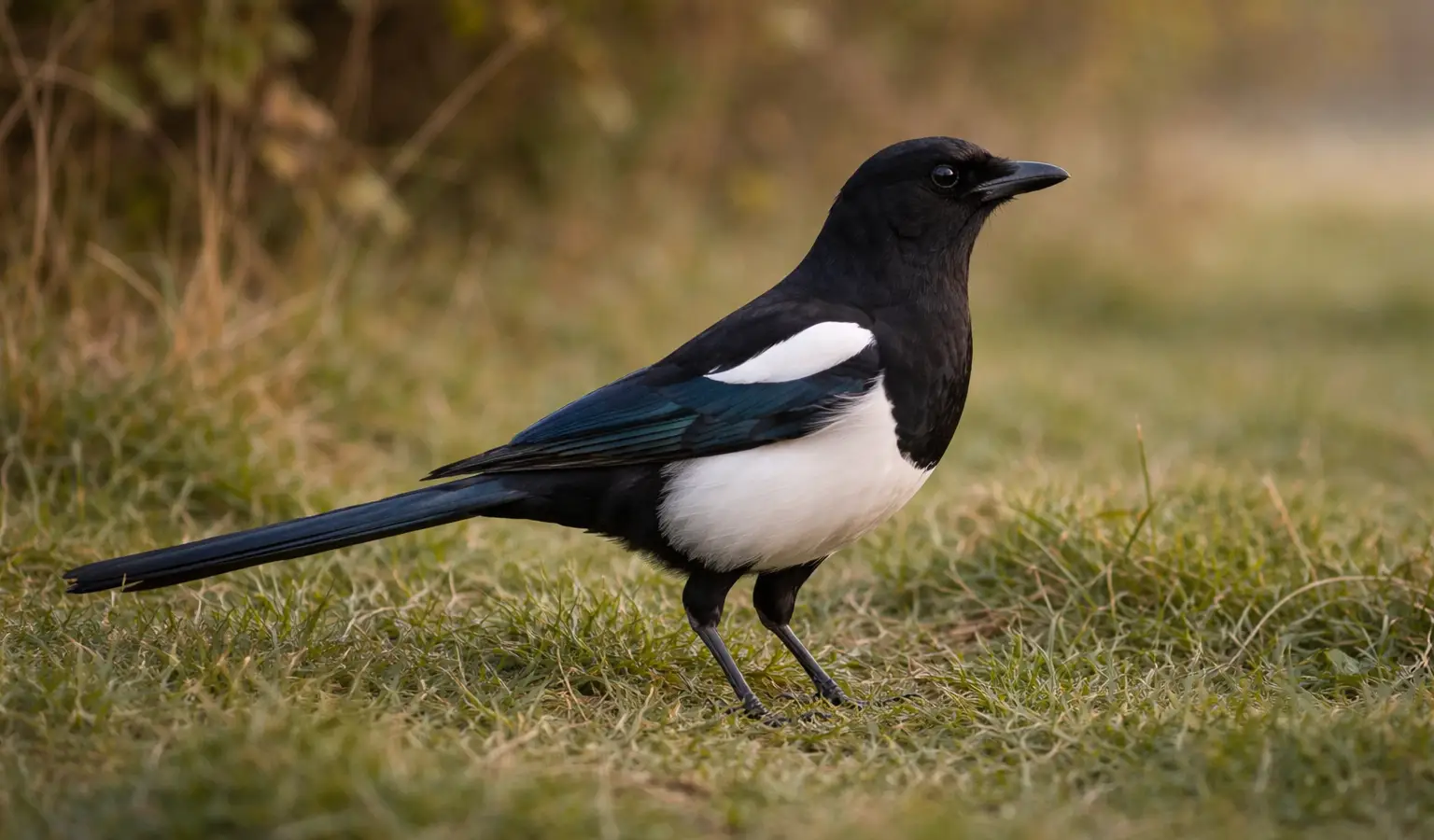
The Eurasian magpie, Pica pica, is a medium-sized corvid widely recognized by its black-and-white plumage, long graduated tail, and sharp, intelligent behavior. It is one of the most adaptable birds in open countryside, farmland mosaics, woodland edges, villages, and urban fringes. Although often noticed for its bold presence and loud calls, the magpie is above all an opportunistic generalist that thrives where food, nesting sites, and edge habitat are available.
From an ecological point of view, the Eurasian magpie occupies a flexible niche. It feeds on insects, carrion, seeds, fruit, eggs, and a wide variety of small prey or scavenged resources. This broad diet helps explain its success in human-shaped landscapes. In some areas it is valued as a scavenger and insect consumer; in others it is viewed more critically because of predation on nests, competition around feeding areas, or local pressure on vulnerable small fauna.
In wildlife management and hunting contexts, the magpie is often discussed less as a game bird than as a species subject to control where regulations permit. Its status can vary by country and by local administrative framework, especially where damage prevention or biodiversity management is involved. For that reason, any discussion of control, shooting, or trapping must always be tied to current local law rather than broad assumptions.
For field observers, the species is rewarding because it combines easy identification with complex behavior. Eurasian magpies are wary, highly observant, capable of learning from disturbance, and often active in pairs or family groups. Their presence can say much about habitat structure, human influence, and the availability of food in a given biotope.
Morphology
Morphology
The Eurasian magpie measures roughly 45 to 50 cm in total length, with much of that length made up by the tail, and typically weighs around 200 to 250 g. It appears slim but strong, with relatively broad wings, a sturdy black bill, and dark legs adapted to walking as much as hopping. In flight, the species shows a distinctive profile: short rounded wings, a long tail, and clear contrast between dark upperparts and white shoulder or flank areas.
At first glance, the plumage looks simply black and white, but in good light the black areas often show a metallic sheen with green, blue, or purple reflections. The head, breast, back, and tail are black; the belly and shoulder patches are white. The tail is long and wedge-shaped, especially conspicuous in adults. Sexes are similar in appearance in the field, while juveniles usually look slightly duller, with a shorter tail and less glossy plumage.
For identification in mixed farmland or urban fringe habitats, key features include:
- Long graduated tail noticeably longer than that of crows
- Bold black-and-white pattern visible at rest and in flight
- Strong, straight bill suited to probing and taking varied foods
- Direct, purposeful gait on the ground
- Harsh chattering calls that often reveal the bird before it is seen
It is unlikely to be confused for long with most other birds once the tail length and plumage contrast are noticed. The main family resemblance is with other corvids, but the overall shape and coloration of Pica pica are distinctive.
Habitat and distribution
Habitat and distribution
Habitat
The Eurasian magpie favors edge-rich habitats rather than deep continuous forest or highly uniform open ground. It does especially well in landscapes that combine hedgerows, scattered trees, copses, pasture, cultivated fields, orchards, gardens, and built structures. This preference for ecotones explains its frequent presence in agricultural plains, peri-urban belts, village outskirts, and fragmented woodland margins.
Suitable magpie habitat usually provides three things: elevated nesting support, open feeding space, and a reliable year-round food base. Tall shrubs, hedges, tree lines, shelterbelts, isolated trees, and small woodlots all offer nesting opportunities. Nearby grassland, ploughed fields, stubble, tracks, farmyards, compost areas, and waste-prone human environments provide foraging opportunities.
In more natural settings, the species is often associated with forest edges, riparian strips, open woodland, and transitional zones rather than dense canopy interiors. In heavily urbanized environments it may persist if there are parks, gardens, cemeteries, or suburban tree cover. At a finer scale, local abundance often reflects disturbance level, food availability, and the density of secure nesting sites.
Distribution
Pica pica has a broad Palearctic distribution and is widely present across much of Europe and large parts of temperate Asia, though taxonomy and regional forms can be treated differently depending on the authority consulted. In many western and central European landscapes, the Eurasian magpie is a familiar resident bird of farmland, villages, and suburban habitats.
Within its range, distribution is rarely uniform. It is generally common in lowland mixed agricultural country, settled areas, and open wooded mosaics, but may be scarcer in extensive treeless uplands, very dense forests, or harsh high-mountain environments. Local population density can also vary with land use, predator pressure, food abundance, and management practices.
Because it is largely sedentary, occurrence patterns tend to be stable from year to year at the local scale, although breeding density and visibility may shift with habitat change. Expansion into urban and suburban environments has been noted in many regions over time, while local declines can occur where nesting cover is removed or where legal control pressure is sustained.
Lifestyle
Lifestyle and behaviour
Diet
The Eurasian magpie is an omnivore with one of the broadest diets among common countryside birds. It takes insects and other invertebrates, earthworms, small vertebrates, eggs, nestlings, carrion, grain, seeds, berries, fruit, and discarded human food. This flexibility is central to its success in both rural and urban-edge habitats.
Season strongly influences what magpies eat. In spring and early summer, animal protein becomes especially important, with beetles, caterpillars, larvae, worms, and occasionally eggs or chicks taken where accessible. During late summer and autumn, they may make greater use of fruits, seeds, harvested fields, and abundant invertebrates in grassland or stubble. In winter, scavenging can become more important, including carrion, refuse, and any concentrated food source around farms or settlements.
Foraging is mostly ground-based, but magpies also search shrubs, low branches, dung-rich pasture, field margins, and disturbed soil. They are quick to investigate mowing, ploughing, livestock activity, and any event that exposes prey. Their reputation as nest predators is real, but often overstated in simplistic terms; in practice, the species combines predation, scavenging, and opportunistic feeding according to local availability.
Behaviour
The Eurasian magpie is a highly alert, mostly diurnal bird with a reputation for caution and intelligence. It often feeds on the ground in open view but rarely without maintaining a strong awareness of danger. Individuals frequently pause to scan, use elevated perches to assess their surroundings, and react quickly to unusual movement, vehicles, people, or repeated disturbance.
Daily activity usually peaks in the morning and late afternoon, especially where feeding areas and safe cover are close together. In warm or disturbed conditions, birds may spend more time using shade, higher perches, or sheltered edges before returning to forage. Their flight is direct but slightly undulating over longer distances, while local movements often involve short hops between ground, fence posts, hedges, and tree branches.
Behavior around pressure is notable. In areas where control occurs, magpies can become extremely wary, avoiding obvious exposure and learning to associate places, sounds, or routines with risk. They also use vocal communication effectively, with harsh chatter and alarm calls that can alert mates or nearby birds. This makes close approach difficult once a bird has identified danger.
Despite this caution, the species is also curious and adaptable. It readily investigates novel food sources, carcasses, turned soil, and human activity that might reveal feeding opportunities. This combination of suspicion and opportunism is one of the defining traits of Pica pica.
Social structure
The social structure of the Eurasian magpie is typically based on territorial pairs during the breeding season and family groups or loose local gatherings outside it. A breeding pair usually maintains and defends a nesting territory, especially around the nest and nearby feeding space. Territorial behavior can be expressed through vocal displays, chases, posture, and persistent monitoring of neighboring birds.
After breeding, recently fledged young may remain with adults for a period, creating small family parties that move through a familiar home range. In autumn and winter, social organization may become somewhat more fluid, with local concentrations forming where food is abundant or roosting conditions are favorable. Even then, magpies are not simply flocking birds in the manner of some passerines; pair bonds and local dominance relationships still matter.
Young non-breeding birds may wander more than established adults and can appear in marginal or newly available habitat. In densely occupied areas, breeding spacing may reflect both food resources and availability of secure nest sites. Overall, the species balances pair-based territoriality with enough social flexibility to exploit changing conditions.
Migration
The Eurasian magpie is generally considered sedentary. Most adults remain within a relatively stable home range throughout the year, especially once established in a suitable breeding territory. This resident behavior is one reason the species is such a constant feature of many rural and suburban landscapes.
That said, sedentary does not mean motionless. Daily and seasonal movements occur between feeding zones, roosts, breeding sites, and sheltered areas. Juveniles may disperse away from their natal territory after the breeding season, sometimes over modest distances, and local redistribution can occur in response to food availability, weather, or disturbance.
In practical field terms, observers usually encounter the same local population across seasons rather than distinct migratory waves. Winter gatherings may create the impression of increased numbers in some places, but this often reflects local concentration rather than long-distance migration.
Reproduction
Reproduction
The breeding cycle of the Eurasian magpie usually begins with pair formation or renewed pair activity in late winter to early spring, depending on region and weather. Nest building is one of the species' most characteristic behaviors. The nest is typically a large domed structure of sticks, often placed high in a tree or large shrub, with an inner cup lined with softer material. The roofed design may offer some protection from predators and weather.
Egg laying generally occurs in spring. A clutch often contains several eggs, though exact clutch size varies with condition and locality. Incubation lasts around 18 days, broadly consistent with available field data, and is mainly carried out by the female while the male contributes to vigilance and food delivery. After hatching, both adults usually feed the young.
Nestlings remain in the nest for several weeks before fledging, and the young often continue to depend on the adults for some time afterward. Breeding success can vary widely according to food supply, weather, predation, disturbance, and habitat quality. Magpies commonly attempt one brood per year, though outcomes differ between populations and seasons.
Because nesting starts relatively early and nests are large and visible before leaf cover is complete, occupied territories can often be identified well before fledging. Old nests may also persist from previous years, so apparent nest presence does not always mean current breeding.
Field signs
Field signs
Field signs of the Eurasian magpie are often easier to detect through observation than through classic spoor. The most obvious sign is the nest: a bulky stick structure, often domed, set in a tree, tall hedge, or large shrub. Old nests may remain visible for a long time, especially in winter, and can indicate long-term occupancy even if not active that season.
On the ground, direct tracks are possible in soft mud, snow, or fine dust, showing a typical anisodactyl bird print with three forward toes and one rear toe, but they are usually less diagnostic than behavior, calls, or visual identification. Droppings may occur on favored perches, fence posts, roost trees, roofs, or beneath nest sites, though they are not especially distinctive without supporting signs.
Useful practical indicators include:
- Regular use of lookout perches such as poles, isolated trees, roofs, and hedgerow tops
- Harsh chattering calls that reveal territorial activity or alarm
- Feeding traces around carcasses, refuse, livestock areas, or freshly disturbed soil
- Repeated flight lines between nest sites, cover, and feeding areas
- Concentrations of feathers or shell fragments near feeding spots, though these are not exclusive to magpies
Because the species is conspicuous and vocal, the best field sign is often simply a pattern of repeated observation at the same edges, tracks, or feeding points.
Ecology and relationships
Ecology and relationships
Ecological role
The Eurasian magpie plays a mixed but important ecological role in the habitats it occupies. As a predator of insects and some small animals, it contributes to regulating certain invertebrate populations. As a scavenger, it helps remove carrion and organic waste from the environment. This cleaning function can be especially visible around roadsides, farmyards, and disturbed open ground.
At the same time, magpies are active nest predators when opportunities arise, taking eggs or chicks of other birds in some circumstances. The ecological impact of this behavior depends heavily on habitat structure, prey abundance, alternative food sources, and the vulnerability of local bird communities. It should therefore be assessed in context rather than assumed to be uniformly severe everywhere.
Like many corvids, the species also influences food webs through seed handling, nutrient transfer, and interactions with predators such as foxes and birds of prey. In managed landscapes, its role is best understood as that of a highly adaptable mesopredator-scavenger closely linked to edge habitat and human-modified environments.
Human relationships
Human relations with the Eurasian magpie are often ambivalent. Many people appreciate it as one of the most striking and intelligent birds of the countryside and urban fringe. Its confidence, vocal presence, and elaborate nest make it easy to observe, and it is a familiar species to birdwatchers, farmers, game managers, and rural residents alike.
At the same time, magpies can become contentious where they are believed to increase pressure on songbird nests, raid poultry feed, exploit waste, or gather around farm buildings and settlements. In small-game management or biodiversity-sensitive contexts, they may be monitored or controlled where law allows, especially if local evidence suggests a concentration problem. Such decisions are usually most defensible when based on site-specific observation rather than general dislike of the species.
For hunters and wildlife managers, the Eurasian magpie is relevant mainly as a species of control rather than as table fare, as it is generally not regarded as edible. Shooting is one method used in some places, but success depends heavily on fieldcraft because the species quickly learns patterns of disturbance. Good coexistence and sound management both start with understanding when magpies are simply present as part of a normal ecosystem and when they are genuinely contributing to a localized issue.
From a health perspective, as with other wild birds, handling should be cautious because magpies may carry avian parasites and, in some situations, may be associated with broader avian disease concerns such as influenza surveillance contexts.
Legal framework and management
Legal framework and management
Legal status
The legal status of the Eurasian magpie varies significantly by country and sometimes by region, season, and management category. In some jurisdictions it may be classed as a huntable or controllable species under specific pest-control or damage-prevention frameworks; in others, its control may be restricted, licensed, seasonal, or linked to clearly defined purposes.
The reference to ESOD periods indicates a regulatory context in which destruction or control outside ordinary hunting patterns may be possible under local rules, but this is highly dependent on current legislation and administrative decisions. Names, classifications, and authorized methods can change over time.
Anyone considering shooting, trapping, nest intervention, or other management action must consult the most recent local legal texts, prefectural or regional orders, hunting federation guidance, and species-specific rules. General species profiles are useful for biology and field understanding, but they are never a substitute for current law. Outside a lawful management framework, disturbance or destruction may be prohibited.
Management tips
Effective Eurasian magpie management starts with careful diagnosis rather than automatic intervention. Not every visible magpie presence represents a problem. Repeated site observation should identify whether birds are merely passing through, holding a breeding territory, exploiting a seasonal food source, or concentrating around a sensitive area such as nesting habitat for vulnerable small birds, rearing pens, or farm infrastructure.
For field reading, focus on habitat structure. Magpies benefit from mosaics of open feeding ground and elevated nesting cover. Tall hedges, isolated trees, shelterbelts, unmanaged edge growth, and nearby food-rich areas can support regular use. If management is justified, understanding these connections is more useful than reacting only to occasional sightings.
Practical points often include:
- Observe at first light and late afternoon to identify regular movement routes and preferred perches
- Map active nests carefully and distinguish old nests from current breeding use
- Reduce artificial food availability where waste, feed spills, or exposed scraps are drawing birds in
- Assess local biodiversity objectives before action, especially in areas with sensitive nesting species
- Expect rapid learning in response to disturbance or repeated control pressure
- Always follow current law on methods, seasons, and authorization
In many situations, management is most effective when integrated with broader habitat and husbandry measures rather than treated as a stand-alone response. Clear objectives, lawful methods, and realistic expectations are essential.
Fun facts
Fun facts
- The Eurasian magpie is one of the most recognizable corvids in the world, yet its plumage is more colorful than it first appears: the black feathers often shine blue, green, or purple in sunlight.
- Its nest is unusually elaborate for a common countryside bird, often forming a large stick dome that is visible from far away in winter trees.
- Magpies are highly observant birds and can quickly change behavior when they associate a place with danger, disturbance, or easy food.
- The long tail is not just decorative; it helps create the species' distinctive silhouette and contributes to its agile balance when moving between ground and branches.
- Despite their controversial reputation, magpies are not only predators. They are also scavengers and insect feeders, which means their ecological role is broader than many people assume.
- Because they are largely sedentary, the magpies seen around a village, farm, or woodland edge are often part of a stable local population rather than passing migrants.