
Eurasian coot
Fulica atra
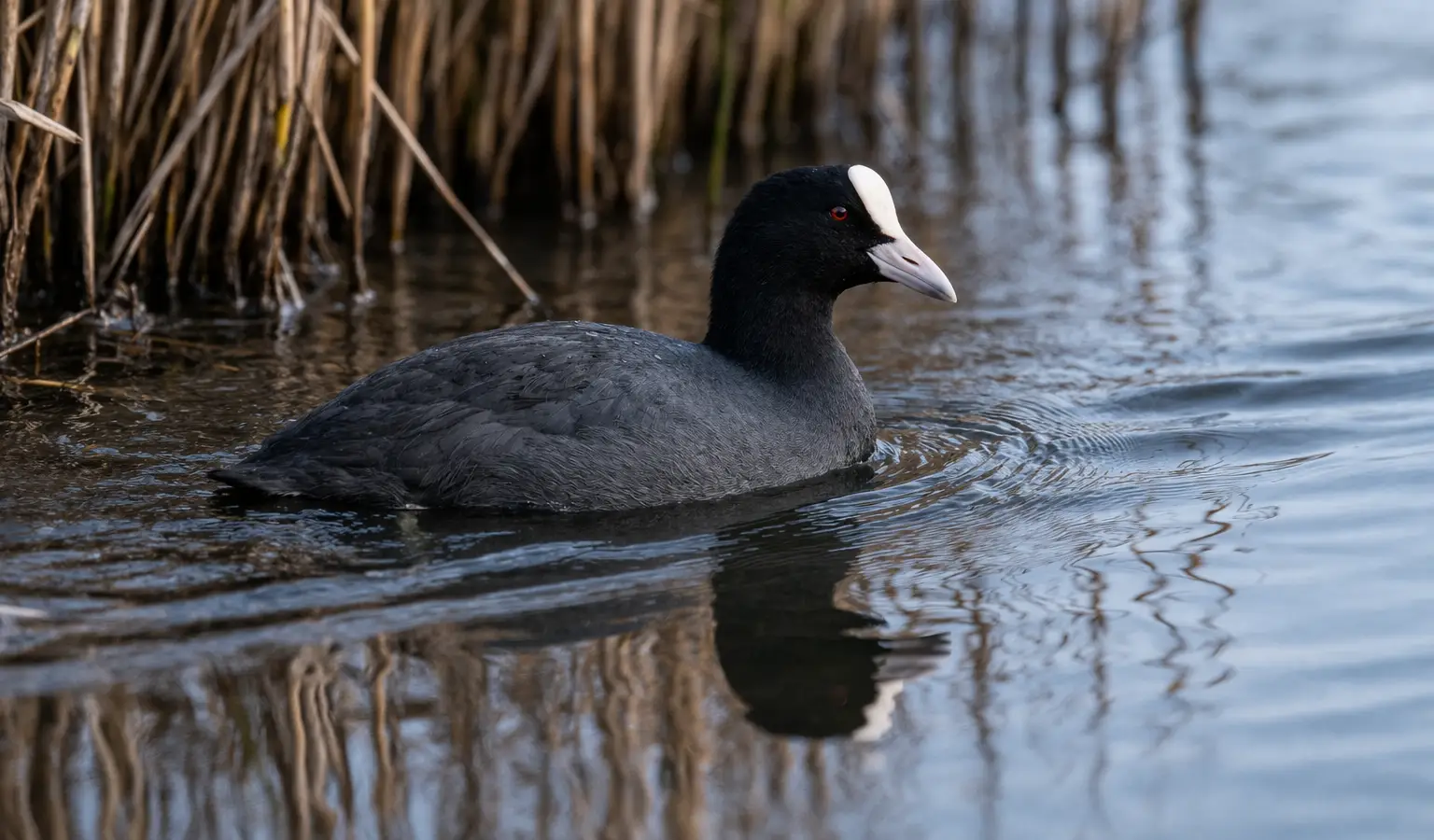
A very common waterbird of lakes and marshes, recognizable by its white bill and frontal shield.
Type
Bird
Lifespan
10 years
Hunting season
September – February
Edible
Yes
Fact sheet
Eurasian coot
Scientific name
Fulica atra
Type
Bird
Meat quality
Firm meat
Edible
Yes
Lifespan
10 years
Incubation
21 days
Size
35-40 cm
Weight
500-800 g
Diet
Omnivore: aquatic plants, insects, mollusks
Status
Huntable under regulations
Hunting season
September – February
Breeding season
4 / 5 / 6
Lifestyle and behaviour
Behaviour : Active swimmer, cohesive flocks, territorial
Social structure : Groups
Migration : Partially migratory
Habitat
- Wetland
- Lake
Natural predators
- Fox
- Birds of prey
Hunting methods
- Driven pass
Health risks
- Avian parasites
Ecosystem role
- Aquatic vegetation cleaning
Signs of presence
- Feathers
Introduction
General description
The Eurasian coot, Fulica atra, is one of the most familiar waterbirds of lakes, ponds, reservoirs, canals, marshes, and sheltered wetlands across much of Eurasia. Although often grouped with ducks in everyday language, it belongs to the rail family and has a distinctive profile: a rounded dark body, a clean white bill, and a white frontal shield that makes it easy to recognize even at a distance. In many waterside landscapes it is among the most visible birds, feeding in open water, along reed edges, and across shallow vegetated margins.
This species matters ecologically because it links aquatic vegetation, invertebrates, and wetland predators within the food web. Coots graze, dabble, dive, and pick food from the surface, helping shape the structure of plant-rich wetlands. Their abundance also makes them important prey for foxes and birds of prey, especially where wintering flocks concentrate on larger water bodies.
In hunting and field contexts, the Eurasian coot is relevant as a huntable waterfowl in some jurisdictions, though its status, season, and methods depend on local law. It is generally regarded as a common species, often seen in cohesive groups outside the breeding season, but it can become fiercely territorial when nesting. For birdwatchers, wetland managers, and hunters alike, it is a useful indicator of productive still or slow-moving waters with sufficient cover and feeding opportunities.
Morphology
Morphology
The Eurasian coot is a medium-sized, compact waterbird, typically about 35 to 40 cm in length and often weighing roughly 500 to 800 g, though local variation occurs. At first glance it appears dark charcoal to blackish overall, with a rounded body, relatively short tail, and a conspicuous white bill extending into a white frontal shield on the forehead. This bright facial marking is the key field mark and usually separates it quickly from moorhens, ducks, and other dark waterbirds.
Its neck can look short or moderately extended depending on posture, and the head often appears smoothly domed. The legs are strong and usually greenish to grayish, with large lobed toes rather than full webbing. Those lobed toes are highly adapted for swimming and walking over soft mud or floating vegetation. In the water, the coot sits fairly low and often progresses with a bobbing head motion. In flight it can look laborious at takeoff, pattering across the surface before becoming more direct and purposeful. Sexes are broadly similar in plumage, while juveniles are duller and grayer, lacking the crisp adult facial contrast.
Habitat and distribution
Habitat and distribution
Habitat
Fulica atra favors freshwater wetlands and other calm waters with a mix of open surface and aquatic or emergent vegetation. Typical habitat includes lakes, marshes, ponds, gravel pits, reedbeds, slow rivers, floodplain backwaters, irrigation basins, and reservoirs. It is especially common where shallow feeding zones border deeper open water, allowing it to alternate between grazing, surface feeding, and short dives.
The species is strongly associated with productive aquatic biotopes rich in submerged plants, filamentous vegetation, and invertebrate life. Reeds, rushes, sedges, and floating vegetation are valuable during the breeding season because they provide nesting support and shelter for broods. Outside the breeding season, coots also use more open and artificial waters, including urban lakes and park ponds, provided disturbance is not constant and food remains available.
Water level stability, shoreline complexity, and winter ice conditions can all influence local use. In some places, coots concentrate on larger ice-free water bodies in cold weather. Dense shoreline cover is particularly important in spring, when pairs defend nesting territories against other coots and neighboring waterbirds.
Distribution
The Eurasian coot has a broad distribution across Europe, much of temperate Asia, and parts of North Africa, with regional populations varying from resident to migratory. It is widespread and often common in lowland wetlands, agricultural water bodies, and large inland lakes. In many countries it is one of the most regularly encountered rallids.
Occurrence is shaped by climate, availability of standing or slow-moving water, and winter freezing. In milder western and southern regions, many birds remain year-round. Farther north and east, or at higher elevations, populations may move southward or toward ice-free coasts, estuaries, and reservoirs in winter. During migration and winter, local densities can increase sharply where suitable feeding water is available.
Because it adapts reasonably well to modified wetlands, the species may persist in landscapes where more specialized marsh birds decline. Even so, local abundance still depends on wetland quality, vegetation structure, water management, and disturbance pressure.
Lifestyle
Lifestyle and behaviour
Diet
The Eurasian coot is an opportunistic omnivore with a diet centered on aquatic plants but regularly supplemented by animal matter. It feeds on submerged and floating vegetation, tender shoots, seeds, algae, aquatic insects, insect larvae, mollusks, small crustaceans, and other readily available wetland food items. Depending on season and site, it may graze on plant material in shallow water, pluck food from the surface, or dive briefly to reach submerged vegetation.
Plant food often forms a major share of the diet, especially in productive lakes and marshes, which is why coots are frequently associated with weed-rich waters. Animal prey may become more important when energetic needs rise, when plant quality drops, or when feeding chicks, which benefit from protein-rich invertebrates during early growth.
Seasonal variation can be marked. In spring and summer, birds commonly exploit fresh aquatic growth and invertebrate-rich shallows. In autumn and winter, they may shift toward tougher vegetation, seeds, or whatever concentrated resources remain accessible on open water. In heavily used wetlands, feeding competition and local hunting or disturbance pressure can also influence when and where coots forage.
Behaviour
The Eurasian coot is an active, vigilant waterbird that spends much of the day swimming, feeding, preening, and interacting with other birds. It is comfortable on open water but usually remains within reach of cover, especially during the breeding season. Its swimming is direct and purposeful, often accompanied by rhythmic head movements, and it can dive efficiently for short periods to reach submerged food.
Outside the nesting period, coots are often seen in cohesive flocks or loose concentrations, sometimes mixed with ducks and other waterfowl. They can appear relatively tolerant of neighbors at that time. During breeding, however, behavior changes dramatically: pairs become strongly territorial, chasing rivals across the water, striking with feet, and defending nest zones with surprising aggression.
When alarmed, a coot may swim away quickly, dive, or run over the water surface before taking flight. Takeoff is usually less abrupt than in many dabbling ducks, and repeated disturbance can push birds farther into open water or toward less accessible wetland sectors. Daily activity varies with season, weather, and local pressure, but feeding often intensifies in the calmer hours of morning and late afternoon.
Social structure
Social structure in the Eurasian coot changes clearly with season. For much of autumn and winter, birds commonly gather in groups, rafts, or broad loose flocks on open water, where collective vigilance helps them exploit feeding areas and respond to disturbance. In such periods they may appear highly social, with regular spacing but relatively limited conflict compared with spring.
During the breeding season, the species shifts toward territorial pair-based organization. A male and female typically occupy and defend a nesting area, especially where emergent vegetation offers secure cover. Territorial boundaries are expressed through posture, calling, pursuit, and physical confrontation. Broods remain associated with adults after hatching, and family groups can be visible in sheltered coves or reed-lined margins until the young become more independent.
Migration
The Eurasian coot is partially migratory. Some populations are largely sedentary and remain on the same wetlands year-round, while others move seasonally in response to cold, ice cover, water availability, and food conditions. This flexible movement pattern is one reason the species can be abundant in winter on large open lakes, reservoirs, estuaries, and sheltered coastal waters where inland wetlands freeze.
Autumn movement generally builds from late summer into fall, and winter distributions may include substantial concentrations far from breeding areas. Spring return movement is often less conspicuous than that of many ducks but can still produce noticeable passage on suitable wetlands. Juveniles may also disperse after the breeding season in search of feeding areas and unoccupied habitat.
At a local scale, coots regularly shift between roosting and feeding sectors depending on disturbance, weather, and hunting pressure. In practical field terms, a water body may hold very different numbers from one week to the next, especially in cold spells or during migration windows.
Reproduction
Reproduction
Breeding usually begins in spring, though timing varies with latitude, water conditions, and climate. Pairs establish territories in vegetated wetland margins and build a bulky nest from aquatic plants, often anchored among reeds, rushes, or floating vegetation. Nest placement is usually chosen to combine concealment with quick access to open water.
The female typically lays a clutch of several eggs, and incubation lasts about three weeks, commonly around 21 days, with both adults contributing to nest attendance to varying degrees. Once hatched, chicks leave the nest early and follow adults through sheltered feeding areas. Young birds depend on parental guidance and protection during the first vulnerable stage of life, when exposure, predators, and food availability all matter greatly.
The species may attempt replacement clutches if an early nest fails, and in productive habitats it can sometimes raise young successfully even in landscapes with moderate human presence. Breeding success depends on stable water levels, adequate nesting cover, reduced disturbance, and sufficient invertebrate-rich feeding habitat for chicks.
Field signs
Field signs
Field signs of Eurasian coot are usually easier to detect on the water than on the ground. The most obvious clues are the birds themselves: dark bodies sitting low on open water, often with a bright white bill visible through binoculars. Beyond direct sighting, observers may find scattered dark feathers near loafing banks, sheltered reed edges, or regular roosting points.
Feeding signs can include cropped aquatic vegetation in shallow margins, narrow openings through floating plants, and repeated use of sheltered channels between reeds. In nesting season, a bulky platform of dead and fresh aquatic plant material anchored in emergent vegetation can indicate breeding presence, though nests should never be approached closely enough to cause disturbance.
Tracks in soft mud can be distinctive but are often overlooked: instead of a duck-like web print, coots leave impressions from long lobed toes. Droppings may occur on favored haul-out spots, low banks, floating debris, or small islands, but these are usually less diagnostic than feathers, vocal activity, and repeated movement routes on a familiar water body.
Ecology and relationships
Ecology and relationships
Ecological role
The Eurasian coot plays several useful roles in wetland ecosystems. By grazing and cropping aquatic vegetation, it can influence plant structure and the distribution of feeding patches, sometimes contributing to the maintenance of open channels within dense growth. It also consumes aquatic invertebrates and mollusks, linking plant-based productivity to higher trophic levels.
As a common and visible wetland bird, it serves as prey for predators such as foxes and birds of prey, especially eggs, chicks, and weakened individuals. Its nests, droppings, and feeding activity also contribute to nutrient cycling within marsh and lake environments. In some systems, concentrations of coots can indicate productive waters with abundant submerged vegetation, while sudden declines may reflect habitat degradation, prolonged disturbance, pollution, or harsh winter conditions.
Human relationships
The relationship between people and the Eurasian coot is varied. For many observers, it is a familiar and accessible wetland bird that can be watched closely on public lakes, marshes, and park waters. Its bold appearance and territorial behavior make it one of the easier waterbirds to identify and study, including for beginners learning wetland ecology.
In hunting contexts, the coot is traditionally known in some regions as a huntable waterfowl species, usually taken incidentally or selectively where regulations allow and where wetlands hold suitable numbers. It is edible, although culinary reputation and local use vary. Because it often gathers on open water, it may be encountered during driven pass or other lawful waterfowl hunting situations, but identification remains important to avoid confusion with protected or non-target species.
In managed wetlands and fishery landscapes, coots may be viewed positively as part of wetland biodiversity, though occasionally they are considered competitors for aquatic vegetation or associated with locally high bird densities. As with many common species, good coexistence depends on balanced habitat management, disturbance control, and respect for seasonal breeding sensitivity.
Legal framework and management
Legal framework and management
Legal status
Legal status varies by country and sometimes by region, even though the Eurasian coot is widely distributed and often common. In the context provided here, it is considered huntable under regulations. Open seasons, authorized methods, protected areas, bag limits, transport rules, and species identification requirements differ according to local wildlife law.
The indicated hunting period is generally from September to February, but readers should treat that as a broad reference rather than a universal rule. Annual decrees, migratory bird regulations, reserve boundaries, and temporary restrictions may modify access or dates. During the breeding season, nests, eggs, and dependent young are typically protected under general bird protection frameworks in many jurisdictions.
Anyone observing, managing, or hunting Eurasian coot should verify the current legal framework with the relevant national or regional authority before any field activity. This is especially important on mixed wetlands where protected waterbirds occur alongside huntable species.
Management tips
For observation, habitat reading is often the key to finding Eurasian coot consistently. Focus on waters that combine open surface with reedbeds, shallow vegetated margins, and moderate shelter from wind. In autumn and winter, scan larger ice-free lakes, reservoirs, and marsh complexes where birds may gather in numbers. In spring, look for pairs holding defined territories along reed edges and quiet coves.
For wetland management, maintaining a mosaic is generally more valuable than favoring either dense cover or bare open water alone. Productive coot habitat usually includes:
- stable or gradually changing water levels during the nesting season
- emergent vegetation for nesting support and brood shelter
- some open-water feeding space nearby
- healthy aquatic plant communities and invertebrate production
- reduced repeated disturbance in breeding areas
In hunting or broader wildlife management contexts, caution is important on mixed-species wetlands. Accurate identification, awareness of local movement patterns, and respect for refuge zones help limit unnecessary pressure. Because coots can shift distribution quickly after disturbance, repeated activity on small waters may reduce local use even where habitat remains suitable.
Fun facts
Fun facts
- The Eurasian coot is not a duck, even though many people first assume it is; it belongs to the rail family.
- Its toes are not fully webbed. Instead, each toe has broad lobes that work well for both swimming and walking on soft wetland surfaces.
- Breeding adults can be surprisingly aggressive and may chase, kick, and grapple with rivals in dramatic territorial disputes.
- On takeoff, a coot often appears to run across the water before becoming airborne.
- Because the white bill and frontal shield contrast so strongly with the dark plumage, even distant birds can often be identified quickly in good light.
- In some wetlands, large winter gatherings of coots can transform the look of open water, with dozens or even many more birds packed into favored feeding areas.