
Eurasian collared dove
Streptopelia decaocto
A widespread sedentary dove species.
Type
Bird
Lifespan
8 years
Hunting season
Selon réglementation locale
Edible
Yes
Fact sheet
Eurasian collared dove
Scientific name
Streptopelia decaocto
Type
Bird
Meat quality
Tender meat
Edible
Yes
Lifespan
8 years
Incubation
14 days
Size
32-34 cm
Weight
200-250 g
Diet
Seeds, fruits
Status
Huntable locally
Hunting season
Selon réglementation locale
Breeding season
5 / 6 / 7
Lifestyle and behaviour
Behaviour : Sedentary, pairs or small groups
Social structure : Faithful pairs
Migration : Sedentary
Habitat
- Farmland
- Urban fringe
Natural predators
- Birds of prey
- Wild cat
Hunting methods
- Standing post
Health risks
- Avian parasites
Ecosystem role
- Seed dispersal
Introduction
General description
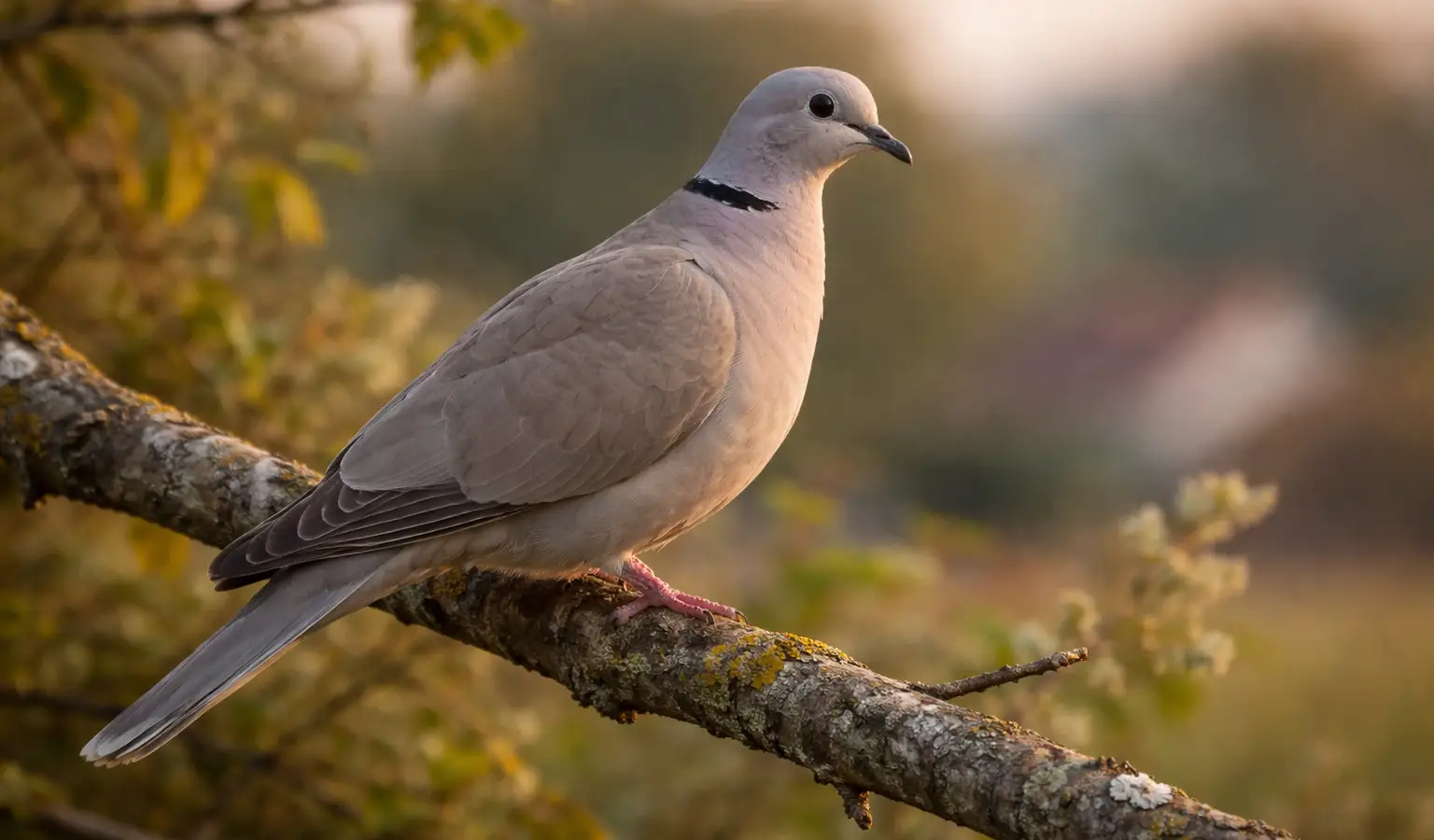
The Eurasian collared dove, Streptopelia decaocto, is a medium-sized dove that has become one of the most familiar birds of village edges, farmland, suburban gardens, and small towns across much of Europe and beyond. Often called the collared dove or Turkish dove in older usage, it is easy to recognize by its pale plumage, slim build, and the narrow black half-collar on the back of the neck. Compared with many migratory game birds, this species is better described as largely sedentary, with local movements rather than true long-distance migration in most populations.
Its success comes from adaptability. The Eurasian collared dove thrives in human-shaped landscapes where grain, spilled seed, hedgerows, utility wires, gardens, and nesting sites are readily available. That ecological flexibility explains its broad expansion during the last century and its regular presence in areas where traditional woodland doves may be less conspicuous. In the field, it is often noticed first by its repetitive three-part cooing call or by small groups flying low and directly between feeding and roosting areas.
From a wildlife and hunting perspective, the species occupies an intermediate place between a common observation bird and a locally huntable dove, depending on national and regional regulation. Where legal harvest exists, knowledge of movement corridors, feeding habits, and daily routines matters more than any idea of long migratory passage, because most birds using a site are local or regional residents. For land managers and naturalists alike, the Eurasian collared dove is a useful indicator of how birds exploit agricultural mosaics and urban fringe habitats.
Morphology
Morphology
The Eurasian collared dove measures roughly 32 to 34 cm in length and typically weighs around 200 to 250 g. It has a slim body, relatively small head, long tail, and broad, rounded wings. The overall tone is soft beige to pale grey-buff, often cleaner and plainer than many other doves. The underparts are light, the upperparts sandy-grey, and the tail shows pale outer feathers that can stand out in flight.
The key field mark is the narrow black nape collar, edged with pale tones, which appears as a half-ring rather than a complete neck band. The eye is dark to reddish, the bill is blackish, and the legs are usually reddish or pinkish. In flight, the species looks pale, neat, and purposeful, lacking the bold wing bars of some pigeons. Males and females look broadly similar in the field, while juveniles are duller and may show a weaker or absent collar until they mature.
For identification, confusion is most likely with turtle doves or other Streptopelia species where ranges overlap. The Eurasian collared dove is generally plainer, larger, and less richly patterned than the European turtle dove, and it usually gives a more repetitive, less purring song. Its upright posture on wires, rooftops, and isolated trees is also a classic visual cue.
Habitat and distribution
Habitat and distribution
Habitat
The preferred habitat of the Eurasian collared dove is strongly tied to open or semi-open country shaped by human presence. It commonly uses farmland, urban fringe, villages, orchards, farmyards, grain storage areas, gardens, and road-edge tree lines. It tends to avoid dense, continuous forest interiors, although it may nest in isolated trees, shelterbelts, parks, or small wooded patches near feeding areas.
This dove does especially well in landscapes that combine feeding ground with elevated perches and nearby nesting cover. Mixed agricultural biotopes with cereals, stubble, livestock holdings, hedges, and scattered buildings are especially favorable. Around towns, it uses ornamental conifers, street trees, utility lines, and backyard feeders. Water is useful but not always limiting where food and roost sites are abundant.
In practical field terms, the best habitat is often a mosaic rather than a single vegetation type: open feeding ground for seed collection, quiet nesting supports, and predictable daytime resting points. The species tolerates human disturbance better than many wild doves, which explains its strong presence close to settlements.
Distribution
Streptopelia decaocto originated in parts of Asia and southeastern Europe but is now widely distributed across most of Europe and has expanded far beyond its historical range. Today it is established over a very large area, including much of western, central, and southern Europe, and it has also colonized regions outside Europe. In many countries it is now considered a standard component of everyday birdlife rather than a localized newcomer.
Occurrence is typically strongest in lowland agricultural country, peri-urban landscapes, and settled rural districts. It may be scarcer in very dense mountain forests, extremely harsh uplands, or isolated habitats with limited winter food. Local abundance can vary with farming practice, winter severity, predator pressure, and nesting opportunities around buildings and tree belts.
Because the species is largely sedentary, distribution patterns are often stable at the local scale once a population is established. However, younger birds may disperse and gradually occupy new territories, which has historically contributed to its remarkable range expansion.
Lifestyle
Lifestyle and behaviour
Diet
The Eurasian collared dove feeds mainly on seeds and small plant material, including cereal grains, weed seeds, and a range of cultivated and wild food items. Fruits may also be taken, especially where soft plant foods are easily available. In farmland, spilled grain around storage sites, livestock areas, harvested fields, and tracks can be especially important.
Its diet shifts with season and land use. During harvest and post-harvest periods, cereal-rich food may be abundant in stubbles and farmyards. At other times, the species relies more on weed seeds, garden feeding opportunities, or small seeds from ruderal vegetation. Like many doves, it usually forages on the ground, walking with a steady, deliberate gait while picking individual food items.
Adults feeding young also produce crop milk, a nutrient-rich secretion typical of pigeons and doves, which is an important part of chick nutrition early in development. This ability helps the species breed successfully even where food quality varies across the season.
Behaviour
The Eurasian collared dove is a mainly diurnal bird with fairly regular daily routines. It often leaves roosting or resting sites soon after dawn to feed in open ground, then spends periods loafing on wires, rooftops, isolated trees, or sheltered branches before returning to feed again later in the day. Activity is often most visible in the early morning and late afternoon.
Its flight is fast, direct, and purposeful, usually along repeated local routes between feeding, watering, and nesting areas. When disturbed, birds may flush with a sharp wing noise and head to a familiar perch rather than disappearing over long distances. They are alert but not always as wary as heavily hunted wild doves, especially in suburban settings where they are accustomed to people.
Calling behavior is one of the species' clearest field signals. Males deliver a repetitive, rhythmic cooing from exposed perches, especially in the breeding season, and may perform short display flights or wing-clapping movements near the nest territory. In areas with sustained disturbance or hunting pressure, birds can become more cautious, feeding earlier, using safer edges, and reducing time in exposed open ground.
Social structure
The Eurasian collared dove is best described as a species of faithful pairs outside and within the breeding season, although it is not strictly solitary. Pairs often remain associated for long periods and defend a small nesting territory centered on a tree, shrub, building ledge, or similar support. The bond is reinforced by mutual calling, courtship feeding, and coordinated nest attendance.
Beyond the immediate nesting context, individuals commonly gather in pairs or small groups, especially at feeding sites, roosts, and favored perches. In productive agricultural or urban-edge habitats, larger loose concentrations may form where grain or seed is concentrated. These aggregations are usually less tightly structured than true flocking species and often consist of local birds sharing the same feeding circuit.
This combination of pair fidelity and tolerant feeding associations is one reason the species adapts so well to settled landscapes. It can maintain stable breeding territories while still exploiting communal food resources when available.
Migration
The Eurasian collared dove is generally considered sedentary across much of its range. Most adults remain within a familiar local area through the year, moving between feeding grounds, roosts, nesting sites, and water rather than undertaking regular long-distance migration. This makes the species quite different from classic migratory birds whose seasonal passage defines hunting or observation patterns.
That said, local and regional dispersal does occur. Young birds in particular may wander after the breeding season, and some populations make broader movements during harsh weather, food shortages, or phases of range expansion. These movements are usually better described as dispersal or short-distance seasonal shifting rather than true migration.
For field observers and managers, this means that presence at a site often reflects local habitat quality and year-round carrying capacity more than a brief migration window. Stable food resources and safe nesting structures can hold birds in the same landscape for long periods.
Reproduction
Reproduction
The breeding biology of the Eurasian collared dove is one of the keys to its expansion. In suitable climates it can begin breeding early and may attempt several broods in a single year. The nest is usually a light, rather flimsy platform of twigs placed in a tree, dense shrub, hedge, ornamental conifer, or on a man-made structure with some cover and support.
A typical clutch contains two eggs, as in many doves. Both adults take part in incubation, which generally lasts about 14 days, though timing may vary slightly with weather and disturbance. After hatching, the chicks are fed crop milk at first, followed by progressively more solid food. Nestling development is relatively quick, and pairs may begin another nesting attempt soon after fledging if conditions remain favorable.
Because the species often breeds near people, nests can be found surprisingly close to houses, roads, gardens, or farm buildings. Breeding success depends on weather, predation, disturbance, and local food supply. Birds of prey, corvids, and mammalian predators can all affect nesting outcome.
Field signs
Field signs
Field signs of the Eurasian collared dove are usually more obvious through sight and sound than through tracks. The most useful indicator is its repetitive three-note cooing, often delivered from utility wires, roof ridges, dead branches, or prominent treetops. Regular use of the same perch can leave visible droppings beneath wires, roost branches, or favored resting spots.
Ground feeding areas may show small concentrations of dove droppings, scattered husks, and repeated bird use along bare soil, farm tracks, grain spills, or stubble edges, but these signs are rarely diagnostic on their own. Under nesting trees or shrubs, one may find a few loose twigs, droppings, or occasional feathers. Nests are typically light and untidy, often visible through sparse foliage.
Tracks can be found in mud, dust, or light snow near water points and feeding patches, but they are small and not always easy to separate from those of other pigeons and doves. In practice, the best field reading comes from combining habitat clues, repeated flight lines at dawn or dusk, characteristic calling, and habitual perching locations.
Ecology and relationships
Ecology and relationships
Ecological role
The Eurasian collared dove plays a modest but meaningful role in the ecosystems it occupies. As a consumer of seeds and plant material, it contributes to the movement of plant matter across the landscape and may participate in seed dispersal in some contexts. By feeding in both cultivated and semi-wild habitats, it links agricultural areas, hedgerows, gardens, and urban edge vegetation.
It is also part of the prey base for birds of prey and small to medium predators, including wild cats where they occur. Eggs and nestlings are vulnerable to a broader set of predators. In this sense, the species helps transfer energy from seed-rich environments to higher trophic levels.
Ecologically, one of its most significant roles is as an adaptable bird of human-dominated landscapes. Its abundance and persistence can reflect the availability of year-round food, nesting substrates, and relatively mild disturbance regimes. In some places, very high local densities may also influence competition for food or nest space with other common urban and farmland birds, though these effects vary by region.
Human relationships
The relationship between people and the Eurasian collared dove is shaped by coexistence, observation, agriculture, and in some areas hunting. Many people know the bird from its constant presence in villages, farmyards, garden feeders, and town margins. Its calm behavior, repetitive call, and readiness to use human-made structures make it one of the most visible doves in settled country.
For farmers, the species is usually a minor and diffuse consumer of grain and seed rather than a major pest, although local concentrations around feed stores or livestock units can occasionally create nuisance concerns. For birdwatchers, it is a textbook example of a successful range-expanding species. For hunters in jurisdictions where harvest is lawful, it may be taken opportunistically or during local dove shooting, often from a standing post near regular flight lines, feeding areas, or evening movement corridors.
The species is also edible, as are many doves, but any use should follow legal requirements, food hygiene standards, and sound game handling practice. As with other wild birds, handlers should be aware of possible avian parasites and use normal hygiene precautions when processing birds.
Legal framework and management
Legal framework and management
Legal status
Legal status varies significantly by country and sometimes by region, season, and local management framework. In some areas the Eurasian collared dove is classified as a huntable species, while in others it may be protected or subject to specific restrictions. The broad label "huntable locally" should therefore be understood as conditional, not universal.
Open seasons, approved methods, bag limits, protected periods during breeding, and transport or sale rules are all matters of local regulation. The indication "according to local regulation" is especially important for this species because its treatment in law may differ from that of other doves or pigeons in the same country.
Anyone observing, managing, or hunting Eurasian collared doves should verify current legislation before acting. That includes checking species identification requirements, hunting season dates, protected-area rules, and any updates linked to conservation policy, animal health measures, or regional population management.
Management tips
For observation or local management, focus first on landscape reading. The most productive areas combine feeding ground, perches, and nesting support within a short distance. Look for cereal stubbles, livestock units with spilled feed, village edges, garden belts, isolated conifers, and wires crossing open ground. Birds often follow the same movement corridors repeatedly, especially between morning feeding sites and daytime resting points.
If the goal is habitat stewardship, maintaining a mixed farmland structure with hedges, scattered trees, and moderate disturbance can support the species while also benefiting other common birds. Around buildings and settlements, avoid unnecessary disturbance near active nests during the breeding season. In high-density situations, sanitation around feed stores may reduce excessive concentration without harming the broader population.
For hunting where legal, careful identification is essential to avoid confusion with protected or more sensitive dove species. Local regulations, season dates, and safe shooting conditions must always come first. Pressure should remain proportionate to local abundance, and hunters should pay attention to how birds use wind, cover, and late-day approach routes rather than expecting classic migratory passage behavior.
Fun facts
Fun facts
- The narrow black neck mark is not a full ring but a half-collar on the back of the neck, which gives the Eurasian collared dove its common name.
- Streptopelia decaocto is one of the best-known examples of a bird that dramatically expanded its range across Europe in modern times.
- Unlike many birds associated with open country, it often thrives because of people, using wires, gardens, buildings, and ornamental trees as part of its normal territory.
- Its repetitive three-part coo is so characteristic that many people learn the bird by voice before they notice the plumage details.
- Both parents help incubate the eggs and feed the chicks, and the species can raise multiple broods when conditions stay favorable.