
Crow
Corvus corone
An intelligent corvid managed for population control.
Type
Bird
Lifespan
15 years
Hunting season
Périodes ESOD
Edible
No
Fact sheet
Crow
Scientific name
Corvus corone
Type
Bird
Meat quality
-
Edible
No
Lifespan
15 years
Incubation
18 days
Size
45-50 cm
Weight
400-600 g
Diet
Omnivore: seeds, fruits, small animals
Status
Huntable for control
Hunting season
Périodes ESOD
Breeding season
3 / 4
Lifestyle and behaviour
Behaviour : Highly intelligent, gregarious
Social structure : Flocks outside breeding season
Migration : Partial migrant
Habitat
- Forest
- Farmland
- Urban fringe
Natural predators
- Fox
- Hawks
Hunting methods
- Shooting
Health risks
- Avian parasites
- Avian influenza
Ecosystem role
- Seed dispersal
- Carcass cleaning
Introduction
General description
The carrion crow, Corvus corone, is a medium-sized black corvid known for its intelligence, adaptability, and close association with mixed rural landscapes, woodland edges, and the urban fringe. It is one of the most familiar crow species across much of western Europe, where it occupies a broad range of biotopes and quickly exploits feeding opportunities created by agriculture, human settlement, and natural carrion. In the field, it is often recognized by its all-black plumage, steady wingbeats, cautious behavior, and harsh, unmistakable calls.
Ecologically, the crow is both useful and controversial. It acts as a scavenger and seed disperser, removes animal remains, and helps recycle organic matter. At the same time, local populations can exert pressure on ground-nesting birds, eggs, nestlings, small mammals, and some agricultural resources. Because of this dual role, it is often discussed in the context of wildlife management, pest control, and population regulation rather than simple conservation messaging.
For hunters, land managers, and naturalists, the crow is a species that rewards close observation. Its wariness, problem-solving ability, and capacity to learn from disturbance make it a challenging bird to approach and a revealing indicator of how wildlife adapts to human pressure. Understanding crow habitat, feeding behavior, seasonal movement, and flock structure is essential whether the goal is observation, crop protection, predator management, or legal control under local regulations.
Morphology
Morphology
The carrion crow measures roughly 45 to 50 cm in length and commonly weighs around 400 to 600 g, although size and mass vary with sex, age, season, and local conditions. It has a robust, compact silhouette with a fairly thick neck, broad chest, strong legs, and a heavy black bill adapted to a highly varied omnivorous diet.
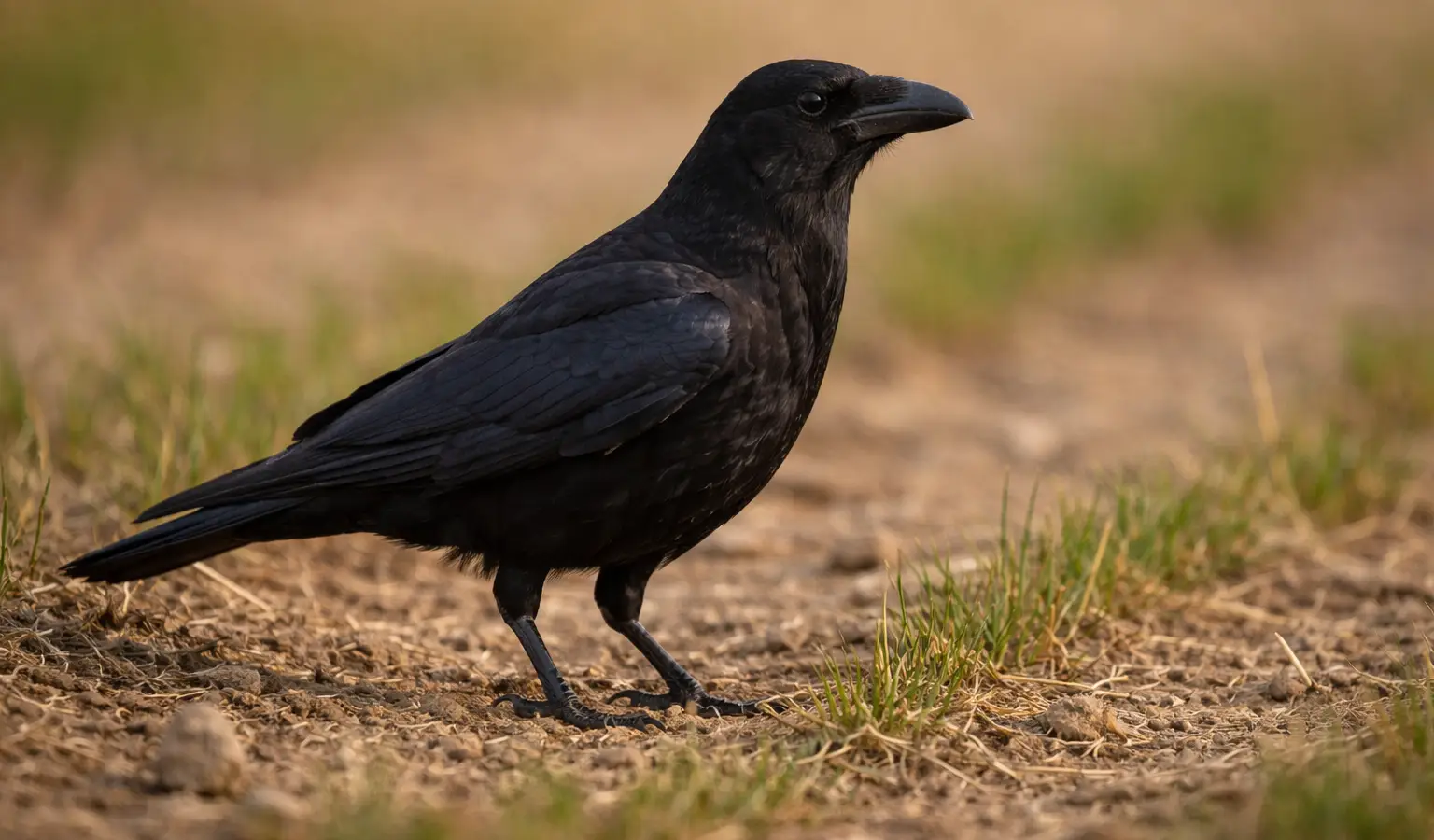
Its plumage is entirely black, often showing a glossy sheen with purple, blue, or green reflections in good light. The eye is dark, the legs and feet are black, and the bill is solid and slightly arched. In flight, the wings appear broad and fingered at the tips, and the tail is relatively square to slightly rounded, helping separate it from some similar corvids at distance.
Field identification is easiest when comparing structure and behavior rather than color alone. The carrion crow is bulkier and heavier-billed than a jackdaw, less shaggy-throated and less massive than a raven, and usually more evenly black than the hooded crow, where ranges meet. Juveniles can look slightly duller, with less gloss and a softer feather texture.
Habitat and distribution
Habitat and distribution
Habitat
Corvus corone is highly adaptable and uses a wide range of habitats, but it is especially common in farmland, woodland edges, hedgerow country, open forest mosaics, wetlands with nearby feeding ground, and the urban fringe. It favors landscapes that combine elevated lookout points, safe nesting cover, and easy access to food on the ground.
In agricultural country, crows often concentrate around pasture, plowed fields, silage areas, livestock holdings, and crop margins where invertebrates, grains, carrion, and waste food are readily available. In forested settings, they usually prefer edges, clearings, tracks, young plantations, and transition zones rather than dense interior forest. Around towns and industrial outskirts, they exploit parks, landfill influence zones, road verges, and other disturbed but productive feeding areas.
Good crow habitat usually includes a mix of nesting trees, open feeding surfaces, water access somewhere in the wider home range, and regular low-risk perches for scanning. Their success often reflects habitat diversity rather than any single vegetation type.
Distribution
The carrion crow is widely distributed across much of western Europe, though its exact range pattern changes where it meets the hooded crow complex in central and northern parts of the continent. In many regions it is a common resident bird of lowlands, farming districts, peri-urban landscapes, and coastal or inland mixed habitat systems.
Local abundance can vary greatly. Some areas hold dense, visible populations because food is concentrated by intensive agriculture, refuse, roadkill, or roosting opportunities. Other areas support lower numbers where breeding territories are more dispersed or where human disturbance, habitat structure, or management pressure limits density.
At the regional scale, distribution is often best understood as a patchwork of resident territories, seasonal feeding concentrations, and winter flocking zones. Even where present all year, crows may appear more numerous in autumn and winter because birds gather from wider surrounding areas.
Lifestyle
Lifestyle and behaviour
Diet
The crow is a classic omnivore with an exceptionally flexible diet. Common foods include seeds, grains, fruits, berries, insects, earthworms, larvae, small mammals, eggs, nestlings, carrion, and a wide range of discarded human food where available. This dietary breadth is a major reason for the species' ecological success.
Season strongly influences feeding. In spring and early summer, animal protein becomes especially important, and crows may search intensively for invertebrates, chicks, eggs, and vulnerable young animals. In late summer and autumn, cereals, maize, fallen fruit, and other plant foods can become more prominent, especially in farmland. During winter, carrion, waste food, and feeding opportunities around livestock or human activity may be especially important.
They forage mostly on the ground, walking with confidence and pausing frequently to inspect the surface. They will turn over debris, probe soft soil, take prey opportunistically, and cache some food items. Their ability to switch quickly between natural prey, crops, and scavenging resources makes diet a central issue in both crow management and coexistence.
Behaviour
Crows are highly alert, observant birds with a strong capacity to assess risk. They are usually active by day, especially from early morning through late afternoon, and often spend much of that time moving between feeding areas, lookout perches, and resting sites. In open country, they rarely feed for long without raising the head to scan for danger.
The species is well known for cautious approach distances and rapid learning. Birds exposed to regular disturbance, shooting pressure, or repeated failed control attempts often become markedly harder to approach. They memorize safe routes, use elevated perches before dropping into feeding ground, and may circle suspicious areas before landing. Alarm calling can quickly change the behavior of nearby crows and other birds.
Flight is steady and purposeful, with regular wingbeats interspersed at times with short glides. Daily patterns often include morning dispersal from roosts, mid-day feeding or loafing, and evening movement back toward communal roost sites outside the breeding season. In breeding territories, behavior becomes more localized and defensive, especially near the nest.
Social structure
Social organization changes with season. During the breeding period, carrion crows are usually found in territorial pairs holding and defending a nesting area against other crows. These pairs may remain together for long periods, and their familiarity can often be seen in coordinated movement, mutual vigilance, and shared nest defense.
Outside the nesting season, the species becomes more gregarious. Small parties, loose feeding groups, and larger flocks may gather where food is abundant, particularly in farmland, stubble, pasture, or roost approach zones. Evening roosts can draw birds from a wide area, creating concentrations much larger than those seen during the day.
Young birds and non-breeding individuals are often more social than established breeding adults. This seasonal shift between territorial pairing and flocking is important for anyone trying to interpret crow presence, local pressure, or apparent population size.
Migration
The carrion crow is generally considered a partial migrant or resident species, depending on region. Many adult birds remain close to their breeding territories throughout the year, especially in mild lowland areas with reliable food resources. Others make short-distance seasonal movements, particularly where winter weather reduces feeding opportunities.
Post-breeding dispersal by juveniles is often more noticeable than true migration. Young birds may wander beyond their natal area before settling, contributing to late summer and autumn changes in local numbers. Winter flock formation can also create the impression of movement as birds gather around productive feeding and roosting sites.
In practical terms, crow movement is usually best described as a mix of residency, local dispersal, and regional seasonal shifting rather than long-range migration across the entire population.
Reproduction
Reproduction
Breeding usually begins in spring, though exact timing varies with latitude, weather, and habitat conditions. Territorial pairs select a nesting site, most often in a tree, sometimes in a tall hedge, shelterbelt, or occasionally on man-made structures where suitable cover exists. The nest is a bulky stick platform lined with softer material.
The female typically lays a clutch of several eggs, often around four to six, and incubation lasts roughly 18 days, though slight variation is possible. During this period the male commonly assists by guarding the territory and bringing food. After hatching, both adults take part in feeding the young.
Nestlings remain dependent for several weeks, and fledged juveniles may continue to follow the adults while learning feeding sites and danger cues. Breeding success can vary considerably depending on food supply, weather during the nesting period, nest predation, and disturbance. In favorable conditions, crows can maintain stable local populations through consistent annual recruitment.
Field signs
Field signs
Field signs of crows are often easier to detect through behavior and presence patterns than through classic tracks alone. Repeated use of feeding fields can be revealed by regular concentrations of birds on pasture, stubble, freshly worked soil, silage edges, or around livestock. Favored perches may show droppings beneath fence posts, isolated trees, utility structures, or roost approach lines.
Tracks can sometimes be found in mud, dust, snow, or soft ground. Like other corvids, the crow leaves a three-forward, one-back footprint, often with a walking pattern rather than hopping. These prints are not always easy to separate from those of similar-sized corvids unless size, stride, and surrounding context are carefully read.
Other signs include scattered shell fragments from opened eggs, pecked remains of small prey, accumulated feathers at plucking spots, and noisy dawn or dusk flightlines toward communal roosts. Around nests, alarm calling, repeated circling, and aggressive defense against raptors or intruders can be some of the clearest indicators of an active breeding territory.
Ecology and relationships
Ecology and relationships
Ecological role
Crows play several important roles in the ecosystem. As scavengers, they help remove carcasses and organic remains from the landscape, contributing to nutrient cycling and reducing the persistence of dead material. As opportunistic feeders, they also consume large numbers of invertebrates and can influence local prey populations.
They contribute to seed dispersal by carrying and dropping fruits or other plant material, and their caching behavior may occasionally assist the spread of some species. In agricultural mosaics, they are part of a broader ecological network linking cropped ground, pasture, woodland edges, and carrion resources.
However, the ecological role of the crow is not uniformly positive or negative. In some local contexts, especially where vulnerable ground-nesting birds are under pressure, high crow density can become a management concern. This is why balanced assessment matters: the species is both a natural cleaner of the countryside and a potential predator of sensitive wildlife stages.
Human relationships
The relationship between people and the crow is complex. Farmers may value its scavenging role yet also experience damage to seedlings, stored feed, fruit, or vulnerable young poultry. Game managers and conservation practitioners sometimes view high local densities as problematic where eggs, chicks, or small ground-nesting species are exposed to predation pressure.
At the same time, crows are widely admired for their intelligence, social awareness, and ability to thrive in changing landscapes. They are among the most observed and studied wild birds near human settlement because they are visible, vocal, and behaviorally sophisticated. Their responses to traffic, tools, cropping patterns, and repeated human routine often appear strikingly adaptable.
In hunting and control contexts, the crow is relevant mainly as a species managed for population regulation rather than for the table, as it is generally not considered edible. Any intervention tends to be justified by local agricultural protection, wildlife conservation, or public health concerns, and it is most credible when it is targeted, legal, and linked to clear management objectives.
Legal framework and management
Legal framework and management
Legal status
Legal status varies significantly by country and sometimes by region, season, land use, and management purpose. In some areas, the carrion crow may be huntable or controllable under specific pest-control frameworks, including periods associated with local rules for damage prevention or wildlife management. The reference to ESOD-type periods indicates that control may depend on a regulated administrative classification rather than a simple general hunting season.
Because corvid regulation is often technical and frequently updated, it is essential to verify current national and local law before any action. Permitted methods, dates, justifications, reporting requirements, and authorized contexts can all differ. Protected areas, nesting season restrictions, and animal welfare rules may also apply.
Anyone involved in crow shooting or control should rely on the latest official legal texts, prefectural or regional orders where relevant, and recognized hunting or wildlife authorities. Legal compliance is a basic part of credible wildlife management.
Management tips
Effective crow management begins with habitat reading rather than immediate intervention. Identify where birds feed, where they stage before entering fields, where they roost, and which landscape features give them security. In many situations, pressure is concentrated around predictable resources such as silage, lambing fields, calving areas, freshly drilled crops, gamebird release zones, or nesting habitat of sensitive species.
Observation is critical because crows quickly detect routine. Watch flightlines at first light and late afternoon, note sentinel perches, and distinguish between resident pairs and transient flocks. Management is usually more coherent when it is timed to a clear objective, such as reducing localized predation pressure or limiting recurring agricultural damage, rather than treating every visible crow as equally significant.
- Use current law: confirm dates, permitted methods, and site-specific restrictions before any control.
- Target the problem area: local pressure points matter more than broad, unfocused disturbance.
- Reduce attractants where possible: secure waste, manage carcass disposal correctly, and limit easy food access around holdings.
- Read behavior: wary birds often change routes and landing habits after disturbance.
- Combine methods thoughtfully: habitat management, husbandry, exclusion, and legal shooting may all have a place depending on the situation.
Where disease concerns such as avian influenza or parasite transmission arise, avoid unnecessary handling of dead birds and follow veterinary or public authority guidance. Good management is measured, lawful, and tied to real ecological or agricultural need.
Fun facts
Fun facts
- Crows recognize patterns: they are well known for learning from repeated human behavior and can become harder to approach after only a few negative encounters.
- Black plumage is not visually simple: in sunlight, a carrion crow can show subtle purple, blue, or green gloss that is easy to miss at distance.
- They are skilled generalists: few birds switch as effectively between seeds, insects, carrion, fruit, and human-associated food.
- Roosts can transform perception: an area that seems to hold only a few crows by day may host many more birds gathering in the evening.
- Longevity can be impressive: while many wild birds do not reach old age, crows are capable of living well over a decade in favorable conditions.