
Common pochard
Aythya ferina
A diving duck of lakes and open waters, commonly wintering in flocks.
Type
Bird
Lifespan
10 years
Hunting season
September – January
Edible
Yes
Fact sheet
Common pochard
Scientific name
Aythya ferina
Type
Bird
Meat quality
Strong-flavoured meat
Edible
Yes
Lifespan
10 years
Incubation
28 days
Size
45-55 cm
Weight
600-900 g
Diet
Omnivore: mollusks, insects, aquatic plants
Status
Huntable under regulations
Hunting season
September – January
Breeding season
4 / 5
Lifestyle and behaviour
Behaviour : Diving duck, lives in flocks
Social structure : Groups
Migration : Migratory
Habitat
- Wetland
- Lake
Natural predators
- Birds of prey
Hunting methods
- Hunting hide
Health risks
- Avian parasites
Ecosystem role
- Mollusk consumption
Introduction
General description
The Common pochard, Aythya ferina, is a medium-sized diving duck associated with lakes, reservoirs, gravel pits, marshes, and other open freshwater wetlands. It is one of the classic Eurasian pochards and is best known for its habit of feeding by diving rather than dabbling at the surface. In many regions it is most noticeable in autumn and winter, when flocks gather on broad, sheltered waters and spend long periods resting offshore.
For field naturalists, the species is an important indicator of wetland quality because it depends on productive aquatic habitats that provide submerged vegetation, invertebrates, and relatively calm open water. For hunters and managers, the Common pochard sits at the intersection of waterfowl tradition, habitat management, and changing conservation concerns. Local abundance can vary greatly from year to year depending on breeding success, water conditions, disturbance, and migration patterns.
Although still familiar in many wetland landscapes, the species has shown declines in parts of its range, especially where breeding wetlands have deteriorated or where broader flyway pressures affect survival and recruitment. That makes accurate identification, careful observation, and responsible management especially important. In the field, its compact diving-duck shape, flocking behavior, and preference for open water usually separate it quickly from dabbling ducks.
Morphology
Morphology
The Common pochard measures roughly 45 to 55 cm in length and commonly weighs about 600 to 900 g, though body mass varies with sex, season, and condition. It has a rounded head, fairly short neck, broad body, and a relatively low profile on the water, all typical of a diving duck. The bill appears broad and bluish-grey to dark in tone, suited to taking a mixed diet of aquatic plants and small animal prey.
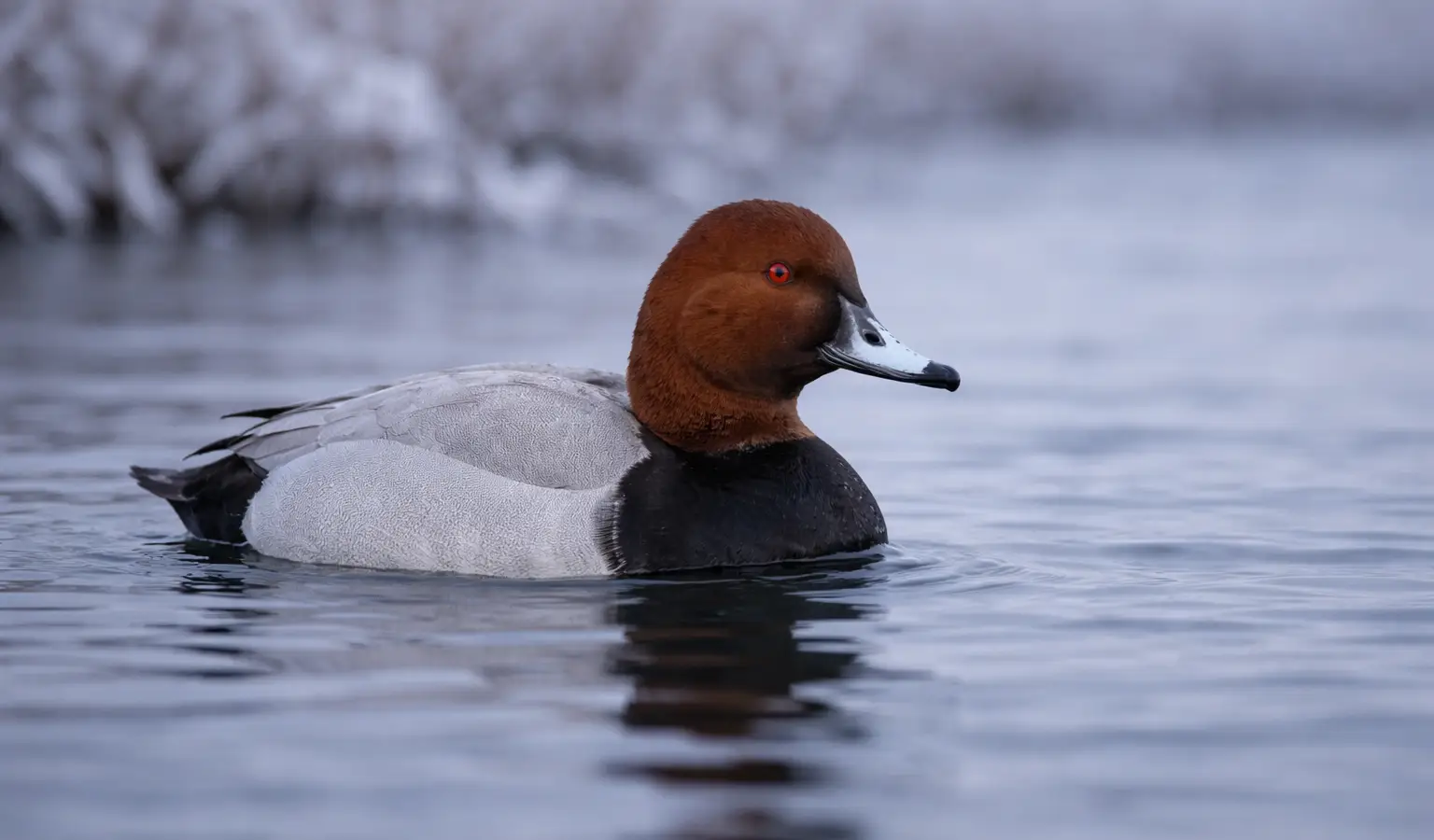
The adult male in breeding plumage is usually the easiest to identify: a rich chestnut to reddish-brown head, black breast, pale grey back, and dark rear body create a distinctive contrast. The eye is often bright red, which is a classic field mark at close range or in good light. Females and immature birds are more subdued, generally brown to grey-brown with softer contrast, which can make separation from other diving ducks more challenging.
In flight, the species shows the fast, direct wingbeats typical of pochards. At distance, observers often rely on structure, flock composition, open-water setting, and the bird's diving behavior as much as plumage details. Confusion can occur with other Aythya species, especially where mixed rafts of diving ducks gather in winter, so careful attention to head shape, body tone, and overall impression is useful.
Habitat and distribution
Habitat and distribution
Habitat
The preferred habitat of the Common pochard is open freshwater with enough depth for diving and enough biological productivity to support aquatic plants, mollusks, insect larvae, and other food. Typical biotopes include natural lakes, floodplain wetlands, reservoirs, fishponds, reed-fringed marshes, gravel pits, and broad river backwaters. Outside the breeding season, it often favors larger expanses of water where flocks can raft together in relative safety.
During breeding, the species generally seeks wetlands that combine open water with emergent cover such as reeds, sedges, or other shoreline vegetation. Nesting usually benefits from a mosaic of sheltered margins and feeding zones nearby. In winter, habitat use broadens and may include artificial waters if disturbance is limited and food is available.
Water level stability, aquatic vegetation, low to moderate disturbance, and good wetland structure all influence local use. In heavily pressured areas, Common pochards may shift toward deeper offshore sections during the day and use quieter feeding areas at dawn, dusk, or night.
Distribution
Aythya ferina has a broad Palearctic distribution, breeding across parts of Europe and temperate Asia and wintering farther south and west where waters remain suitable. Its exact occurrence depends on region, climate, and flyway. In some countries it is a regular wintering waterfowl, while in others it is more localized as a breeder, passage migrant, or cold-season visitor.
Across western and central Europe, the Common pochard is often encountered mainly in migration and winter on lakes, reservoirs, and large wetlands. Breeding populations tend to be more scattered and concentrated in suitable marshes and productive inland waters. In harsher winters, birds can move further toward milder coastal or lowland areas, while mild conditions may keep more individuals farther north or east.
Local abundance can fluctuate sharply. Some wetlands hold large flocks in one season and relatively few birds in another, depending on freezing conditions, water management, food resources, and disturbance. Because of these changes, current regional data are often more informative than old assumptions about abundance.
Lifestyle
Lifestyle and behaviour
Diet
The Common pochard is an omnivore with a strong reliance on aquatic food taken underwater. Its diet commonly includes mollusks, aquatic insects and their larvae, small crustaceans where available, seeds, roots, shoots, and other submerged plant material. The exact balance between animal and plant food can shift with season, habitat type, and local availability.
On nutrient-rich wetlands, mollusks and other invertebrates can be especially important, helping birds build reserves outside the breeding season. Aquatic vegetation often becomes a major part of the diet where submerged plants are abundant and accessible. Because it is a diving duck, the species can exploit food resources below the surface that dabbling ducks use less efficiently.
Feeding activity often increases in calm conditions and in areas with manageable depth. Seasonal water drawdown, vegetation loss, eutrophication, or severe disturbance may reduce food quality or force birds to move. For wetland managers, the Common pochard is closely tied to the condition of productive shallow-to-moderate depth water rather than simply the presence of open water alone.
Behaviour
The Common pochard is a classic diving duck in both shape and routine. It spends much of its active time swimming in open water, diving repeatedly to feed, and resting in groups between feeding bouts. Compared with many dabbling ducks, it often appears calmer and more offshore, especially on large lakes where birds may remain well away from the shoreline during daylight.
Daily behavior is shaped by disturbance, weather, and season. On pressured wetlands, flocks may rest during the day in the safest open sectors and feed more actively at dawn, dusk, or at night. When alarmed, birds usually paddle away from danger into open water first if distance allows; if pressure increases, they take flight with rapid wingbeats and a direct line of escape.
Outside the nesting season, the species is noticeably gregarious. During cold weather it may form dense rafts with conspecifics or mixed groups of other diving ducks. It is generally vigilant but not as edge-oriented as species that rely on shoreline cover. This open-water behavior is a key part of how observers and hunters locate it in the field.
Social structure
The social structure of the Common pochard is centered on groups and flocks. For much of the year, especially in migration and winter, individuals gather in loose to sometimes dense concentrations on suitable water bodies. These flocks offer collective vigilance and allow birds to use open water habitats where safety depends more on distance and group awareness than on concealment.
During the breeding season, social spacing increases as pairs establish nesting areas within suitable wetland vegetation. Even then, the species is not strictly solitary in the broader landscape sense, because several pairs may use the same marsh complex if habitat quality is high. After breeding, birds often return to more social patterns as they molt, disperse, and regroup.
Mixed-species associations are common in wintering areas, particularly with other diving ducks and coots. Such associations can complicate counts and field identification but are typical of productive wetlands where several open-water species exploit similar feeding zones.
Migration
The Common pochard is a migratory waterfowl species, although the intensity and distance of movement vary across its range. Northern and continental populations generally move south or west in autumn as breeding waters cool or freeze, while birds in milder regions may be partly resident or only shift short distances between molting, feeding, and wintering sites.
Migration is often linked closely to weather. Cold snaps can trigger rapid arrivals on ice-free waters farther south, and temporary thaw periods may redistribute birds again within the same winter. This means local numbers can change quickly, sometimes within days, as flocks respond to freezing conditions, wind, disturbance, or changing food access.
Spring return movement tends to be more discreet than the conspicuous buildup seen on some wintering waters. Along migration routes, the species uses staging wetlands where birds rest and rebuild reserves. Protecting those stopover sites is important because migration success depends on a chain of suitable wetlands rather than on one site alone.
Reproduction
Reproduction
Breeding usually begins in spring, with timing varying by latitude, water conditions, and annual weather. Pairs form on wintering grounds or during spring migration, then move toward breeding wetlands that provide both cover and nearby feeding water. The nest is generally placed in dense emergent vegetation close to water, often concealed among reeds, sedges, or other marsh plants.
The female lays a clutch of eggs and undertakes most of the incubation, which commonly lasts about 28 days. Ducklings are precocial, leaving the nest soon after hatching and following the female to feeding areas. As with many waterfowl, early brood survival depends heavily on wetland structure, food abundance, predation pressure, and weather during the first weeks of life.
Breeding success may vary widely between sites and years. Fluctuating water levels, nest predation, loss of shoreline cover, and repeated disturbance can all reduce productivity. In poor conditions, recruitment may be weak even where adult birds remain visible in migration or winter.
Field signs
Field signs
Field signs of the Common pochard are subtler than those of large terrestrial game, because most evidence is found on or near water. The most useful sign is often the birds themselves: compact diving ducks sitting low on open water, regularly disappearing underwater to feed, then resurfacing nearby. Repeated use of the same calm sectors of a lake or reservoir can reveal favored feeding and resting zones.
Along sheltered shorelines, islands, or reed margins, observers may occasionally find feathers, molted down, or resting concentrations marked by droppings where birds loaf close to cover. Nest signs, when present in breeding habitat, are usually hidden in dense emergent vegetation and should be approached with great care or ideally left undisturbed. Unlike dabbling ducks, the species often leaves fewer obvious shallow-water feeding traces visible from the bank.
Tracks are possible in soft mud near nesting or loafing spots but are rarely the primary way to locate the species. In practice, good field reading relies more on scanning open water, understanding wind shelter, identifying flock behavior, and watching where diving activity is concentrated.
Ecology and relationships
Ecology and relationships
Ecological role
Within wetland ecosystems, the Common pochard plays a useful role as a consumer of both aquatic invertebrates and plant material. Its feeding on mollusks, insect larvae, and submerged vegetation links it directly to the biological productivity of lakes and marshes. By moving nutrients through feeding and excretion, the species contributes to the functioning of open-water wetland food webs.
As prey, eggs, ducklings, and sometimes weakened adults may be taken by birds of prey and other predators. Its broods can be especially vulnerable in exposed wetlands with poor cover. The species also serves as an ecological signal: persistent declines or reduced use of historic sites may point to habitat degradation, altered hydrology, excessive disturbance, or reduced food availability.
Because it uses submerged resources, the Common pochard occupies a somewhat different niche from many dabbling ducks. In mixed wetland communities, that adds diversity to how waterfowl exploit habitat and can help illustrate the overall structure and health of a wetland system.
Human relationships
The Common pochard has long been part of the cultural landscape of Eurasian wetlands, known both to birdwatchers and to traditional waterfowl hunters. On suitable winter waters, it is often one of the more recognizable diving ducks seen from hides, dikes, or observation points. Its tendency to raft on open water makes it a classic species for wetland counts and cold-season bird observation.
In hunting contexts, the species may be legally huntable in some countries or regions, but practical relevance depends heavily on local regulation, flyway status, conservation concern, and site-specific management. Because identification among diving ducks can be difficult at range or in poor light, responsible hunters need strong species recognition skills, especially where similar ducks occur together or where restrictions change over time.
The bird is also relevant to discussions about wetland restoration, water quality, reedbed management, and disturbance from recreation. In some places it is considered edible, but that does not remove the need for attention to hygiene, local health advisories, and legal compliance. As with many wild waterfowl, coexistence depends on balancing use, conservation, and habitat stewardship.
Legal framework and management
Legal framework and management
Legal status
Legal status varies by country and sometimes by region, season, and current conservation assessments. The Common pochard may be huntable under regulations in certain jurisdictions, including a season that can extend roughly from September to January where local law allows, but this should never be assumed without checking the latest official rules.
Because the species has experienced declines in parts of its range, management frameworks may change over time. Temporary restrictions, bag limits, protected areas, species-specific suspensions, or tighter identification requirements may apply. International flyway agreements, national hunting law, and wetland protection measures can all influence what is permitted.
The safest guidance is practical: always verify current local legislation, protected-site rules, and conservation updates before any hunting activity or handling. For observers and managers, legal status also matters because monitoring obligations and disturbance controls can be stronger on important wintering or breeding wetlands.
Management tips
Management for the Common pochard should focus on maintaining productive, undisturbed wetland mosaics rather than only preserving water surface area. The species benefits from waters that combine open diving zones with sheltered vegetated margins for breeding and refuge. Stable or seasonally appropriate water levels, healthy submerged vegetation, and reduced shoreline degradation are often more important than cosmetic habitat changes.
For observation and census work, scan open water carefully from distance using light and wind to advantage. Birds often gather on the lee side of large wetlands or in sectors where disturbance is lowest. Early morning and late afternoon can be especially informative for reading movement between roosting and feeding areas.
- Limit repeated disturbance from boats, dogs, and shoreline traffic on key wintering and breeding waters.
- Retain reedbeds, sedge margins, and quiet marsh edges that support nesting cover.
- Monitor water quality and aquatic food resources, not just bird numbers.
- Use caution with species identification in mixed flocks of diving ducks.
- Where hunting is allowed, adapt pressure to local abundance, conservation guidance, and site sensitivity.
Because regional status can be unstable, management is strongest when it combines habitat improvement, regular monitoring, and flexible regulation informed by current population trends.
Fun facts
Fun facts
The Common pochard is a true diving duck, so much of its feeding takes place out of sight below the surface, unlike dabbling ducks that tip up in shallow water.
The male's chestnut head and red eye make it one of the most striking classic inland waterfowl in good winter light.
Large winter flocks often look calm from a distance, but within the raft there is constant small-scale movement as birds dive, reshuffle, rest, and react to wind or disturbance.
Because it often mixes with other Aythya ducks, it is a species that rewards careful observation and improves an observer's waterfowl identification skills.
Its presence on a wetland often says something meaningful about open-water habitat quality, food availability, and the value of a site within a wider migration network.